The CASE Journal
Kabbage: an innovative source of short-term business loans
Michael Ozlanski, Emma Marie Fleck,
Article information:
To cite this document:
Michael Ozlanski, Emma Marie Fleck, (2018) “Kabbage: an innovative source of short-term business loans”, The CASE
Journal, Vol. 14 Issue: 6, pp.716-735, https://doi.org/10.1108/TCJ-03-2018-0042
Permanent link to this document:
https://doi.org/10.1108/TCJ-03-2018-0042
Downloaded on: 11 January 2019, At: 10:03 (PT)
References: this document contains references to 45 other documents.
To copy this document: permissions@emeraldinsight.com
The fulltext of this document has been downloaded 56 times since 2018*
Users who downloaded this article also downloaded:
(2018),”The rebranding of VoiceStream to T-Mobile”, The CASE Journal, Vol. 14 Iss 6 pp. 635-647 <a href=”https://
doi.org/10.1108/TCJ-11-2017-0109″>https://doi.org/10.1108/TCJ-11-2017-0109</a>
(2018),”The University Club”, The CASE Journal, Vol. 14 Iss 6 pp. 694-715 <a href=”https://doi.org/10.1108/
TCJ-10-2017-0098″>https://doi.org/10.1108/TCJ-10-2017-0098</a>
Access to this document was granted through an Emerald subscription provided by emerald-srm:448547 []
For Authors
If you would like to write for this, or any other Emerald publication, then please use our Emerald for Authors service
information about how to choose which publication to write for and submission guidelines are available for all. Please visit
www.emeraldinsight.com/authors for more information.
About Emerald www.emeraldinsight.com
Emerald is a global publisher linking research and practice to the benefit of society. The company manages a portfolio of
more than 290 journals and over 2,350 books and book series volumes, as well as providing an extensive range of online
products and additional customer resources and services.
Emerald is both COUNTER 4 and TRANSFER compliant. The organization is a partner of the Committee on Publication
Ethics (COPE) and also works with Portico and the LOCKSS initiative for digital archive preservation.
*Related content and download information correct at time of download.
Downloaded by Western Sydney University Library At 10:03 11 January 2019 (PT)

Kabbage: an innovative source of
short-term business loans
Michael Ozlanski and Emma Marie Fleck
Growing a source of financing
In 2008, three entrepreneurs debuted a unique and innovative lending company to serve the
specific needs of online retailers, start-ups and microbusinesses. The founders were Rob
Frohwein, former CEO of LAVA Group, an intellectual property and technology investment bank
(Bloomberg, 2017a); Marc Gorlin, a seasoned entrepreneur who co-founded companies such
as Pretty Good Privacy and VerticalOne Corporation (Bloomberg, 2017b); and Kathryn Petralia,
former VP of strategy at Revolution Money with 15 years of experience in the credit and
payments industry (Bloomberg, 2017c). Their company, Kabbage, named after a slang term for
money, offered a modern twist on lending for this niche market that had long been underserved
by traditional lenders. In an interview, co-founder Petralia explained the origin of Kabbage:
The idea for Kabbage was born when my co-founder, Rob, was actually working with a company that
was using a recently launched E-bay API[1], this was in 2007, to identify whether or not an item listed
on E-bay was counterfeit or fraudulent. He realized there was a lot of rich data there that could be
used to underwrite a small business loan (Kabbage, 2016).
These online data, which could be analyzed quickly and accurately using proprietary
algorithms, became the foundation of Kabbage. The company introduced a new model for online
business lending that online retailers, start-ups and microbusinesses could use to fund their
operations. In reflecting on the role that Kabbage played in assisting entrepreneurs, co-founder
Frohwein noted:
Small businesses have always been the ugly step child of the financial world [and have been] unable to
get access to [loans to] grow their business. With online merchant channels it’s even that much harder
because traditional financial sources don’t understand online businesses. Thus, the challenges faced
by small businesses are likely even greater for those that engage primarily in e-commerce than those
that sell through traditional retail stores (Fuscaldo, 2012).
Kabbage initially offered cash advances to entrepreneurs who predominantly sold their products
through online merchants such as eBay, Amazon and Etsy. However, its business model evolved
into a method of aggregating data from accounting systems such as Intuit, Quickbooks and
Sage to provide quick and easy short-term loans to more traditional brick-and-mortar
and service-oriented businesses that also faced funding challenges (Kabbage, 2015).
How does lending work?
At the time, when Kabbage was founded, banks typically used information such as credit ratings,
financial statements and income tax returns to evaluate loan applications (Dahl, 2015, p. 7).
In reviewing this information, which could be a lengthy process, lenders tried to minimize default
risk, which is the possibility that borrowers will not be able to repay their loan with interest
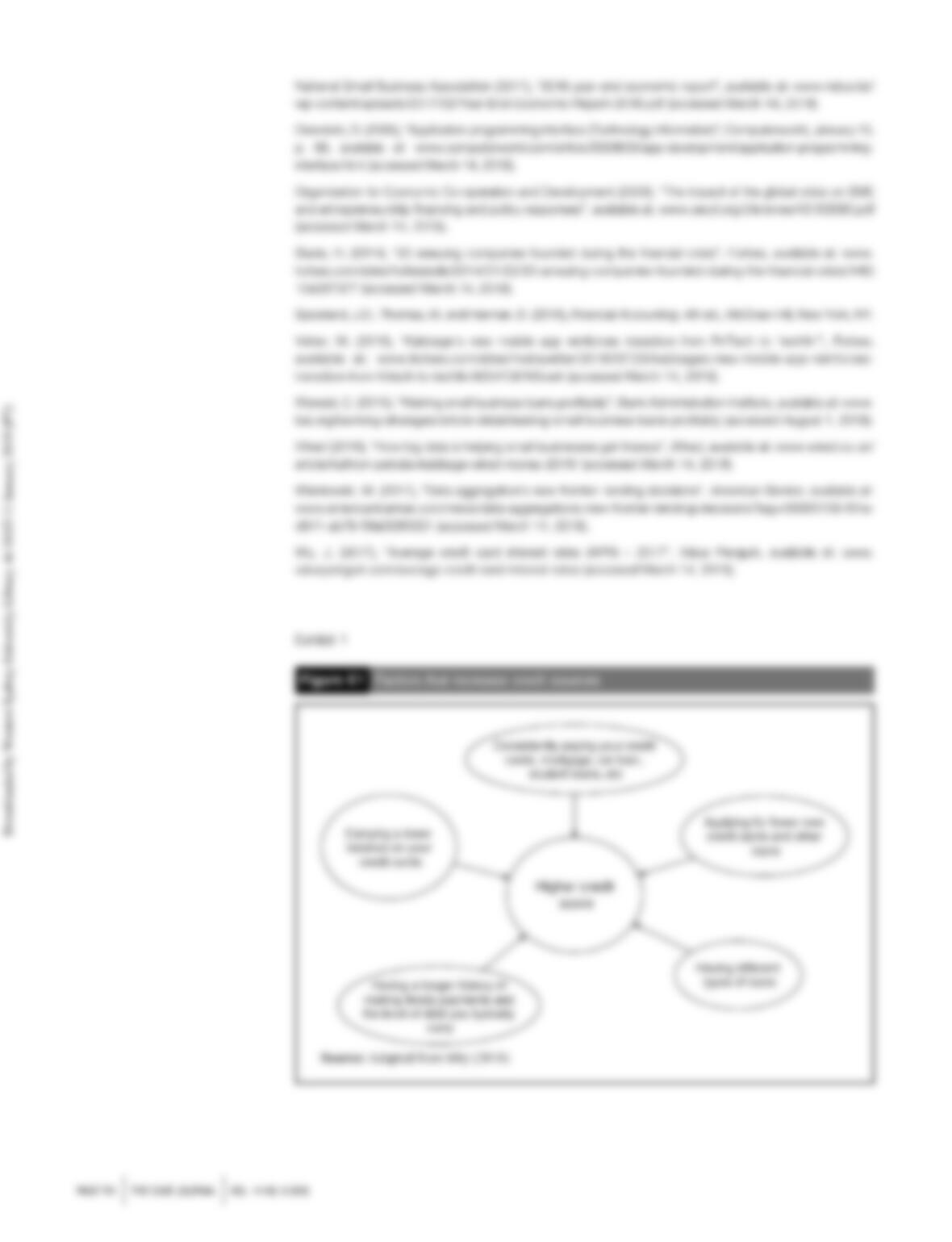
(Spiceland et al., 2016). Exhibit 1 summarizes the factors that positively influenced credit scores
and helped to predict how well someone could handle debt. Higher credit scores were associated
with lower default risk and increased the likelihood that loan applications would be approved.
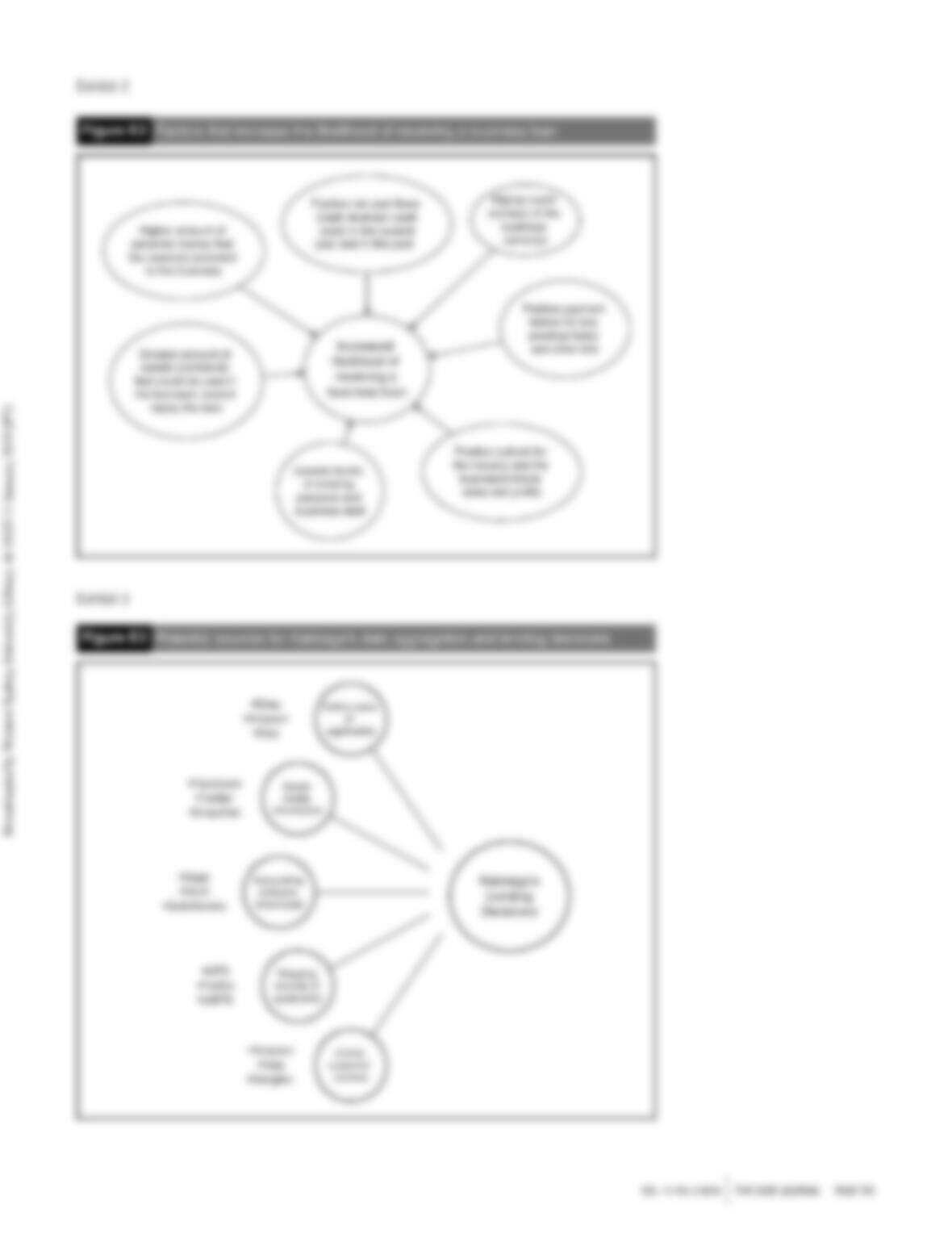
Additionally, Exhibit 2 summarizes the factors that typically increased the likelihood that an
application for a traditional business loan would be approved. All of the factors increased the
Disclaimer. This case is written
solely for educational purposes
and is not intended to represent
successful or unsuccessful
managerial decision making. The
authors may have disguised
names; financial, and other
recognizable information to protect
confidentiality.
Michael Ozlanski is based at
Sigmund Weis School of
Business, Susquehanna
University, Lewisburg,
Pennsylvania, USA.
Emma Marie Fleck is Associate
Professor of Management at
Sigmund Weis School of
Business, Susquehanna
University, Lewisburg,
Pennsylvania, USA.
PAGE 716
j
THE CASE JOURNAL
j
VOL. 14 NO. 6 2018, pp. 716-735, © Emerald Publishing Limited, ISSN 1544-9106 DOI 10.1108/TCJ-03-2018-0042
Downloaded by Western Sydney University Library At 10:03 11 January 2019 (PT)
likelihood that the business could consistently generate cash flows to repay a loan and thus
posed a lower risk of default to the lender. For example, a proven history of timely payment of
other bills and a history of previous personal and business loans were good indicators that future
loans could be repaid. It was also important that a business show promising prospects for future
profits and cash flows and that the business’s owners have some of their own personal funds
invested in the business. Having some “skin in the game”showed a personal commitment to the
success of the business, which also lowered the risk of default (Carbajo, 2018; Crystal, 2018).
Unfortunately, when Kabbage came on the scene, many of the 25.5m microbusinesses in the
USA did not prepare financial statements, did not exhibit strong measures of financial
performance or did not have an established credit history. Each missing factor increased the
likelihood that a loan application would be denied by a traditional lender (Carr and Anacker, 2013;
Fest, 2013; Klein, 2014). Kabbage’s founders recognized that this was often frustrating for
entrepreneurs, who could spend up to 25 h gathering data and completing their applications, and
it was especially vexing if their applications were denied by multiple lenders (Mills, 2014; Dahl,
2015, p. 7). Not only were they still short on funds, but they had also spent time and energy on
failed applications that could have been allocated instead to developing new products, planning
for expansion or serving customers.
The difficulties experienced by start-ups and microbusinesses only worsened during the financial
crisis of 2008. These concerns were particularly affected because of their inability to downsize (as
they were already small) or diversify their economic activities (Organisation for Economic
Co-operation and Development, 2009), and many experienced declines in sales and operating
cash flows. It was at this point that many of these businesses most needed access to loans.
However, traditional banks, which were historically shy about lending to these entities, further
tightened their lending criteria (National Small Business Association, 2017). Overall, loan
approvals dropped 22 percent below pre-recession levels (Faux and Abelson, 2014), and they
still had not yet fully rebounded by 2018. A 2017 survey of small-business owners, including
owners of start-ups and microbusinesses, reported that approximately 30 percent of them still
lacked adequate financing. This restricted their ability to expand, hire employees or purchase
assets such as inventory, supplies and equipment (National Small Business Association, 2017).
The recent approval rates for traditional small-business loans were approximately 24 percent at
large banks and 50 percent at smaller community banks (Biz2Credit, 2017). However, it was
unlikely that traditional banks would become more willing to fund start-ups and microbusinesses
in the foreseeable future.
Kabbage co-founder Rob Frohwein once observed, “banks simply haven’t been equipped to
serve businesses seeking smaller loan sizes under $250,000”(Hobey, 2016). Even though
community banks served as the backbone of small-business lending, they were still not likely to
lend money to start-ups and microbusinesses. Not only did these entities tend to pose a higher
default risk, but community banks also did not find it profitable to underwrite very small loans.
Banks generally incurred the same costs to process applications for all loans less than $1m, so
smaller loans produced less interest income for them (Mills, 2014). A recent analysis suggested
that the total cost to obtain, set up and monitor a small-business loan under $100,000 was
approximately $3,000–4,000. These underwriting costs were fixed regardless of the size of the
loan. The analysis also suggested that banks would typically suffer a net loss on these loans if the
terms were for less than one year (Wendel, 2015). Therefore, even community banks, which
typically served the needs of the small-business community, had an incentive to prefer larger
customers to small start-ups and microbusinesses[2].
An innovative solution
Kabbage got its start by providing online merchants with accessible financing by a process that
differed from the approach taken by traditional banks. It provided a quicker, easier and more
convenient application process for businesses that had no financial track record. When talking
about the inspiration for the company, co-founder Rob Frohwein stated, “We founded
Kabbage based on the fundamental premise that businesses can use the power of their own
data to grow in ways [that were] never before thought possible”(CNBC, 2016).
VOL. 14 NO. 6 2018
j
THE CASE JOURNAL
j
PAGE 717
Downloaded by Western Sydney University Library At 10:03 11 January 2019 (PT)
Unlike traditional banks, which asked applicants to provide information such as credit ratings,
financial statements and income tax returns, Kabbage asked for direct access to their online
business records. These data included bank accounts, eBay transaction history, PayPal
activity, shipping records, customer feedback, social media activity and downloads from
accounting systems such as Intuit, Quickbooks and Sage. A summary of Kabbage’sdata
sources is provided in Exhibit 3.
This unique approach gave Kabbage a competitive advantage. Since applicants provided direct
access to their data, Kabbage could complete its analysis and develop a financial profile of
applicants in a few minutes. Kabbage also instantly transferred the funds to borrowers’bank
accounts. Even if a traditional lender was interested in evaluating an application from a start-up or
microbusiness, the primary clients of Kabbage, it could still take weeks or even months to make a
decision (Dahl, 2015, p. 7; Vetter, 2016).
Obtaining direct access to numerous data sources also allowed Kabbage to develop a
comprehensive understanding of applicants’operations and financial performance –even in the
absence of company-prepared financial statements. “We probably know more about any given
business than any other company has known about a small business, ever,”noted Kabbage
co-founder Kathryn Petralia (Mitroff, 2012). She also stated, “If you see that the customer’s
business is changing over time –they’re selling different products, they’re changing their price
points, transaction volume is going up or down –you get a lot more visibility and insight into that
business than a pure financial statement’s going to give you”(Kaufman, 2013).
Fellow co-founder Marc Gorlin, who later left the company to pursue another start-up
opportunity, observed that every eBay transaction generated 300 data points that could be
incorporated into lending decisions (Max, 2012). However, eBay was just one possible data
source. Kabbage required applicants to provide direct access to “their transaction, revenue,
expense and other vital data.”Through this process of “data aggregation,”Kabbage
assessed applications in only a matter of minutes (Wisniewski, 2017). The more data that
Kabbage obtained from its applicants, the better it could understand and anticipate the unique