JR Tucker School AP Terms List
Written by Mr. Mable, Instructor
This list is compilation of terms from Mr. Mable’s J. R. Tucker School AP Terms List and the
Psychology Teacher Network “Top 100” Terms and Concepts for Psychology – modified at
AHS in March, 2016
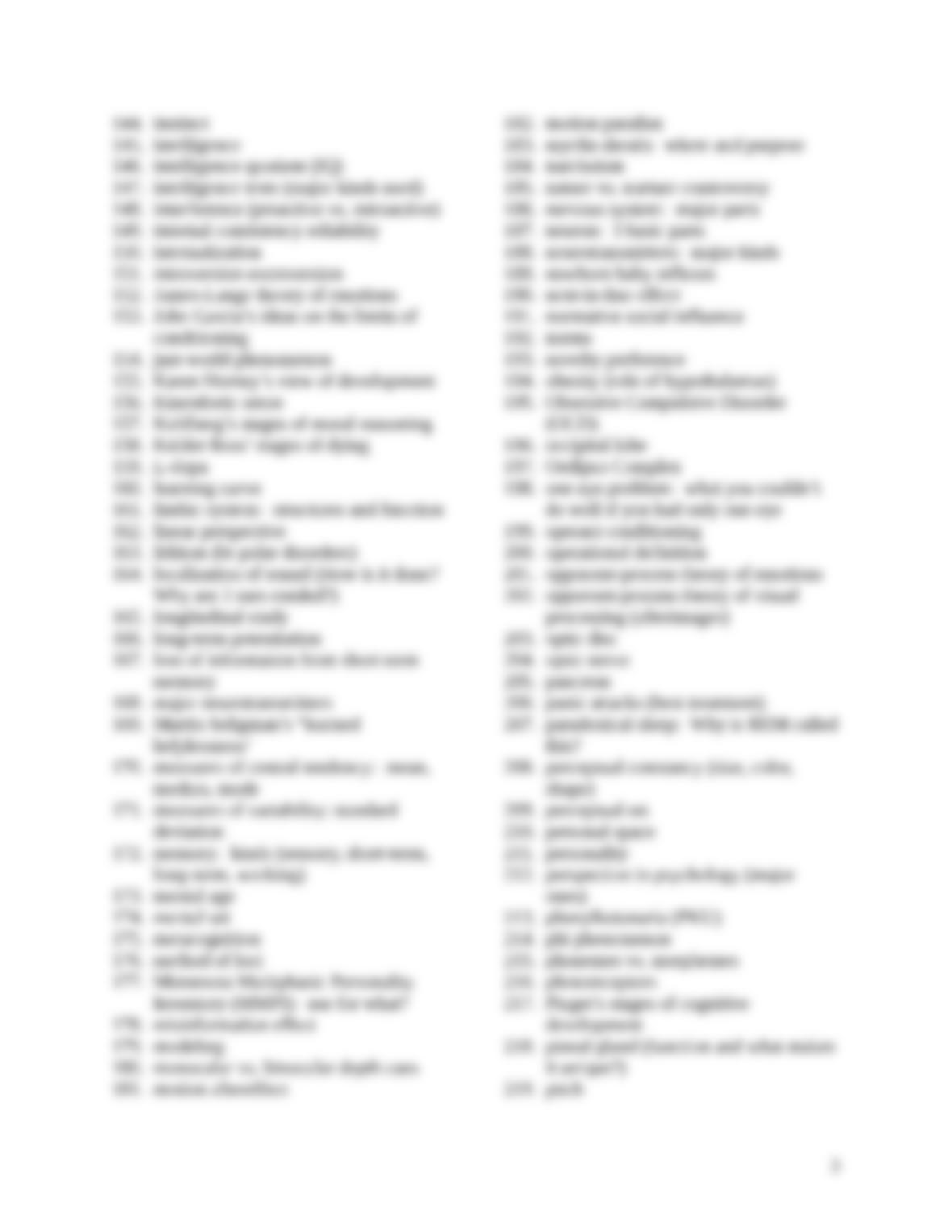
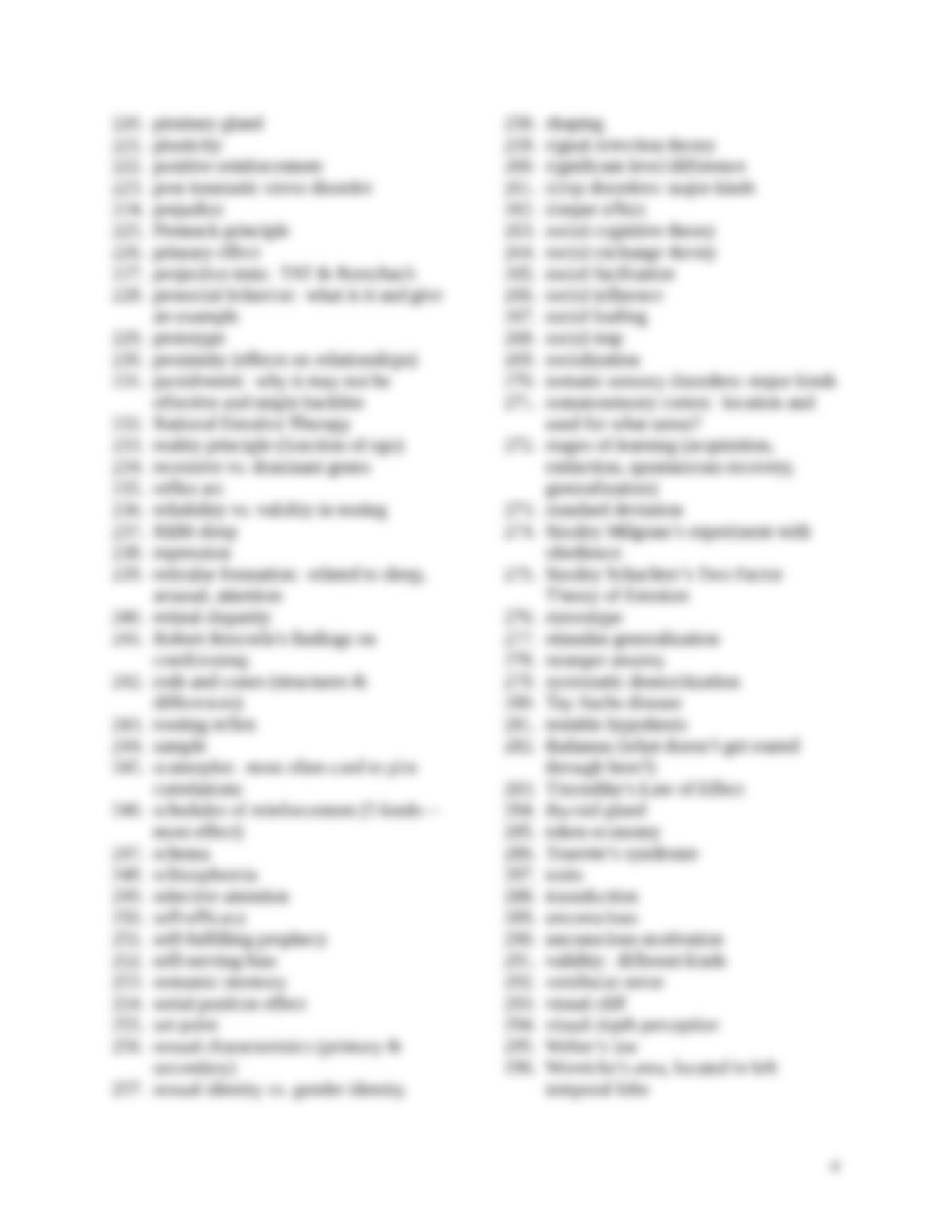
1. Aaron Beck’s view of depression
2. absolute threshold
3. achievement vs. aptitude tests
4. action vs. resting potential
5. acuity-vision
6. aggression
7. Ainsworth Strange Situation (paradigm)
8. Albert Bandura: major view of learning
and Bobo Doll experiment
9. Albert Ellis—Rational Emotive Therapy
(RET)
10. Alfred Adler—inferiority complex
11. all-or-nothing law (all-or-none) of neural
firing
12. altruism
13. American Psychological Association
(APA)
14. amnesia (anterograde & retrograde)
15. anxiety
16. anxiety disorder
17. arousal
18. Asch’s conformity study
19. attachment
20. attribution theory
21. aversive conditioning (good or bad?)
22. Babinsky response
23. behavior as being adaptive
24. bell curve (normal distribution)
25. Benjamin Whorf’s Theory of Linguistic
Relativism (Determinism)
26. binocular disparity
27. blind spot
28. blood brain barrier
29. brainstem
30. Broca’s aphasia
31. bystander intervention: factors that
influence it
32. Cannon’s Bard Theory of Emotion
33. Carl Rogers: person (client) centered
theory
34. Carol Gilligan’s critique of Kohlberg’s
theory
35. central nervous system
36. chaining
37. childhood characteristics
38. chunking
39. classical conditioning (distinguish
between operant conditioning)
40. Chameleon Effect
41. cognitive dissonance theory
42. Cocktail Party Effect
43. complementary colors
44. conformity
45. consciousness
46. control group
47. correlation coefficient
48. correlational method
49. cortexes of the brain: major ones
50. cross sectional studies
51. crystallized vs. fluid intelligence
52. CS-CR-USC-UCR
53. Daniel Goleman’s views of emotional
intelligence
54. David McClelland’s achievement
motivation studies
55. David Rosenhan’s study in a mental
institution
56. defense mechanisms: major ones
57. deindividuation
58. deinstitutionalization
59. dendrite
60. depression
61. developmental psychology
62. Diagnostic Statistical Manual of Mental
Disorders V (purpose & limits)
63. difference threshold (JND)
1
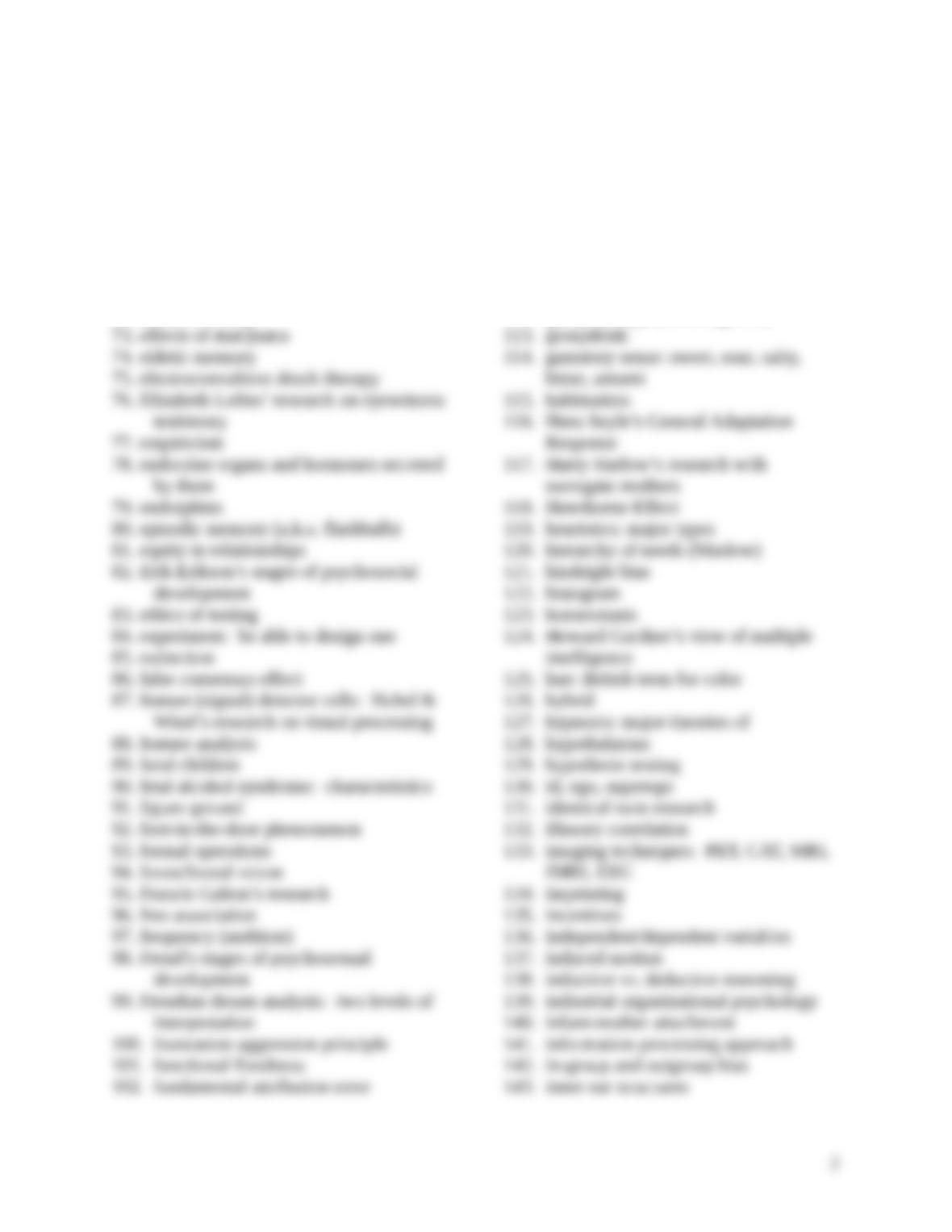
64. discrimination (in learning theory & race
relations)
65. displacement
66. dissociative disorders
67. distance cues
68. Down’s syndrome
69. dream analysis
70. drives
71. Ebbinghaus’ research on memory
72. echoic memory
103. galvanic skin response (GRS)
104. ganglia
105. Gansfeld Procedure
106. Gate Control Theory of Pain
107. generalization of a study
108. genotype & phenotype
109. Gestalt principles
110. Gestalt psychology
111. glial cells
112. group therapy (advantages of)