Antecedents of urban residents’ separate collection intentions for
household solid waste and their willingness to pay: Evidence from
China
Zhaohua Wang
a
,
b
,
c
,
*
, Xiaoyang Dong
a
,
b
,
c
, Jianhua Yin
d
a
School of Management and Economics, Beijing Institute of Technology, Beijing 100081, China
b
Center for Energy &Environmental Policy Research, Beijing Institute of Technology, Beijing 100081, China
c
Collaborative Innovation Center of Electric Vehicles in Beijing, Beijing 100081, China
d
School of Business, University of International Business and Economics, Beijing 100029, China
article info
Article history:
Received 20 April 2016
Received in revised form
20 September 2016
Accepted 30 September 2016
Available online 30 September 2016
Keywords:
Household solid waste
Antecedents
Separate collection intentions
Willingness to pay
abstract
Rapid mass migration into cities and economic growth have created various problems of sustainability.
The increasing household solid waste, bringing about environmental pollution and land occupation, is
among the concerns and separate collection is recognised as a sound way to dispose it. However,
separate collection behaviours are not common in China, and the research into the dynamics of urban
residents’ separate collection intentions for household solid waste is scarce. For filling this gap, we
extend the theory of planned behaviour to explore the antecedents of separate collection intentions for
household solid waste and identify their effects on residents’ willingness to pay for separate collection by
other organisations. The results show that separate collection intentions towards household solid waste
are significantly influenced by the behaviours of others, facility conditions, and moral obligations, while
their willingness to pay for separate collection is also affected by age, perceptions of results and gov-
ernment policies. In conclusion, urban residents’willingness to pay is more sensitive to perceptions of
results and policy implications than separate collection intentions in China. Accordingly, the government
should provide a pro-environmental climate, convenient facilities, detailed cases, cultivate environ-
mental moral obligations and propose appropriate promotional and incentive policies for different
recycling modes.
©2016 Elsevier Ltd. All rights reserved.
1. Introduction
Accompanying the rapid economic growth and urbanization
process, massive municipal sustainable development issues have
arisen, among which urban waste management is a great concern
(Chong et al., 2016). Over 1.3 billion tonnes of municipal solid waste
are produced worldwide each year, bringing enormous challenges
for urban waste disposal (Welivita et al., 2015). Household solid
waste occupies a significant part of urban waste (Hering, 2012;
Swami et al., 2011). As for China, problems of urban household
waste are likewise impeding socio-economic development. The
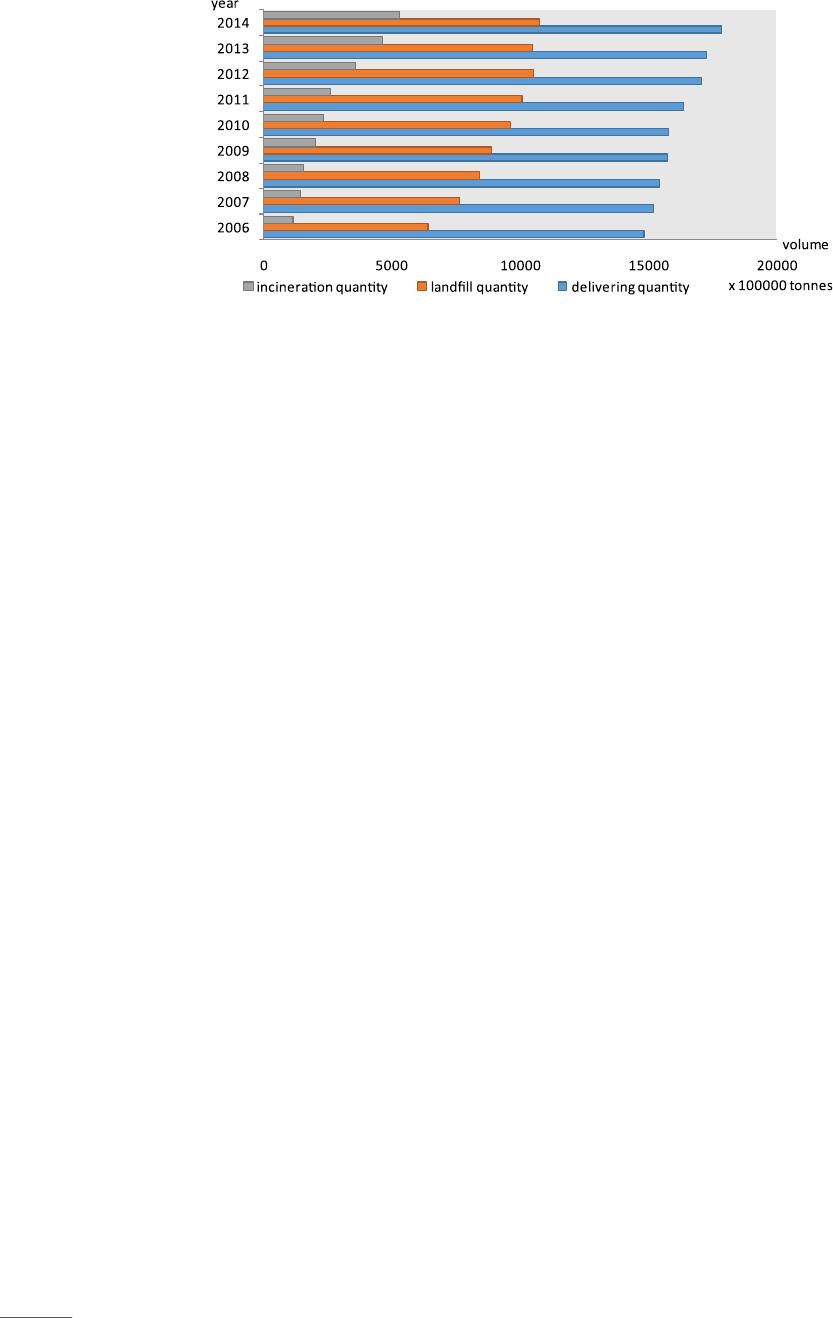
delivered quantity of household solid waste is rising year-by-year,
most of which is handled by way of landfill and incineration
(Fig. 1). By 2014, there were 604 national landfill sites in China
(Ministry of Housing and Urban-Rural Development, 2014), occu-
pying a lot of land and polluting both land and the surrounding
groundwater systems. In addition, in 2014, there were 188 incin-
eration plants (Ministry of Housing and Urban-Rural Development,
2014). These plants produce poisonous gases such as dioxins (LAN,
2010) and cause a serious waste of resources and environmental
pollution problems (Gu et al., 2014; Zabaleta and Rodic, 2015).
An economic system circular economy is promoted worldwide
to increase resource use efficiency and achieve a better balance of
economy, environment and society. The residents’ separation
collection of household solid waste embodies circular economy in
reduce, reuse and recycle from consumers’ responsibility perspec-
tive, improving the entire living and economic model (Ghisellini
et al., 2016). Household solid waste includes food waste, recy-
clable waste such as paper, glass, metal, hazardous waste including
batteries, pesticide containers, and other solid waste (Liu et al.,
*Corresponding author. School of Management and Economics, Beijing Institute
of Technology, Beijing 100081, China.
E-mail address: wangzh1018@hotmail.com (Z. Wang).
Contents lists available at ScienceDirect
Journal of Cleaner Production
journal homepage: www.elsevier.com/locate/jclepro
http://dx.doi.org/10.1016/j.jclepro.2016.09.223
0959-6526/©2016 Elsevier Ltd. All rights reserved.
Journal of Cleaner Production 173 (2018) 256e264
2015), among which the recyclable component can reach 89.3% (Gu
et al., 2015). Separate waste collection facilitates the reduction of
greenhouse gas emissions and waste volumes (Calabr
o, 2009; Geng
et al., 2009). Meanwhile, conventional resources can be conserved
and heat can be generated through waste-to-energy process
(Agovino et al., 2016; Cucchiella et al., 2014). In the context of cir–
cular economy, waste separate collection not only lays the foun-
dation for waste reuse but also works as a sustainability indicator
(Chong et al., 2016; Rigamonti et al., 2016). Total weight of waste by
type and disposal, weight of transported, imported, exported, or
treated waste deemed hazardous under the terms of the Basel
Convention Annex I, II, and VIII, and percentage of transported
waste shipped internationally are indicator measures of Global
Reporting Initiative Sustainability Reporting Guidelines (GRI
1
G4
Guidelines); toxic emission and waste, along with packaging ma-
terial and waste are Environmental Social and Governance (ESG)
key issues of Morgan Stanley Capital International (MSCI) ESG
research; some other standards like ISO 14001 and ISO 14031
consider waste management as important ratings (GRI, 2014; MSCI,
2015; Rahdari and Anvary Rostamy, 2015). Consequently, organi-
sations and cities attach great importance to waste recycling, aimed
at achieving business goals and gaining competitive advantages
through improved reputations, efficiencies of organisations and
improved confidence of stakeholders (ISO, 2015). For example,
Ben’s &Jerry’s plant applies Chunkinator to digesting all the ice
cream waste from the plant, satisfying roughly 20% of its energy
needs and Unilever are increasingly using post-consumer recycled
materials in their plastic bottles. In short, waste recycling can make
a better world economy and environment, and separate collection
of household solid waste is the fundamental and meaningful re-
sponsibility from the consumer aspect.
To promote and standardise the classification, collection,
transportation, and disposal of urban waste, the Chinese Govern-
ment introduced a series of policies and regulations, such as: Law of
the People’s Republic of China on the Prevention and Control of
Environmental Pollution by Solid Waste,Regulations on the Admin-
istration of Municipal Appearance and Environmental Sanitation,
Administrative Measures for Urban Living Garbage, and so on. Be-
sides, China released The General Planning for National Municipal
Solid Waste Disposal Facilities Construction During the 12th Five-Year
Plan Period in 2012. It requires that domestic waste classification
pilots should be promoted nationwide in 2015, and China should
establish a near-perfect supervision system for municipal solid
waste disposal. However, Chinese residents’ awareness of house-
hold solid waste separation and collection is still weak (Gu et al.,
2015), the recovery rate of the municipal solid waste is less than
2% in China (Zhang et al., 2016), and waste classification pilots run
with difficulty. In addition, low recovery rates of household solid
waste are common elsewhere: for example, the recovery rates of
Germany and Austria are 60%e70%, Australia, Belgium, Holland,
and Sweden manage about 50%, the United States, Britain, France,
and Italy are at 30%e40%, and Iran and Turkey reach less than 10%
(Environmental Protection Agency, 2012; European Environment
Agency, 2013; Hyder Consulting, 2011; Pakpour et al., 2014).
In face of the negative current situation of household solid waste
separation and collection, some scholars come to focus on the
formation mechanism of recycling behaviours with regard to
household solid waste. Wan et al. (2014) combined the theory of
planned behaviour with norm-activation theory, concluding that
recycling intentions were influenced by perceived policy effec-
tiveness in Hong Kong. Pakpour et al. (2014) applied the extended
theory of planned behaviour and found that attitudes, subjective
norms, perceived behavioural control, moral obligations, self-
identify, intention, action planning, and past behaviour signifi–
cantly predicted household waste collection behaviours in Iran.
Crociata et al. (2015) used a probit model and identified that cul-
ture, and participation dimensions influenced recycling behaviours.
Alpízar and Gsottbauer (2015) identified that reputational concerns
played a role in shaping pro-environmental behaviours through
experiments.
Questionnaires or experiments are used to study the factors
influencing residents’recycling behaviours; however, researchers
seldom talk about influences of government policies, surrounding
facilities, and demographic variables on the separate collection
intentions for household solid waste, especially with regard to the
intentions of Chinese urban households. Meanwhile, residents pay
the government for its waste handling and separate collection be-
haviours, which is a potential measure for use in promoting sepa-
rate collection of household solid waste while few scholars have
researched this field. This research aims to improve the situations
in these aspects.
We take Chinese urban households as an example, and propose
two kinds of household solid waste recycling scenarios: the first
involves urban residents themselves classifying and recycling
household solid waste; the second involves urban residents paying
other organisations to implement separate collection of household
solid waste. In this research, we extend the theory of planned
behaviour with government policies, facility conditions, and
Fig. 1. China’s household solid waste treatment capacity.
Source: China Urban Construction Statistical Yearbook, 2014.
1
All the abbreviations in this paper and their full names are summarized in
Appendix C.
Z. Wang et al. / Journal of Cleaner Production 173 (2018) 256e264 257
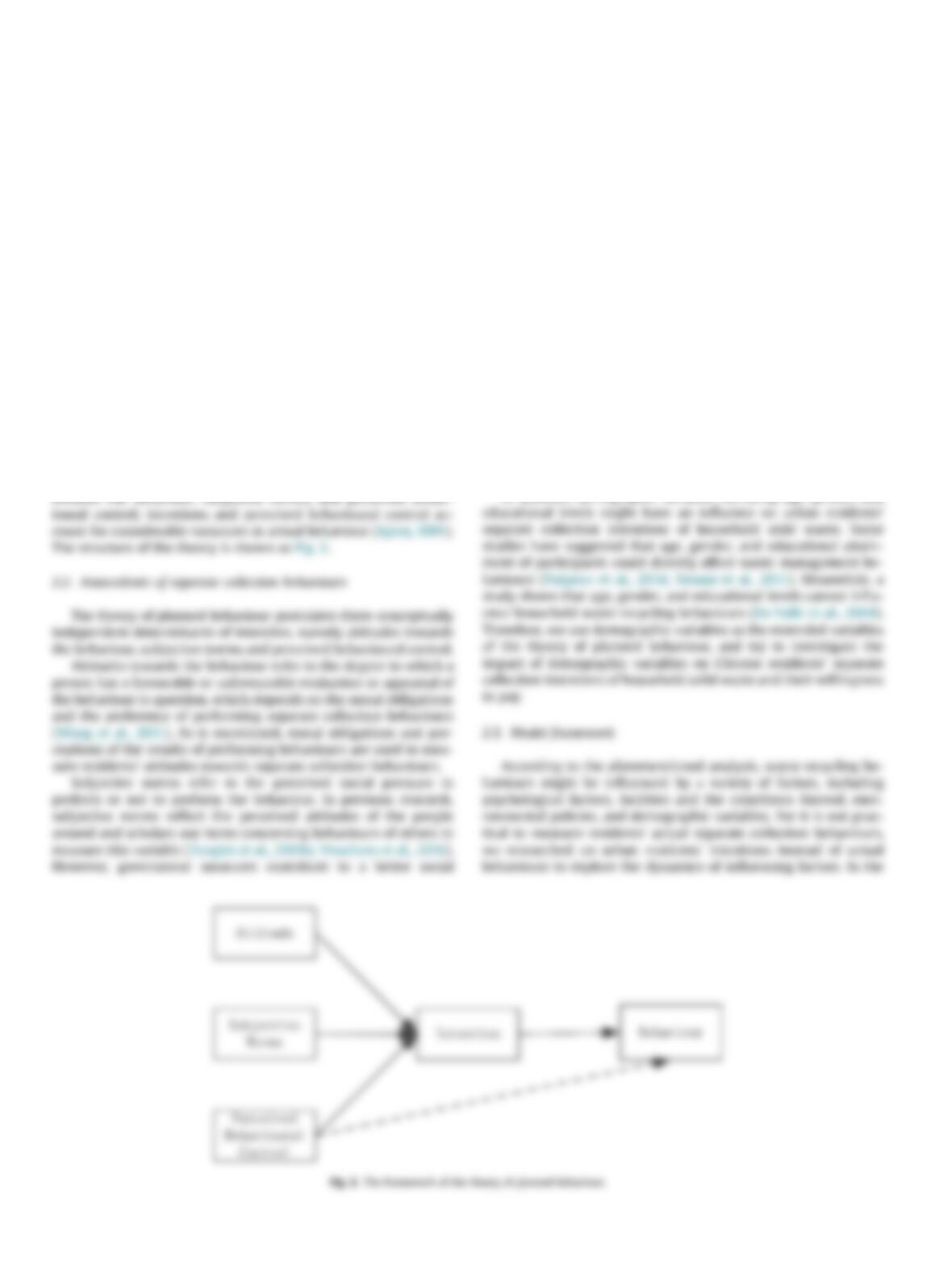
demographic variables, discuss antecedents of separation collec-
tion intention and antecedents of households’willingness to pay
for separation collection, and expect to provide a theoretical
reference for the construction of recycling modes and policies.
2. Conceptual model development
Residents’separate collection behaviours and their willingness
to pay belong to pro-environmental behaviours. According to pre-
vious research, we apply the theory of planned behaviour to
exploring influencing factors and extend the basic framework of
the theory of planned behaviour.
2.1. The theory of planned behaviour
The theory of planned behaviour (TPB) is often applied to pro-
environmental behaviour analysis (de Leeuw et al., 2015; Masud
et al., 2016). It provides a useful model and a framework for sys-
tematically exploring the factors which influence householders’
recycling decisions (Taylor and Todd, 1995; Tonglet et al., 2004a).
Hence, we have chosen TPB as the theoretical basis to investigate
how factors affect household waste separation and collection in-
tentions. In this theory, intentions can be predicted from attitudes
atmosphere, forming social pressure (or cohesion) to some extent
(Moh and Abd Manaf, 2014; Murakami et al., 2015). So in this
research, the government measures part is added to test the effects
of government policies on residents’household solid waste sepa-
ration and collection intentions in China, which is claimed to be
novel.
Perceived behavioural control means the perceived ease or
difficulty of performing the behaviour, assumed to reflect past
experience as well as anticipated impediments and obstacles. In
previous research, scholars use items such as: “It is up to me
whether or not I recycle household waste every time I have it for
disposal”to measure perceived behavioural control, which in-
dicates global control perception (Pakpour et al., 2014). However,
infrastructure conditions should be considered in any practice
analysis (Liu et al., 2016). Therefore, the facility conditions for
separately collecting household solid waste are involved in this
extended TPB model, making its measurements more objective.
Separate collection intentions, in this work, are assumed to
capture the motivational factors influencing separation collection
behaviours, indicating how hard people are willing to work in
sorting and recycling household waste, and how much of an effort
they are planning to exert to recycle household solid waste (Ajzen,
1991).
In addition, demographic variables including age, gender, and
Z. Wang et al. / Journal of Cleaner Production 173 (2018) 256e264258