IJASOS- International E-Journal of Advances in Social Sciences, Vol. I, Issue 3, December 2015
http://ijasos.ocerintjournals.org
443
JOB SATISFACTION, SERVICE QUALITY AND THE CUSTOMER
SATISFACTION IN THE IT SECTOR OF KARACHI
Muhammad Muzammil Ghayas1 and Javed Hussain2
1 PhD Scholar, Iqra University, PAKISTAN, muzzammilghayas87@gmail.com
2 Dean, Iqra University, PAKISTAN, drjaved@iqra.edu.pk
Abstract
This research investigates the relationship between the job satisfaction and the customer satisfaction. Data
were collected from 316 employees of IT sector who works for the support contracts and their respective
contact persons of the clients they work for. Hence there were 632 respondents in all. Structural Equation
Modeling (SEM) was used as the statistical technique. Results indicate that all eight job satisfaction facets
studied in the research have significant positive impact on Customer Satisfaction and the Service Quality.
Moreover, it is also found that the Service Quality partially mediates the relationship between all the studied
job satisfaction facets and the Customer satisfaction.
Keywords: Job Satisfaction, Customer Satisfaction, Service Quality, IT Sector, Karachi.
1 INTRODUCTION
Customer satisfaction has always been a topic of discussion for the marketers. Marketers have tried to raise
the levels of customer satisfaction in every era to remain competitive. A century or two ago, the level of
customer satisfaction could have been increased with the help of declining prices but the introduction of the
globalization and the technological advancements of the twenty first century has changed the world in a
dramatic manner. The business world has been affected by these dramatic changes too and the business
world that once used to predominantly revolve around the products is now in principle revolves around the
services.
The service industry grew at a tremendous pace in the twentieth and the twenty first centuries, thus the task
of enhancing the customer satisfaction has become more challenging than ever. The marketers in their quest
to enhance the customer satisfaction found that it is the service quality that can enhance the level of the
customer satisfaction and hence they started to look for the ways of enhancing the level of service quality. The
researchers in the field of Human Resources asserted that it is the job satisfaction that can be helpful in
increasing the service quality and hence the marketers started to found the much needed answer of the
customer satisfaction through the job satisfaction. A number of researchers e.g. Wangenheim, (2007); Chi and
Gursoy (2009); Naeem (2013) and Kermani (2013) confirmed the positive association between the job
satisfaction and the customer satisfaction. Once it is established that job satisfaction has positive impact on
customer satisfaction, researchers then started their quest to establish that if it is really the service quality that
mediates the relationship between job satisfaction and the customer satisfaction. Hence this study aims to
explain relationship between the job satisfaction and the customer satisfaction and the role that service quality
plays in the relationship between the two variables. Moreover two new variable of job satisfaction namely the

IJASOS- International E-Journal of Advances in Social Sciences, Vol. I, Issue 3, December 2015
http://ijasos.ocerintjournals.org
444
positive health benefits and the educational enhancement opportunities were also added in the research along
with the previously studied facets of the job satisfaction.
2 LITERATURE REVIEW
Ashraf, Joarder and Al-Masum (2008) proposed significant correlation between the compensation and job
satisfaction. Gallardo, Sanchez-Canizares, Lopez-Guzman, and Jesus (2010) also suggest compensation
being correlated with job satisfaction. Malik, Nawab, Naeem and Danish (2010) also included compensation
as the facet of job satisfaction in their study.
Ghayas and Siddiqui (2012) used communication as a job satisfaction facet while studying turnover intentions
in the pharmaceutical industry of Pakistan. Ali and Haider (2012) also asserted that the dimensions of
communication are significantly associated with job satisfaction. While studying the banking sector, Saleem,
Majeed, Aziz and Usman (2013) supported the argument of communication being a significant predictor of job
satisfaction.
While examining the teaching staff, Saba (2011) argued that the co–workers’ support is a determinant of job
satisfaction. Kabir and Parvin (2011) also supported the arguments of co-workers support being significantly
influenced correlated with the job satisfaction. Ghayas and Siddiqui (2012) also used co–workers’ support as
a facet of job satisfaction.
Lam, Baum and Pine (2001) found correlation between the nature of work and the job satisfaction. Chen (2006)
also argued that the nature of work is a facet of job satisfaction. Salleh, Nair and Harun (2012) also asserted
that nature of work is a determinant of job satisfaction.
Al-Ahmadi (2002) proposed that supervision is a facet of job satisfaction. Chen (2006) also advocates that
supervision is a facet of job satisfaction. Mosadeghrad, Ferlie and Rosenberg (2008) also used supervision as
a job satisfaction facet while examining job satisfaction of Hospital Employees. Malik et al. (2010) also used
supervision as a job satisfaction facet.
Joseph, Ng, Koh, and Ang, (2007) advocates the presence of correlation between promotional opportunities
and job satisfaction. Azeem (2010) also used PO as job satisfaction facet.
Wangenheim (2007) suggested positive association between job satisfaction and customer satisfaction. Chi
and Gursoy (2009) advocated the presence of causal relationship between the two variables. Naeem (2013)
suggested the presence of correlation between the JS and the CS. Kermani (2013) also found that JS has
significant impact on the CS. Amoopour et al. (2014) also supported the arguments of positive relationship
between the two variables.
3 METHODOLOGY
3.1 Instrument and Measures
Two separate questionnaires were used for the research; the first survey was used to collect the data for
measuring the job satisfaction the employees of the IT Sector of Pakistan. Whereas the second questionnaire
was used to measure the customer satisfaction of the contact persons of the respective clients for that the IT
Sector employees were providing services for.
The first questionnaire that was used for measuring the facets of the job satisfaction was comprised of 32
items, out of these 32 items 24 items were adapted and contextualized from Paul Spector’s Job Satisfaction
Survey and were used to measure six out of the eight independent variables. Whereas eight additional items
were developed to measure the two independent variables namely Positive Health Benefits (PHB) and the
Educational Enhancement Opportunities (EEO).
The second questionnaire was used for measuring the Service Quality and the Customer Satisfaction was
developed. The questionnaire consists of eight items other than the questions to gather demographic data.
Four items were developed to measure the mediating variable Service Quality and the rest of the four were
developed for measuring the dependent variable Customer Satisfaction in the IT sector.
3.2 Sample and Data Collection
Purposive sampling used and the data was collected only from those employees of the IT sector of Karachi
who work for support contract and their respective clients. A total of 350 pair of questionnaires (700
questionnaires) were distributed for the survey to the employees of the IT Sector and their respective clients.
IJASOS- International E-Journal of Advances in Social Sciences, Vol. I, Issue 3, December 2015
340 IT Sector Employees and 323 IT Sector clients returned the filled questionnaires and there were a total of
316 pairs of filled questionnaires that were received from both the IT sector employees and their clients.
3.3 Statistical Model
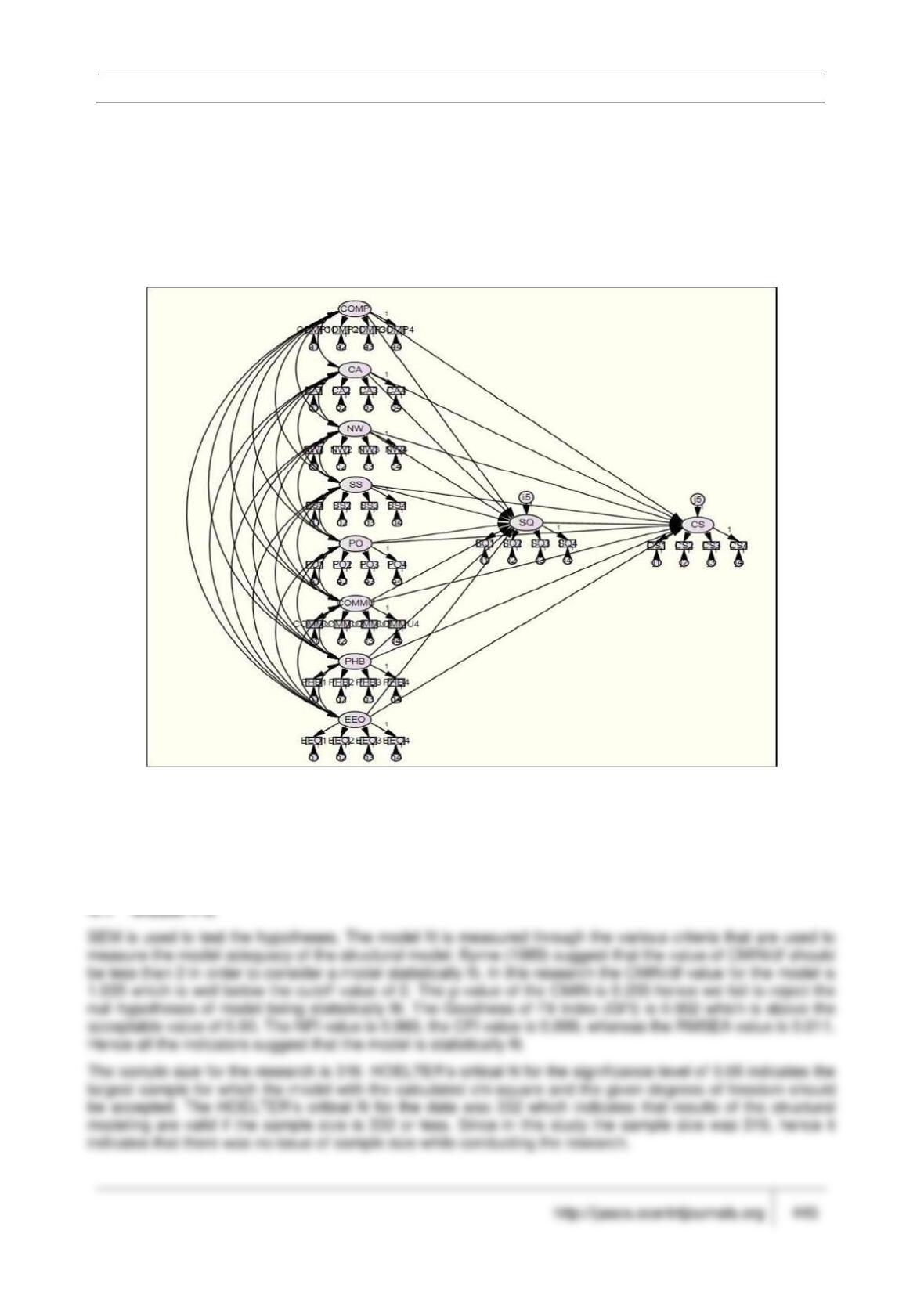
Two statistical models were made to test the hypotheses. The first model was a structural model that was used
to test the impact of various JS facets on mediating variable SQ and the CS. The relationship between the
mediating variable SQ and the CS was also tested in the same model. Moreover the mediating effect was also
calculated from this model.
Whereas in the second model was used to test the type of mediation, the second model was an amended
version of the first model in which the mediating variable service quality was removed. Hence the purpose of
the model was to calculate the impact of the facets of job satisfaction on the customer satisfaction in the
absence of the mediating variable service quality.
4 RESULTS