Resource Based View
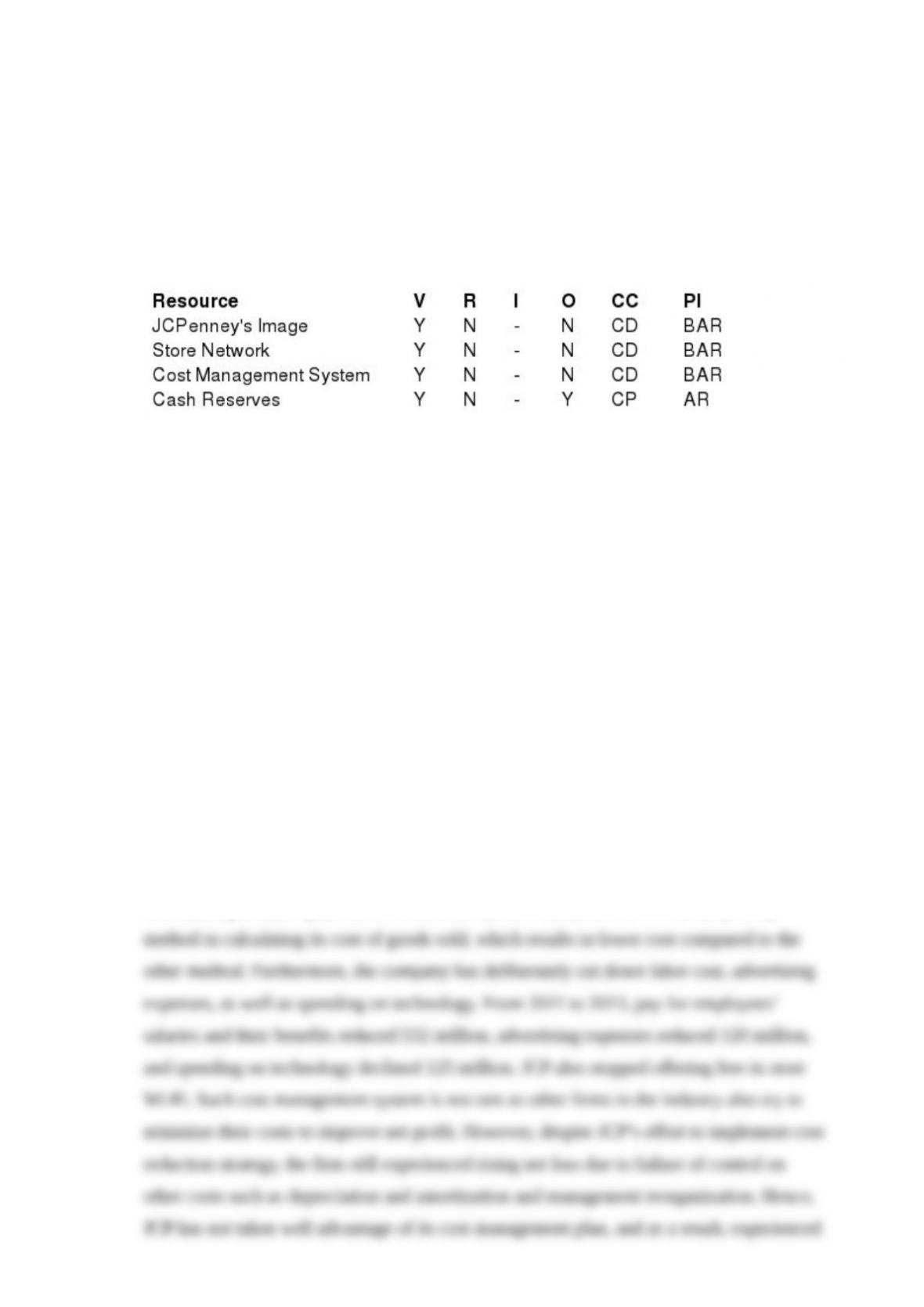
This session analyzes JCP’s resources including its image, store network, cost management
system, and cash reserves by determining whether the resources are valuable (V), rare (R),
costly to imitate (I) and organizationally exploited by the company (O). Based on these
components, the study will also provide the resources’ competitive consequences (CC) and
their performance implications (PI).
JCP possess the second largest store network among all firms in the industry. As of
February 1, 2014, JCP has 1,094 stores in 49 states of the United States. Wide store
network is valuable to JCP because revenue earned in stores from 2011 to 2013 totaled
$38,504 million, contributed 91.44% to total revenue in the same period. The resource is
not rare since other firms in the industry also operate stores nationwide and are attempting
to launch new stores, expanding their store network and reaching to more areas. However,
JCP’s store chain has not been well exploited by the firm, as in-store sales reduced 20.92%
from $15,760 million to $10,779 million (CAGR 11-13). In addition, revenue earned per
store square foot also declined 20.09% from 212 million to 147 million (CAGR 11-13).
The company also plans to close down 33 unprofitable stores in 2014 as a step towards
cost saving initiative, which is a largest number of stores within the last five years. This
resource, therefore, is JCP’s competitive disadvantage and generate below average returns.
According to JCP’s most recent 10Ks, the company is in the progress of reducing its costs
to enhance profitability (JCP, 2012; JCP, 2013). JCP has used first in first out (FIFO)