Abir Ahmed
10/16/13
Jakarta, Indonesia

Abir Ahmed
10/16/13
Jakarta, Indonesia
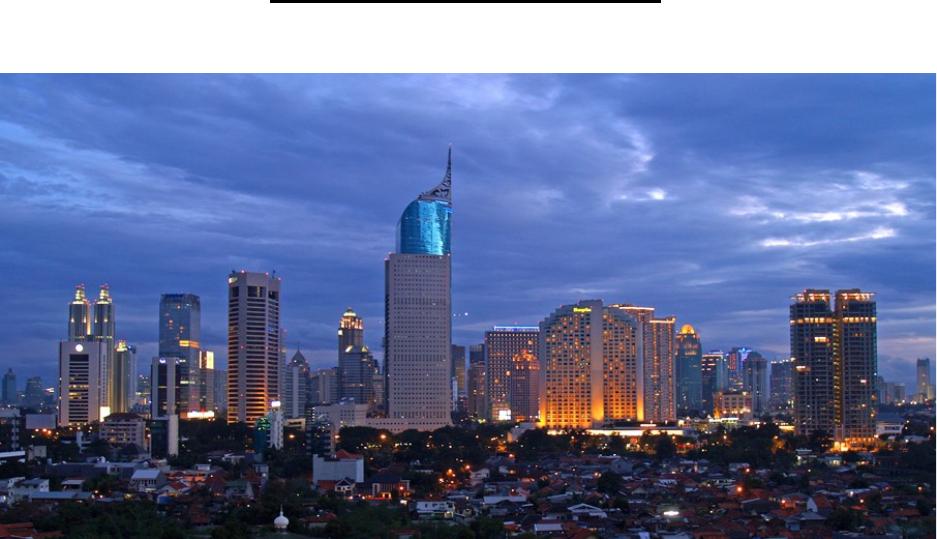
A city of over twenty million people, a city of industry, a major trade and !nancial center,
and a center of educa”on in its country. A country that is very wealthy in terms of culture and
diversity, housing people from all over the world who joined together to make this city what it
is. At !rst glance it would appear as though the city in ques”on is New York City. However, that
could not be further from the truth. Jakarta, Indonesia, is the capital of Indonesia, and is the
second most populous city in the world behind only Tokyo.
Geographically, Jakarta rests on a ,at alluvial plane !lled with a vast array of swampy
areas, and the inland areas of the city are at a slightly higher al”tude. The area is rather fer”le
and is a suffcient place to grow fruit and various crops1. The city’s layout is curiously more of a
Bri”sh design, even though the ones who !rst a0empted to plan the city were the Dutch, who
had been driven out by the people of Bantam, na”ve to the island of Java2. Jakarta is a city
composed of se0lers from other places who came together to form Jakarta. However, several of
these peoples stayed amongst themselves to form communi”es of one na”onality. For example,
the historical city center, Kota Tua, houses a major por”on of the Chinese popula”on in Jakarta,
similar to Chinatown in New York City3. The kampong house, also known as the village house, is
the most common type of house in the city, most of which are built from material such as
bamboo or wood4. Higher ups in the city such as government workers usually reside in houses
known as colonial urban houses, which are usually either detached or semi detached single
family houses5. As Jakarta modernizes itself, more and more families are moving into apartment
1 Encyclopedia Britannica, Academic edi”on, s.v “Jakarta (Indonesia)
2 Encyclopedia Britannica, s.v “Jakarta (Indonesia)
3Encyclopedia Britannica, s.v “Jakarta (Indonesia)
4 Encyclopedia Britannica, s.v “Jakarta (Indonesia)
5 Encyclopedia Britannica, s.v “Jakarta (Indonesia)

Abir Ahmed
10/16/13
buildings, although these are both expensive and cramped in terms of living space at the
present “me.
Jakarta is one of the most populated urban areas on the planet. The popula”on
experienced a massive boom during the 1940s, when immigra“on rates skyrocketed. This is
most likely due to an improvement of economic condi”ons; as such things will naturally a0ract
outsiders to the country. The government has a0empted to regulate the popula”on by
preven”ng unemployed new se0lers from coming into the city, as a means to keep economic
condi”ons at a high level6. Popula”on is expected to increase as well, due to the fact that most
of the current popula”on is young. Most of the immigrants are from the island of Java, followed
by Sumatrans, and small groups of Arabs, Indians, Europeans, and, Americans.
These groups also have had a major part in shaping the culture of Jakarta. It is heavily
in,uenced by the Javanese, and that can be witnessed in the music, dance, and theater of
Jakarta7. Aside from the Javanese, the other regions of Indonesia have also helped shape the
culture of Jakarta. The Balinese, who come from the island of Bali, leC their in,uence on
tradi”onal Jakartan dances. Other ethnic groups that have an impact on the arts of Jakarta are
the Dutch, and the Chinese. Islam also has an impact on Jakartan culture; It can be seen in
things like the Zapin dance, which was believed to have been introduced by Arabs during the
15th century8.
Jakarta as a city places a heavy emphasis on cultural arts. It hosts several cultural and art
fes”vals such as the Jakarta Interna”onal Film Fes”val, Jakarta Fashion and Food Fes”val, and
6 Encyclopedia Britannica, s.v “Jakarta (Indonesia)
7 Berita Jakarta, s.v “Jakarta Now – Culture
8 Berita Jakarta, s.v “Jakarta Now – Culture

Abir Ahmed
10/16/13
the Jakarta Arts and CraCs Exhibi”on, among many others9. The city celebrates its own heritage
through the Jakarta Fair, which celebrates the anniversary of the city itself. Jakarta also makes
an eHort to showcase the cultures of other countries as well, through cultural centers such as
the UK Bri”sh Council, France Centre Cultural Francais, Japan Founda”on, and quite a few other
centers10.
Jakarta is the center of one of the fastest growing economies on the planet. Indonesia
has the largest economy in South East Asia, with a growth rate of around 6%11. It is a member of
one of the G-20 major economies, which is a group of bank governors and !nance ministers
from 20 of the most major economies of the world. Indonesia has a rich pool of natural
resources such as oil and coal, and countries looking for a cheaper trading partner than more
established powers like China and India have taken a special interest in Indonesia. All of this
would make it appear as though Indonesia is on the track to becoming an economic
powerhouse; however, the outlook is not quite as posi”ve as it would appear.
Although Indonesia’s economy had been growing at a very fast pace, it has begun to
slow down. Previously over 6%, the GDP growth dropped to 5.8%, which fell well short of the
6.3% target that the government had been aiming for this year12. The value of Indonesian
currency has dipped as well, with the rupiah being at its lowest level versus the dollar in nearly
four years. ACer over a decade of a surplus, the account balance swung to a de!cit of 2.7% of
GDP in 2012.
9 Travel Jakarta (Mobilereference 2010) ; 17
10 Travel Jakarta (Mobilereference 2010) ; 17
11 Kevin O’Rourke, The Poli”cs of Jakarta’s Protec”onism, Wall Street Journal, May 23 2012
12 Indonesia’s Economy Slipping, The Economist, August 24 2013
Abir Ahmed
10/16/13
There appear to be several reasons for this dip. President Susilo Yudhoyono’s
government has completely failed to properly deal with the rampant corrup“on, bureaucrats,
and horrible infrastructure plaguing Indonesia. The scandals con“nue to pile up, with the most
recent one being in the oil industry. Rudi Rubiandini was caught accep”ng a $400,000.00 bribe
from a Singapore based energy !rm known as Kernel Oil13. Reports also say that this was merely
the second installment of the bribe accepted by the former Indonesian oil and gas regulator,
which was $700,000.00 in total. The oil industry had already been declining over the last
decade, and this event certainly did not help to boost it. The country’s current oil reserves are
predicted to be sucked dry by the mid 2020s, and expedi”ons for new reserves have been
rather unsuccessful.