1
SUNY-COLLEGE AT OLD WESTBURY
SCHOOL OF BUSINESS
DEPARTMENT OF ACCOUNTING, TAXATION AND BUSINESS LAW
Course Title and Faculty
CRN 90619 –
BU 4590 – 003 Dr. Roger Mayer
Cost Accounting Office: NAB Room No.0027
Fall 2016 – Tuesday/Thursday, 11:20 AM – 12:50 PM Email: mayerr@oldwestbury.edu
Classroom: New Academic Building 1119
Office Hours: Tuesday/Thursday 1:00 – 3:30:PM
Course Description
Cost Accounting is concerned with information needed to effectively plan and control company operations
and make good business decisions. This course encompasses: cost analysis and reports for planning and
control. Cost information system: design and operation of job order and process costing. Planning and
control of factory overhead; variance analysis, product costing, and responsibility accounting. Planning and
control of labor and material cost. Sales and profit planning control.
Course Goals/Objectives
This course is structured to enable you to accomplish the following:
• Possess a fundamental knowledge of current cost accounting principles and standards for both
manufacturing and service businesses.
• Understand planning, control and accounting practices related to materials, labor and factory
overhead costs.
• Be able to identify cost behavior patterns and estimate costs.
• Understand the design and operation of both process and job order cost methods particularly with
respect to cost accumulation and product costing.
• Apply concepts related to the budgeting process, including the preparation of flexible budgets.
• Prepare and interpret cost analyses and internal reports for internal decision makers.
• Understand the features of standard cost systems and related analysis of variances.
• Demonstrate how cost analysis influences management’s decision-making, including cost-volume–
profit planning, direct costing and differential cost analysis.
• Utilize Excel in accounting analysis.
• Identify how ethical considerations impact cost analysis and decision making.
Course Prerequisite
Principles of Accounting II (BU 3511 or equivalent).
Text
Required: Principles of Cost Accounting, 17th ed., Thomson/South-Western; ISBN 978-1-305-08740-8,
by Vanderbeck ; Study Guide for above (optional). Other useful resources include The Wall Street Journal
and periodicals such as the Journal of Accountancy, The CPA Journal and Strategic Finance.
Assessment of the Learning Objectives/Goals
The learning objectives/goals will be achieved through lectures and illustrations, required textbook reading
and preparation of homework assignments, group work, and class discussion.
Mission of the School of Business
“The mission of the School of Business is to provide high quality education in a supportive learning
community to a diverse student population, thereby developing effective and ethical business professionals
for a global environment.”
Course Requirements and Grading
Mode of Instruction
Class time will be allocated to lecture, discussion of assigned readings, illustration, review of homework
problems, and interactive dialogue. A few days before each class, I will post a set of lecture notes or slides
on the Angel course site that highlight the principles, practices and/or analytical techniques contained in the
assigned readings. The class lectures will promote your understanding of the material and spur critical
thinking about the subject matter.
Student Responsibilities
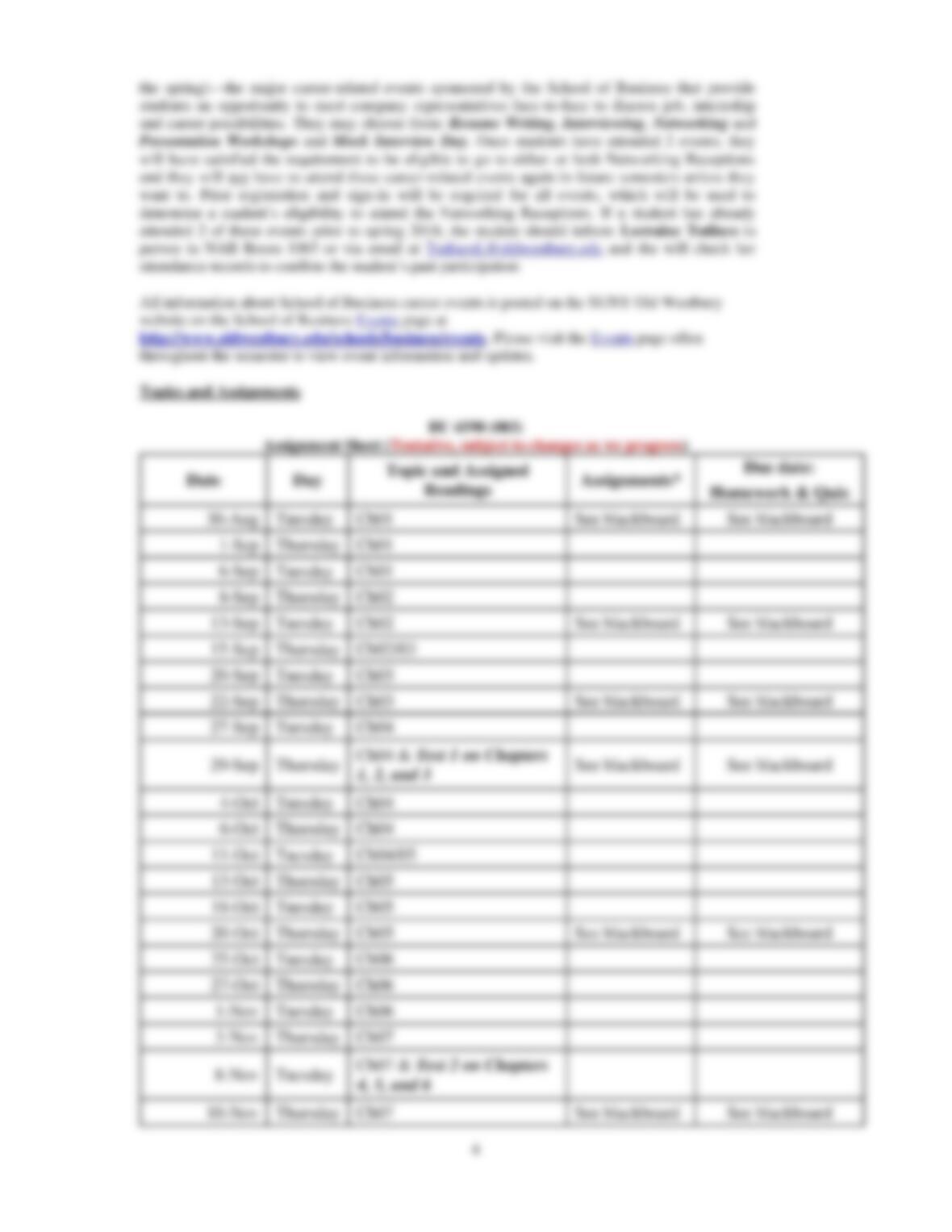
Students are required to come to class highly prepared for discussion and participation in solving problems.
Students must read the chapters and complete the homework assignments prior to the designated class
meeting. Students must be prepared to discuss the topics and assignments. Assignments are subject to
change as the course progresses. Homework assignments will be checked on a surprise basis. All collected
assignments must be completed individually and must be on time.
Attendance
Students are expected to attend all class meetings. Attendance and class participation are essential to
mastering the subject matter and to succeed in the course. If professional or personal responsibilities
require absence from class, let me know in advance.
Students arriving late for class (10 or 15 minutes after the scheduled class start) may be marked absent.
Likewise, students leaving class early may be marked absent. Absence from half the session is considered
an absence from the entire session.