Investment Portfolio Theory 1
Tutorial week 2: 08 – 02 – 2021
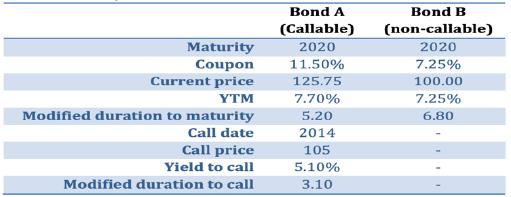
Question 16.1: Consider the following 2 bonds
Using this information, calculate the projected price change for both bonds if
its yield to maturity falls by 75 points (assume that bond A is not called).
Answer: In order to calculate the projected price change, we can use the
following formula: Δ𝑃 = −𝐷̃⋅ Δ𝑦 ⋅ P. Using this formula, the answers will be:
– Bond A: – 5.20 x (- 0.0075) x $125.75 = $4.90 → $130.65 → + 3.90%
– Bond B: – 6.80 x (- 0.0075) x $100.00 = $5.10 → $105.10 → + 5.10%
Q: Compare the price and yield behavior of the two bonds under the following
two scenarios (just reasoning with arguments, no computations needed):
– I. Strong economic recovery with rising inflation expectations.
– II. Economic recession with reduced inflation expectations.
Answer: Within the first situation, we see higher inflation which will lead to
higher interest rates. Since interest rates and bonds are inversely related, the
price of the bond will likely fall and that the probability that bond A will be
called will decline and thus behaving more like bond B. It is likely that the
probability of calling bond A declines, because the interest rate is now higher,
due to the inflation, than the interest rate (coupon payment) on the bond. At
the same time, the modified duration to call of bond A will fall with rising
inflation (and higher interest rates), so it will make more payouts earlier while
inflation and interest rates are still lower (which may be better for bond A).
In the second scenario, the inflation will be lower such that interest rates are
likely lower. Since interest rates and bonds are inversely related, the price of
the bond will likely increase. This price appreciation of bond A, the callable
bond, is more limited since it is more likely to be called due to the lower
interest rates. The non-callable bond B on the other hand has a higher duration
(which is now in a reduced inflation expectations environment a good thing)
that will probably lead to some price appreciation.
Question 16.2: My pension plan will pay me $10,000 once a year for a 10-year
period. The first payment will come in exactly 5 years. The pension fund wants
to immunize its position. The current interest rate is 10% per year. What is the
duration of the pension fund’s obligation?
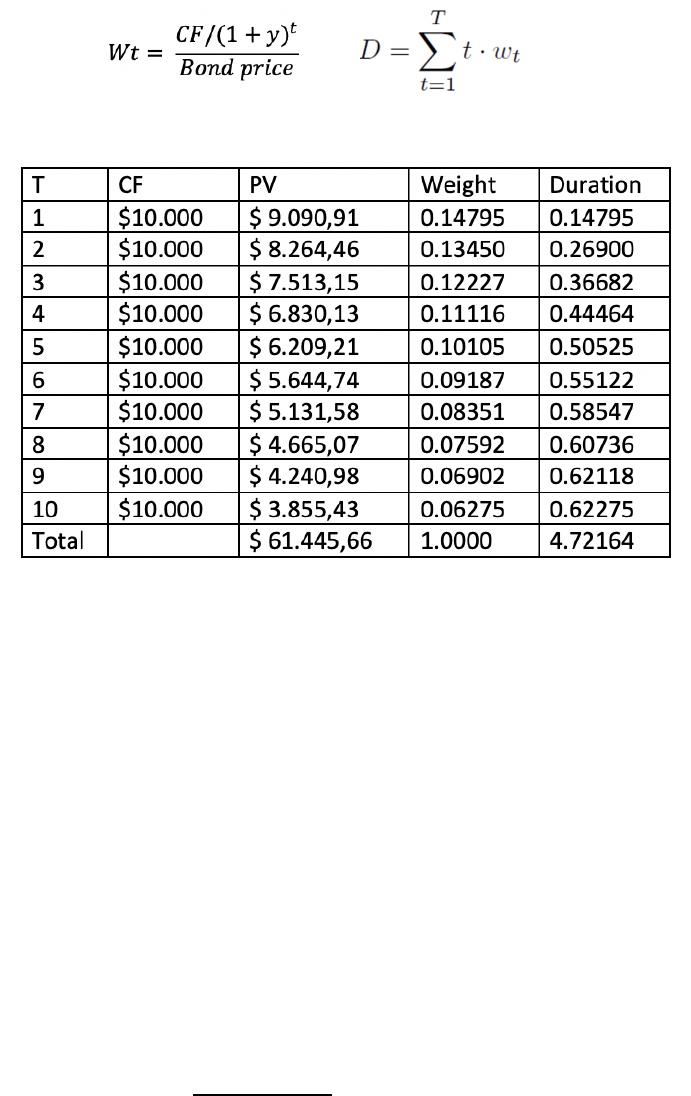
Answer: In order to calculate the duration of the obligation, we need to
multiply the weight of each payments with its duration using the following:
Using these formulas, we get the following answer in the table underneath:
Therefore, the duration of the pension fund’s obligation is 4.72164 years. Now,
since the payment stream starts in five years, instead of year one, we add four
years to the duration such that duration is equal to 8.72164 years.
Q: If the plan uses 5-year and 20-year zero-coupon bonds to construct the
immunized position, how much money ought to be placed in each bond? What
will be the face value of the holdings in each zero-coupon bond?
Answer: First, we need to determine the present value of the obligation.
According to the table, the present value is equal to $61.445,66. However, we
also know that the payments start in year five, such that the total time-period
of the obligation is not 10 years, but 14 years. Therefore, the known present
value needs to be discounted four more years, giving us the following answer:
𝑃𝑉 = $61.445,66
1.104= $41.968,22
Next, we need to determine the duration of each part of this question:
– Duration liability = 8.71264 years
– Duration 5-year zeros = 5 years
– Duration of 20-year zeros = 20 years
The following step is to make sure that the duration of the assets and the
liabilities will be equal. Therefore, we have to solve the following equation:
8.71264 = 5 𝑥 𝑤+ 20 𝑥 (1−𝑤)= 0.7525
Thus, we need to fund the obligation with the 5-year and 20-year zeros by:
– 75.25% of $ 41.968,22 = $ 31.581,09 market value of 5-year zeros
– 24.75% of $ 41.968,22 = $10.387,13 market value of 20-year zeros
Now, with the $ 41.968,22 the pension fund receives today from selling the
obligation, they need to buy 5-year zeros worth $31.581,09 and 20-year zeros
worth $10.387,12. However, the numbers are the market values of each