0
STRICTLY CONFIDENTIAL
Investment Banking
Valuation, Leveraged Buyouts, and Mergers &
Acquisitions
Chapter 1: Comparable Companies Analysis
JOSHUA ROSENBAUM & JOSHUA PEARL

1
Copyright © 2013 by Joshua Rosenbaum and Joshua Pearl. All rights reserved.
Published by John Wiley & Sons, Inc., Hoboken, New Jersey.
Published simultaneously in Canada.
No part of this publication may be reproduced, stored in a retrieval system, or transmitted in any form or by any means, electronic, mechanical, photocopying, recording, scanning, or otherwise, except as
permitted under Section 107 or 108 of the 1976 United States Copyright Act, without either the prior written permission of the Publisher, or authorization through payment of the appropriate per-copy fee to
the Copyright Clearance Center, Inc., 222 Rosewood Drive, Danvers, MA 01923, (978) 750-8400, fax (978) 750-4470, or on the web at www.copyright.com. Requests to the Publisher for permission should
be addressed to the Permissions Department, John Wiley & Sons, Inc., 111 River Street, Hoboken, NJ 07030, 201) 748-6011, fax (201) 748-6008, or online at http://www.wiley.com/go/permissions.
Limit of Liability/Disclaimer of Warranty: While the publisher and author have used their best efforts in preparing this book, they make no representations or warranties with respect to the accuracy or
completeness of the contents of this book and specifically disclaim any implied warranties of merchantability or fitness for a particular purpose. No warranty may be created or extended by sales
representatives or written sales materials. The advice and strategies contained herein may not be suitable for your situation. You should consult with a professional where appropriate. Neither the
publisher nor author shall be liable for any loss of profit or any other commercial damages, including but not limited to special, incidental, consequential, or other damages.
For general information on our other products and services or for technical support, please contact our Customer Care Department within the United States at (800) 762-2974, outside the United States at
(317) 572-3993 or fax (317) 572-4002.
Wiley also publishes its books in a variety of electronic formats. Some content that appears in print may not be available in electronic books. For more information about Wiley products, visit our web site
at www.wiley.com.
Library of Congress Cataloging-in-Publication Data:
ISBN-13 978-0-470–44220-3
Printed in the United States of America
10 9 8 7 6 5 4 3 2 1

2
Comparable Companies Analysis Steps
Step I. Select the Universe of Comparable Companies
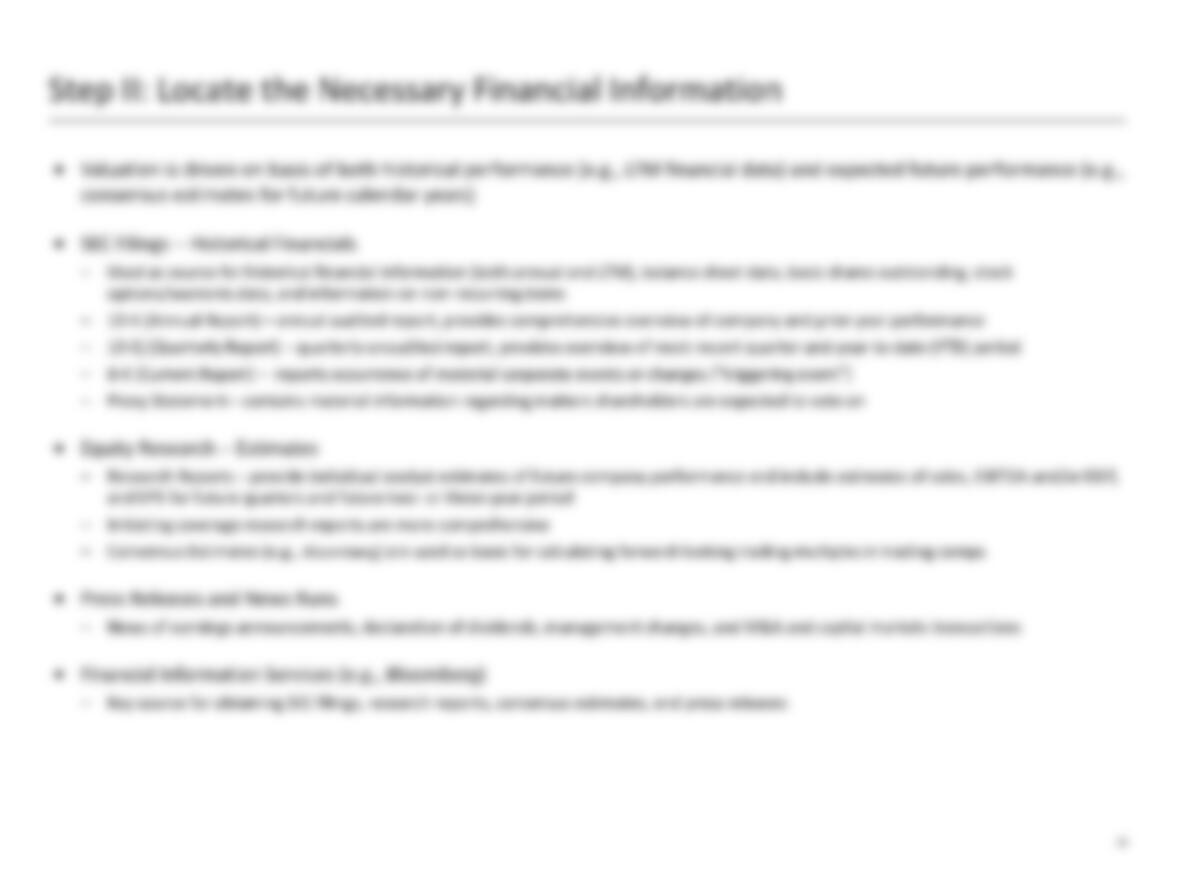
Step II. Locate the Necessary Financial Information
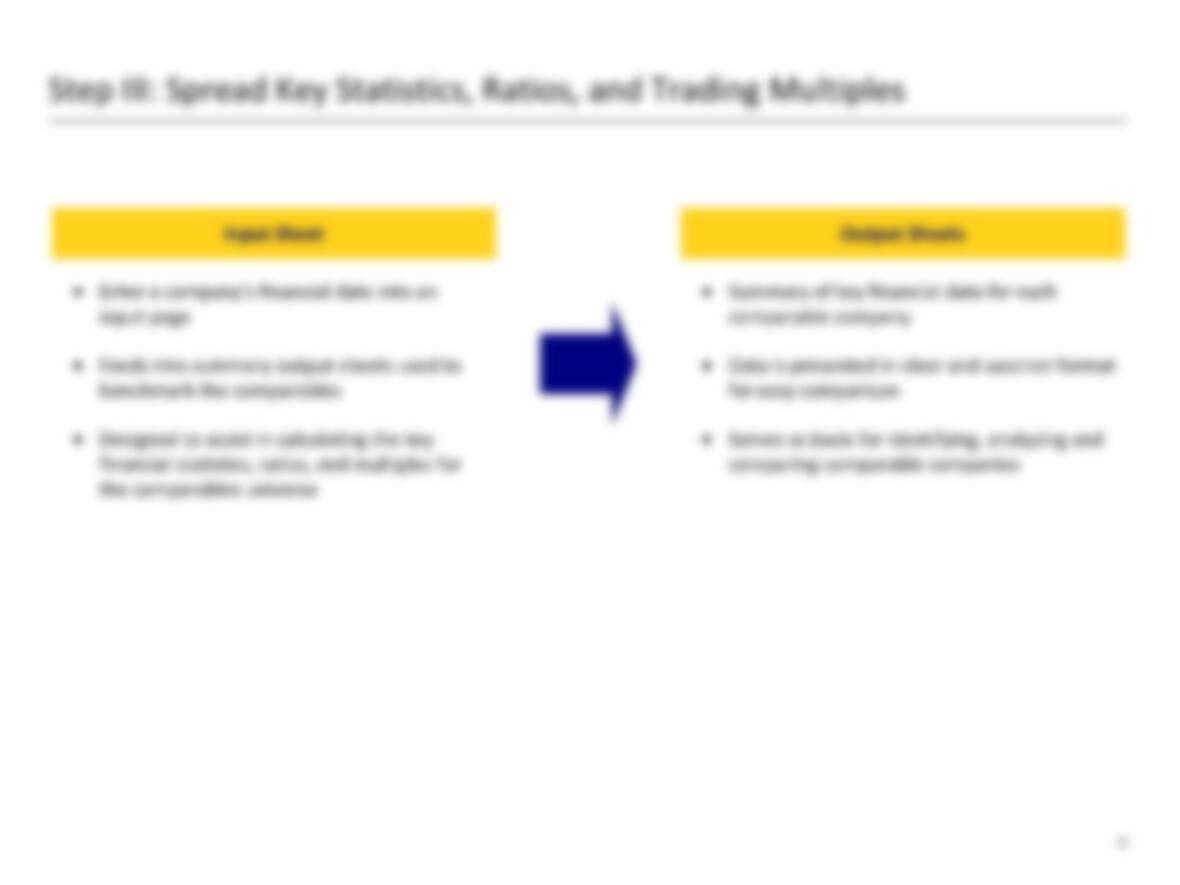
Step III. Spread Key Statistics, Ratios, and Trading Multiples
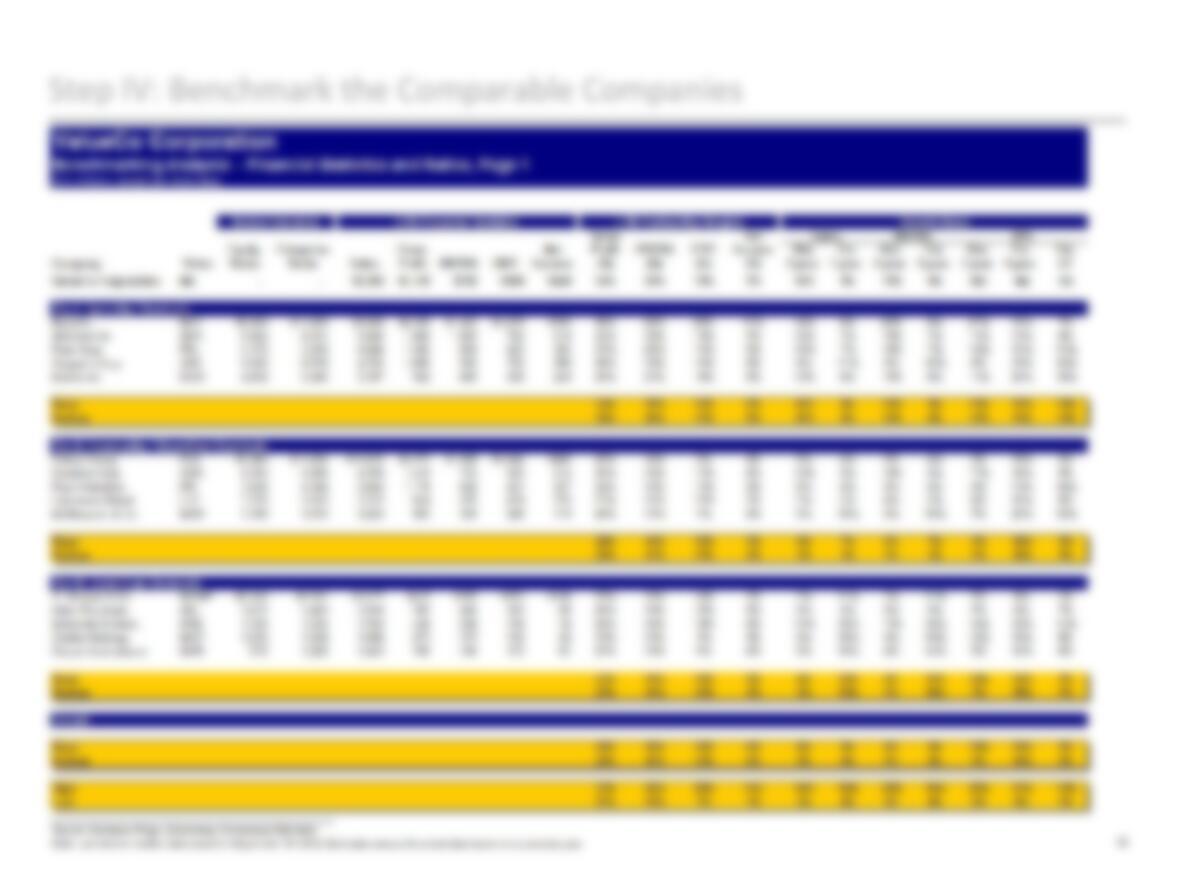
Step IV. Benchmark the Comparable Companies
Step V. Determine Valuation

3
Overview of Comparable Companies Analysis
•Provides market benchmark against which a banker can establish valuation for private company or analyze the value of
public company at given point in time
•Built upon premise that similar companies provide highly relevant reference point for valuing a target company
–Share key business and financial characteristics, performance drivers, and risks
–Valuation parameters can be established for the target by determining relative positioning among peer companies
•Broad range of applications, most notably for various M&A situations, IPOs, restructurings, and investment decisions
•Selecting universe of comparable companies for target is core of analysis
–Peer companies are benchmarked against each another and the target based on various financial statistics and ratios
–Utilizes measure of value in numerator and operating metric in denominator
•Designed to reflect “current” valuation based on prevailing market conditions and sentiment
–Market trading levels may be subject to periods of irrational investor sentiment that skew valuation either too high or
too low
–No two companies are exactly the same
– May fail to accurately capture a given company’s true value
4
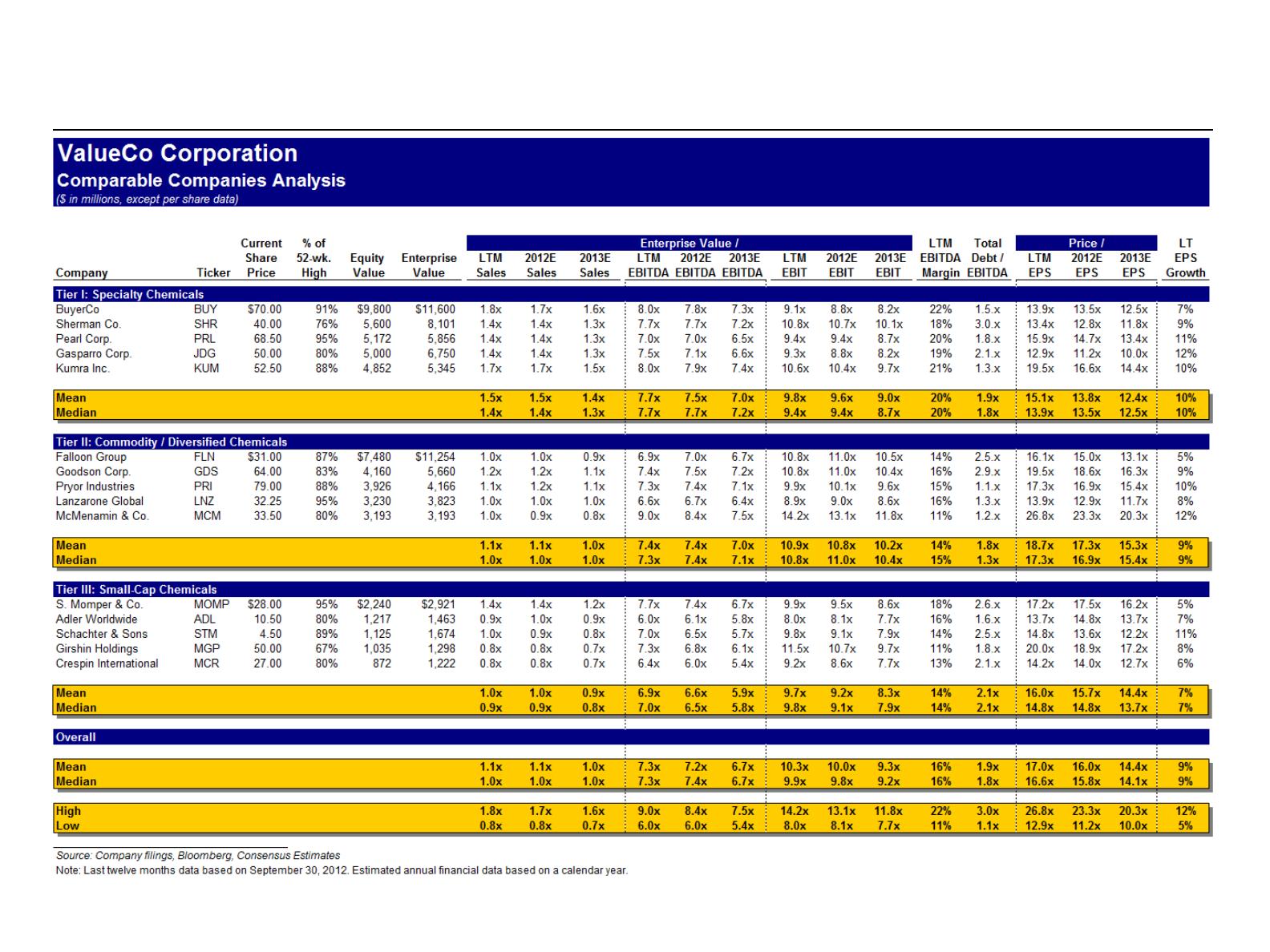
Comparable Companies Analysis Output

Step I
Select the Universe of Comparable Companies
Private Targets
•Greater challenge to locate information
(unless company has public debt)
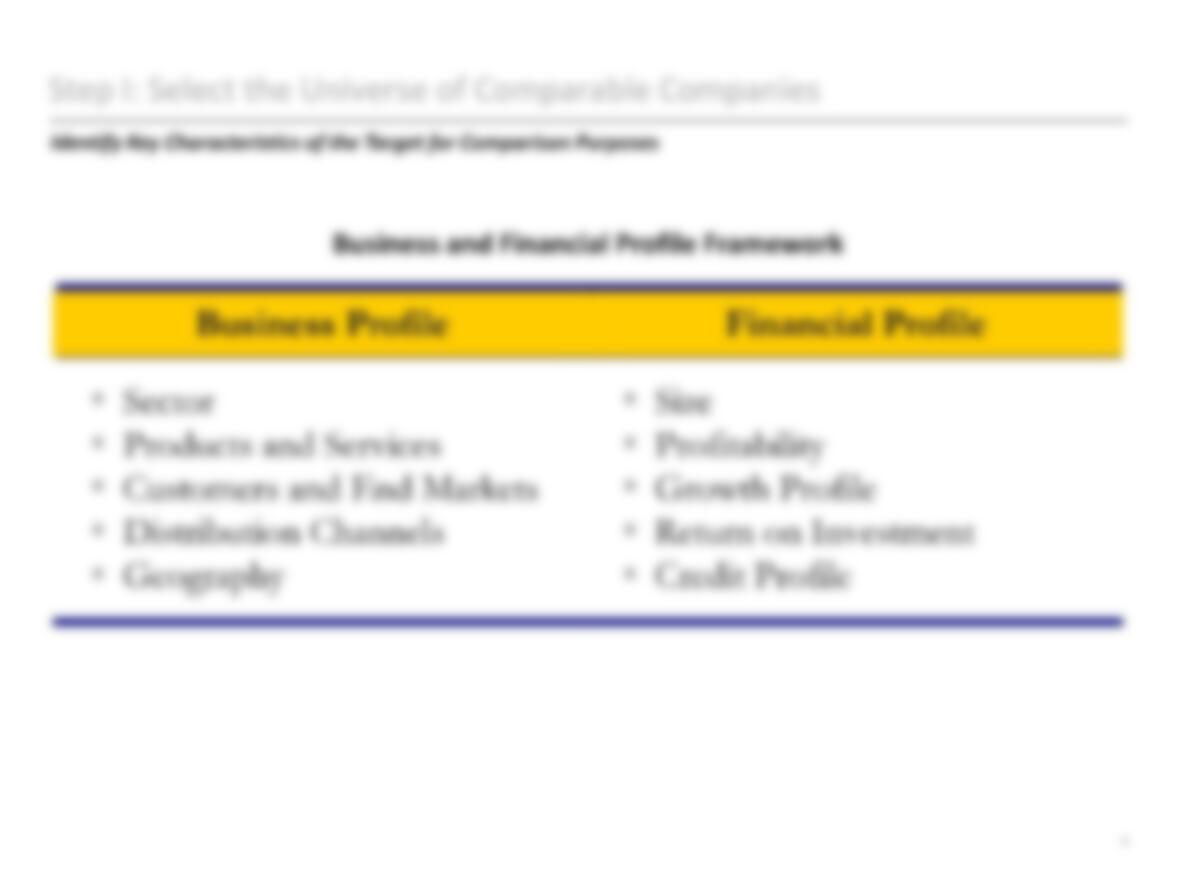
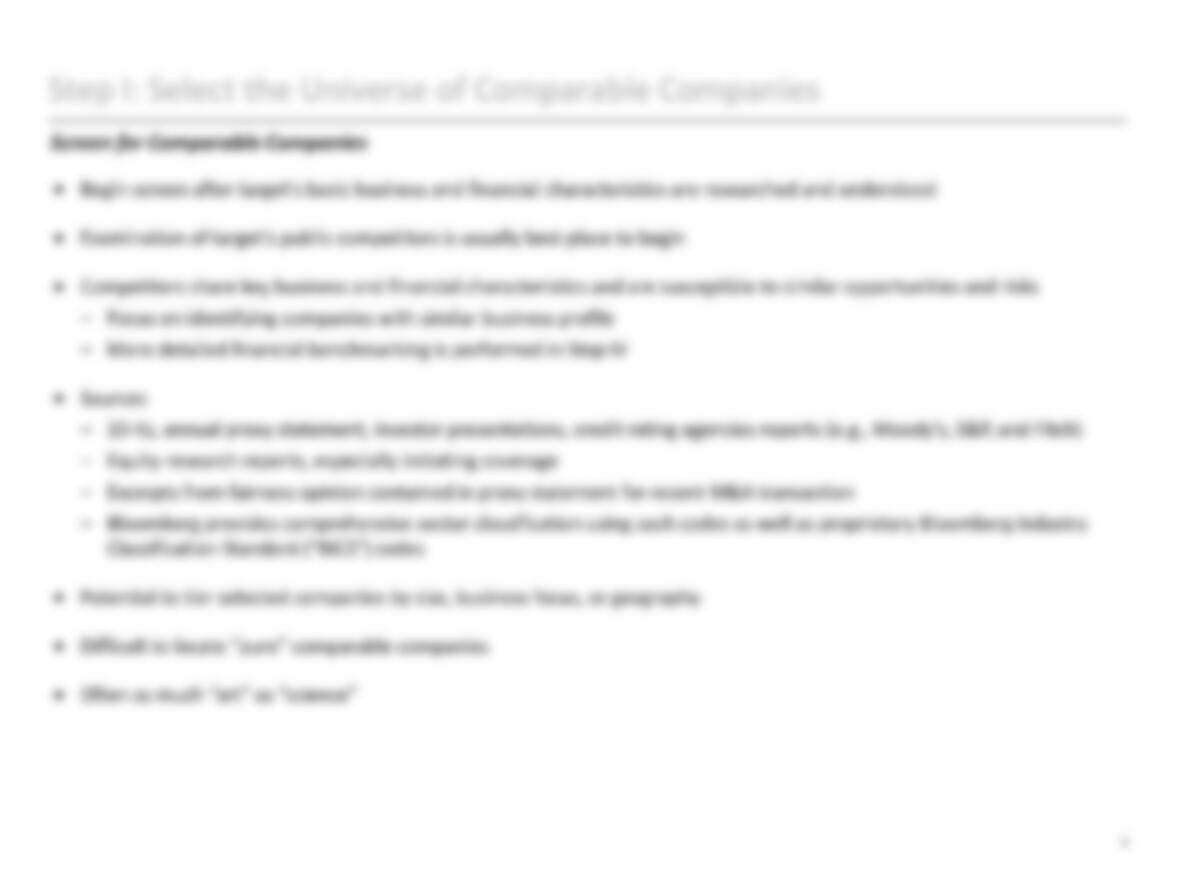
Step I: Select the Universe of Comparable Companies
Study the Target
Public Targets
•Process of learning the in-depth “story” of
target should be exhaustive
•Read and study as much company- and sector-
specific material as possible
•Annual (10-K) and quarterly (10-Q) SEC filings
•Consensus research estimates