CHAPTER 12: INTRODUCTION TO TRANSFER TAXES
1. WHAT IS TRANSFER? DISCUSS THE TYPES OF TRANSFER, TYPES OF UNILATERAL TRANSFER AND THE APPLICABLE TAX FOR
EACH.
Transfer-is the transmission of property from one person to another.
The different types of transfer are the following:
A) Bilateral-transmission for a consideration such as sale/barter; subject to income tax
B) Unilateral-gratuitous transmission without consideration such as the following:
a) Donation-gratuitous transfer from a living donor or donation inter-vivos; subject to donor’s tax (transfer tax)
b) Succession-gratuitous transfer to heirs upon or in contemplation of death or donation mortis causa; subject to estate tax (transfer
tax)
D) Complex-transfer for less than full and adequate consideration; subject to transfer tax on transfer element while income tax on
gain element
2. ENUMERATE AND EXPLAIN THE THEORIES RATIONALIZING TRANSFER TAXATION.
Theories:
A) Tax Evasion or Minimization Theory-to fight tax evasion which minimize income taxes
B) Tax Recoupment Theory-to recoup future losses in income taxes caused by transfers
C) Benefit Received Theory-exercise of the privilege to transfer property is a benefit to transferor
D) State Partnership Theory-the government is an indirect partner behind all forms of wealth accumulation
E) Wealth Redistribution Theory-to distribute funds from the wealthy to benefit the society
F) Ability to pay Theory-the ability to transfer property is an indication of an ability to pay tax
3. DISCUSS THE NATURE OF TRANSFER TAXES
Nature:
A) Privilege Tax-transfer tax is a privilege and not a penalty
B) Ad Valorem Tax-the amount of transfer taxes is dependent on the value of the properties transferred.
C) Proportional Tax-Taxes under train law are imposed at flat 6% of the net estate or gift
D) National Tax-transfer taxes are levied by the national government and not by LGU
E) Direct Tax-transfer taxes cannot be shifted and transferor is one subject to tax
F) Fiscal or Revenue Tax-are levied to raise money for the support of the government
4. WHAT ARE THE CLASSIFICATIONS OF TAXPAYERS UNDER TRANSFER TAXES AND RELATED SCOPE?
Taxpayer Classification
Scope of Tax Application
Resident or Citizens (Resident Citizen, Non-resident citizen, Resident Alien)
Taxable on transfer of property in the Philippines and abroad
Non-resident aliens
Taxable on transfer of property in the Philippines
5. WHY IS SITUS OF PROPERTY RELEVANT IN TRANSFER TAXATION?
This is to determine whether or not the transfer occur in the location of the property. Inter-vivos subject property is transferred at the place where
they are located at the date of donation while that of mortis causa is transferred in the place where they are located at the point of death.
6. WHAT IS RECIPROCITY RULE ON NON-RESIDENT ALIENS?
Transfer involving intangible personal properties is exempt from transfer tax provided that the country in which such alien is a resident of also
exempts Filipinos from the same.
7. ENUMERATE MOTIVES ASSOCIATED WITH LIFE WHICH CANNOT BE CLASSIFIED AS DONATION MORTIS CAUSA
Motives associated with life:
A) To reward services rendered
B) To relieve the donor of the burden of management of the property
C) To save on income tax
D) To see children financially independent
E) To see children enjoy the property while the decedent still lives
F) To settle family disputes
8. WHY IS IT ESSENTIAL TO CLASSIFY DONATIONS?
It is essential to classify donation to know the timing of the gratuitous transfer of ownership and the type of tax to be imposed based on the
classification of the transfer.
9. DISCUSS HOW CONDITIONAL TRANSFERS, REVOCABLE TRANSFERS AND TRANSFER WITH RESERVATION OF TITLE TO
PROPERTY UNTIL DEATH ARE COMPLETED.
Conditional Transfers are completed inter-vivos upon the happening of a condition during lifetime of donor whether:
A) Fulfillment by transferee
B) Waiver of the condition by transferor
Revocable Transfers are completed inter-vivos upon:
A) Waiver by the transferor to exercise his right of revocation or
B) Lapse of his reserved right to revoke
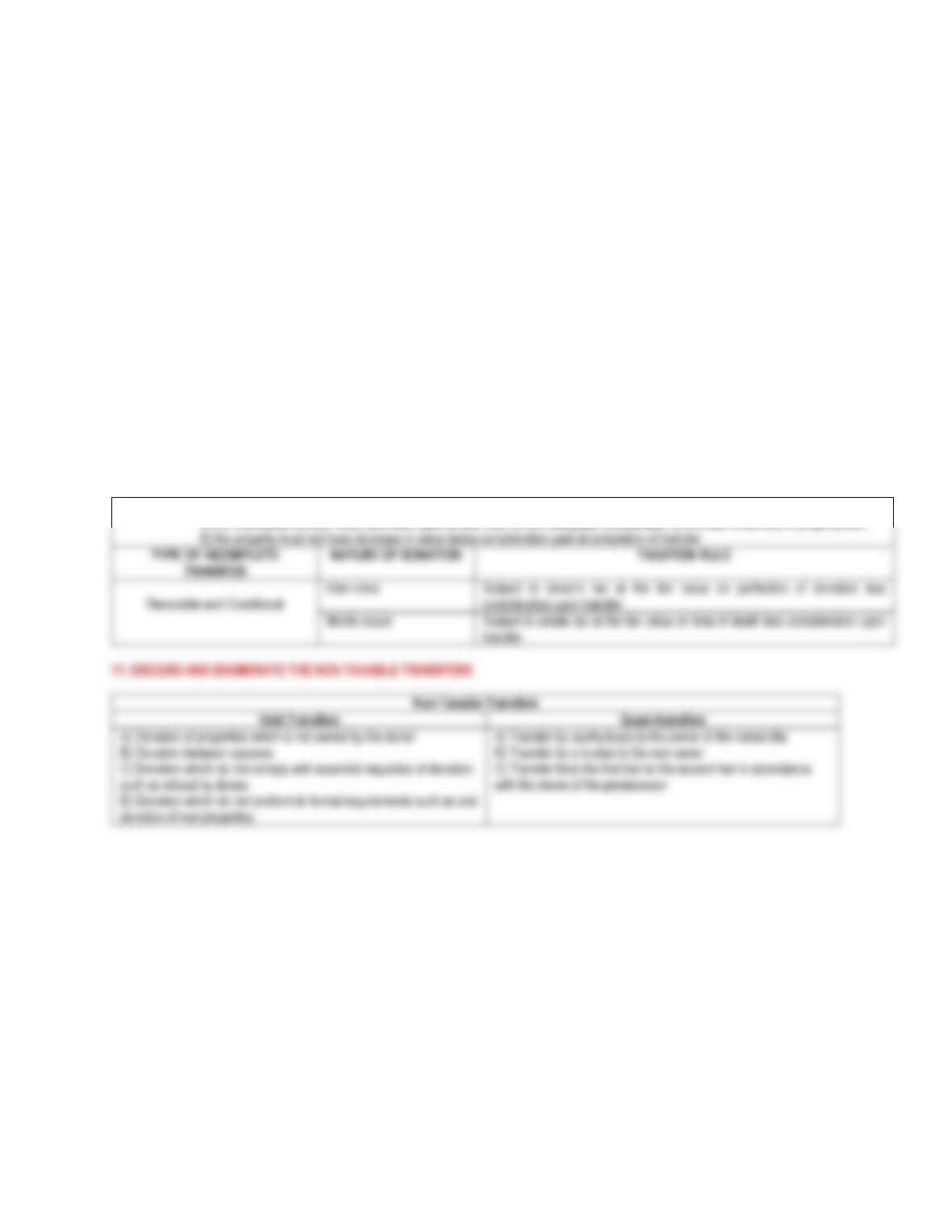
Conditional and Revocable transfers are not complete inter-vivos but mortis causa when the transfer is pre-terminated by the decedent and
therefore will not be subjected to donor’s tax but estate tax.
Transfer with reservation of title to property until death are completed by the death of the decedent.
10. DISCUSS THE TAXATION OF INCOMPLETE COMPLEX TRANSFERS
In order for an incomplete complex transfers to be taxable, there are two essential requisites: