ECON 1005 Principles of Economics I: Microeconomics Semester 1, 2019/20
1
Introduction to Microeconomics
1. What is Economics?
• Economics is a discipline that studies how people make choices under the problem of scarcity.
o Scarcity: a situation in which the amount of resources available is insufficient to satisfy
wants.
§ Individuals face a scarcity of spending power and time.
§ Societies face a scarcity of resources: labor, capital, land and entrepreneurship.
o The problem of scarcity forces people to make choices and to face tradeoffs.
• Microeconomics: the study of how individual economic units make choices and their
interaction in individual markets.
• Macroeconomics: the study of the aggregate behavior of the overall economy as a whole.
2. Opportunity Cost
• The opportunity cost of any choice is what we have to forgo when we make the choice.
• When the alternatives to a choice are mutually exclusive, only the highest valued alternative
forgone is included in the opportunity cost.
Example 1: Suppose that you are considering what to do with an upcoming Sunday morning. Here
are your options, from least to most–preferred: (1) studying for economics; (2) staying in bed; (3)
playing mobile games. What is the opportunity cost of a decision to play the mobile games?
Example 2: What is the opportunity cost of pursuing a full–time university degree?
• The opportunity cost of any choice includes both explicit costs and implicit costs.
Example 3: Suppose you just get two concert tickets for free from your uncle. What is the
opportunity cost of using the ticket to attend the concert yourself?
Example 4: You have already paid $70 to watch a movie. Thirty minutes into the movie, you
realize that the movie is dreadful. Now you have to make a choice between staying and leaving. Is
the $70 paid for the admission ticket irrelevant to your decision?
• A sunk cost is one that has already been incurred and cannot be recovered, regardless of any
future choice to be made.
o It should be irrelevant when making decisions.
3. Production Possibility Frontier (PPF)
• Due to the complexities of the real world, economists rely on simplified models (or theories)
to explain and predict individuals’ and societies’ behaviors and their outcomes.
• Production possibilities frontier (PPF): a curve that shows all combinations of two goods
that can be produced with a given amount of resources and current technology level.
o The simple model that illustrates the fundamental issues in economics.
o It can be applied at individual level or society level.
ECON 1005 Principles of Economics I: Microeconomics Semester 1, 2019/20
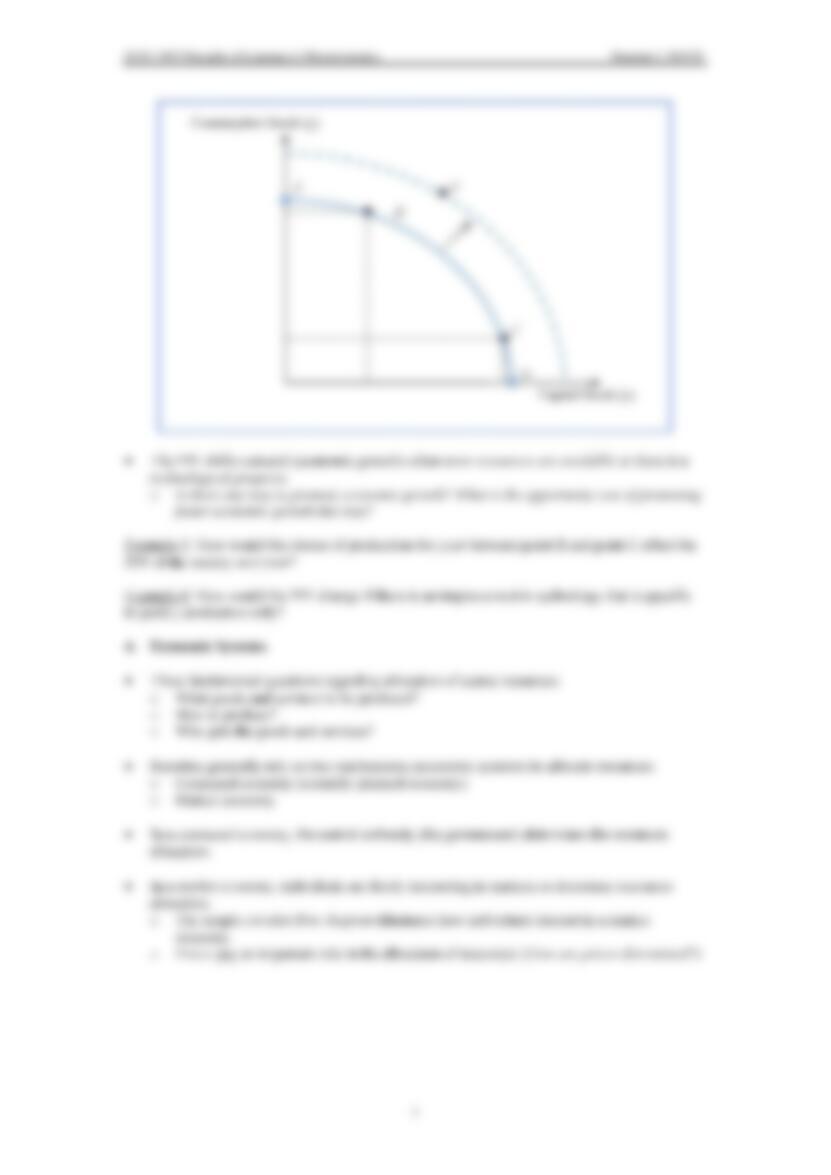
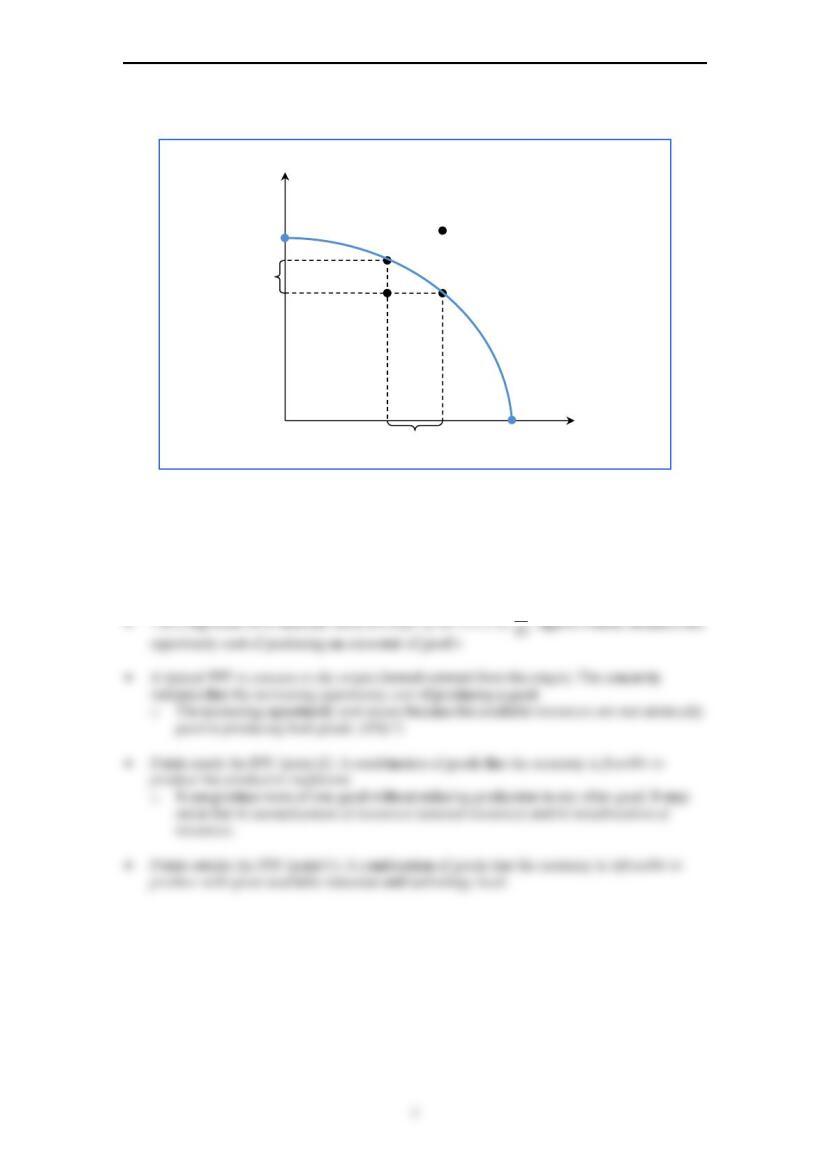
• An example of a typical PPF (from a society’s perspective):
• The movement along a downward sloping PPF illustrates the basic concepts of scarcity and
choice (or tradeoff).
o Moving from point B to point C indicates that the only way to increase production in
good x is to reduce production in good y.
o Thus, the opportunity cost of producing more good x by ∆x units is the production of ∆y
units of good y.
!”
Consumption Goods (y)
B
∆y
Capital Goods (x)
∆x
D
C
A
E
F