Intro to Finance – Problem Set 3 – © Schlingemann 2000
1
Introduction to Finance
BUSFIN 1030
Professor Schlingemann
Problem Set 3
SOLUTIONS
Problem 1:
You are deciding among three cars to use as a company car. The garage offers you a lease
deal and two different options for purchasing the car. You are completely indifferent
among these cars except for their costs. Once you have decided which car to take, you
will always take the same car again at the end of its useful life. The pre-tax residual value
(salvage value) for the car at the end of its useful life is equal to (100 / n) % of the
purchase price, where n is equal to the lifetime of the car. All cars are fully depreciated
according to its lifetime on a straight-line basis with no half-year convention. The
discount rate is 7% and the tax rate is 20%. Assume that you pay the price of the car up
front, and the annual costs at the end of the year. The costs of leasing occur at the end of
each period. (For example, if you purchase Car B, you pay $18,000 in year 0 and $1,000
in year 1, year 2, etc. If you lease car A, you pay $4,650 in year1, year 2, etc.) Note:
consider all relevant cash flows for this problem.
Lease A Purchase B Purchase C
Purchase price — $18,000 $45,000
Total annual costs* $4,650 $900 —
Lifetime of the car 3 years 5 years 18 years
* Includes all after-tax costs like fuel, wear and tear, maintenance, etc.
Using the Equivalent Annual Cost (EAC) method, which of the cars should you decide to
drive always?
ANSWER:
First find the relevant cash flows associated with each purchase option:
Purchase B:
Depreciation tax shield = 20% × $3,600 = $720
After-tax salvage value = $3,600 – 20% × $3,600 = $2,880
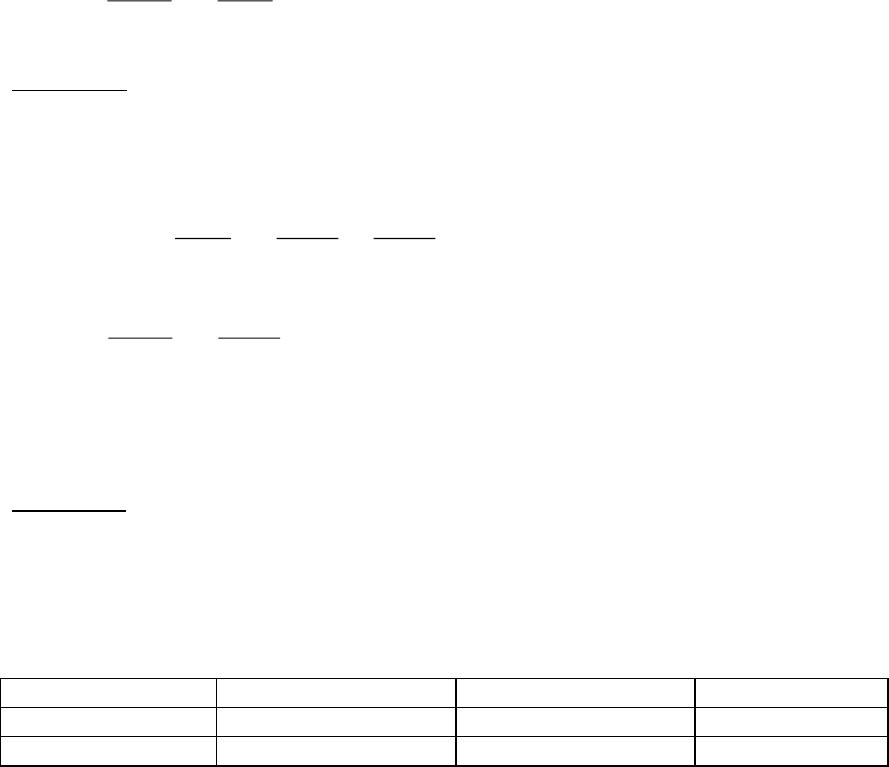
PVB = 18,000 +
=−
−
−
55 07.1
880,2
07.1
1
1
07.0
720900
$16,684.64
Intro to Finance – Problem Set 3 – © Schlingemann 2000
2
EACB
=
−5
07.1
1
1
07.0
B
EAC
16,684.64 EACB = $4,069.23
Purchase C:
Depreciation tax shield = 20% × $2,500 = $500
After-tax salvage value = $2,500 – 20% × $2,500 = $2,000
PVC = 45,000 +
=−
−
−
1818 07.1
000,2
07.1
1
1
07.0
500
$39,378.73
EACC
=
−18
07.1
1
1
07.0
B
EAC
39,378.73 EACC = $3,914.74
Purchase C has the lowest cost per year (note that the lease is already in $ per year).
Problem 2:
You are thinking about investing your money in the stock market. You have the
following two stocks in mind: stock A and stock B. You know that the economy can
either go in recession or it will boom. Being an optimistic investor, you believe the
likelihood of observing an economic boom is two times as high as observing an economic
depression. You also know the following about your two stocks:
State of the Economy
Probability
RA
RB
Boom
10%
–2%
Recession
6%
40%
a) Calculate the expected return for stock A and stock B
b) Calculate the total risk (variance and standard deviation) for stock A and for stock B
c) Calculate the expected return on a portfolio consisting of equal proportions in both
stocks.
d) Calculate the expected return on a portfolio consisting of 10% invested in stock A and
the remainder in stock B.
e) Calculate the covariance between stock A and stock B.
f) Calculate the correlation coefficient between stock A and stock B.
g) Calculate the variance of the portfolio with equal proportions in both stocks using the
covariance from answer e.
h) Calculate the variance of the portfolio with equal proportions in both stocks using the
portfolio returns and expected portfolio returns from answer c.
ANSWER
a) p(boom) = 2/3 and p(recession)=1/3 (Note that probabilities always add up to 1)
E(RA) = 2/3 × 0.10 + 1/3 × 0.06 = 0.0867 (8.67%)
E(RB) = 2/3 × -0.02 + 1/3 × 0.40 = 0.12 (12%)
b) SD(RA) = [2/3 × (0.10-0.0867)2 + 1/3 × (0.06-0.0867)2]0.5= 0.018856 (1.886%)
SD(RB) = [2/3 × (-0.02-0.12)2 + 1/3 × (0.40-0.12)2]0.5 = 0.19799 (19.799%)
c) Portfolio weights: WA=0.5 and WB=0.5:
E(RP) = 0.5 × 0.0867 + 0.5 × 0.12 = 0.10335 (10.335%)
d) Portfolio weights: WA=0.1 and WB=0.9:
E(RP) = 0.1 × 0.0867 + 0.9 × 0.12 = 0.11667 (11.667%)
e) COV (RA,RB) =
2/3 × (0.10-0.0867) × (-0.02-0.12) + 1/3 × (0.06-0.0867) × (0.40-0.12) = –0.0037333
f) CORR(RA,RB) = –0.0037333 / (0.018856 × 0.19799) = –1 (Rounding! Remember
the correlation coefficient cannot be less than –1)
g) VAR(RP) = 0.52 × 0.0188562 + 0.52 × 0.197992 + 2 × 0.5 × 0.5 × –0.0037333 =