Engineering Fundamentals: An Introduction to Engineering Moaveni
© 2020 Cengage Learning®. May not be scanned, copied or duplicated, or posted to a publicly
accessible website, in whole or in part.
Engineering Fundamentals: An Introduction to Engineering Moaveni
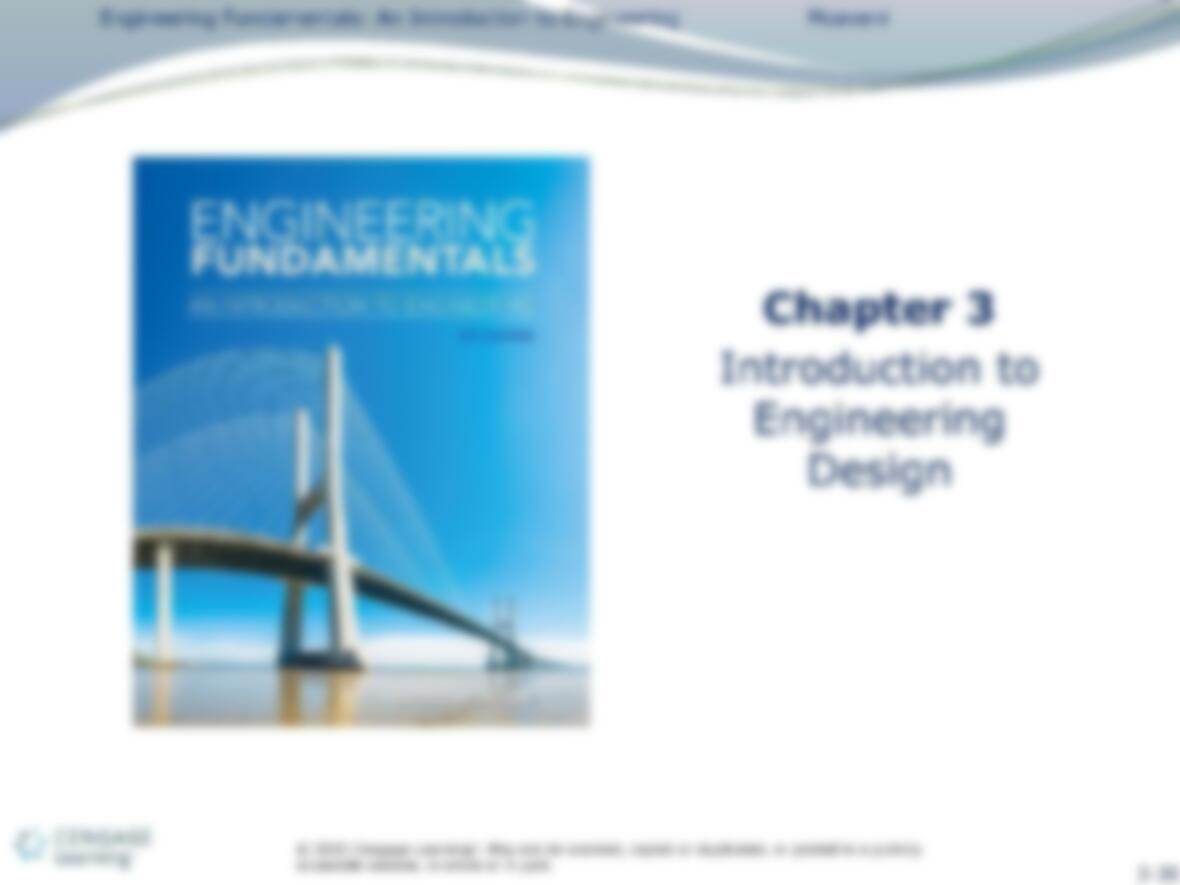
Chapter 3
Introduction to
Engineering
Design
3-1

Engineering Fundamentals: An Introduction to Engineering Moaveni
© 2020 Cengage Learning®. May not be scanned, copied or duplicated, or posted to a publicly
accessible website, in whole or in part.
Engineering Fundamentals: An Introduction to Engineering Moaveni
Learning Objectives
1. Engineering Design Process
Explain the basic steps that engineers follow to design something
and to arrive at a solution to a problem
2. Additional Design Considerations
Describe what is meant by sustainability and its role in design;
also explain the roles of engineering economics and material in
engineering design
3. Teamwork
Explain what is meant by a design team and describe the
common traits of good teams; also explain how good teams
manage conflicts
3-2

Engineering Fundamentals: An Introduction to Engineering Moaveni
© 2020 Cengage Learning®. May not be scanned, copied or duplicated, or posted to a publicly
accessible website, in whole or in part.
Engineering Fundamentals: An Introduction to Engineering Moaveni
Learning Objectives
4. Project Scheduling and the Task Chart
Describe the process that engineering managers use to ensure
that a project is completed on time and within the allocated
budget
5. Engineering Standards and Codes
Describe why we need standards and codes and give examples of
standards and codes organizations in the United States and
abroad
6. Water and Air Standards in the United States
Describe the drinking water, indoor and outdoor air sources of
pollutants, and the water and air quality standards in the United
States
3-3

Engineering Fundamentals: An Introduction to Engineering Moaveni
© 2020 Cengage Learning®. May not be scanned, copied or duplicated, or posted to a publicly
accessible website, in whole or in part.
3-4
Engineering Design Process
Basic Steps
1. Recognizing the need for a product or a service
2. Defining and understanding the need
3. Research and preparation
4. Conceptualization
5. Synthesis
6. Evaluation
7. Optimization
8. Presentation

Engineering Fundamentals: An Introduction to Engineering Moaveni
© 2020 Cengage Learning®. May not be scanned, copied or duplicated, or posted to a publicly
accessible website, in whole or in part.
Step 1: Recognizing the need for
a product or a service
The need for a product or service could come from
You
Company
Client(s)
3-5

Engineering Fundamentals: An Introduction to Engineering Moaveni
© 2020 Cengage Learning®. May not be scanned, copied or duplicated, or posted to a publicly
accessible website, in whole or in part.
3-6
Step 2: Problem definition and
understanding
The most important step in any design process
Before you move on to the next step,
Make sure you understand the problem
Make sure that the problem is well defined
Good problem solvers are those who first fully
understand what the problem is

Engineering Fundamentals: An Introduction to Engineering Moaveni
© 2020 Cengage Learning®. May not be scanned, copied or duplicated, or posted to a publicly
accessible website, in whole or in part.
3-8
Step 3: Research and preparation
Collect useful information as much as you can
Search to determine if a product already
exists that closely meets the need
Consider if you can adopt or modify existing
components
Review and organize the information collected
in a suitable manner

Engineering Fundamentals: An Introduction to Engineering Moaveni
© 2020 Cengage Learning®. May not be scanned, copied or duplicated, or posted to a publicly
accessible website, in whole or in part.
3-9
Step 4: Conceptualization
Generate ideas or concepts that could offer
reasonable solutions to your problem
Identify the components of the system
Analyze the merit of the developed concepts
Evaluate alternatives
Create a milestone chart

Engineering Fundamentals: An Introduction to Engineering Moaveni
© 2020 Cengage Learning®. May not be scanned, copied or duplicated, or posted to a publicly
accessible website, in whole or in part.
3-10
Step 5: Synthesis
At this point you begin to consider details
Perform calculations
Run computer models
Narrow down the type of materials to be used
Size the components of the system
Answer questions about how the product is
going to be fabricated
Consult pertinent codes and standards for
compliance

Engineering Fundamentals: An Introduction to Engineering Moaveni
© 2020 Cengage Learning®. May not be scanned, copied or duplicated, or posted to a publicly
accessible website, in whole or in part.
3-11
Step 6: Evaluation
Analyze the problem in more detail
Identify critical design parameters and consider
their influence in your final design
Make sure that all calculations are performed
correctly
For uncertainties, perform experimental
investigation
Identify the best solution from alternatives

Engineering Fundamentals: An Introduction to Engineering Moaveni
© 2020 Cengage Learning®. May not be scanned, copied or duplicated, or posted to a publicly
accessible website, in whole or in part.
3-12
Evaluating Alternatives
When a design is narrowed down to a few
workable concepts, evaluation of these
concepts is needed before detail design is
pursued
Each design would have its own evaluation
criteria
Engineering Fundamentals: An Introduction to Engineering Moaveni
Step 7: Optimization – minimization
or maximization
Optimization is based on some particular
criterion such as cost, strength, size, weight,
reliability, noise, or performance