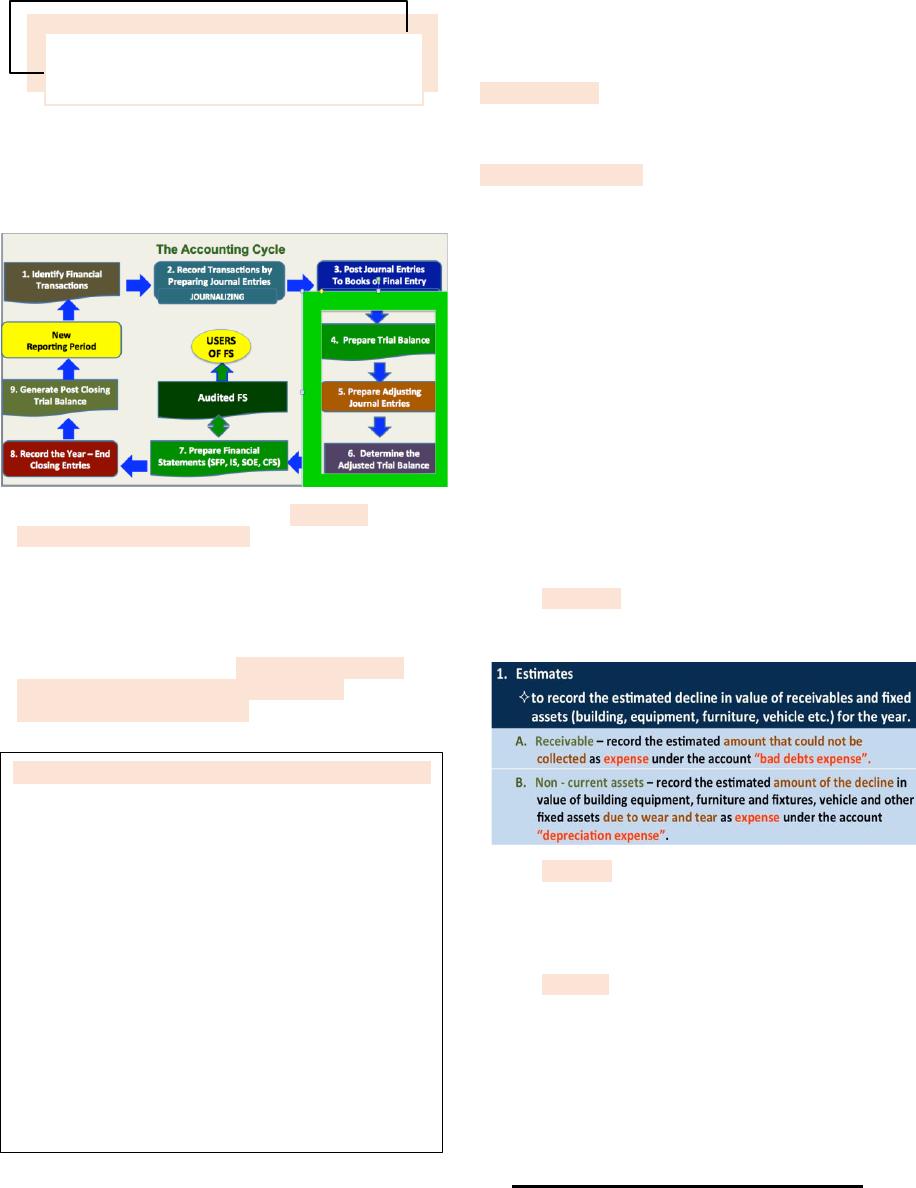
Accounting Cycle – series of steps used to collect
and process financial information in order to
prepare financial statements and maintain financial
records on the desired accounting period.
The preparation of the trial balance proves the
equality of the debit and credit of the recording
process, provides an overview of the balances of
the accounts and to determine if there are accounts
that needs to be adjusted. From the trial balance,
the Accountant needs to perform an analysis of the
accounts. Thus, the 5th step is the preparation of
Adjusting Journal Entries to update and correct the
amount of accounts to ensure that financial
statements are fairly presented.
Accounting principles (GAAP) that guide the
recognition of adjusting entries
1. Time Period – the life of the business is divided
into uniform periods of time so that regular financial
statements can be prepared.
2. Accrual Principle:
a. Revenue Recognition Principle – income
is recognized as earned at the time the service
is rendered or the goods were delivered in the
case of merchandising and manufacturing
type of operations regardless whether cash is
received or not.
b. Expense Recognition Principle – expense
is recognized when incurred regardless of
when payment is made.
c. Matching Principle – expenses should be
matched against the income during the period
it was earned.
The Three Types of Adjusting Journal Entries
1. Estimates:
a. Depreciation b. Bad Debts
2. Deferrals:
a. Supplies and Prepayment of Expense
b. Advance payment from customers
3. Accruals:
a. Accrual of income – for income
already earned but were not collected nor
recorded.
b. Accrual of expense – for expenses
already incurred or consumed but were
not paid nor recorded.
Lesson 2.1: Estimates – Bad Debts
Expense
Introduction on Adjusting Journal
Entries
What are adjusting entries. Why are these necessary?
1. Are prepared at the end of the accounting period
to update the value of the accounts, ensuring the
accuracy before preparing financial statements.
2. Its purpose is to get both income statement and
the statement of financial position to be
presented fairly.
3. Adjusting journal entries consist of:
• 1 nominal/ Income Statement account
(expense or revenue)
• 1 real/Statement of Financial Position
account (asset or liability).
4. Adjusting journal entries can be prepared at any
time but all adjusting entries for the reporting
period must be dated and posted within the
applicable reporting period.
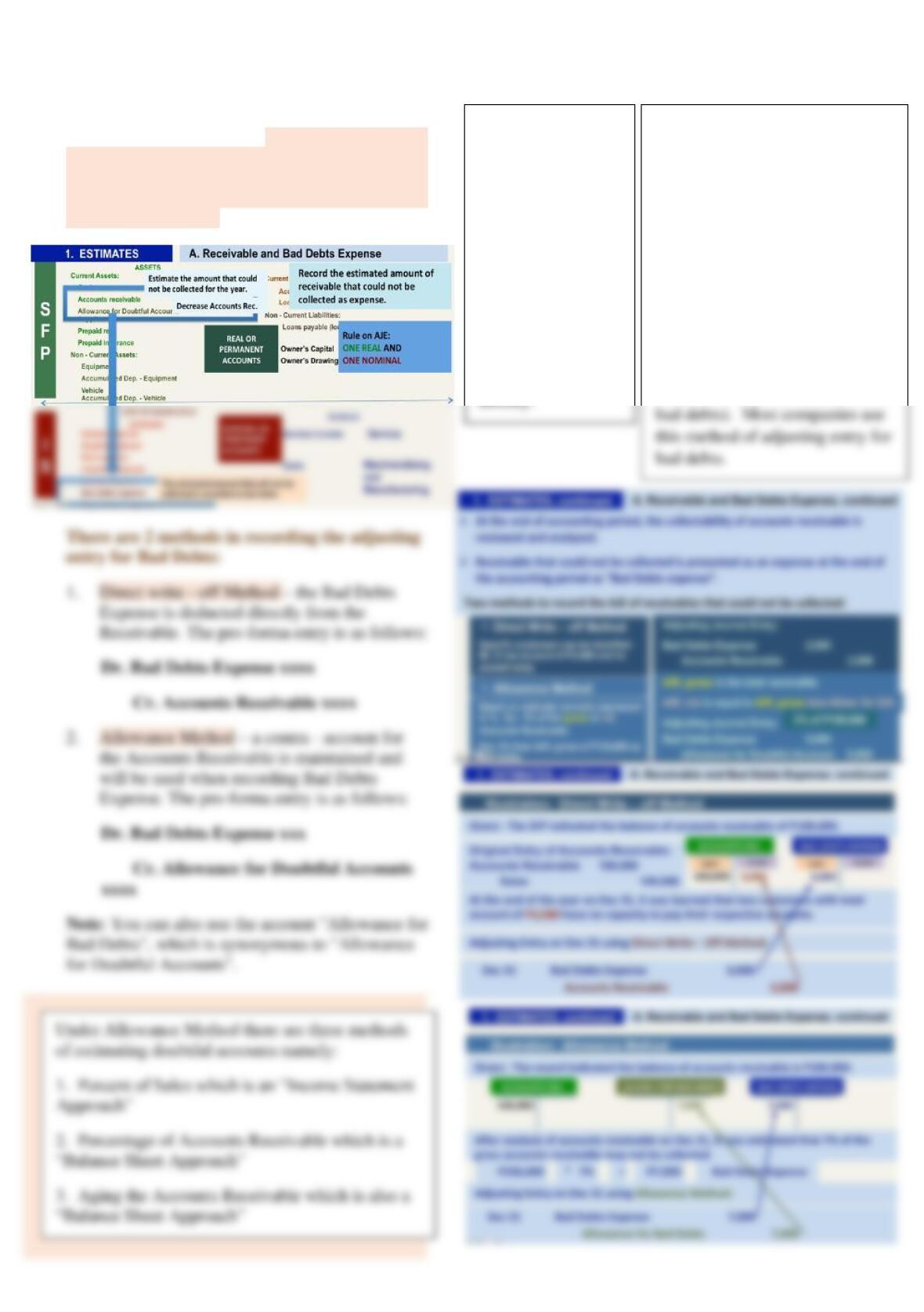
Bad Debts Expense – estimated amount of
receivables that could not be collected from
customers or from those who owe the company. The
required adjusting entry is to reduce the value of
Receivables presented as Asset in the Statement of
Financial Position by recording it as a non – cash
expense using the account Bad Debts Expense of
the Income Statement.
Differences Between the 2 Methods:
Direct Write-Off
Method
– Recognizes bad
debts only when it is
certain that the
account of the
specific customer
could not be
collected anymore.
– Credits the
accounts receivable
to decrease it
Allowance Method
– Recognizes the doubtful amount
every accounting period based on
an estimated amount or a certain
% of the gross receivable. The
estimated amount or the % used
in estimating the amount is based
on the experience of the company
from prior periods.
– Credits the contra-account of
the receivable (allowance for
doubtful account or allowance for