PLEASE ATTACH THIS DECLARATION ON TO THE FRONT OF YOUR
ASSIGNMENT
Student Name: _____Pardis Shahriari_______________________________________
Student Number: ___32354219_____________________________________________
Unit Code/Title:
__BUS171____________________________________________________
Assignment Number and Name: ______Externalities________________________
Tutor’s Name (not lecturer): ___Loretta Dumas_____________________________
Tutorial Day/Time (internal students): ____Tuesday (8.30 – 10.30_______________
Your assignment should meet the following requirements. Please confirm (by ticking the
boxes) that your assignment:
Is presented on A4 size paper
Is printed one side only and 1.5 or double spaced (or as per the unit information)
has a margin of 2.5cm on the left-hand side of the page
is firmly stapled; and
has the declaration below signed
DECLARATION
• Except where indicated, the work I am submitting in this assignment is my own work and
has not been submitted for assessment in another unit.
• This submission complies with Murdoch University’s academic integrity commitments. I
am aware that information about plagiarism and associated penalties can be found in the
assessment policy. If I have any doubts or queries about this, I am further aware that I can
contact my Unit Coordinator prior to submitting the assignment.
• I acknowledge that the assessor of this assignment may, for the purpose of assessing this
assignment:

▪ Reproduce this assignment and provide a copy to another academic staff member;
and/or
▪ Submit a copy of this assignment to a plagiarism-checking service. This web-based
service may retain a copy of this work for the sole purpose of subsequent plagiarism
checking, but has a legal agreement with the University that it will not share or
reproduce it in any form.
• I have retained a copy of this assignment.
Signed: ______________________________Date:_____________________________________
IT IS YOUR RESPONSIBILITY TO ENSURE THAT THIS ASSIGNMENT IS
SUBMITTED IN ACCORDANCE WITH THE INSTRUCTIONS IN THE UNIT
INFORMATION AND LEARNING GUIDE OR ON LMS.
NOTE: FRONT DESK RECEPTION CANNOT TAKE RESPONSIBILITY FOR
RECEIPT OF ASSIGNMENTS.
Introduction: Externalities and its Major Causes
This paper discusses how positive and negative externalities can be detrimental to economic
efficiency and how corrective models such as Pigouvian Tax and property rights can minimise the
risk of market failure. Externalities can be positive (negative) and it is defined as a benefit (cost)
that affects people who are not directly involved in the consumption or production of that good
(Hubbard and O’Brien, 2013). Market failure occurs when economically efficient choices deviate
from privately optimal choices (Gillingham and Kenneth, 2010) and it causes discrepancy between
the private marginal benefits (costs) and social marginal benefits (costs) in either production or
consumption (Hubbard and O’Brien, 2013). This deviation between the two benefits (costs) makes
the market allocatively inefficient. This paper focuses on corrective measures that can mitigate
positive consumption externalities and negative production externalities to improve net social
welfare.
Difficulties in enforcing property rights in public goods is intangible and immeasurable, hence, it
is considered as one of the major culprits that causes externalities (Hubbard and O’Brien, 2013).
This difficulty arises with public goods due to the two characteristics that public goods have; non-
excludability and non-rivalry. Meaning that Non-payers cannot be excluded from using these
products and the consumption of the good by one unit would not reduce anyone else’s share, such
as, weather prediction or national defence (Mankiw, 2011). Another cause for some externalities
can result from “common pool resources” (CPR). CPRs are the resource systems created by
naturally or by humans which are large enough and therefore costly to exclude potential
beneficiaries and users (Carpenter, 1998). Unlike public goods, CPRs can be depleted by the use
of others, therefore, free rider problem of externality will arise and individuals using them would
be indifferent to the externalities that they inflict on others by using them (Tietenberg and Lewis,
2009).
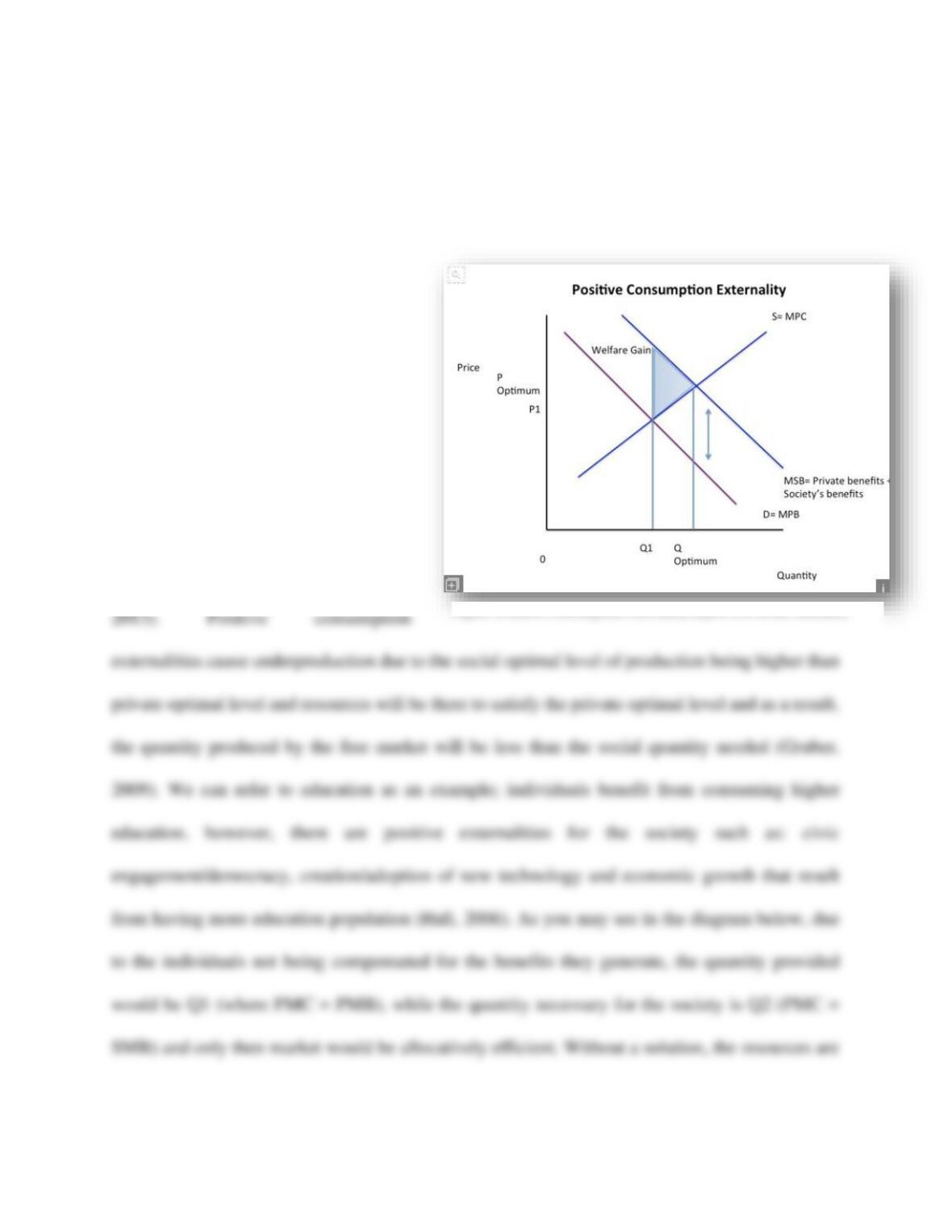
Positive Consumption Externalities
When the consumption of a good causes
benefits to person uninvolved in the
process, Social benefit would be larger
than the Private benefit and this results
in the social marginal benefit curve to be
above private marginal benefit, which
leads to positive consumption
externalities (Hubbard and O’Brien,