EC306: ASSIGNMENT ONE
QUESTION 1
a. Adam smith
During the early 18th and 19th century, mercantilism was the prevailing theory which dictated a
country’s terms of trade. Mercantilism is the view that national well-being or wealth was based on
national holdings of gold and silver (Pugel 2015 p .33). This view also holds that, imports were bad
while exports were regarded as good and in order for a country to achieve a favourable balance of
trade, governments must levy array of taxes and restrictions to prohibit imports and subsidizing and
encouraging exports (Economic Theories 2008). This view was however rebutted by Adam Smith who
argued that a country’s well-being is based on its ability to consume products and that the importance
of national production and exports is only indirect (Pugel 2015 p.33). Hence, a country’s gains should
not be at the expense of others since a surplus in international trade is a deficit for other countries.
In opposition to the mercantilism theory, Adam smith devise the absolute advantage theory –a theory
stating that a country can produce more of one good at a lower cost with high labour productivity
than other countries (Pugel 2015 p.33). This implies that in order for countries to gain from trade, they
should focus on their absolute advantages and disadvantages. This is illustrated below.
Output per day of work.
Food
Clothing
Country A
12
7
Country B
5
9
According to the above table, country A has an absolute advantage in producing food while country B
has an absolute advantage in producing clothing.
According to Adam Smith, if country A can produce more food at a lower cost than country B, and if
country B can produce more clothing at the lower cost than country A, then it is beneficial to both
parties to exchange goods with each trading the good it produces at a lower cost for the good it
produces at higher costs. This enables both countries to gain from trade by only specializing in
producing more of a good that it can at a lower cost.
However, the following assumption must be held in order for absolute advantage to be valid.
• The unregulated perfectly competitive market exists.
• There is free trade involving two firms or countries only.
• Labour is the only production cost.
• Production characterizes constant returns to scale.
Absolute advantage has several implications for the countries involving in free trade.
• Countries become more specialize in production which thus, increases their production
efficiency and effectiveness.
• More quantity of the traded goods is produced due to specialization and production efficiency
and,
• Through specialization in production and labour countries can maximize their production and
resources.

However, if one country has an absolute advantage in both of the goods being traded, that particular
country gains more from the trade while the absolute disadvantaged country loses from the trade.
The losing country must therefore consider other terms of trade alternative that will benefit them.
In summary, Adam Smith’s absolute advantage theory emphasizes that with free trade and a
competitive market, countries involving in free trade can gain from trade by focussing on their
absolute advantages and disadvantages in respect to their cost, labour productivity and the amount
of quantity being produced.
b. David Ricardo.
David Ricardo shows us that there is a basis for beneficial trade whether or not countries have absolute
advantage (Pugel 2015 p.35). His writings in the early 19th Century has established the principles of
comparative or relative advantage, a theory based on careful examination of the opportunity cost.
Opportunity cost is the amount of goods forgone in order to produce more of one good and it exist
due to resource scarcity which resulted in the shift in resource allocation from one good to produce
more of another good. Comparative advantage is based on the following assumption:
• There is free trade involving two goods and two countries
• The market for both commodity and factors of production is perfectly competitive.
• Cost of production is define in terms of labour productivity
• Production is characterized by constant returns to scale
• Full employment exists between two countries with no technological change.
According to the principles of comparative advantage, a country can gain from trade by only
specializing in producing and exporting more of the goods that it can at a lower opportunity cost and
importing the goods that is of relative disadvantage to them. This is illustrated in the example below.
Free-trade
PNG
Fiji
Fanta drink.
1
2
Coke Zero.
4
3
• The opportunity cost of producing one unit Fanta drink in PNG is 4 books
• To produce one Fanta drink in Fiji the opportunity cost is 1.5 books (3/2).
• Thus, Fiji has a comparative advantage in Fanta drink production.
• PNG has a comparative advantage in coke zero production because it can produce coke zero at a
lower opportunity cost of 0.25 Fanta drink than Fiji which is 0.66 Fanta drink (2/3).
Both countries can gain from trade if Fiji export Fanta drink to PNG and import Coke zero from PNG
whilst PNG export coke zero to PNG and import Fanta from Fiji.
The implications of comparative advantage principles is that it shows beneficial trade can occur even
if one country is less productive in both goods being traded (Pugel 2015 p.35). It also shows that
specialization in goods production is due to lower opportunity costs rather than actual lower costs.

To conclude, David Ricardo’s principles of comparative advantage infers that beneficial trade is
possible when there exist a difference in opportunity cost between two countries and that countries
can gain from trade if they specialises in the production of the commodities in which they have a
greater comparative advantage of.
c. Eli Heckscher
Eli Heckscher is a notable Swedish economic historian who develop the factor proportions theory of
comparative advantage in international trade known as the Heckscher-Ohlin theory (H-O theory)
(Pugel 2015 p.61). This theory explains what determines a nation’s trade pattern with an emphasis
being on the differences in resources among two countries. By using the Ricardian theory of trade,
Heckscher devise the factor endowment theory to illustrate how one country should specialize in
developing those activities for which its factor endowment are best suited, in exchange for those
which it did not produce. This theory was further developed and publicised with contributions from
Bertil Ohlin. The H-O theory is based on the assumption that: (1) free mobility of commodities
internationally and all countries uses similar production technology, (2) factors of production are
mobile domestically but immobile internationally, (3) tastes are the same in all countries, (4) there are
no economies of scale, (5) perfect competition prevails in all markets, (6) no transportation costs, (7)
all resources are fully employed, and (8) countries have different factor endowments and thus factor
prices (Review of Radical Political Economics/ Spring 2003 ).
The implication of Eli Heckscher contribution to our understanding of international trade is that trade
arises due to differences in factor inputs availability in different countries and the differences in the
proportions in which these factors are used in producing different products.
In conclusion, Eli Heckscher contribution to the international trade is an alternative to the David
Ricardo’s principles of comparative advantage but it considers the factor endowments and inputs
proportions rather than the opportunity cost of producing a commodity.
d. Bertil Ohlin
Bertil Ohlin is both a successor and a student of Eli Heckscher at the Stockholm School of Business
Administration 1930-65 (Brems 1989). He is famous for, and received the 1977 Nobel Prize for his
modernization of the theory of international trade. Inspired by his teacher, Eli Heckscher, he modified
the factor endowment theory by postulating the eight assumptions of the Heckscher-Ohlin theory.
Based on the assumption of the H-O theory, Ohlin stated that commodities that require much of
abundant factors of production and few of scarce factors should be exported in exchange for factors
that require factors in opposite proportions (Pugel 2015 p.61). Indirectly, this implies that factors that
have abundant supply are exported while factors that scarce supply are imported. This is known as
the H-O theory of trade patterns.
For instance, if country A is land scarce and is labour intensive in candy production because it is labour
abundant and country B is land intensive in corn production and is labour scarce, the H-O theory
predicts that the pattern of trade would be such that country A will export the labour intensive good
(Candy) and import the land intensive good (corn) and vice versa for country B.
This implies that both countries will gain from trade because export will increase a country’s demand
for its abundant factor and import will reduce the demand for its scarce factor. Trade would also raise
the price of the abundant factor, reduce the price of the scarce one, and encourage substitution
between them. Thus, both countries will specialize in producing the goods that it can produce would
be specialise in producing the good that uses its relative abundant factors. Hence, trade raises the real
return to the factor used intensively in the raising price industry and lowers the real return to the
factor used intensively in the falling price industry.
In summary, Bertil Ohlin contribution to the H-O theory has provide us with insights of the basis for
the pattern international trade by concentrating on the factor endowments and what is exported and
imported by each country.
Question 2
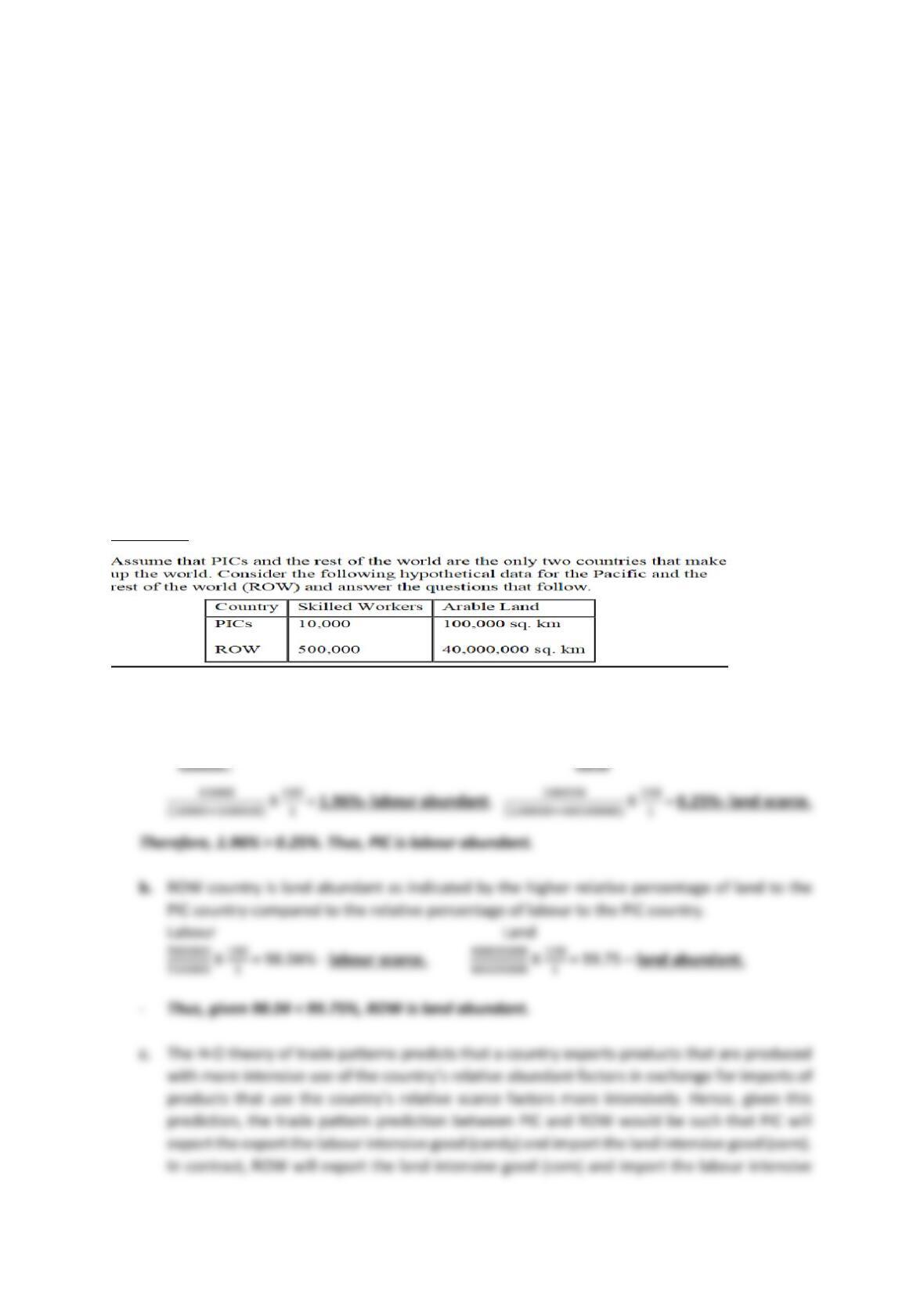
a. PIC country is labour abundant because their relative percentage of labour to the rest of the
world is higher than their relative percentage of land to the rest of the world.
PIC