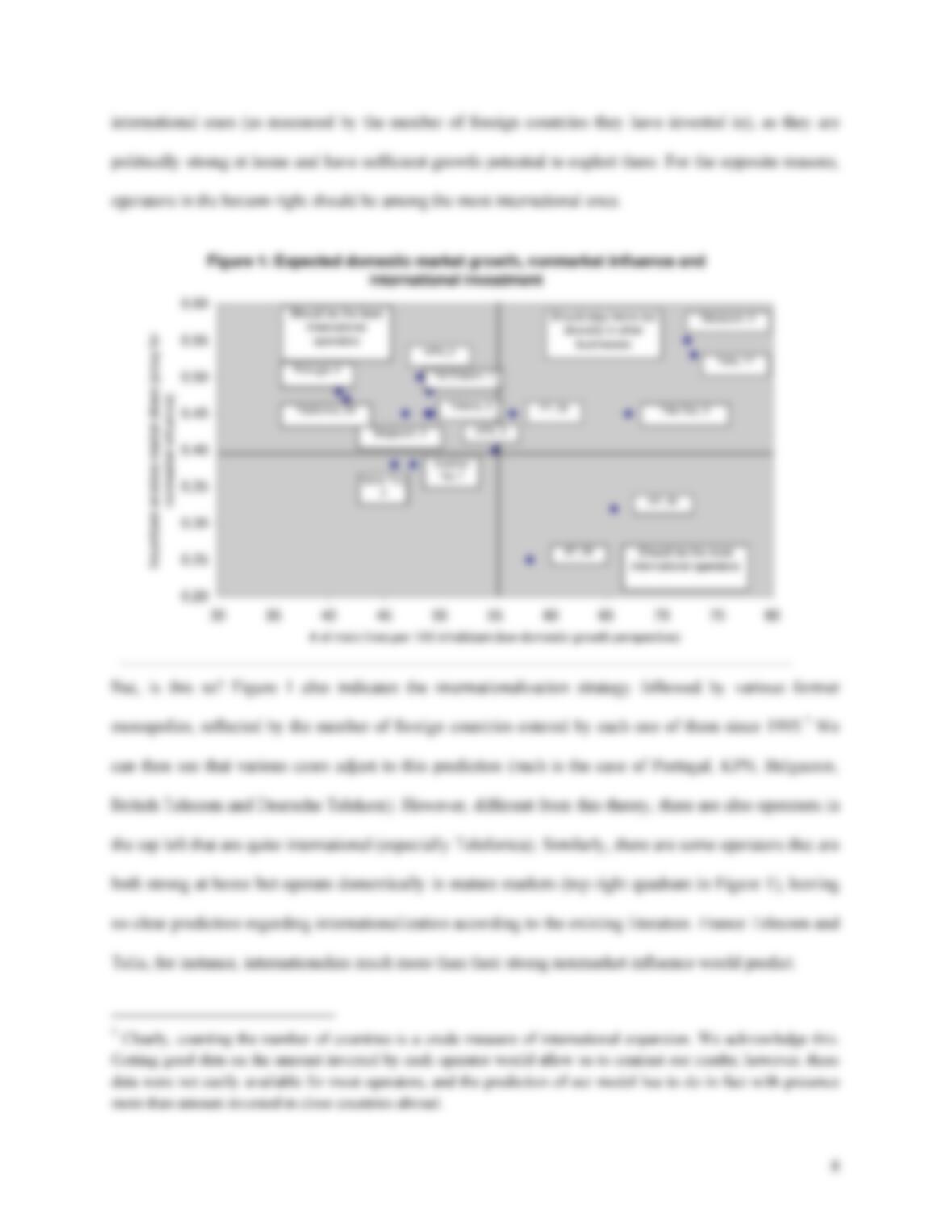
1
INTERNATIONAL EXPANSION, DIVERSIFICATION AND
REGULATED FIRMS’ NONMARKET STRATEGY
Santiago Urbiztondo
Fundación de Investigaciones Económicas Latinoamericanas (FIEL),
Buenos Aires, Argentina
Tel: 5411 4314 1990, Email: santiago@fiel.org.ar
Jean-Philippe Bonardi
University of Lausanne – Faculty of Business and Economics
Lausanne, Dorigny, Internef – 1015 – Switzerland
Tel: 0041.21 692 3440, Email: Jean-Philippe.Bonardi@unil.ch
and
Bertrand Quélin
HEC School of Management
1, rue de la Liberation
78351 Jouy en Josas Cedex, France
Tel. : +33 1 39 67 72 70, Fax: +33 1 39 67 70 84, Email: quelin@hec.fr
First version: March 2008
This version: February 2009
Abstract
Previous studies have shown that regulated firms tend to diversify for different reasons than unregulated
ones. This is the case for product but also for geographical diversification, i.e. international expansion.
The logic generally advanced is that regulated firms tend to diversify when they face costly and difficult
relationships with the regulatory authority in charge of their sector. This approach, however, does not
explain (1) what is really at the core of the problem in regulated firms’ relationships with regulators, (2)
why these firms cannot overcome part of the problem by developing nonmarket strategies –lobbying,
campaign contributions, etc.– to influence regulatory decisions, and (3) why they sometimes opt for
international expansion rather than product diversification. In this paper, we propose a theoretical model
that provides potential answers to these questions. We start by considering the firm-regulator
relationship as an incomplete information problem, in which the firms know things that the regulator
does not, but can cannot convey hard information about these things. In this setting, we show that when
firms face tough nonmarket competition domestically, going abroad can create a mechanism that makes
information transmission credible and therefore strengthen their position in their home market.
International expansion, in consequence, can be a way to solve some of the problems that regulated firms
face at home in addition to a way for these firms to grow their business abroad.

2
1. Introduction
The question of the international diversification, i.e. the expansion in foreign countries, of regulated firms
is an understudied yet important question in the economics and management literature (Calzolari, 2004;
Garcia-Canal and Guillen, 2008; Kashlak and Joshi, 1994). In many cases, international ventures
implemented by regulated firms have left observers puzzled, the logic underlying these strategic moves
being seemingly quite different from what was observed in unregulated sectors (Sarkar et al. 1999). In the
1990s, for instance, many telecommunication operators launched into ambitious international expansions
which targeted neighbouring developed countries. The underlying logic for these foreign acquisitions left
observers puzzled.1 Clearly, the lack of growth in home markets and the need to find other sources of
growth outside were factors that, at least partially, motivated these moves. Also, there could be different
motives to become a multinational (M), including risk-diversification and increased profitability by
exploiting specific industrial knowledge in fast-growing markets. However, why invest in developed and
mature markets and not only in faster growing markets? Why not concentrate on product diversification at
home, for which incumbent operators seem to have superior capabilities? What are the differential
benefits from being an entrant or a acquiring a former incumbent in the foreign countries where the
expansion takes place? More generally, are there other expected benefits specific to regulated firms
driving their international expansion, which have not been considered in the existing literature? The
purpose of this paper is to provide new answers to this last question.
To date, there is a large literature on the diversification of regulated firms.2 This literature tends to focus
on specific reasons, related to their regulated environment, why these firms diversify, and on
explanations for why these diversification moves often led to little apparent financial success (Gerpott &
1 See for instance www.lexinter.net/ACTUALITE/france_telecom.
2 This literature, however, focuses primarily on the regulatory implications of the topic (i.e., how these
diversifications should be regulated) and less on the strategic reasons why regulated firms might want to do so
(Calzolari, 2004; Palmer, 1991; Sappington, 2003). To our knowledge, this literature has not looked much at
international diversification either.

3
Jakopin, 2005; Thomson, 1999). Simply put, the argument in this literature goes like this:3 when regulated
firms are engaged in hostile and high-transaction cost relationships with their regulatory authority, and
since they do not have the opportunity to solve this transaction cost problem through vertical integration,
they tend to diversify out of their core business and in unregulated activities. Russo (1992) finds support
for this argument for U.S. electric utilities. Kashlak and Joshi (1994) make a similar type of argument but
point out that, instead of going into unregulated activities, regulated firms might also invest in
international diversification if the firm’s home market displays slow growth. They also find some
empirical support for it by looking at U.S. telecommunications operators.
From a theoretical point of view, however, this literature presents at least three limitations related to (1)
what makes firm-regulator relationships hostile, (2) the lobbying strategies that the firm could potentially
use to alleviate these hostile relationships, and (3) the lack of distinction between international and
product diversification. Below we discuss these three aspects.
Limitation 1: Firm-regulator hostile relationship.
Several studies have reported the often hostile nature of the regulated firms-regulators relationships. In
public utilities and network industries, in effect, there are plenty of sources of potential disagreements
between regulated firms and regulators. Among these, one can find (1) the proper valuation of capital
stock and asset values, essential for setting appropriate tariffs and/or rates of return, (2) the allocation of
licences to operate and the changing of the rules regarding these licences, or (3) the extent to which new
entrants should be protected to promote competition (Parker, 2003). However, in the literature on
regulated firms’ diversification strategies, the real nature of the potentially hostile firm-regulator
3 Here, we leave aside ‘non-strategic’ types of explanations for regulated firms’ diversification, such as for instance
the free cash-flow hypothesis (Jensen, 1986). According to this hypothesis, managers of firms with weak internal
and external governance environments and limited opportunities for profitable growth in their core businesses will
divert resources into diversifying strategies, even where the latter involve investments with negative net present
values. This type of argument might explain some of the variance in regulated firms’ diversification performance,
but we concentrate here on aspects related to firms’ external environment rather than internal and governance
aspects.

4
relationships is never clearly expressed. In most empirical studies, the nature of the relationships (from
collaborative to hostile) is measured using variables about the ‘Regulatory Climate’ collected by analysts
(see for instance Geiger and Hoffman, 1998, or Russo, 1992). These measures are instructive, but they are
of little help to build a theory of why these relationships impact corporate diversification.
In what follows, we will propose that the core part of these sometimes hostile relationships is the
imperfect information faced by the regulator (and the higher political institutions delegating the task)
when the latter has to make regulatory decisions. As has been highlighted by much literature in Industrial
Organization, the regulated firms have private information that would be relevant for the regulator and her
political principals; at the same time, it is also obvious that the firm, the regulator and the delegating
politicians often have misaligned interests (Laffont and Tirole, 1993). As a result, when the firms try to
convey soft, i.e. non-verifiable, information to the policy-makers, they face a credibility problem.4 This
makes the firm-regulator and regulator-politicians relationships difficult, and might thus impact on the
firm’s decision to diversify out of its core market.
Limitation 2: Regulated firms’ lobbying (or nonmarket strategies).
The second limitation of the existing literature on regulated firms’ diversification has to do with their
capacity to overcome the problems related to their relationships with regulators in other ways than by
diversifying. Even if these relationships can be hostile, there are alternative strategies that firms can
develop, such as lobbying or, more generally, nonmarket strategies. Following Baron (2001), we call
nonmarket strategies all the activities developed by firms to influence policy-makers. Many activities
belong to nonmarket strategies such as informational lobbying, interest group formation, campaign
contributions, constituency building, media campaigns, etc. (Hillman, Keim and Schuler, 2004). Baron
(1995) shows examples of how these nonmarket strategies can be effectively integrated with market
4 There is a literature on how ‘soft’ information can be conveyed to policy-makers (see Grossman and Helpman
(2001) for a survey). However, it is often difficult for firms to convey this information credibly to a regulator
because the firm’s payoffs mainly depend on the policy adopted, which is based on the information disclosed (Lyon
and Maxwell, 2004).
5
strategies (such as price strategies, differentiation, technology development, diversification, etc.), both in
the context of domestic or international strategies (Baron, 1997).
Hence, there are good reasons to believe that regulated firms –at least the incumbents– will be efficient at
developing these nonmarket strategies since (1) they are large entities and often have deep pockets (de
Figueiredo and Edwards, 2007), (2) they can build on organized constituencies, especially employees, and
(3) they generally have superior lobbying skills and capabilities developed through decades of
interactions with policy-makers (Bonardi, 2004). In a study of U.S. electric utilities, Bonardi, Holburn
and Vanden Bergh (2006) confirm that these regulated firms develop nonmarket strategies and are often
successful when they do so.
So, what role do these nonmarket strategies play in the firm-regulator relationship, and how do they
impact diversification strategies? When are they effective, and when are they not?
Limitation 3: Product versus international diversification
Last, while the existing literature on regulated firms’ nonmarket strategies might explain diversification, it
cannot disentangle product and geographic diversifications. Both can indeed be strategic options for firms
wishing to free themselves from hostile regulatory supervision. Does it mean that they are perfect
substitutes for regulated firms? Or is there something that is achieved only through geographic
diversification?
The point that has not been taken into account so far in the literature is that diversification in unregulated
sectors, regulated sectors or international markets, have very different implications regarding firm-
regulator relationships. Whereas investing in product diversification does little to change these
relationships, international expansion affects them by helping the regulator to get (or forcing her to take
into account) comparable information about what the firms are doing in other (also regulated) markets.
While product diversification allows to partially escape from regulatory intervention (or its incidence over

6
global profits), international diversification separates but does not reduce overall regulatory exposure.
This will be a key aspect of our approach in this paper.
Objectives of the paper
In this paper, we provide a theoretical model that makes an explicit assumption regarding Limitation 1,
and provides new answers to Limitations 2 and 3. As mentioned, the modelling assumption regarding
firms-regulator relations revolves around the concept of imperfect governance of, and incomplete
information faced by, the regulatory authority, a traditional set-up in regulatory economics: the regulated
firm has information that the regulator doesn’t have (for instance regarding its internal costs), which
makes the task of regulating a sector a difficult one; at the same time, since the regulator can make
decisions with a large discretion regarding the facts that underlie her judgements (and therefore can
deviate from the mandate formally governing her actions), (delegating) political administrations and the
regulated service more generally suffer from potentially inefficient and arbitrary decisions.
When one concentrates on the regulated firm’s strategy, however, a key aspect is that the firm also lacks
credibility: in many cases, it communicates soft –and virtually impossible to verify– information, which
the regulatory authority will hardly believe nor will be forced to take into account. As suggested by Lyon
and Maxwell (2004), this creates a difficult situation for the firm as well, especially if this firm is
competing with other firms or interest groups also providing information to the regulator. In this context,
we argue that international diversification can be a strategic way for regulated firms to solve this problem,
limiting the discretion enjoyed by the regulator in its favour.5 We also show that this has implications for
the destinations where regulated firms invest: for the firm to use international expansion as a way to build
a benchmark to make information credible, there needs to be some institutional proximity between the
home and target countries. Firms that try to build this mechanism will therefore invest more in close
5 See de Figueiredo, Spiller and Urbiztondo (1999) for an analysis of competition among interest groups, in which
groups send biased reports to the regulator limiting the discretion and informational advantages of regulators vis-à-
vis political officials.
countries. On the other hand, firms that do not need to build this benchmark (because they already have a
strong nonmarket influence over their home regulator) will tend to invest more in far (different) countries.
The rest of the paper is organized as follows. Section 2 provides empirical motivation for our theoretical
model by looking at the international strategies of one type of regulated firms: European
telecommunication operators. Some anomalies with the existing literature are identified. Section 3 puts
the foundation of a model that could account for some of these anomalies. The formal model itself is
analyzed in Section 4. Section 5 discusses the results and concludes.
2. Empirical motivation
In order to motivate our theoretical investigation, we first start with some empirical observations based on
data about European telecommunication operators. Since our focus here is on regulated firms’ strategies,
we focus our analysis on former national monopolies, i.e. the firms that have been traditionally heavily
regulated. Arguably, most of these firms have kept strong relationships with national regulatory
authorities, allowing them to develop nonmarket strategies (Bonardi, 2004). However, new entrants and