ch1
Student: ___________________________________________________________________________
1. The primary function of financial accounting is to provide relevant financial information to parties external
to business enterprises.
True False
2. Accrual accounting attempts to measure revenues and expenses that occurred during accounting periods so
they equal net operating cash flow.
True False
3. The FASB is currently the public sector organization responsible for setting accounting standards in the
U.S.
True False
4. The Public Reform and Investor Protection Act of 2002 (Sarbanes-Oxley) changed the entity responsible for
setting auditing standards in the United States.
True False
5. A rules-based approach to standard setting stresses professional judgment as opposed to following a list of
rules.
True False
6. Under federal securities laws, the SEC has the authority to set accounting standards in the U.S.
True False
7. The primary responsibility for properly applying GAAP when communicating with investors and creditors
through financial statements lies with a firm’s auditors.
True False
8. Auditors play an important role in the resource allocation process by adding credibility to financial
statements.
True False
9. Materiality can be affected by the dollar amount of an item, the nature of the item, or both.
True False
10. Conservatism is a desired qualitative characteristic of accounting information.
True False

11. Equity is a residual amount representing the owner’s interest in the assets of the business.
True False
12. Revenues are inflows or other enhancements of assets or settlements of liabilities from activities that
constitute the entity’s ongoing operations.
True False
13. Gains or losses result, respectively, from the disposition of business assets for greater than, or less than,
their book values.
True False
14. Comprehensive income is another term for net income.
True False
15. Determining fair value by calculating the present value of future cash flows is a level 1 type of input.
True False
16. The FASB’s framework for measuring fair value doesn’t change the situations in which fair value is used
under current GAAP.
True False
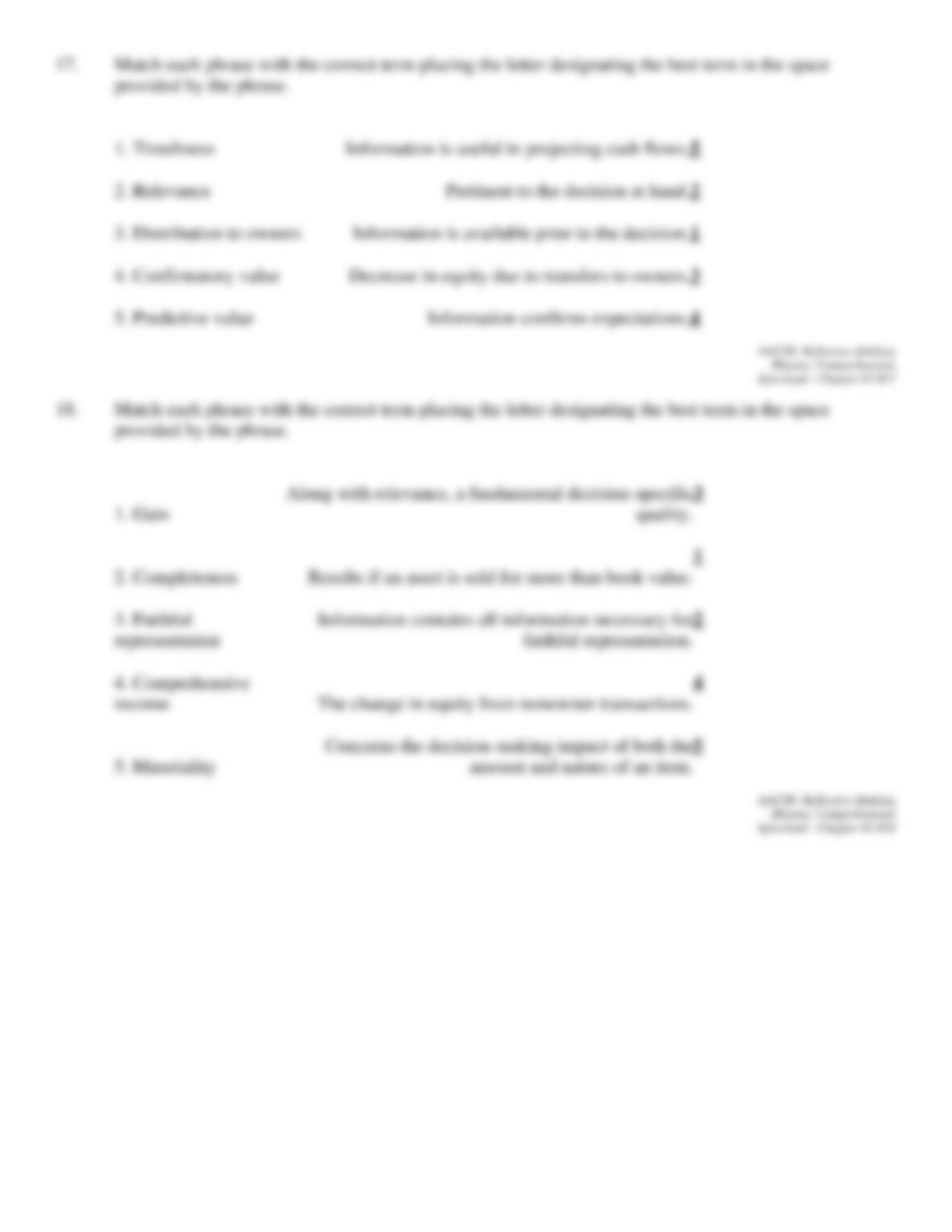
17. Match each phrase with the correct term placing the letter designating the best term in the space provided
by the phrase.
1. Timeliness Information is useful in projecting cash
flows. ____
2. Relevance Pertinent to the decision at hand. ____
3. Distribution to owners Information is available prior to the decision. ____
4. Confirmatory value Decrease in equity due to transfers to
owners. ____
5. Predictive value Information confirms expectations. ____

18. Match each phrase with the correct term placing the letter designating the best term in the space provided
by the phrase.
1. Gain Along with relevance, a fundamental decision-specific
quality.
__
__
2. Completeness Results if an asset is sold for more than book value.
__
__
3. Faithful
representation Information contains all information necessary for
faithful representation.
__
__
4. Comprehensive
income The change in equity from nonowner transactions.
__
__
5. Materiality Concerns the decision-making impact of both the
amount and nature of an item.
__
__
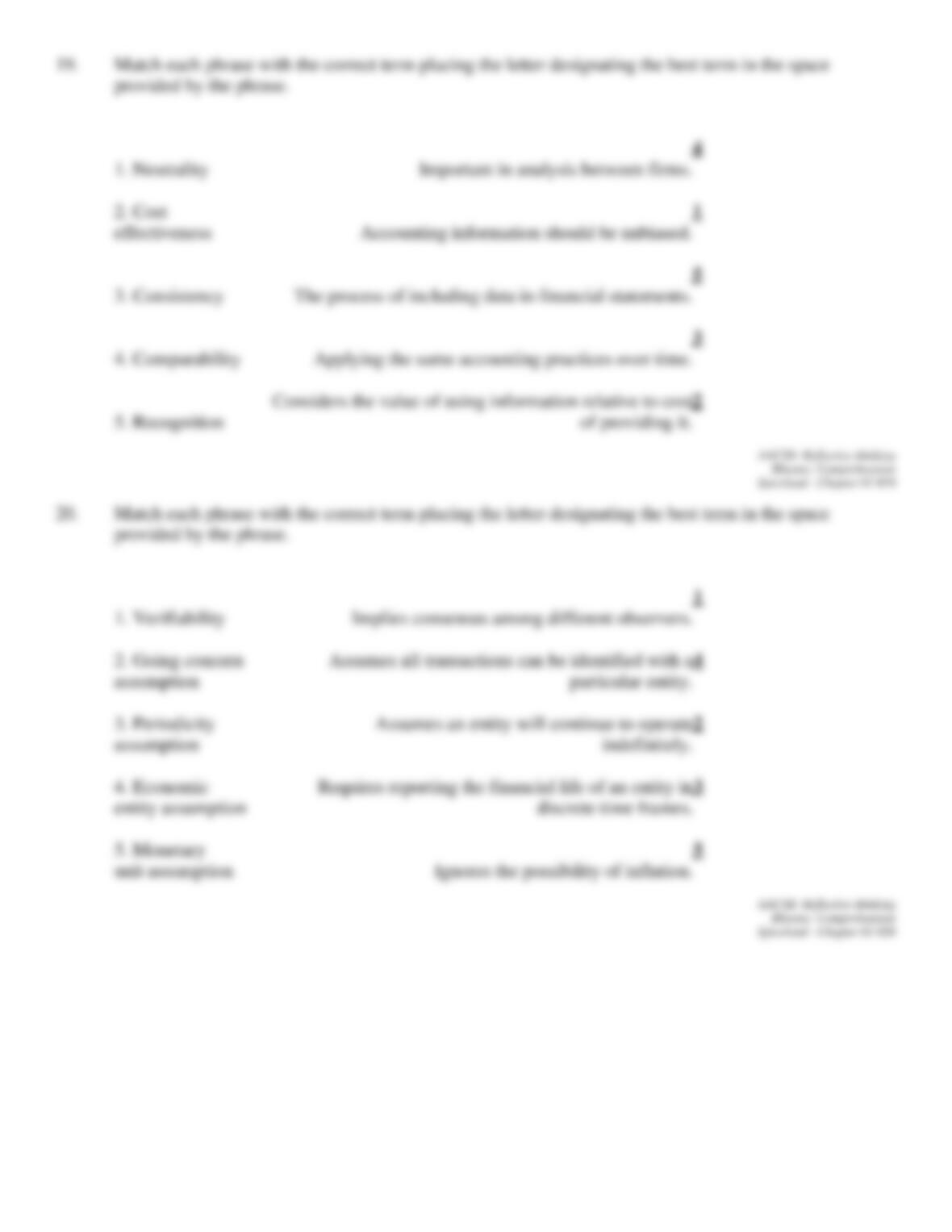
19. Match each phrase with the correct term placing the letter designating the best term in the space provided
by the phrase.
1. Neutrality Important in analysis between firms.
__
__
2. Cost
effectiveness Accounting information should be unbiased.
__
__
3. Consistency The process of including data in financial statements.
__
__
4. Comparability Applying the same accounting practices over time.
__
__
5. Recognition Considers the value of using information relative to
cost of providing it.
__
__

20. Match each phrase with the correct term placing the letter designating the best term in the space provided
by the phrase.
1. Verifiability Implies consensus among different observers.
__
__
2. Going concern
assumption Assumes all transactions can be identified with a
particular entity.
__
__
3. Periodicity
assumption Assumes an entity will continue to operate
indefinitely.
__
__
4. Economic
entity assumption Requires reporting the financial life of an entity in
discrete time frames.
__
__
5. Monetary
unit assumption Ignores the possibility of inflation.
__
__
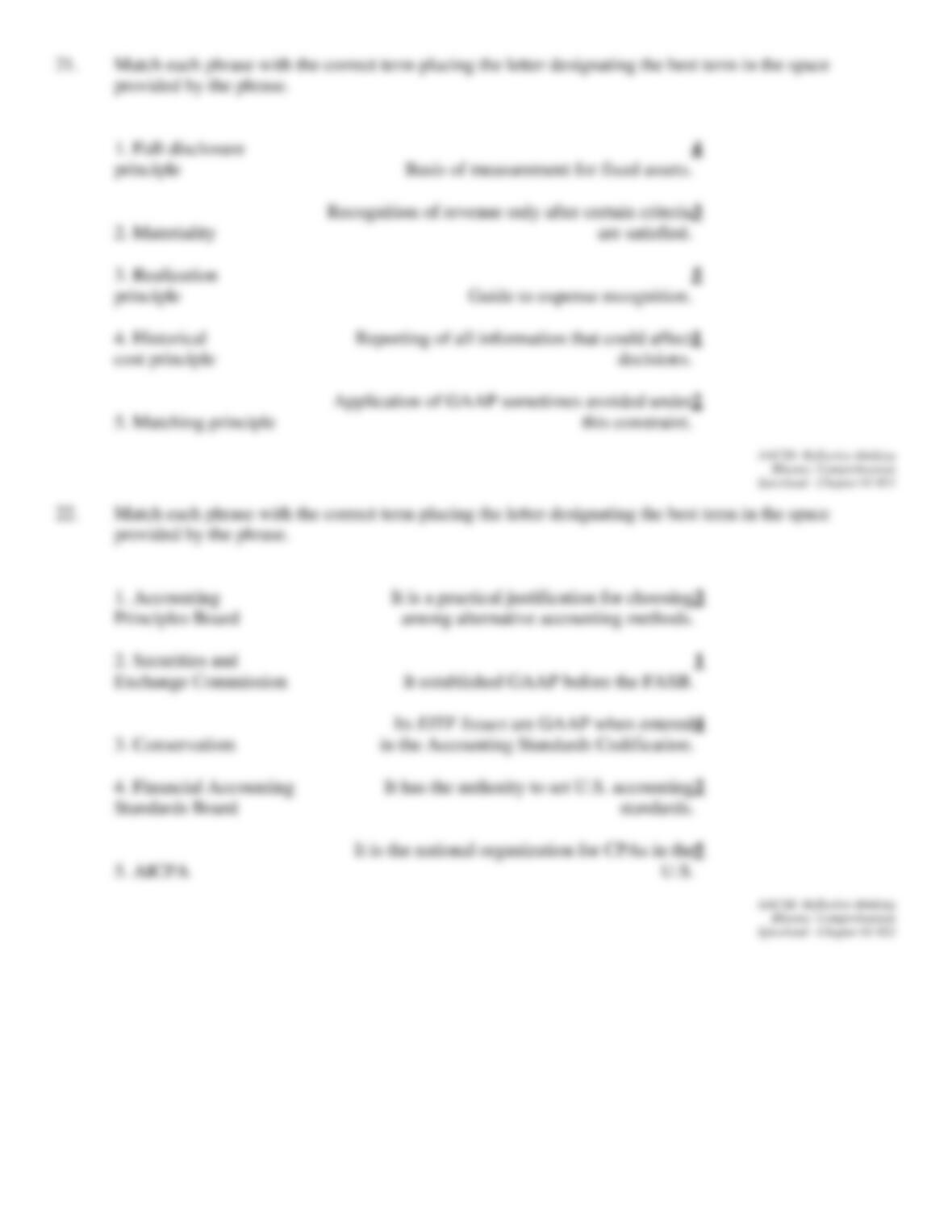
21. Match each phrase with the correct term placing the letter designating the best term in the space provided
by the phrase.
1. Full-disclosure
principle Basis of measurement for fixed assets.
__
__
2. Materiality Recognition of revenue only after certain criteria
are satisfied.
__
__
3. Realization
principle Guide to expense recognition.
__
__
4. Historical
cost principle Reporting of all information that could affect
decisions.
__
__
5. Matching principle Application of GAAP sometimes avoided under
this constraint.
__
__

22. Match each phrase with the correct term placing the letter designating the best term in the space provided
by the phrase.
1. Accounting
Principles Board It is a practical justification for choosing
among alternative accounting methods.
__
__
2. Securities and
Exchange Commission It established GAAP before the FASB.
__
__
3. Conservatism Its EITF Issues are GAAP when entered
in the Accounting Standards Codification.
__
__
4. Financial Accounting
Standards Board It has the authority to set U.S. accounting
standards.
__
__
5. AICPA It is the national organization for CPAs in the
U.S.
__
__
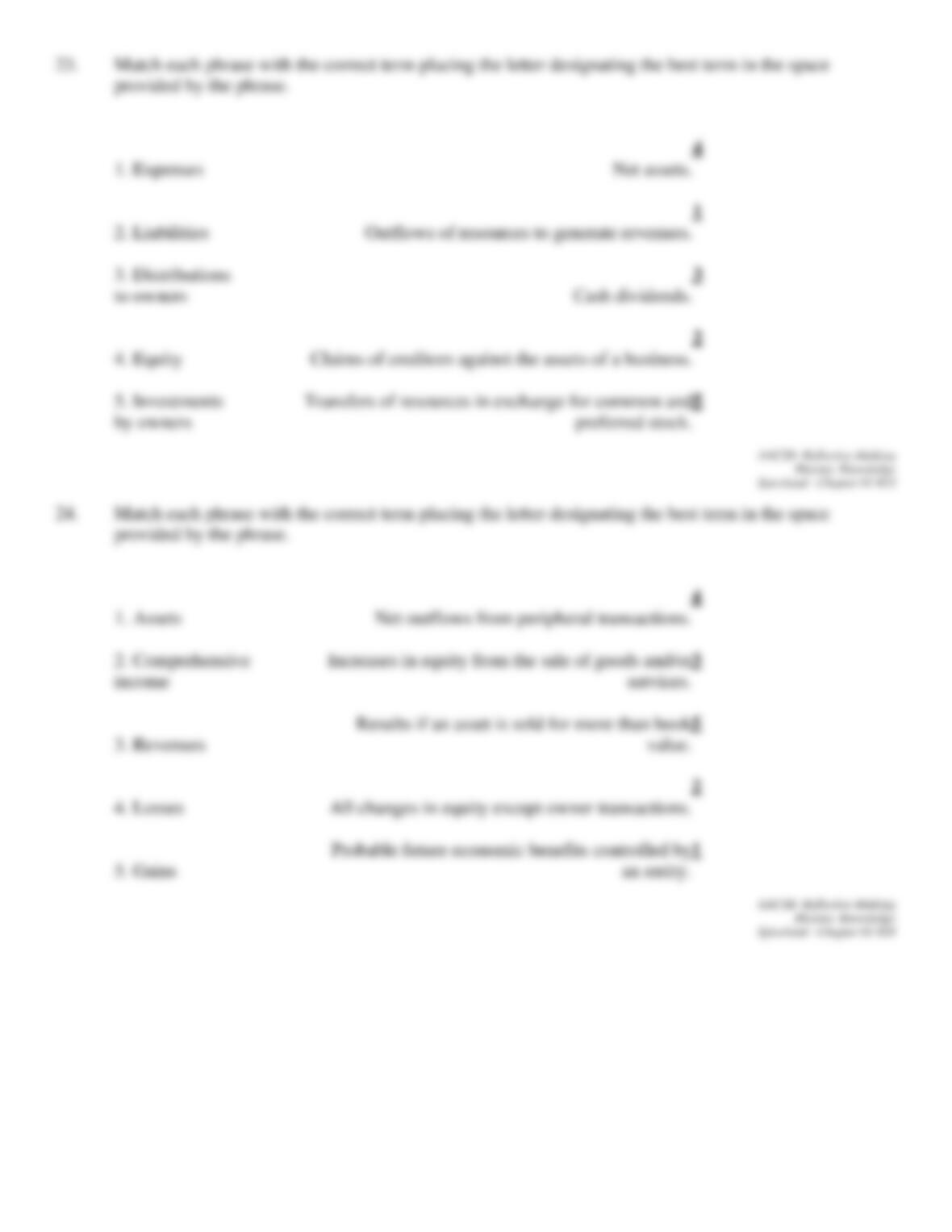
23. Match each phrase with the correct term placing the letter designating the best term in the space provided
by the phrase.
1. Expenses Net assets.
__
__
2. Liabilities Outflows of resources to generate revenues.
__
__
3. Distributions
to owners Cash dividends.
__
__
4. Equity Claims of creditors against the assets of a business.
__
__
5. Investments
by owners Transfers of resources in exchange for common and
preferred stock.
__
__

24. Match each phrase with the correct term placing the letter designating the best term in the space provided
by the phrase.
1. Assets Net outflows from peripheral transactions.
__
__
2. Comprehensive
income Increases in equity from the sale of goods and/or
services.
__
__
3. Revenues Results if an asset is sold for more than book
value.
__
__
4. Losses All changes in equity except owner transactions.
__
__
5. Gains Probable future economic benefits controlled by
an entity.
__
__
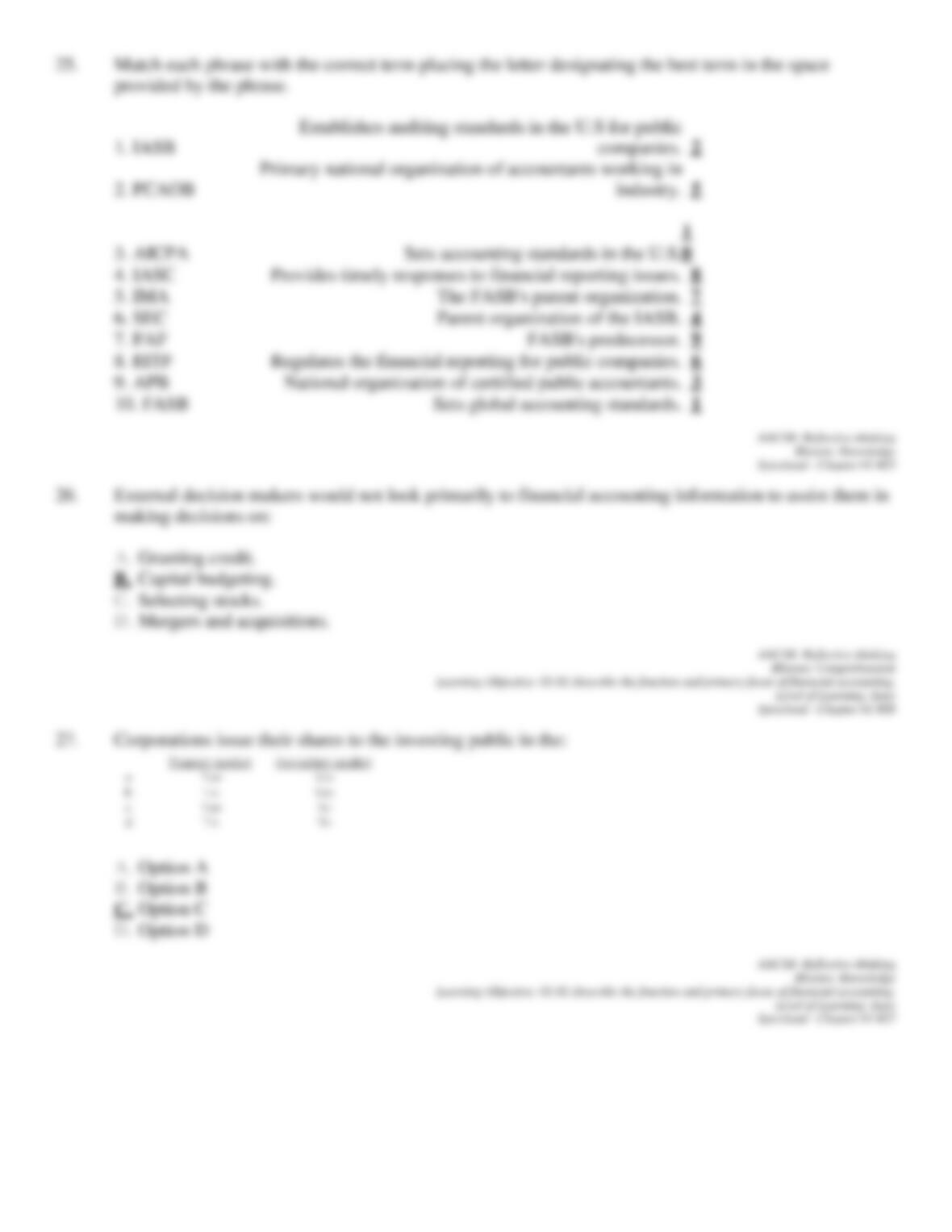
25. Match each phrase with the correct term placing the letter designating the best term in the space provided
by the phrase.
1. IASB Establishes auditing standards in the U.S for public
companies.
____
2. PCAOB Primary national organization of accountants working in
industry.
____
3. AICPA Sets accounting standards in the U.S.
____
4. IASC Provides timely responses to financial reporting issues.
____
5. IMA The FASB’s parent organization.
____
6. SEC Parent organization of the IASB.
____
7. FAF FASB’s predecessor.
____
8. EITF Regulates the financial reporting for public companies.
____
9. APB National organization of certified public accountants.
____
10. FASB Sets global accounting standards.
____
26. External decision makers would not look primarily to financial accounting information to assist them in
making decisions on:
A. Granting credit.
B. Capital budgeting.
C. Selecting stocks.
D. Mergers and acquisitions.

27. Corporations issue their shares to the investing public in the:
A. Option A
B. Option B
C. Option C
D. Option D
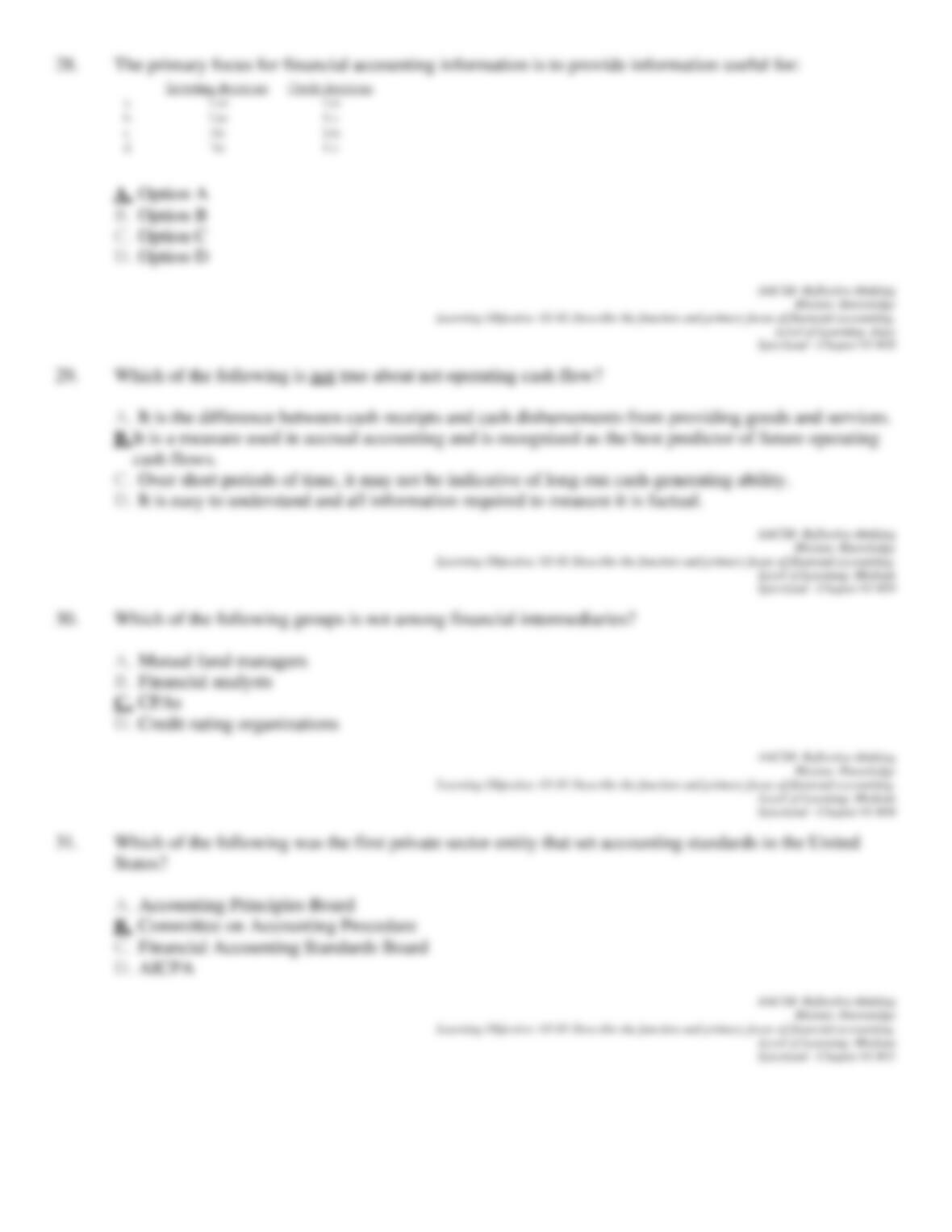
28. The primary focus for financial accounting information is to provide information useful for:
A. Option A
B. Option B
C. Option C
D. Option D
29. Which of the following is not true about net operating cash flow?
A. It is the difference between cash receipts and cash disbursements from providing goods and services.
B. It is a measure used in accrual accounting and is recognized as the best predictor of future operating cash
flows.
C. Over short periods of time, it may not be indicative of long-run cash-generating ability.
D. It is easy to understand and all information required to measure it is factual.
30. Which of the following groups is not among financial intermediaries?
A. Mutual fund managers
B. Financial analysts
C. CPAs
D. Credit rating organizations
31. Which of the following was the first private sector entity that set accounting standards in the United States?
A. Accounting Principles Board
B. Committee on Accounting Procedure
C. Financial Accounting Standards Board
D. AICPA
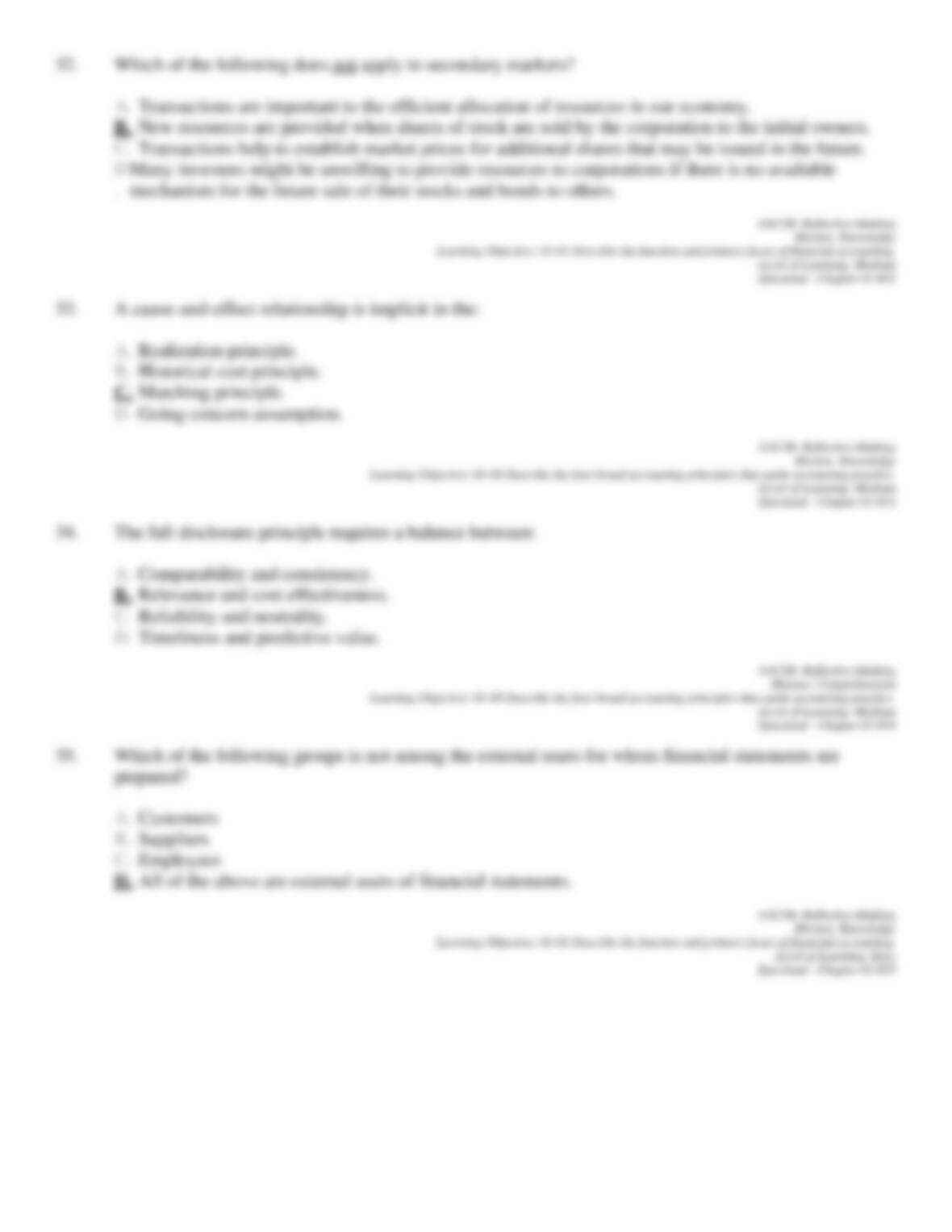
32. Which of the following does not apply to secondary markets?
A. Transactions are important to the efficient allocation of resources in our economy.
B. New resources are provided when shares of stock are sold by the corporation to the initial owners.
C. Transactions help to establish market prices for additional shares that may be issued in the future.
D
. Many investors might be unwilling to provide resources to corporations if there is no available
mechanism for the future sale of their stocks and bonds to others.

33. A cause-and-effect relationship is implicit in the:
A. Realization principle.
B. Historical cost principle.
C. Matching principle.
D. Going concern assumption.
34. The full disclosure principle requires a balance between:
A. Comparability and consistency.
B. Relevance and cost effectiveness.
C. Reliability and neutrality.
D. Timeliness and predictive value.
35. Which of the following groups is not among the external users for whom financial statements are prepared?
A. Customers
B. Suppliers
C. Employees
D. All of the above are external users of financial statements.
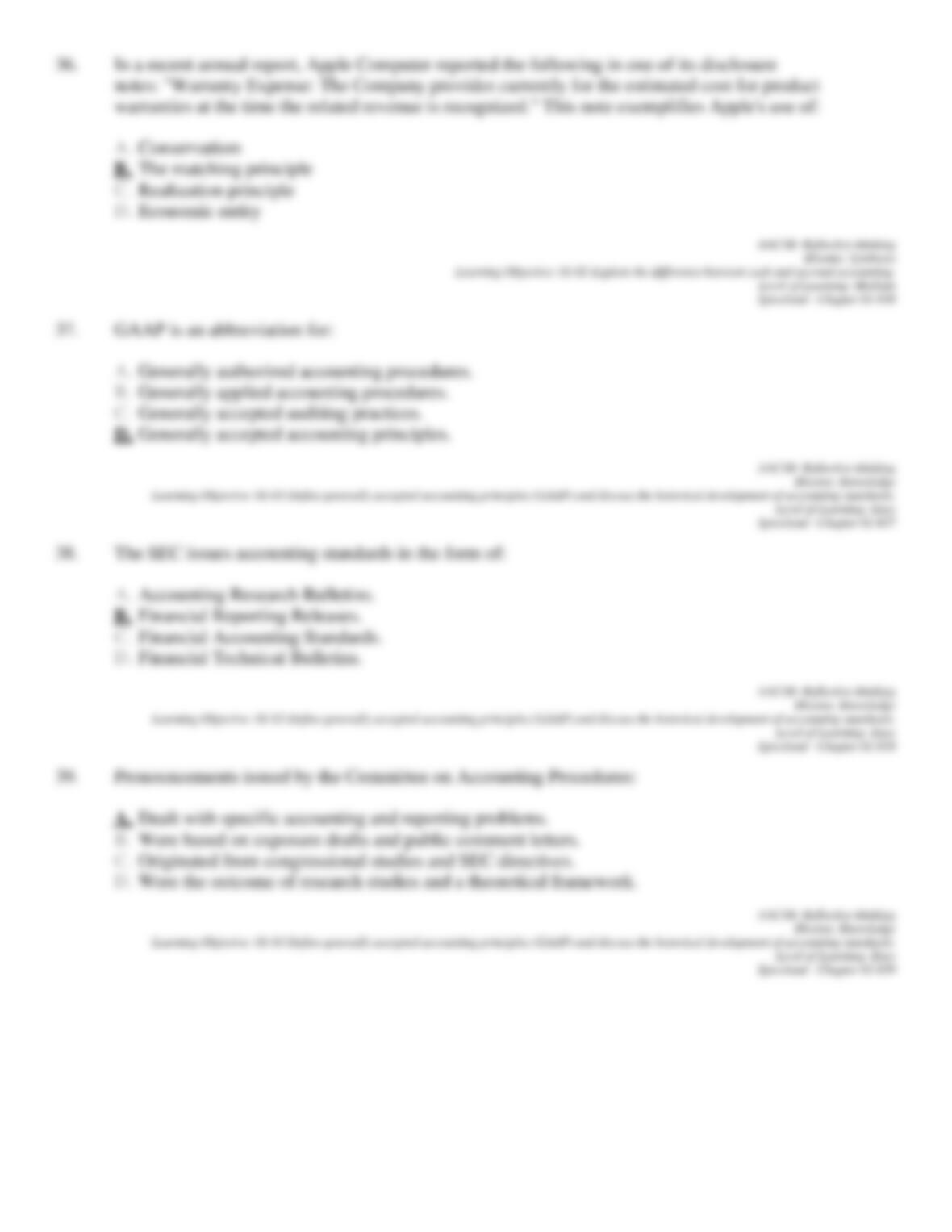
36. In a recent annual report, Apple Computer reported the following in one of its disclosure notes: “Warranty
Expense: The Company provides currently for the estimated cost for product warranties at the time the
related revenue is recognized.” This note exemplifies Apple’s use of:
A. Conservatism
B. The matching principle
C. Realization principle
D. Economic entity
37. GAAP is an abbreviation for:
A. Generally authorized accounting procedures.
B. Generally applied accounting procedures.
C. Generally accepted auditing practices.
D. Generally accepted accounting principles.
38. The SEC issues accounting standards in the form of:
A. Accounting Research Bulletins.
B. Financial Reporting Releases.
C. Financial Accounting Standards.
D. Financial Technical Bulletins.
39. Pronouncements issued by the Committee on Accounting Procedures:
A. Dealt with specific accounting and reporting problems.
B. Were based on exposure drafts and public comment letters.
C. Originated from congressional studies and SEC directives.
D. Were the outcome of research studies and a theoretical framework.

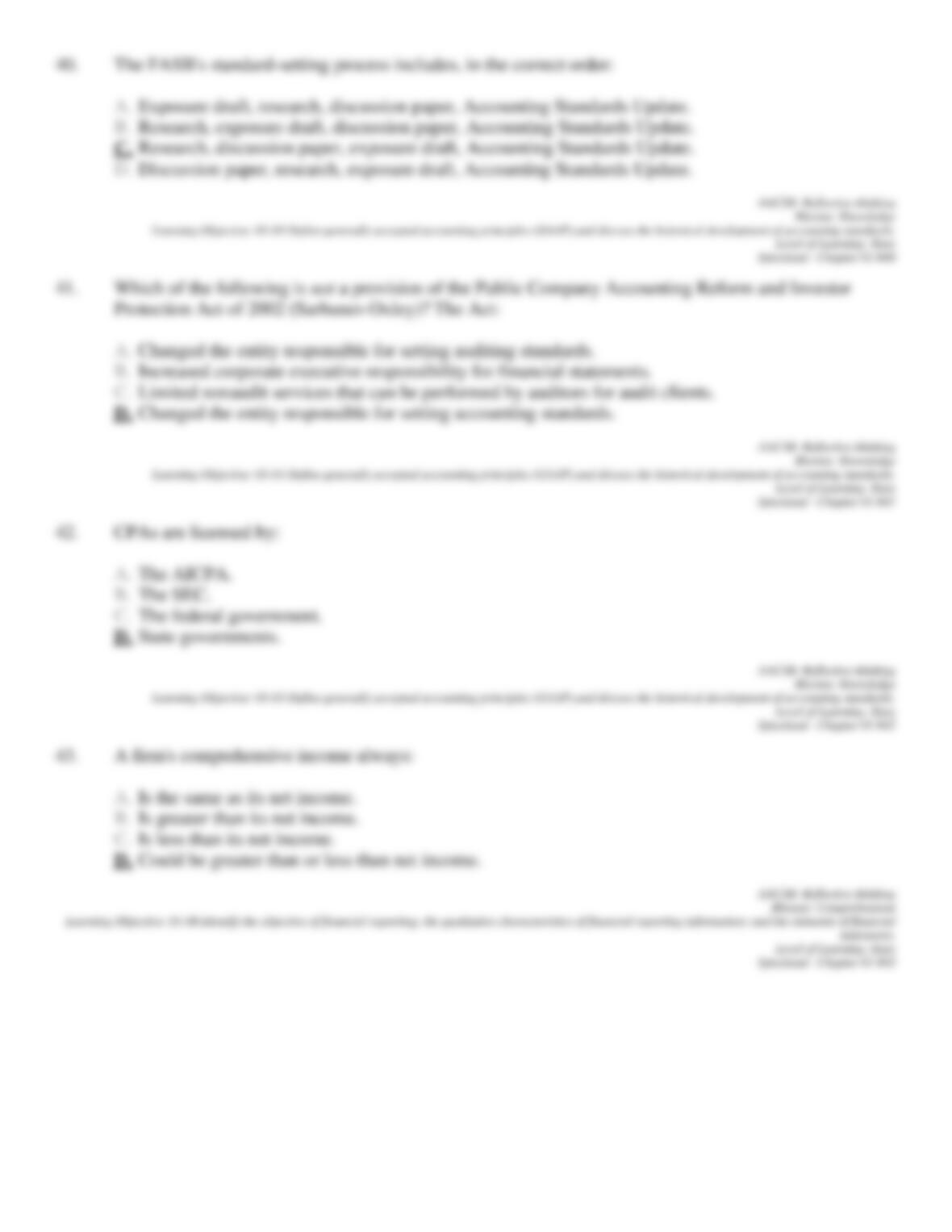
40. The FASB’s standard-setting process includes, in the correct order:
A. Exposure draft, research, discussion paper, Accounting Standards Update.
B. Research, exposure draft, discussion paper, Accounting Standards Update.
C. Research, discussion paper, exposure draft, Accounting Standards Update.
D. Discussion paper, research, exposure draft, Accounting Standards Update.
41. Which of the following is not a provision of the Public Company Accounting Reform and Investor
Protection Act of 2002 (Sarbanes-Oxley)? The Act:
A. Changed the entity responsible for setting auditing standards.
B. Increased corporate executive responsibility for financial statements.
C. Limited nonaudit services that can be performed by auditors for audit clients.
D. Changed the entity responsible for setting accounting standards.
42. CPAs are licensed by:
A. The AICPA.
B. The SEC.
C. The federal government.
D. State governments.
43. A firm’s comprehensive income always:
A. Is the same as its net income.
B. Is greater than its net income.
C. Is less than its net income.
D. Could be greater than or less than net income.
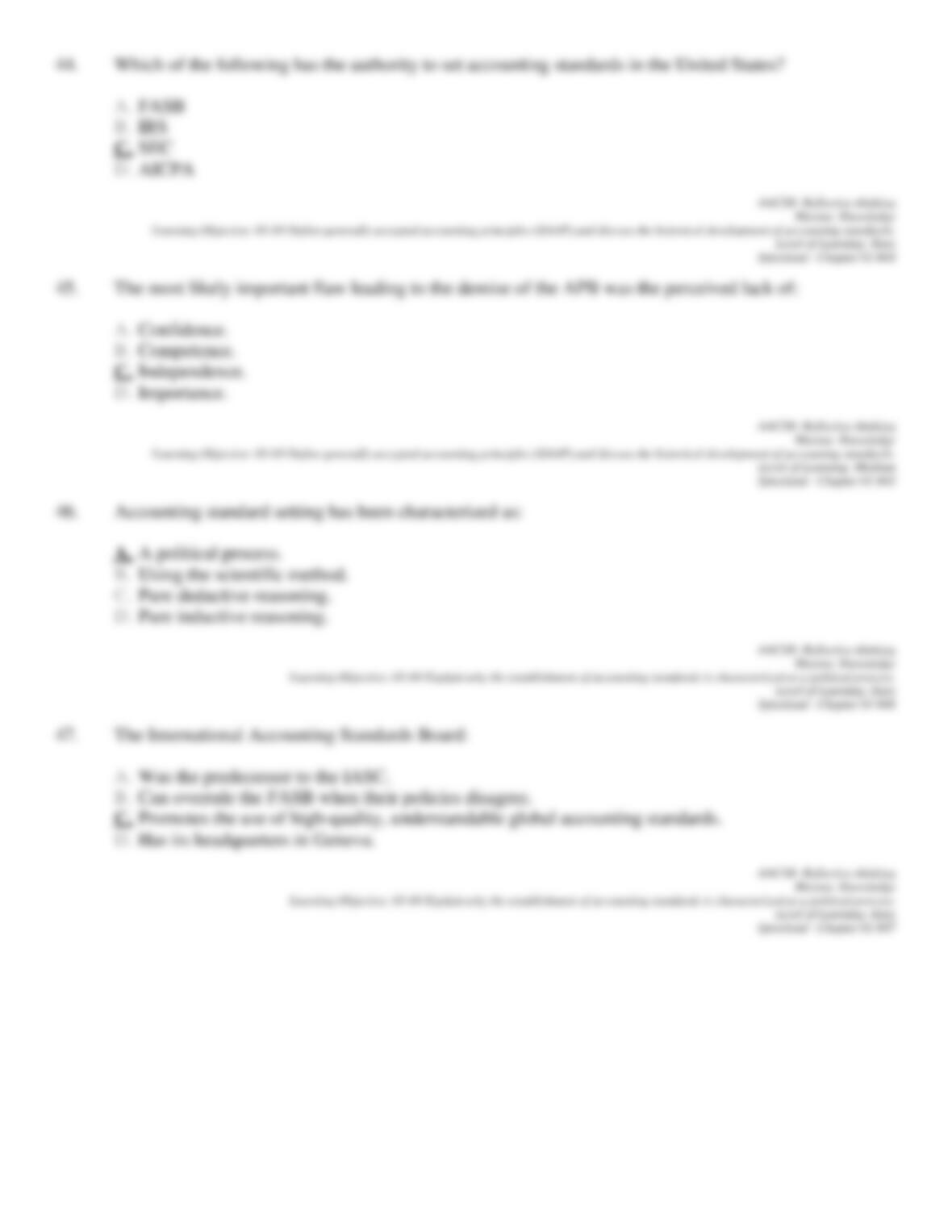
44. Which of the following has the authority to set accounting standards in the United States?
A. FASB
B. IRS
C. SEC
D. AICPA
45. The most likely important flaw leading to the demise of the APB was the perceived lack of:
A. Confidence.
B. Competence.
C. Independence.
D. Importance.
46. Accounting standard setting has been characterized as:
A. A political process.
B. Using the scientific method.
C. Pure deductive reasoning.
D. Pure inductive reasoning.

47. The International Accounting Standards Board:
A. Was the predecessor to the IASC.
B. Can overrule the FASB when their policies disagree.
C. Promotes the use of high-quality, understandable global accounting standards.
D. Has its headquarters in Geneva.
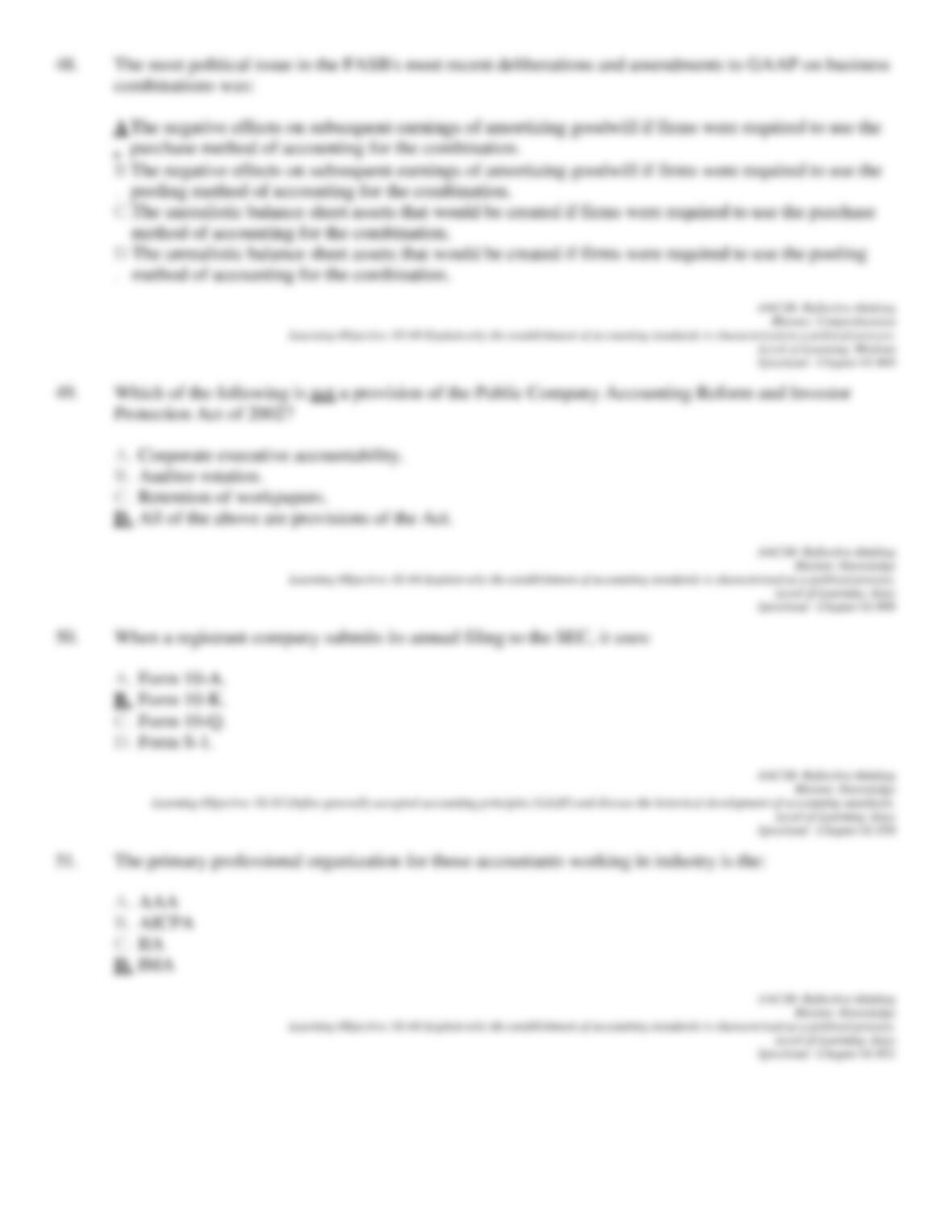
48. The most political issue in the FASB’s most recent deliberations and amendments to GAAP on business
combinations was:
A
. The negative effects on subsequent earnings of amortizing goodwill if firms were required to use the
purchase method of accounting for the combination.
B
. The negative effects on subsequent earnings of amortizing goodwill if firms were required to use the
pooling method of accounting for the combination.
C
. The unrealistic balance sheet assets that would be created if firms were required to use the purchase
method of accounting for the combination.
D
. The unrealistic balance sheet assets that would be created if firms were required to use the pooling
method of accounting for the combination.
49. Which of the following is not a provision of the Public Company Accounting Reform and Investor
Protection Act of 2002?
A. Corporate executive accountability.
B. Auditor rotation.
C. Retention of workpapers.
D. All of the above are provisions of the Act.
50. When a registrant company submits its annual filing to the SEC, it uses:
A. Form 10-A.
B. Form 10-K.
C. Form 10-Q.
D. Form S-1.
51. The primary professional organization for those accountants working in industry is the:
A. AAA
B. AICPA
C. IIA
D. IMA
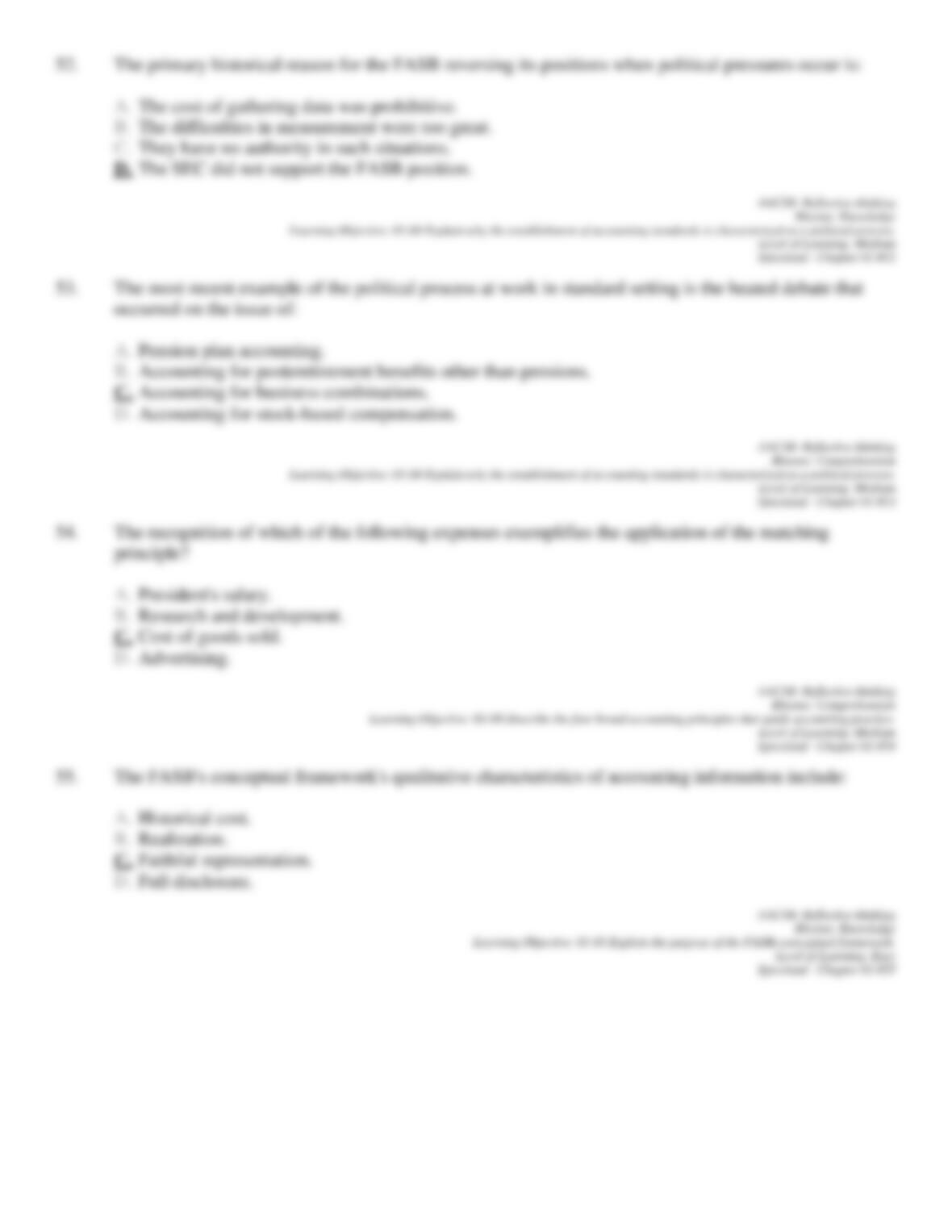
52. The primary historical reason for the FASB reversing its positions when political pressures occur is:
A. The cost of gathering data was prohibitive.
B. The difficulties in measurement were too great.
C. They have no authority in such situations.
D. The SEC did not support the FASB position.

53. The most recent example of the political process at work in standard setting is the heated debate that
occurred on the issue of:
A. Pension plan accounting.
B. Accounting for posteretirement benefits other than pensions.
C. Accounting for business combinations.
D. Accounting for stock-based compensation.
54. The recognition of which of the following expenses exemplifies the application of the matching principle?
A. President’s salary.
B. Research and development.
C. Cost of goods sold.
D. Advertising.
55. The FASB’s conceptual framework’s qualitative characteristics of accounting information include:
A. Historical cost.
B. Realization.
C. Faithful representation.
D. Full disclosure.
56. The FASB’s conceptual framework’s qualitative characteristics of accounting information include:
A. Full disclosure.
B. Relevance.
C. Going concern.
D. Historical cost.
57. The conceptual framework’s qualitative characteristic of relevance includes:
A. Predictive value.
B. Verifiability.
C. Completeness.
D. Neutrality.
58. The conceptual framework’s qualitative characteristic of faithful representation includes:
A. Predictive value.
B. Neutrality.
C. Confirmatory value.
D. Timeliness.
59. The conceptual framework’s recognition and measurement concepts recognize which of the following as an
assumption, rather than a principle?
A. Going concern.
B. Historical cost.
C. Full disclosure.
D. Realization.
60. The conceptual framework’s recognition and measurement concepts recognize which of the following as a
principle, rather than an assumption?
A. Periodicity.
B. Monetary unit.
C. Conservatism.
D. Full disclosure.
61. Phase A of the new conceptual framework focuses on:
A. Objective and qualitative characteristics.
B. Presentation and disclosure.
C. Recognition and measurement.
D. Elements of financial statements.
62. The primary objective of financial accounting information is to provide useful information to:
A. Management.
B. Capital providers.
C. Regulators.
D. None of the above.
63. SFAC No.5 focuses on:
A. Objectives of financial reporting.