ijcrb.webs.com
INTERDISCIPLINARY JOURNAL OF CONTEMPORARY RESEARCH IN BUSINESS
COPY RIGHT © 2013 Institute of Interdisciplinary Business Research
457
JULY 2013
VOL 5, NO 3
The Impact of Porter Model`s Five Competence Powers on Selecting
Business Strategy
“An Empirical Study on Jordanian Food Industrial Companies”
Dr. Saleh Jaradat
Management Department, Jadara University, Jordan
Dr. Salam Almomani
Accounting Department, Jadara University, Jordan
Dr. Mansour Bataineh
Finance Department, Jadara University, Jordan
Abstract
The purpose of this study is to Applying Porter Model for Five Competitive Forces on the Food
Industrial Companies in Jordan to Select Business Strategies. The variables of the study
consisted of the independent variable, applying Porter model for the five competitive forces and
the dependent variable, selecting business strategies (cost-leadership, differentiation and focus
strategy). The study employed the statistical analytical descriptive approach based on the
literature review and fieldwork to answer the research questions and discussing hypotheses. The
population of the study consisted of (69) industrial company located in Amman governorate,
Zarqa governorate and Mafraq governorate. The study adopted the population as the sample of
the study. The sample totaled (69) industrial companies totaling (281) managers.
The study used the questionnaire to collect data and measure the sample’s attitudes towards the
analysis of the effect of the five competitive forces of the industrial companies on selecting
business strategies and clarifying the importance of its existence in the industry environment.
The data analyzed by using SPSS, (F) test, (T) test as well as multiple regression analysis.
The findings indicated that the ranks of the competitive forces were as follows (the severity of
rivalry between current industrial companies, threat of substitutes, the bargaining power of
buyers, the bargaining power of suppliers and threat of new entry in industry) in a high degree
and in various degrees.
The findings showed that the importance of the sample’ attitudes towards the ability of cost–
leadership and differentiation strategies towards facing the threat of the five forces were high.
Meanwhile, it was weak for the focus strategy.
Furthermore, the findings indicated that there is a significant statistical effect for the applying of
the five competitive forces on industrial companies to select business strategies.
There is a significant statistical effect for the threat of new entry on industry and the bargaining
power of suppliers on selecting cost-leadership and differentiation strategies; meanwhile, there

ijcrb.webs.com
INTERDISCIPLINARY JOURNAL OF CONTEMPORARY RESEARCH IN BUSINESS
COPY RIGHT © 2013 Institute of Interdisciplinary Business Research
458
JULY 2013
VOL 5, NO 3
is no effect for the bargaining power of buyers and the threat of substitute’s products as well as
severity of rivalry between current industrial companies on cost-leadership and differentiation
strategies.
The findings showed a significant statistical difference for all competitive forces on selecting
focus strategy except for the severity of rivalry between current industrial companies. The
findings indicated that there are significant statistical differences between food industrial
companies when selecting business strategies due to the company capital and the number of
products.
Based on the findings of the study recommended the need of taking into consideration the
implementation of Porter model by food industrial companies to enable them to select the
suitable business strategies effectively. Additionally, directing the future studies to study the
factors analysis impact of external environment and internal environment for organization from
the top management perspective.
Keywords: Impact ; Porter Model`s Five Competence Powers ; Selecting Business Strategy ;
Empirical Study ; Jordanian Food Industrial Companies
1. Introduction
All businesses around the world are trying to improve their efficiency and maximize their
market share by optimizing the opportunities available in the market and handling the problems
and challenges. To reach these goals, the managements of businesses should realize that they live
within a dynamic external and internal environment which has a lot of variables that affect the
company and its market value. In this context, the managements are used to conduct a SWOT
model to analyze all internal and external factors affecting the company and influence their
survival and prosperity. This model analyzes the strengths, weaknesses, opportunities and threats
that are related directly and indirectly to the company. In the same manner, Porter (1979)
developed his model which called Porters Five Forces Model that is considered as a main
framework of strategic planning for the businesses. This model helps in evaluating the company`s
environment and understanding its competitive position that extends beyond the current rivalry
threat.
A successful strategic planning enables the company to improve their competitive advantage.
Strategy can be formulated on three levels, namely, corporate level, business unit level and
departmental level.

ijcrb.webs.com
INTERDISCIPLINARY JOURNAL OF CONTEMPORARY RESEARCH IN BUSINESS
COPY RIGHT © 2013 Institute of Interdisciplinary Business Research
459
JULY 2013
VOL 5, NO 3
Porter recognized the following three generic strategies: cost-leadership strategy, differentiation
strategy and focus strategy. These three strategies are supposed to be implemented at the
businesses to build a competitive advantage of the companies.
Porter 1979 explained how competitive forces shape strategy as he leaved a considerable impact
on the strategic framework. He opened the door for implementing this model on levels of
corporations, regions, nations and health care.
The management can use this model in dealing with competition as they used to deal with a too
narrow concept of competition by looking only to the current direct competitors. But now
competition extends beyond the current competitive firms to include customers, suppliers,
potential entrants and substitute products. So, the competition forces will include four additional
forces to be five forces in total, (Porter, 2008).
This paper tries to apply the Porters five forces model on the Jordanian food industry. The
Jordanian industries have an obvious impact on the domestic economy as they compose (52%)
percent of the Gross Domestic Product (GDP) in Jordan. Food industries considered as the main
component of the Jordanian industrial economy. In the year 2010, these industries participate in
twenty two percent of Gross Domestic Product in Jordan, (National Peru Report, 2010).
To satisfy the various customers’ needs, these companies should improve their innovation and
efficiency to respond to the changes in the customer’s needs and wants which insures
improvement, prosperity and continuity. The food industrial companies in Jordan face a lot of
problems and challenges came from internal and external environments which have been
discussed several times in the Jordanian industrial champers. Furthermore, there are several
competitive factors in the company’s external environment which have an important role in
determining the success and failure of the company and have an important impact on selecting
suitable business strategy.
Despite the important role of each environmental factor that affect the business strategy, this
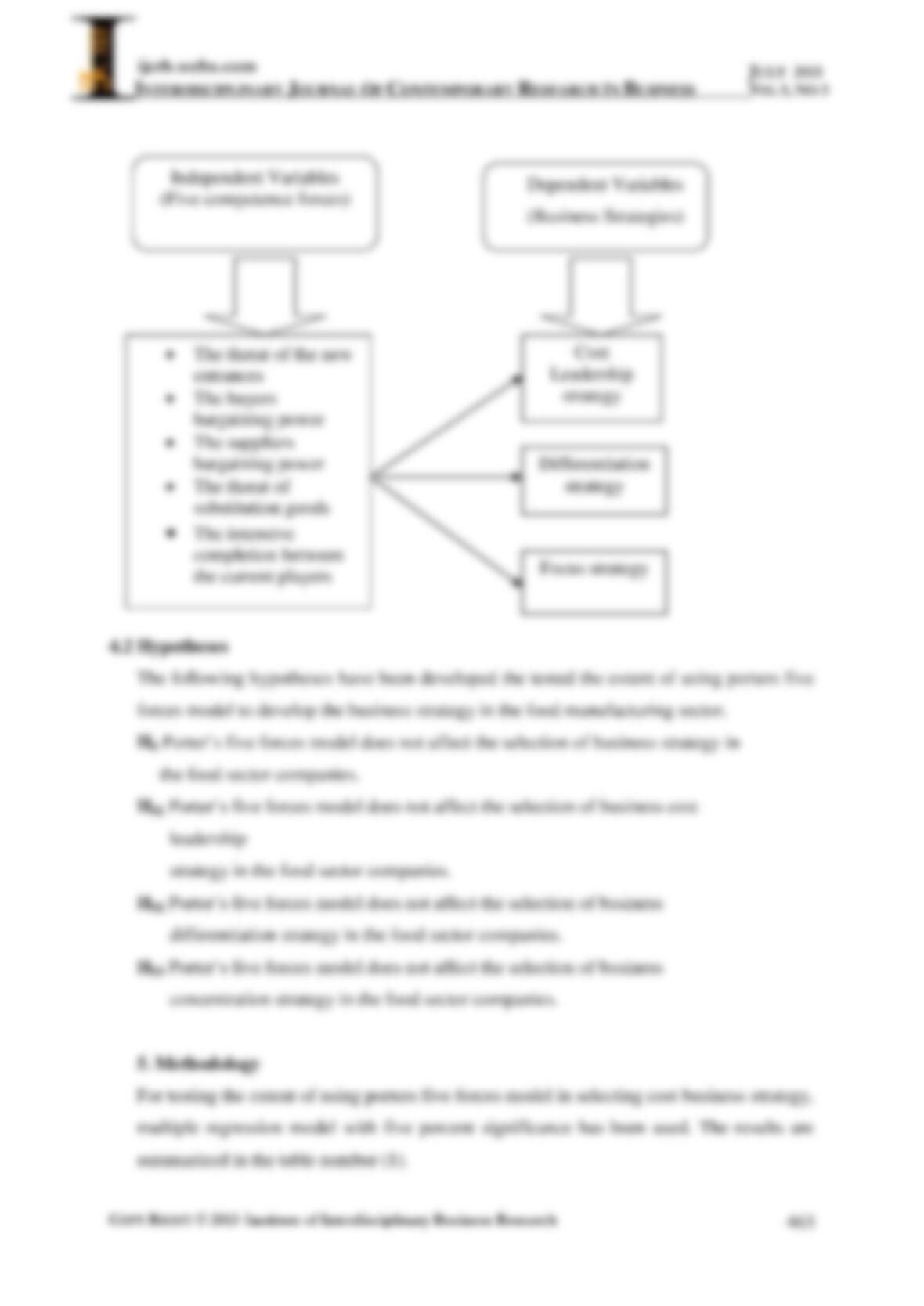
paper will focus on analyzing the industrial environment through applying the five competence
factors of Porter’s model namely, the threat of new entrances, the buyers bargaining power, the
suppliers bargaining power, the threat of substitute products and services and the rivalry among
existing companies.
This model may help the companies in selecting a suitable business strategy. Now, the porter‘s
model is widely used and it is one of the important models used in determining the business
strategy in the most industries.
ijcrb.webs.com
INTERDISCIPLINARY JOURNAL OF CONTEMPORARY RESEARCH IN BUSINESS
JULY 2013
VOL 5, NO 3
Porter encourages the businesses to the focus on the factors of his model, to evaluate these
factors and to classify them according to their degrees of importance when they conduct
business environmental surveys,(porter, 1980). Also, the determination of main factors of
competence forces could help in exploring the read ground of strategic programs in the
organization. This will help highlighting the strength and weaknesses of the business internal
environment which help in selecting business strategies in a good manner, (Al-doury,2005).
The importance of this study came from exploring the relationship between strategic analysis
and strategic options. The food industry in Jordan has a critical impact on supporting the
economy as it has an important role in increasing the real GDP, employing thousands of
employees, decreasing the trade balance deficit , and increasing the governments tax revenues.
Also, this study takes its importance from trying to enable the companies in dealing with
expected competence factors in its environment. This may help the companies to select a strong
and suitable business strategy to face these forces and achieve their objectives.
Johnson and Sholes,(2008), define the business strategy as a plan that takes it‘s position on the
different business units the company as it focuses on improving the companies working in the
same industry. Wheelen and Hunger,(2008), mentioned that the business strategies