Background of the Covid-19 outbreak in Malaysia
Malaysia was finds the first case of Covid-19 on 25th January, and this must traced back to 3
Chinese nationals who had close contract with an infected person in Singapore and travelled
into Malaysia on 24th January 2020. Since the first case come out in Malaysia, the Ministry of
Health (MOH) had developed Covid-19 management standard guidelines quickly, and
designated 34 hospital and screening centers in each states of Malaysia (Asita, 2020).
Period
Issue
Details
4th February 2020
First Malaysian Infector
Infector person had recently
returned from Singapore
when he started to develop a
fever and a cough.
6th February 2020
Local Transmission
The younger sister of the first
Malaysian infected was
reported positive for Covid-
19, she was the first Covid-
19 patient in Malaysia who
contracted the virus via local
transmission.
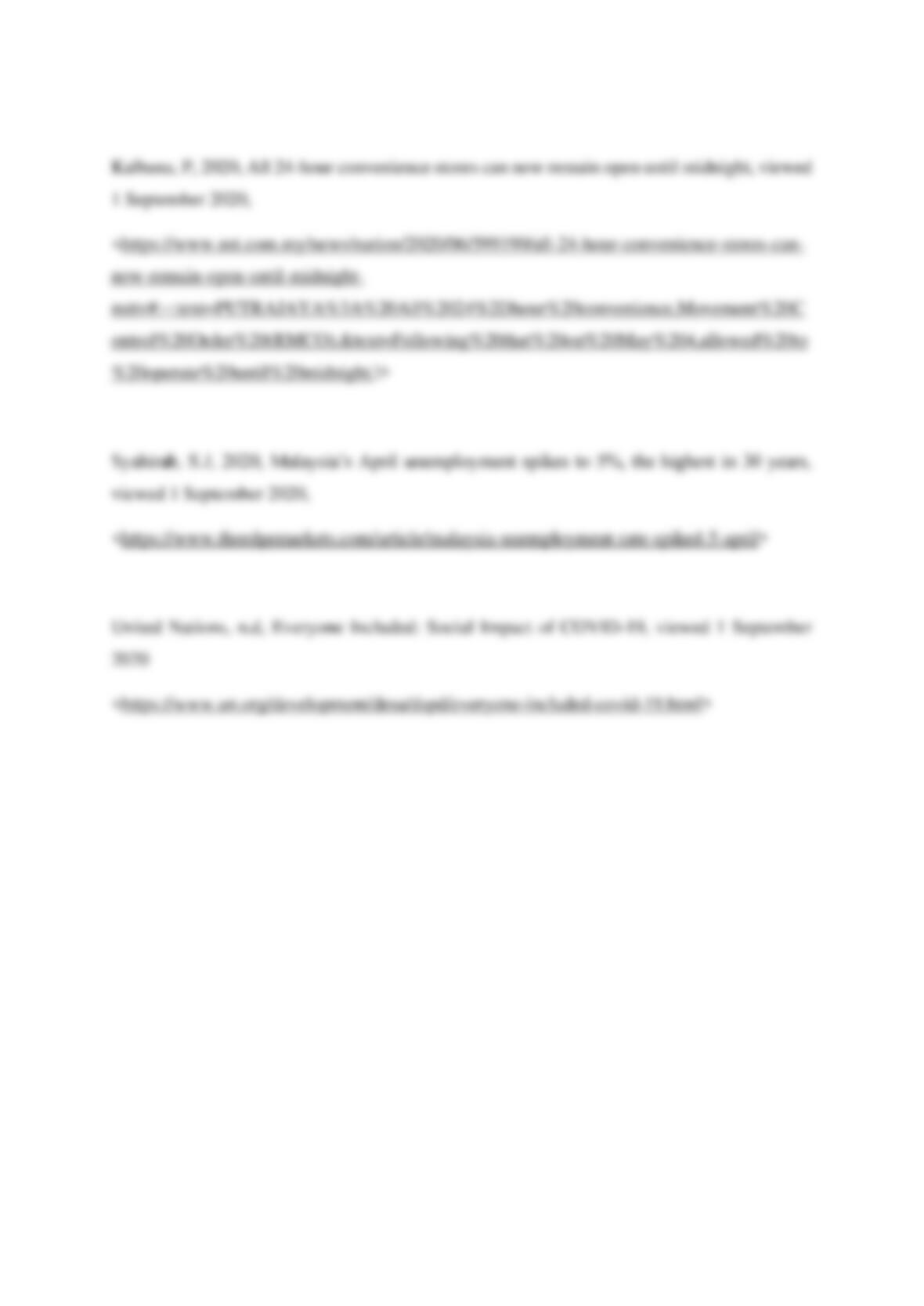
March 2020
Religious Event
Reported Covid-19 cases
was grow at a slow rate until
a religious event at Sri
Petaling, Kuala Lumpur,
which led to an exponential
rise in case (Calvin, 2020),
(Appendix 1).
16th March 2020
Announcement of
Movement Control Order
The positive cases was
increased beyond 533 cases.
Since the Covid-19 is highly
infectious, to reduce the
rapid spread of Covid-19, the
Prime Minister of Malaysia
was announced a Movement
Control Order (MCO) will

started at 18th March (Asita,
2020).
Due to the incubation period of Covid-19 was very long, at the beginning of MCO the reported
cases of Covid-19 still growing at a very fast rate. At now it had more the 9,000 reported case
in Malaysia, it is less than other countries, and all this will be attributed to government measures.
Common challenges faced globally in the Covid-19
Due to the Covid-19 pandemic, it has change many people live and bringing a lot of challenges
for the public. For the first challenges will be increasing of unemployment rate. In terms of
employment, the youth unemployment rate is very high, and for those employed often work in
the informal economy or gig economy, unstable contracts or economic service sectors, which
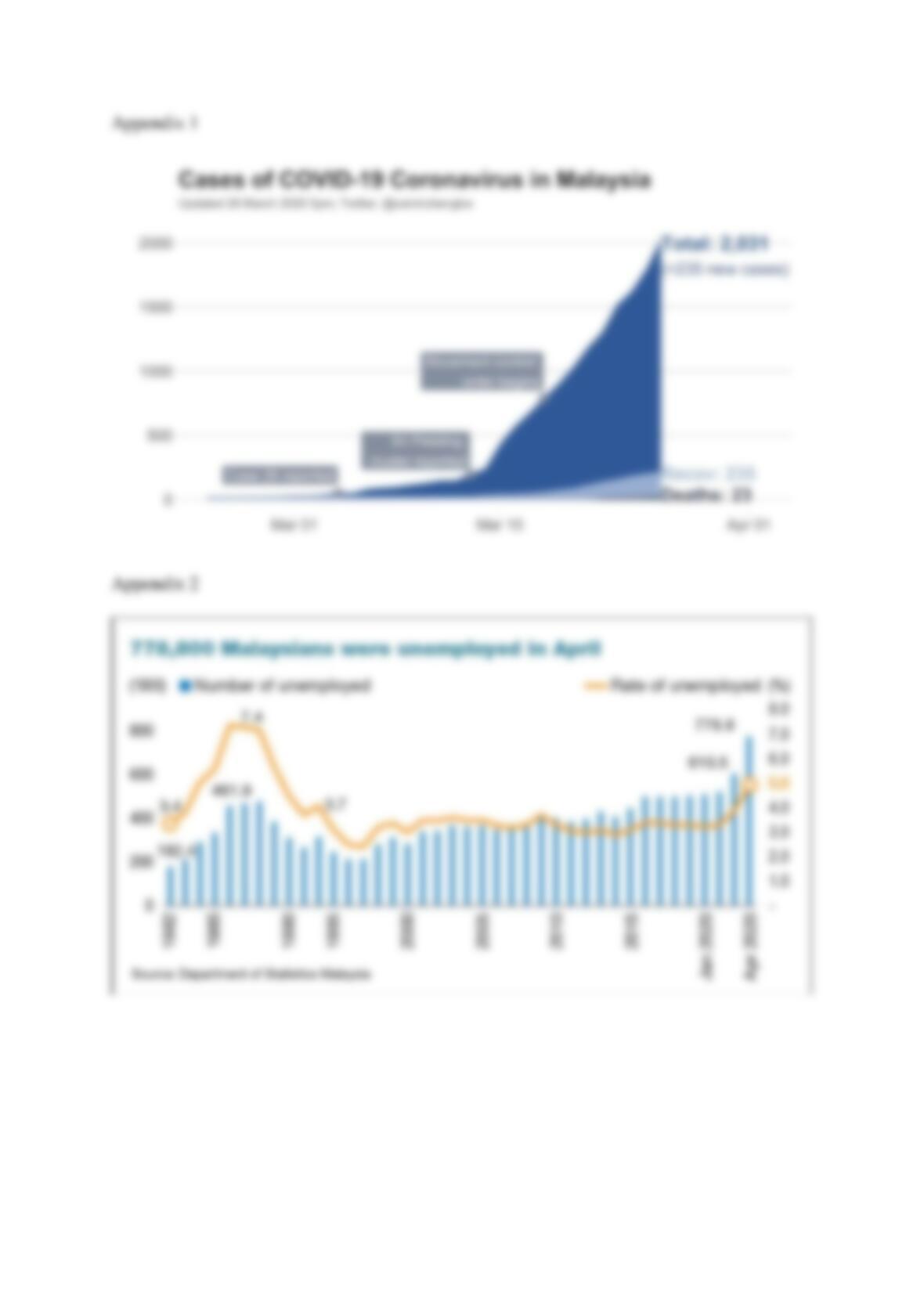
are likely to be severely affected by COVID-19. Just take a Malaysia with an example, it have
attain around 778 thousand of people become unemployed in April 2020 (Syahirah, 2020)
(Appendix 2). Second, the challenges will be the unable to provide good education level for
the student. For an example, with the closure of schools and universities in many jurisdictions,
more than one billion young people are now no longer attending school. The interruption of
education and learning may have a mid- to long-term impact on the quality of education,
although teachers, school administration, local and national governments should be aware of
their efforts to deal with unprecedented situations to the greatest extent possible. But it still
cannot solve the impact of Covid-19 on education perfectly (United Nations, n.d).
Types of risk
Details
Fundamental Risk
Since the Covid-19 is one of the virus that
just come out in 2019 and so far there is no
vaccine as all. Besides, it incubation period
is too long and has highly infectious, so it is
hard to control the spread of Covid-19, hence
until now it has above 20 million people was
diagnose of the Covid-19. Since that cannot
control by any one of individuals and group
individuals. And it will affected in big area
of people.
Indirect Loss
Due to the Covid-19, most of the business
suspends its normal operation hours due to
movement control order in Malaysia. Most of
the local companies will encounter a loss
form the time at with the firm suspends its
normal operations and continue over time
until the firm is able to resume its business as
usual.
Types of hazard
Legal Hazard
Since the movement control order had set up
by the government on 18 March 2020, it had
directly increase in frequency and severity of
loss to many business. This is because,
movement control order is one of the legal
doctrines that had limit the operation hour of
affect the performance of the business.
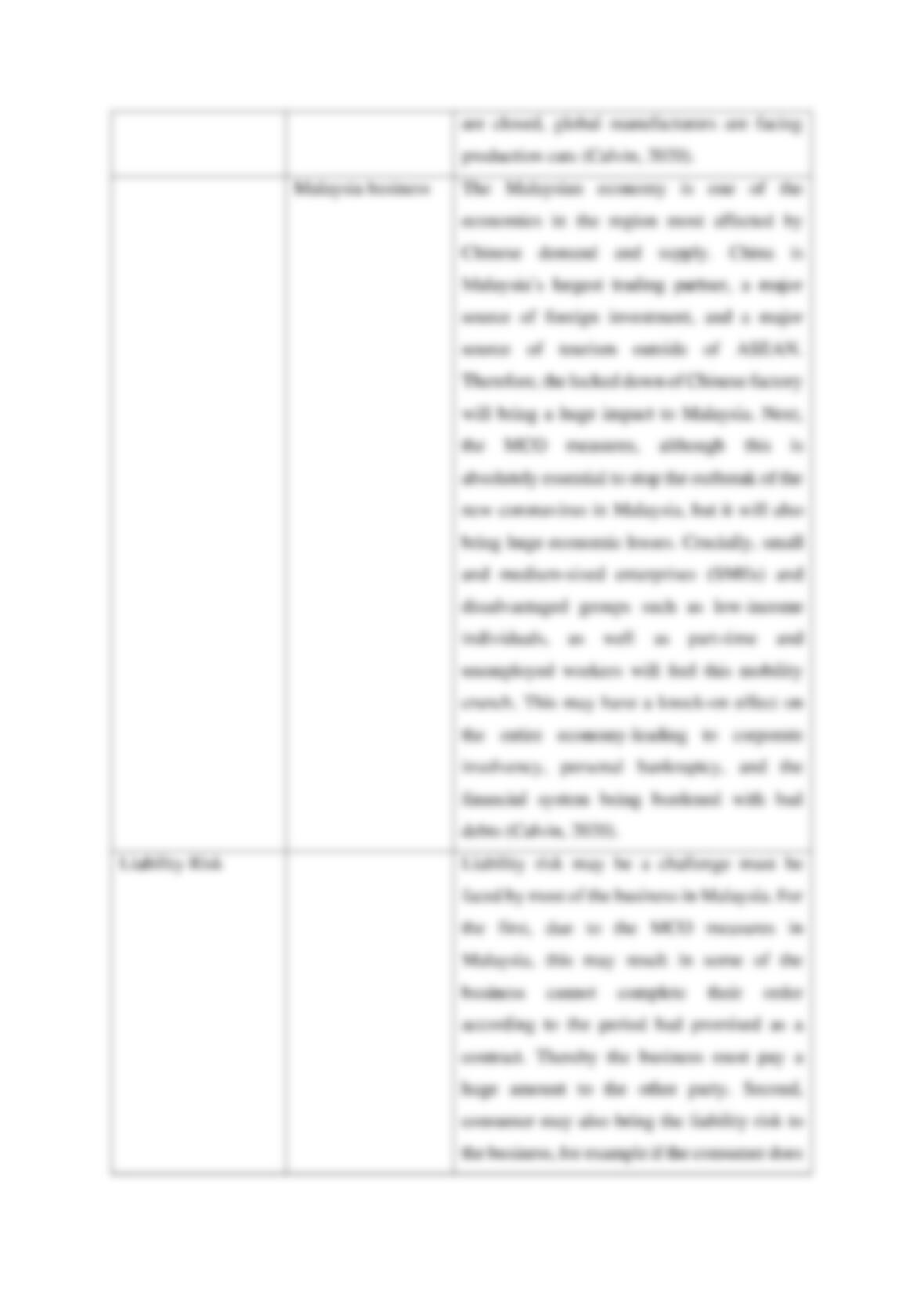
to lower prices, and because Chinese factories