Team FME
Active Listening
www.free-management-ebooks.com
ISBN 978-1-62620-963-3
Communication Skills

Copyright Notice
© www.free-management-ebooks.com 2013. All Rights Reserved
ISBN 978-1-62620-963-3
The material contained within this electronic publication is protected under International
and Federal Copyright Laws and treaties, and as such any unauthorized reprint or use of
this material is strictly prohibited.
You may not copy, forward, or transfer this publication or any part of it, whether in elec-
tronic or printed form, to another person, or entity.
Reproduction or translation of any part of this work without the permission of the copy-
right holder is against the law.
Your downloading and use of this eBook requires, and is an indication of, your complete
acceptance of these ‘Terms of Use.’
You do not have any right to resell or give away part,
or the whole, of this eBook.

ISBN 978-1-62620-963-3 © www.free-management-ebooks.com 1
ACtive LiStening
table of Contents
Preface 2
Visit Our Website 3
Introduction 4
Characteristics of Active Listening 7
Listener Orientation 8
Reffective Technique 12
Questioning Skills 17
Barriers to Active Listening 21
Advantages for Managers 24
Summary 25
Other Free Resources 27
References 28

ISBN 978-1-62620-963-3 © www.free-management-ebooks.com 2
ACtive LiStening
Preface
Talking to other people one-to-one makes up a significant proportion of the total amount
of communication that you are involved in each day. Active listening will reduce the
chance of misunderstandings, help to solve problems, and allow you to take advantage
of opportunities you may have previously missed. This eBook describes what active lis-
tening is and how it can make you a more effective manager.
You will learn:
●Why it is so important to actively listen
●The six aspects of listener orientation you should adopt
●How to use reffection and clarification in the context of active listening
●How to overcome the internal barriers to effective active listening
●How to integrate different types of questioning into active listening

ISBN 978-1-62620-963-3 © www.free-management-ebooks.com 3
ACtive LiStening
visit Our Website
More free management eBooks along with a series of essential templates and check-
lists for managers are all available to download free of charge to your computer, iPad, or
Amazon Kindle.
We are adding new titles every month, so don’t forget to check our website regularly for
the latest releases.
Visit http://www.free-management-ebooks.com
ISBN 978-1-62620-963-3 © www.free-management-ebooks.com 4
ACtive LiStening
introduction
The simplest example of interpersonal communication in the workplace is a conversa-
tion between two people. This activity makes up a significant proportion of the total
amount of communication that you are involved in each day, and doing it well has a big
inffuence on your effectiveness as a manager.
A deceptively simple concept called active listening can really help you to improve your
communication skills. It was originally developed in the context of therapeutic inter–
views, but its principles can be applied to workplace communications.
An Active
Listener
is
Neutral Non-
judgmental
Engaged
throughout
Listening is the most fundamental component of interpersonal communication skills and
is an active process in which a conscious decision is made to listen to and understand the
messages of the speaker. As a listener, you should remain neutral and non-judgmental;
this means trying not to take sides or form opinions, especially early in the conversation.
Active listening is concerned with improving your ability to understand exactly what the
other party means when speaking to you. This is not as straightforward as it sounds be-
cause active listening involves listening for meaning (specifically, the meaning perceived
by the other party), not just listening to the words they use and accepting them at face
value.
Active listening requires patience because people need time to explore their own
thoughts and feelings before putting them into words. This means that short periods of
silence should be accepted and you need to resist the temptation to jump in with ques-
tions or comments every time the speaker pauses.
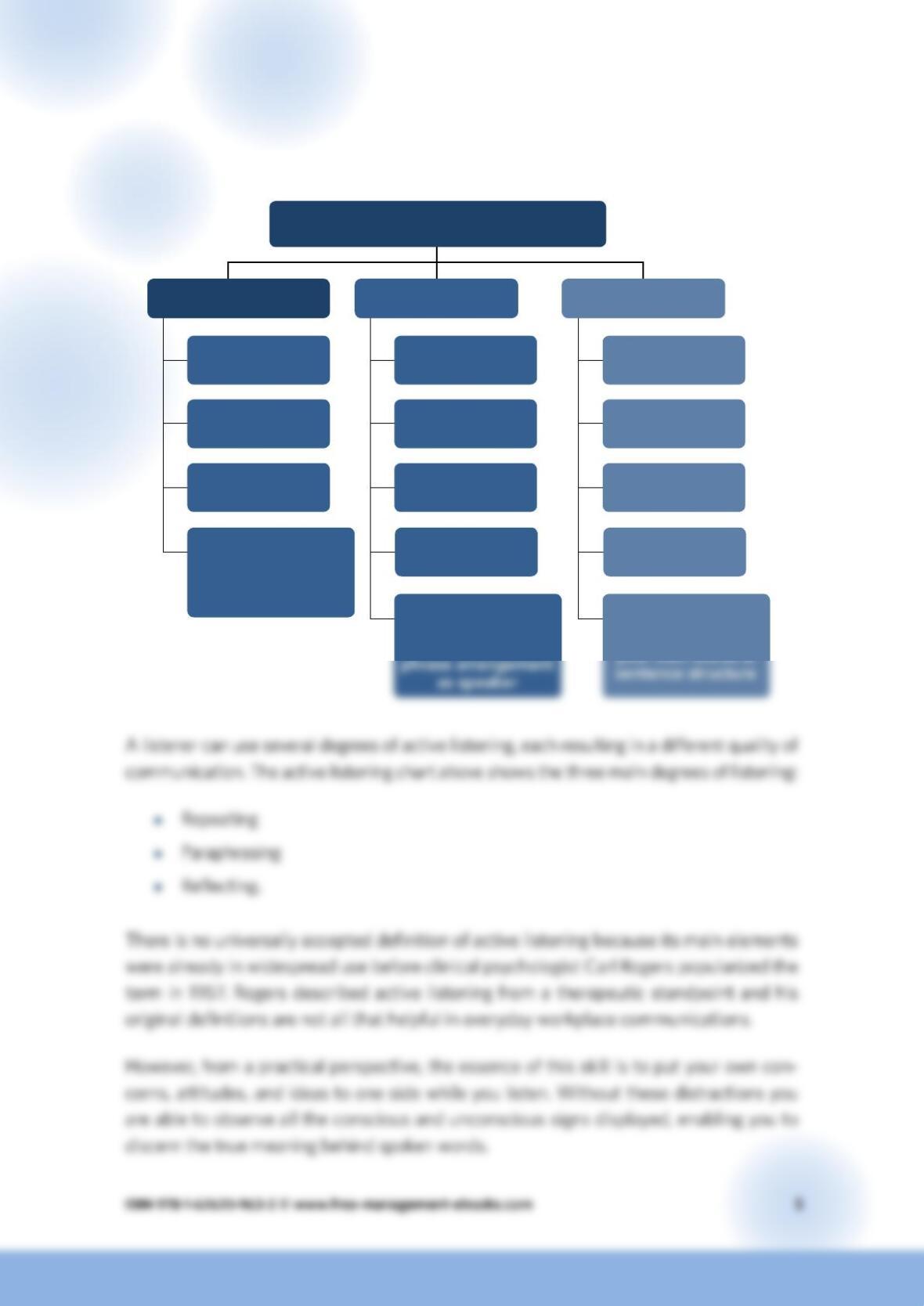
ACtive LiStening
Perceiving
Paying Attention
Remembering
Rendering the
message using
Thinking &
Reasoning
Degrees of Active Listening
Repeating
Perceiving
Paying Attention
Remembering
Refl ecting
Repeat the
message using
exactly the same
words as speaker
Perceiving
Paying Attention
Remembering
Rendering the
message using
similar words &
Paraphrasing
Thinking &
Reasoning