Infectious diseases
By
Dr. Muhammad Shahzad
Aslam
Typhoid Fever
CASE PRESENTATION
•Seven people without travel history to an endemic
region were diagnosed with typhoid fever between
September and October 2014. Each patient diagnosed
with typhoid and/or paratyphoid fever was to be
reported to a local health center for government
surveillance, where each patient was interviewed for
history of travel and meal. All seven patients had
consumed food in an Indian buffet, including curry with
rice, tandoori chicken, and fresh vegetables, at a
restaurant in the center of Tokyo. Patients 1–3 sat
together and ate the delivered meal of the same menu
separately served on plastic plates using separate
spoons and forks on the same day (August 8, 2014).
CASE PRESENTATION
•Patients 4–7 were exposed at the restaurant but on
different dates as follows: patients 6 and 7 on August 8,
2014; patient 4 on August 22, 2014; and patient 5 on
August 14, 2014. All the seven employees (four chefs
and three waiters) of the Indian buffet were
asymptomatic. Urine and stool samples from the seven
employees were tested for chronic carriage. One
employee, a Nepali chef in the restaurant (index patient
8), was the only carrier and the implicated source of
this outbreak.
Kobayashi, T., Kutsuna, S., Hayakawa, K., Kato, Y., Ohmagari, N., Uryu, H., … & Takei, R. (2016).
An Outbreak of Food-Borne Typhoid Fever Due to Salmonella enterica Serotype Typhi in Japan
Reported for the First Time in 16 Years. The American journal of tropical medicine and
hygiene, 94(2), 289-291.
Typhoid fever
Typhoid fever, also referred to as enteric fever.
Affects up to 30 million individuals worldwide
each year
Causative agent : Salmonella enterica, and
its two subtypes, typhi and paratyphi.
In endemic areas, children and
adolescents are affected most often, but
there is no age preference in developed
countries
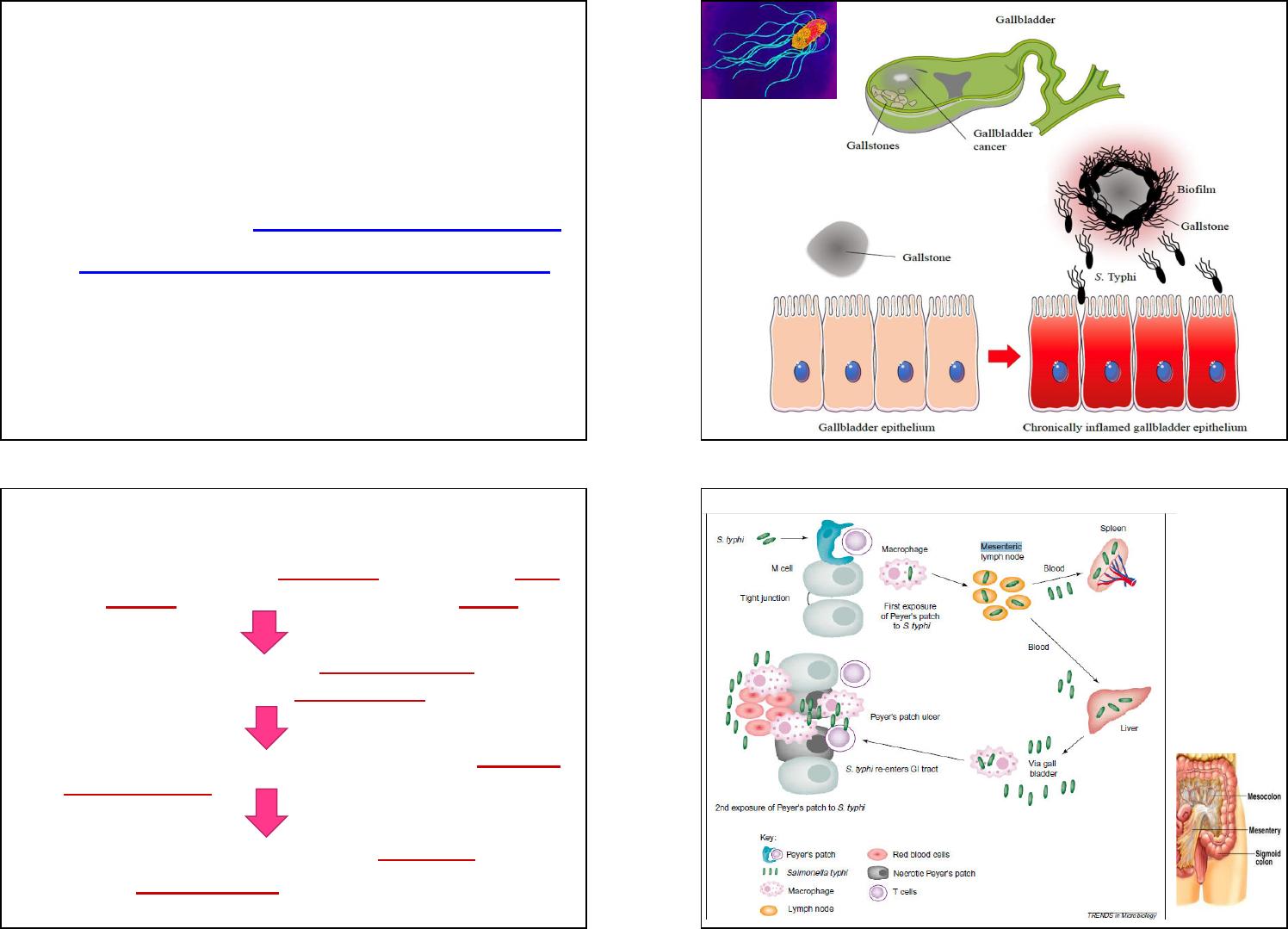
Pathogenesis
S. typhi are able to survive in gastric acid and, once in the small
intestine, they are taken up by and invade M cells.
Bacteria are then engulfed by mononuclear cells in the
underlying lymphoid tissue.
Unlike S. enteritidis, S. typhi can then disseminate via lymphatic
and blood vessels.
This causes reactive hyperplasia of phagocytes and
lymphoid tissues throughout the body.
MORPHOLOGY
Infection causes Peyer patches in the terminal ileum to
enlarge into sharply delineated, plateau-like
elevations up to 8 cm in diameter.
Draining mesenteric lymph nodes are also enlarged.
Mucosal damage creates oval ulcers, oriented along
the axis of the ileum, that may perforate
The spleen is enlarged and soft, with uniformly pale
red pulp and prominent phagocyte hyperplasia.
Widal’s test
Clinical Features
Anorexia
Abdominal pain
Bloating
Nausea
Vomiting
Bloody diarrhea
followed by a short asymptomatic phase that gives way
to bacteremia and fever with flulike symptoms.
Clinical Features
Antibiotic treatment can prevent further
disease progression.
High fever if not treated with Antibiotics.
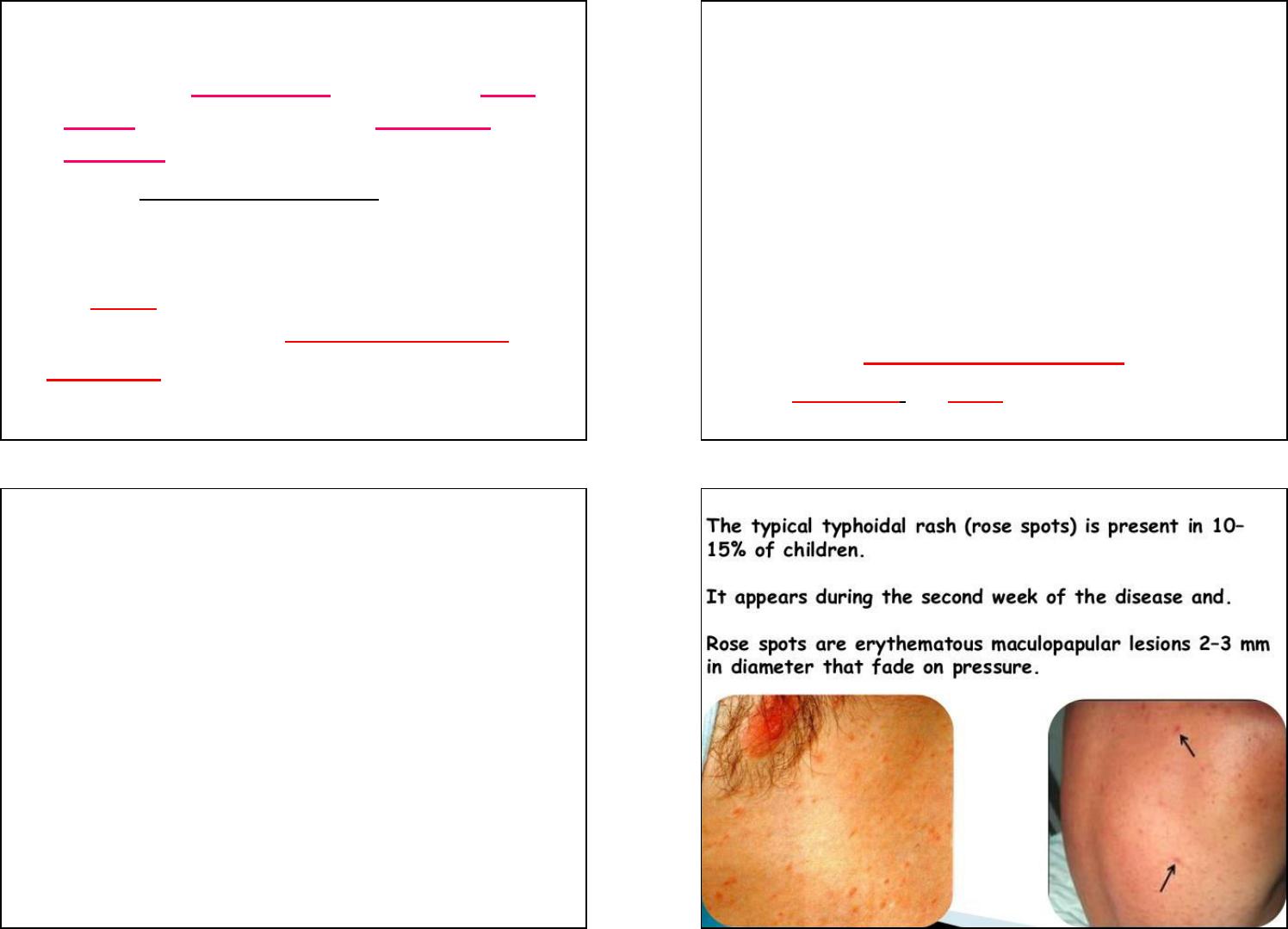
Rose spots, small erythematous maculopapular
lesions, are seen on the chest and abdomen.
Relapse could occur.
Systemic dissemination: May cause extraintestinal
complications including encephalopathy, meningitis,
seizures, endocarditis, myocarditis, pneumonia, and
cholecystitis.
Bacillary dysentery
SYSTEMATIC REVIEW
Pfeiffer, M. L., DuPont, H. L., & Ochoa, T. J. (2012). The patient presenting
with acute dysentery–a systematic review. Journal of Infection, 64(4), 374–
386.
Bacillary dysentery
Bacillary dysentery is a type of dysentery, and is
Shigellosis
Gram-negative