Has the industrial Revolution Really Increased the
Standard of Living?
Ce Sun, Minghang Quan
Bard College
April 3rd 2013
Econ 216
European Economics History
Olivier Giovannoni
Abstract
The industrial revolution, unquestionably one of the most important events in human
history, is widely agreed to be the mark of the transition to the modern era. First
initiated by the invention of the steam engine, the industrial revolution set
productivity of the human race to a whole new horizon. It seems apparent that the
average living standard in the western world should increase a lot by such inventions.
However, even though as many economists agree that this revolution significantly
increased aggregate output and induced massive consumption, there is still a constant
debate of whether the industrial revolution really increased people’s living standard in
Europe. Despite the great jump of GDP level, we observe that the population during
that period also increased significantly. Hence the real GDP per capita did not
increase as much as one expected. Many scholars argued that the living standard of
the ordinary people, known as the working class, actually fell; while others believed
that the living standard did rose. This paper will carry out a research on the living
standard of people in Europe and further interpret the debate on this historical event
by studying the opinions from both sides.

Introduction
First introduced in a letter in the year of 1799 by French envoy Louis-Guillaume Otto,
the term “Industrial Revolution” is used to announce that France had “entered the race
to industrialise.”
1
Later in the 1840s, Friedrich Engels described this great change in
the world also as the “Industrial Revolution” and claimed that it is “a revolution
which at the same time changed the whole of civil society”
2
. The Industrial
Revolution is indeed revolutionary. Many historians consider this change to have
entirely altered the everyday life of everyone in the world.
The first Industrial Revolution is initiated at around 1750 when the textile production
technology started to develop. During that period, weaving and spinning machines are
invented and improved in many ways. At 1733, the flying shuttle was invented by
John Kay and after several improvements in the next ten years on this great invention
the production of a weaver is doubled. Later the Spinning Jenny invented by James
Hargreaves in 1764 makes it possible to support enough coarse spread to weaving
companies in order to meet the demand of their improved weaving machines. These
technologies in two decades become widely adopted in most textile manufacturing
companies and have significantly increased their production. Along with the
improvement in textile business, the emergence of many other technologies greatly
improved many different industries. Coal becomes the most widely used power
source to burn instead of wood. The latter takes much more labor to mine and actually
coal was more abundant than wood
3
. With the wide use of steam engines starting in
1775, mining, transportation and metal production started to improve. Mining
becomes more efficient, railroads and steamboats start to emerge and better quality of
steel and iron are being produced. All these innovations completely changed the way
people live at that moment. Fast transportation makes trades more rapid and far
reaching. Steamboats and railroads start to stimulate the flow of good around Europe.
1
Crouzet, François (1996). “France”. In Teich, Mikuláš; Porter, Roy. The industrial
revolution in national context: Europe and the USA. Cambridge University Press. p. 45. ISBN
978-0-521-40940-7
2
Engels, Friedrich (1840), The Condition of the Working Class in England
3
Landes 1969
This provides customers with more consumption choices and experiences from all
around the world. Technological improvements in manufacturing industries
significantly increase the supply of goods. There were many more changes taking
place during that period, all of which helped making the world we live in like this
today.
Many scholars agree that the Industrial Revolution marks the transition of human race
into the modern society. They argue that the significance of this event is equivalent to
the moment when human first start to grow food. With all these changes taking place,
it is plausible to assert that the people in that era start to live better compared to the
years before the industrial revolution. Historians and economists studied the change
of quality of living in that period but a controversial conclusion comes to our eyes.
Even though many argue that the living standard increased during the Industrial
Revolution, a majority of studies show that the living standard didn’t grow as much at
we have expected. All these papers discuss the change of living standard during the
First Industrial Revolution from different perspectives.
What is the living standard? In order to estimate the living standard, we have to know
the definition of the living standard. Intuitively, the living standard is the level of
wealth, comfort, material goods and necessities available to a certain socioeconomic
class in a certain geographic area. But because living standard reflects the wellness of
being, it cannot simply be fully explained as a set of numbers. It is rather qualitative
but still we must quantify it in order to have a better evaluation towards such topic.
Many different measurements have been used to interpret the living standard and
different measurements may return us different results when we use them to look at
the Industrial Revolution. Generally, through out the past literatures, measurements
such as real income, poverty rate, quality and availability of employment, quality of
housing, education, life expectancy and environmental quality etc., are closely studied
and interpreted regarding to the years of the Industrial Revolution. A number of
scholars argue that as the real income during the Industrial Revolution did not
increase too much, people were not richer and thus the living standard during that
period did not increase. While others found that the life expectancy during the first
Industrial Revolution actually increased and hence they say that the living standard
increased during that period. Many other papers have reached to the above two
different results with various approaches. This paper will try to include and explain all
the major arguments on this controversial topic and by balancing the opposite views,
the paper will generate an aggregate conclusion on whether the living standard has
increased or not during the Industrial Revolution.
Real Income
The most direct way to estimate the living standard is by wages, usually adjusted for
purchasing power, inflation, and cost of living. A majority of the literature discussing
the living standard had provided extensive review on whether the real income had
increased over industrial revolution, when did it increase, in which regions of the
country, and in which working classes.
Majewski (1986) shows that the first industrial revolution created large amounts of
capitalism in the early 19th century, improved people’s standard of living, and paved a

path for modern developments that benefit us today.
4
He proposes that although there
are problems associated with the industrial revolution, the majority of historians
believe that there is at least a slight increase in the material standard of living. He uses
the evidences in Sir John’s article in 1926 named “An Economic History of Modern
Britain”, and shows that since John there has been widely accepted that the real wage
rose in the first industrial revolution. The evidence is so conclusive that Williamson
(1985) even confidently declares that “unless new errors are discovered, the debate
over real wages in the early nineteenth century is over: the average worker was much
better off in any decade from the 1830s on than any decade before 1820″
5
.
Substantial evidences support such confidence. Hartwell (1971) proposes that
although money wages seemed to remain stable, prices of goods have decreased a lot
because entrepreneurs struggled to provide low-price goods and services to
costumers
6
. Although there are disagreements in the extent of increase in real wages,
Williamson (1985) provides evidence that real wages of blue-collar workers doubled
between 1810 and 1850. Similarly, McCloskey (1981) also proves that real wages
increased significantly, based on a longer period of time
7
. Specifically, he shows that
real wages rose from 11 pounds per capita in 1780 to 28 pound per capital in 1860.
The increase in wages directly affects the improvements in the standard of living.
Take consumption of food, or diet, for example. Hartwell (1971) shows that per capita
consumption of meat, sugar, tea, eggs, and beer all increased. An even stronger
indication of the improvement is the increase in imported foods. Per capita
consumption of foreign cocoa, cheese, coffee, rice, and tobacco all increase. Hartwell
(1971) shows that at the same time, some luxuries and expensive food, such as meat,
vegetables, and fruits, were eaten regularly by more and more people by 1850. He
4
Majewski, J. (1986), The Industrial Revolution: Working Class Poverty or Prosperity?,
available at http://www.fee.org/the_freeman/detail/the-industrial-revolution-working-class-
poverty-or-prosperity#axzz2TNW38SyL
5
Williamson, J. (1985), Did British Capitalism Breed Inequality?, Boston: Allen and Unwin.
6
Hartwell, R. (1971), The Industrial Revolution and Economic Growth, London: Methuen
and Co.
7
McCloskey, D. (1981), The Industrial Revolution 1780-1860: A Survey, The Economic
History of Britain Since 1700, Cambridge: Cambridge University Press.

shows that in fact the average diet of English people of 1850, 5 ounces of butter, 30
ounces of meat, 56 ounces of potatoes, and 16 ounces of fruits and vegetables, is very
similar to the diet of English people today.
Although such increase in real wage is important by itself, it displays even more
significance when considering the large increase in population during the industrial
revolution. McCloskey (1981) shows that because the death rate falls, the population
of England and Wales increase by 1.25% per year between 1780 and 1860, resulting
in almost a triple increase in population during these 80 years. Taking such huge
increase of population into consideration, the increase in real wages accompanied
with fast increase in population is the first in European history, and largely boosted
the increase in food consumption. Thus it is shown that the Malthusian trap, that
geometrically increasing pollutions will surpass arithmetically increasing food
supplies, has been broken. Even though more people inevitably resulted in less food
per person in the early European history, the first industrial revolution accomplished
by providing more food per person, which is considered to be an great achievement of
capitalism in general and the industrial revolution in particular.
While some authors try to find the timing of the increase in real wages, some authors
tend to review the real income wages by dividing it into different regions. Clark (2001)
sees that there is no formed national series of agricultural wages
8
. Bowley (1898) has
calculated a wage index for years between 1770 and 1914, using mainly secondary
sources and wage surveys for England and Wales
9
. However, Clark (2001) points out
that although Bowley (1989)’s index is well founded after 1824, the index relies on
considerable interpolation for earlier period, and doesn’t take manuscript sources into
consideration. Clark (2001)’s paper use large amounts of manuscript and secondary
sources to calculate a consistent series of day wages for farm workers in England for
years between 1670 and 1850. Clark (2001)’s series differs significantly from the
widely used Bowley series for years between 1790 and 1820. He divides the wage
8
Clark, G. (2001), Farm Wages and living Standards in the Industrial Revolution: England,
1670-1850, Economic Histor Review, LIV, 3, 477-505
9
Bowley, A. (1898). The Statistics of Wages in the United Kingdom during the last
HundredYears. Part I. Agricultural Wages,” Journal of the Royal Statistical Society, 61, 702-
722.
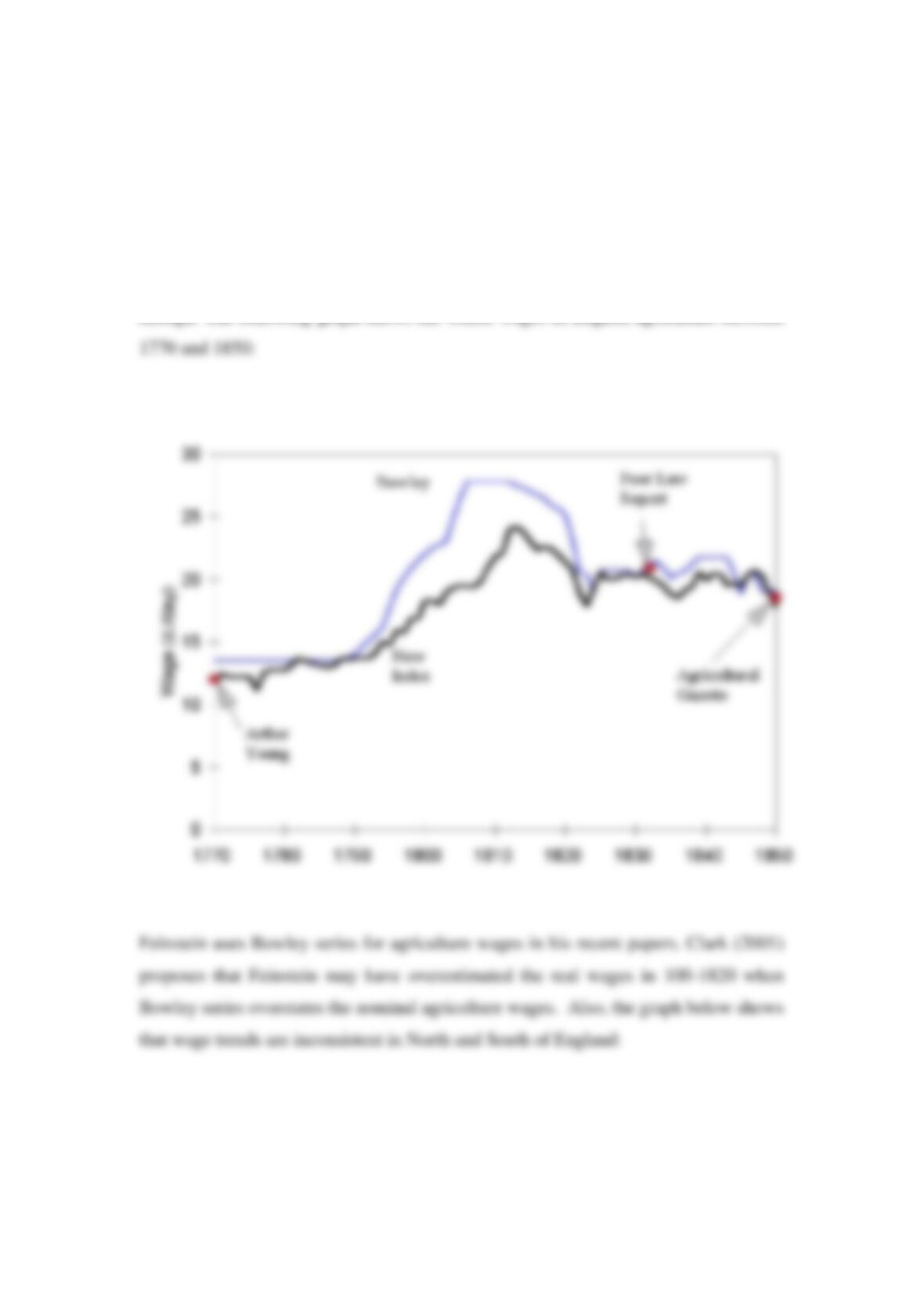
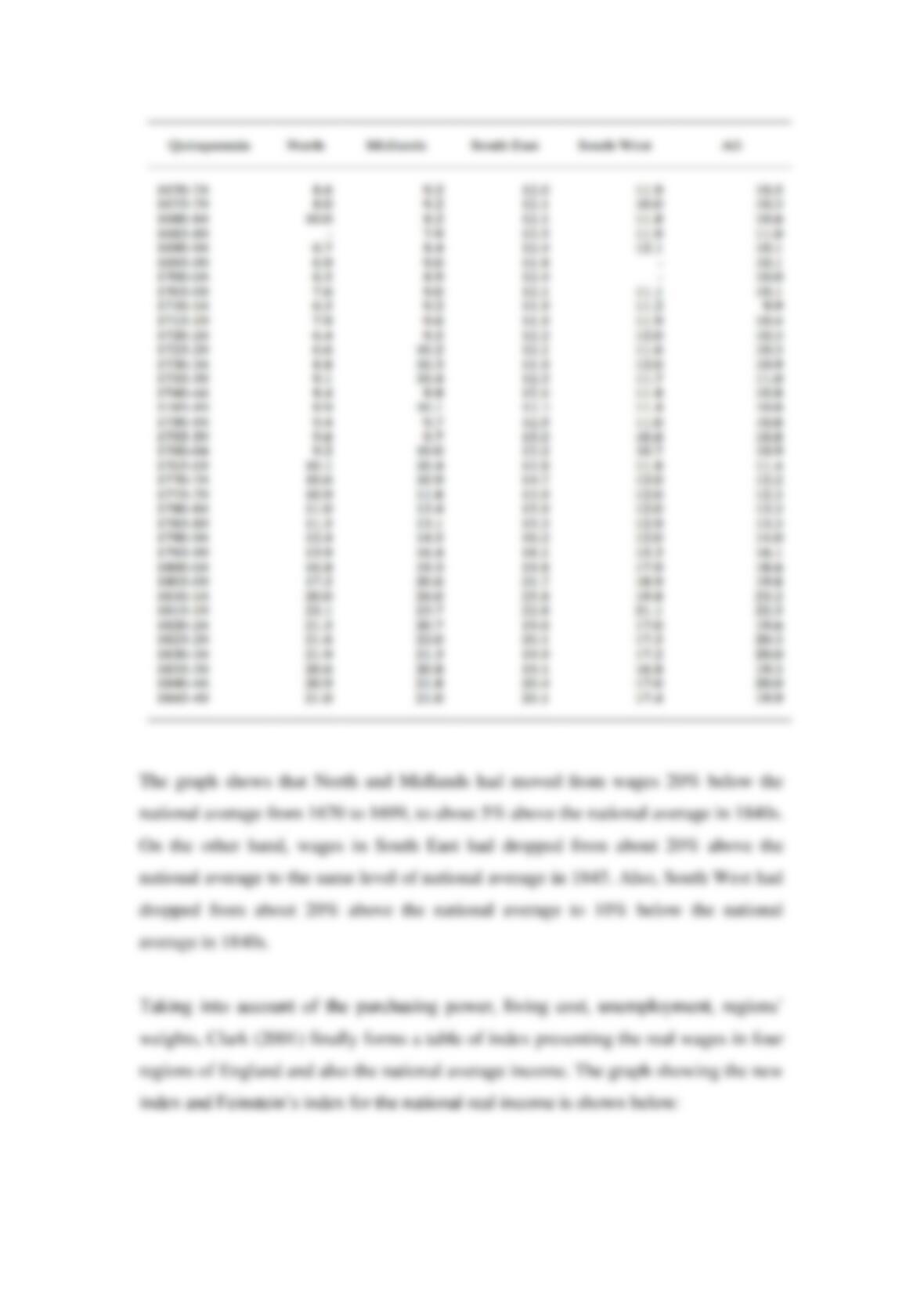
estimation into four regions by quinquennia. This new series shows that the real
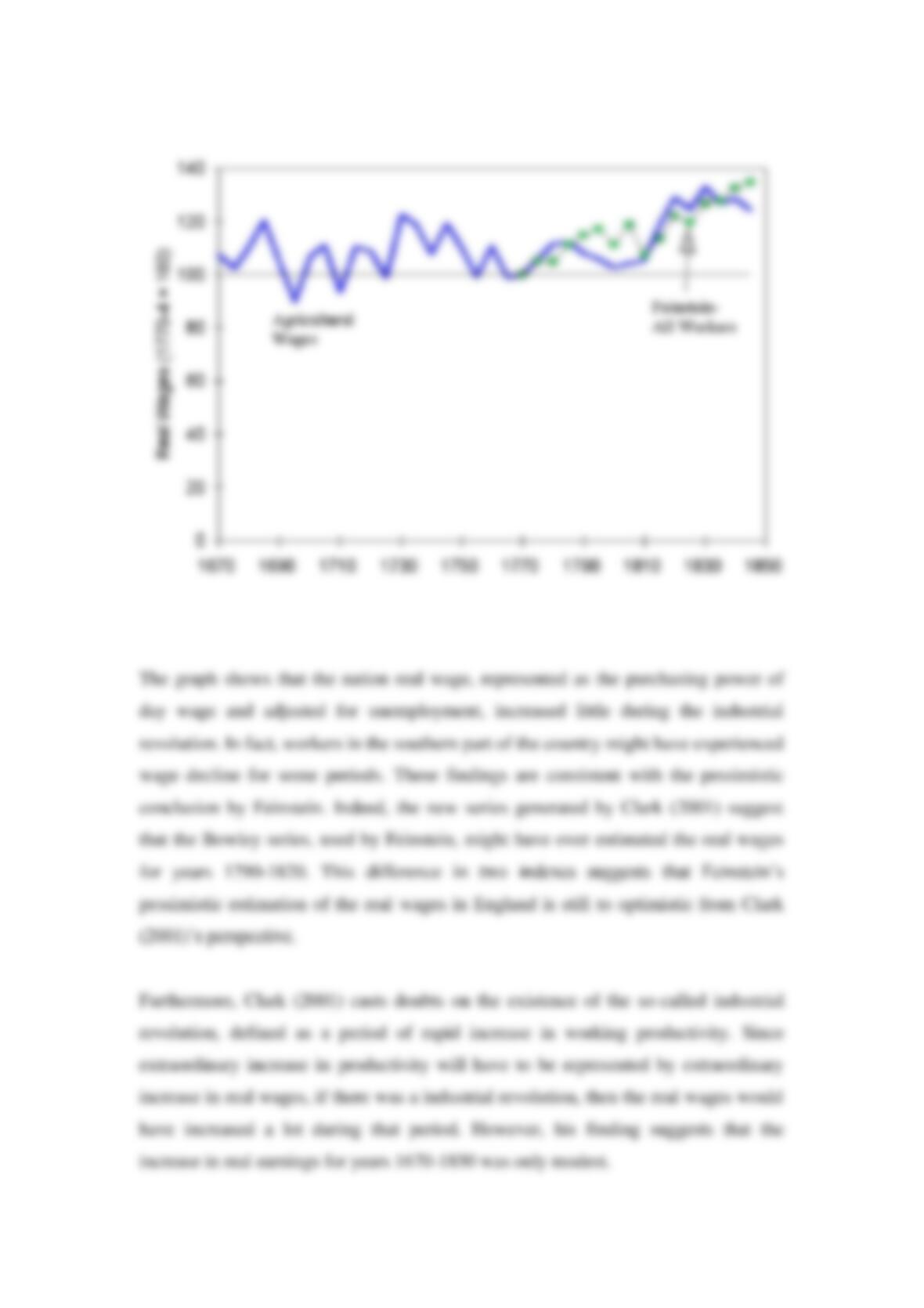
agricultural wages has little movement over the 180 years from 1670 to 1850. Also,
the wage trends differ considerably between northern and southern areas. For example,
the real wage dropped 10% in the South West, but increased by 75% in the north.
Also, he points out that the flatness of the series shows that Feinstein is too optimistic
about the real wages in the industrial revolution, although Feinstein is pessimistic