Chapter 07
Individual Income Tax Computation and Tax Credits
True / False Questions
1. Both the width (or range) of the tax brackets (the amount of income taxed at a
particular rate) in the tax rate schedules and the range of the tax rates in the tax rate
schedules (the di”erence between the lowest tax rate and the highest tax rate) vary
by $ling status.
True False
2. The tax rate schedules are set up to tax lower levels of income at higher tax rates
than higher levels of income.
True False
3. Tax rate schedules are provided for use by (relatively) higher income taxpayers while
the tax tables are provided for use by (relatively) lower income taxpayers.
True False
4. If a married couple has one primary breadwinner, $ling a joint return will likely result
in a marriage penalty.
True False
5. If both spouses of a married couple earn roughly equivalent wages, the couple is
likely to pay a marriage penalty due to the nature of the tax rate schedules.
True False
6. A marriage penalty occurs when a couple pays more taxes by $ling a joint tax return
than they would have paid had they $led married $ling separate returns.
True False
7. All capital gains are taxed at preferential rates.
True False
7-1
© 2014 by McGraw-Hill Education. This is proprietary material solely for authorized instructor use. Not authorized for sale or distribution
in any manner. This document may not be copied, scanned, duplicated, forwarded, distributed, or posted on a website, in whole or part.
8. Long-term capital gains, dividends, and taxable interest income are all taxed at
preferential rates.
True False
9. Generally, income from an active trade or business is subject to the 3.8% Medicare
contribution tax.
True False
10. In certain circumstances a child with very little income may have their income taxed
at the parents’ marginal tax rate.
True False
11. The kiddie tax does not apply to children over 24 years old at the end of the tax
year.
True False
12. The alternative minimum tax system requires taxpayers to apply an alternative tax
rate on the regular income tax base to determine the amount of the alternative
minimum tax.
True False
13. Regular taxable income is the starting point for determining the alternative minimum
tax.
True False
14. The alternative minimum tax is the AMT base multiplied by the AMT rate.
True False
15. Long-term capital gains are taxed at the stated AMT rate for purposes of the
alternative minimum tax.
True False
16. Taxpayers are not allowed to deduct personal or dependency exemptions for
alternative minimum tax purposes.
True False
7-2
© 2014 by McGraw-Hill Education. This is proprietary material solely for authorized instructor use. Not authorized for sale or distribution
in any manner. This document may not be copied, scanned, duplicated, forwarded, distributed, or posted on a website, in whole or part.
17. For alternative minimum tax purposes, taxpayers are required to add back the
regular tax standard deduction amount for their $ling status whether or not they
itemized deductions for regular tax purposes.
True False
18. For alternative minimum tax purposes, taxpayers are allowed to deduct state income
taxes but are not allowed to deduct charitable contributions.
True False
19. The AMT exemption amount is phased-out for high income taxpayers.
True False
20. All else equal, a reduction in regular income tax rates would require more taxpayers
to pay the alternative minimum tax.
True False
21. Due to the alternative minimum tax rate structure, timing tax planning strategies are
not e”ective under the alternative minimum tax system.
True False
22. Employees must pay both Social Security tax and Medicare tax on all of their wages
no matter the amount of their wages.
True False
23. For married couples, the Social Security wage base limitation applies separately to
each spouse.
True False
24. For married couples, the Medicare tax is based on the couple’s combined wages.
True False
25. Alton reported net income from his sole proprietorship of $90,000. To determine his
self employment tax, he would multiply $90,000 by the self-employment tax rate.
True False
26. Employee status is always better than independent contractor status for a taxpayer
because the employee is responsible for paying the employee portion of the FICA
taxes.
True False
7-3
© 2014 by McGraw-Hill Education. This is proprietary material solely for authorized instructor use. Not authorized for sale or distribution
in any manner. This document may not be copied, scanned, duplicated, forwarded, distributed, or posted on a website, in whole or part.
27. Self-employed taxpayers are allowed to deduct the full amount of the
self-employment taxes they pay.
True False
28. Employees are not allowed to deduct FICA taxes they pay.
True False
29. Employees are allowed to deduct a portion of the FICA taxes they pay.
True False
30. Katlyn reported $300 of net income from her sole proprietorship. She is not required
to pay self-employment tax.
True False
31. All else equal, taxpayers are more likely to be classified as employees rather than
independent contractors if they are allowed to determine their own working hours
and work without frequent oversight.
True False
32. Tax credits reduce a taxpayer’s taxable income dollar for dollar.
True False
33. The child tax credit is subject to phase-out based on the taxpayer’s AGI.
True False
34. Parents may claim a child tax credit for a dependent child who is 22 years of age at
the end of the year if the child is a full-time student.
True False
35. Parents may claim a child and dependent care credit for expenses incurred in
providing for their dependents while the parents work as long as the children are over
age 14 and under age 20 at year end.
True False
36. John and Sally pay Janet (Sally’s older sister) to watch John and Sally’s child Dexter
during the day. Janet cares for Dexter in her home. John and Sally may claim a child
and dependent care credit based on the amount they pay Janet to care for Dexter.
True False
7-4
© 2014 by McGraw-Hill Education. This is proprietary material solely for authorized instructor use. Not authorized for sale or distribution
in any manner. This document may not be copied, scanned, duplicated, forwarded, distributed, or posted on a website, in whole or part.
37. The child and dependent care credit entitles qualifying taxpayers to a credit equal to
the full amount of qualified expenses.
True False
38. The American opportunity credit is available only for those students who are in their
first or second year of postsecondary education.
True False
39. The lifetime learning credit can be used toward the cost of any course of instruction
to acquire or improve a taxpayer’s job skills, no matter the age of the taxpayer.
True False
40. The American opportunity credit and lifetime learning credit are available to all
taxpayers regardless of their income level.
True False
41. The earned income credit is sometimes referred to as a negative income tax.
True False
42. To qualify for the earned income credit, the taxpayer must have a quali$ed
dependent.
True False
43. An 80-year-old taxpayer with earned income and no dependent children could qualify
for the earned income credit.
True False
44. Business credits are generally refundable credits.
True False
45. Taxpayers are generally allowed to carry back and/or carry forward unused business
credits.
True False
46. When applying credits against a taxpayer’s gross tax liability, nonrefundable personal
credits are applied first, then business credits, and $nally refundable personal
credits.
True False
7-5
© 2014 by McGraw-Hill Education. This is proprietary material solely for authorized instructor use. Not authorized for sale or distribution
in any manner. This document may not be copied, scanned, duplicated, forwarded, distributed, or posted on a website, in whole or part.

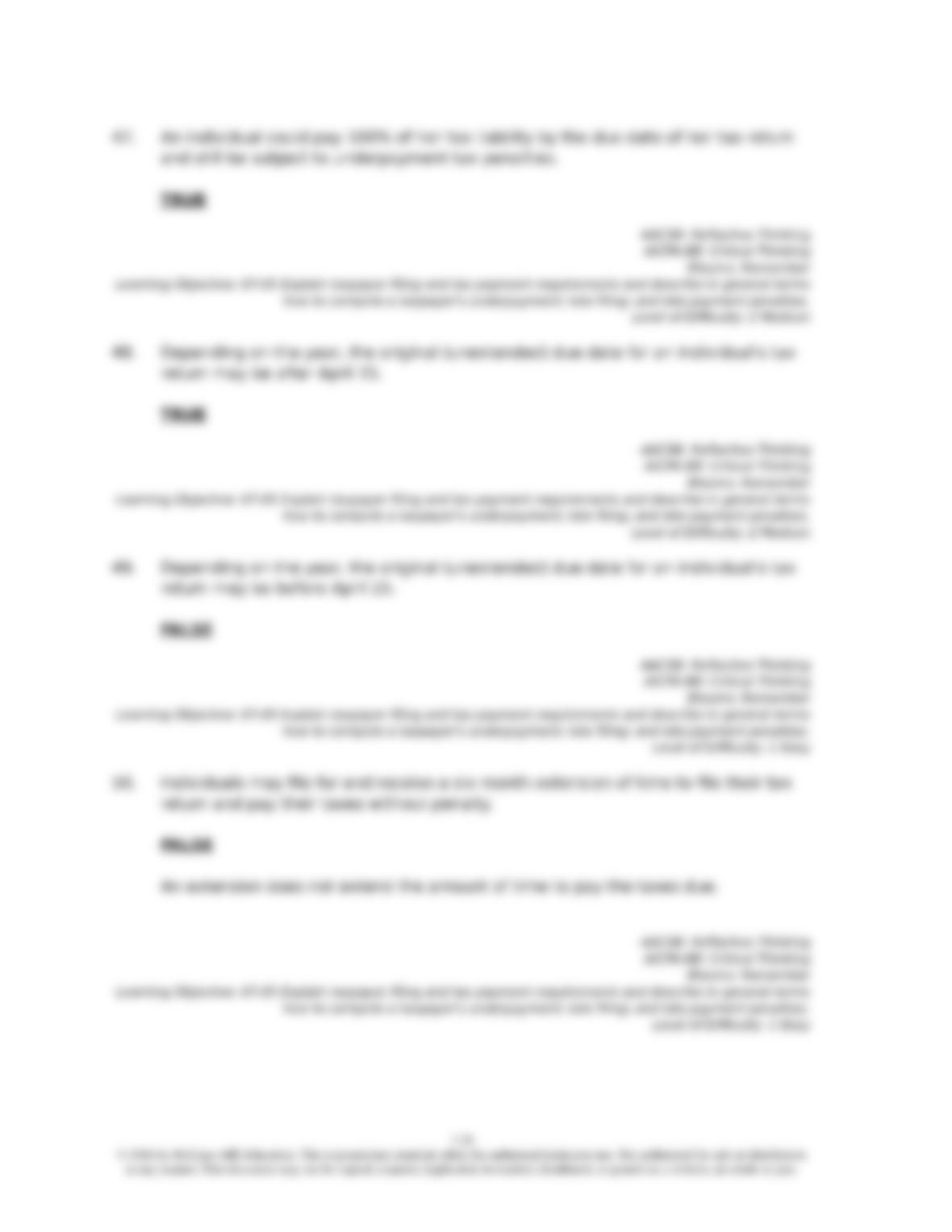
47. An individual could pay 100% of her tax liability by the due date of her tax return and
still be subject to underpayment tax penalties.
True False
48. Depending on the year, the original (unextended) due date for an individual’s tax
return may be after April 15.
True False
49. Depending on the year, the original (unextended) due date for an individual’s tax
return may be before April 15.
True False
50. Individuals may $le for and receive a six-month extension of time to $le their tax
return and pay their taxes without penalty.
True False
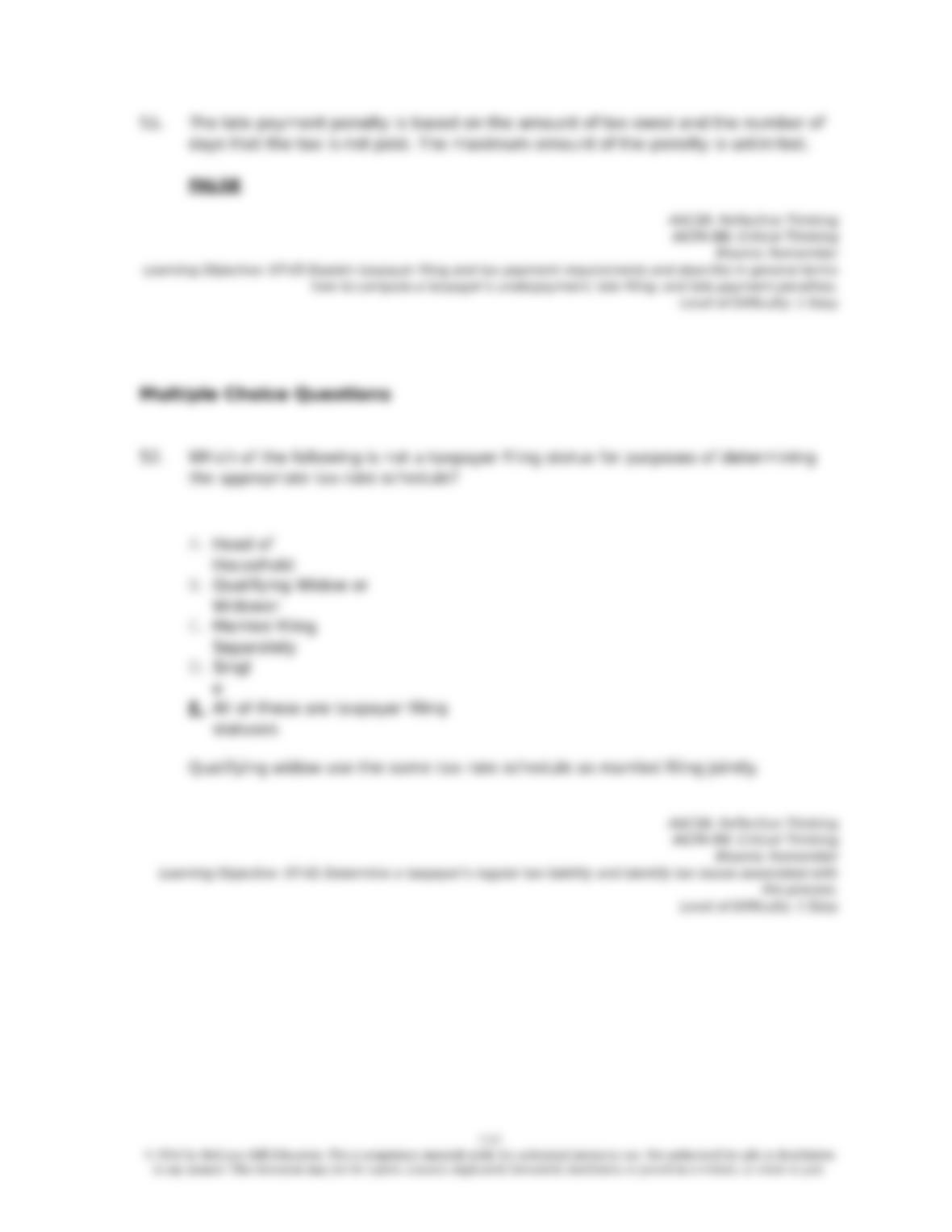
51. The late payment penalty is based on the amount of tax owed and the number of
days that the tax is not paid. The maximum amount of the penalty is unlimited.
True False
Multiple Choice Questions
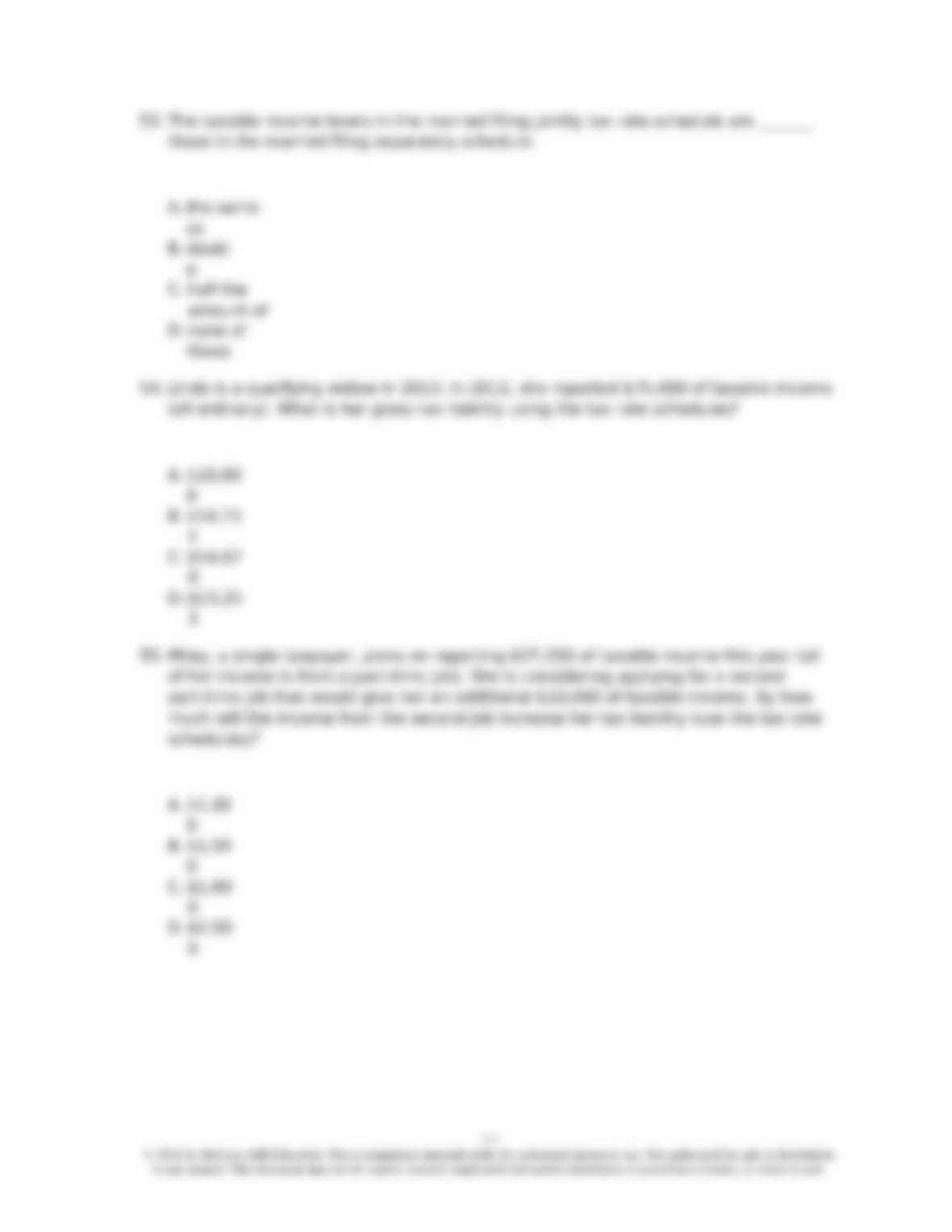
52. Which of the following is not a taxpayer $ling status for purposes of determining the
appropriate tax rate schedule?
A. Head of
Household
B. Qualifying Widow or
Widower
C. Married Filing