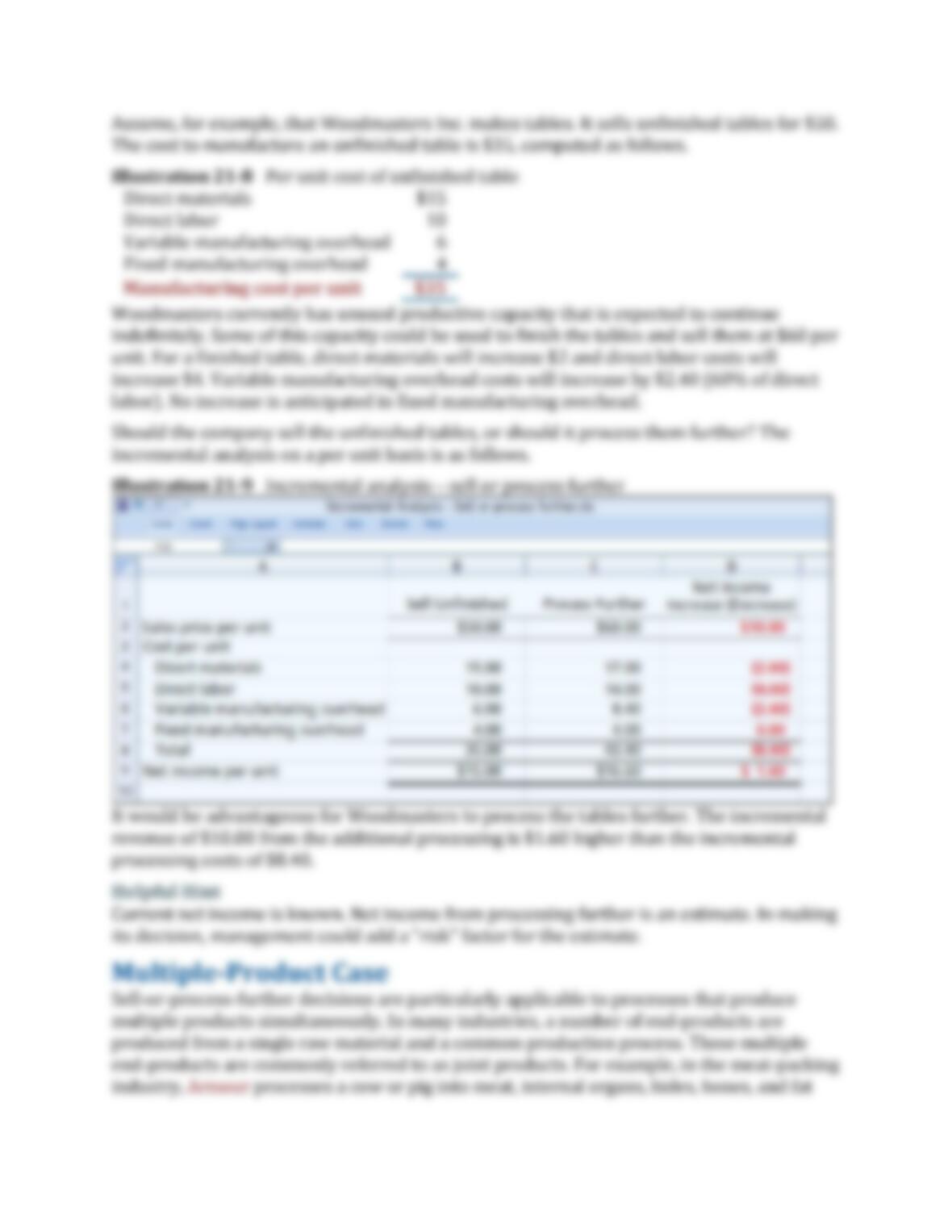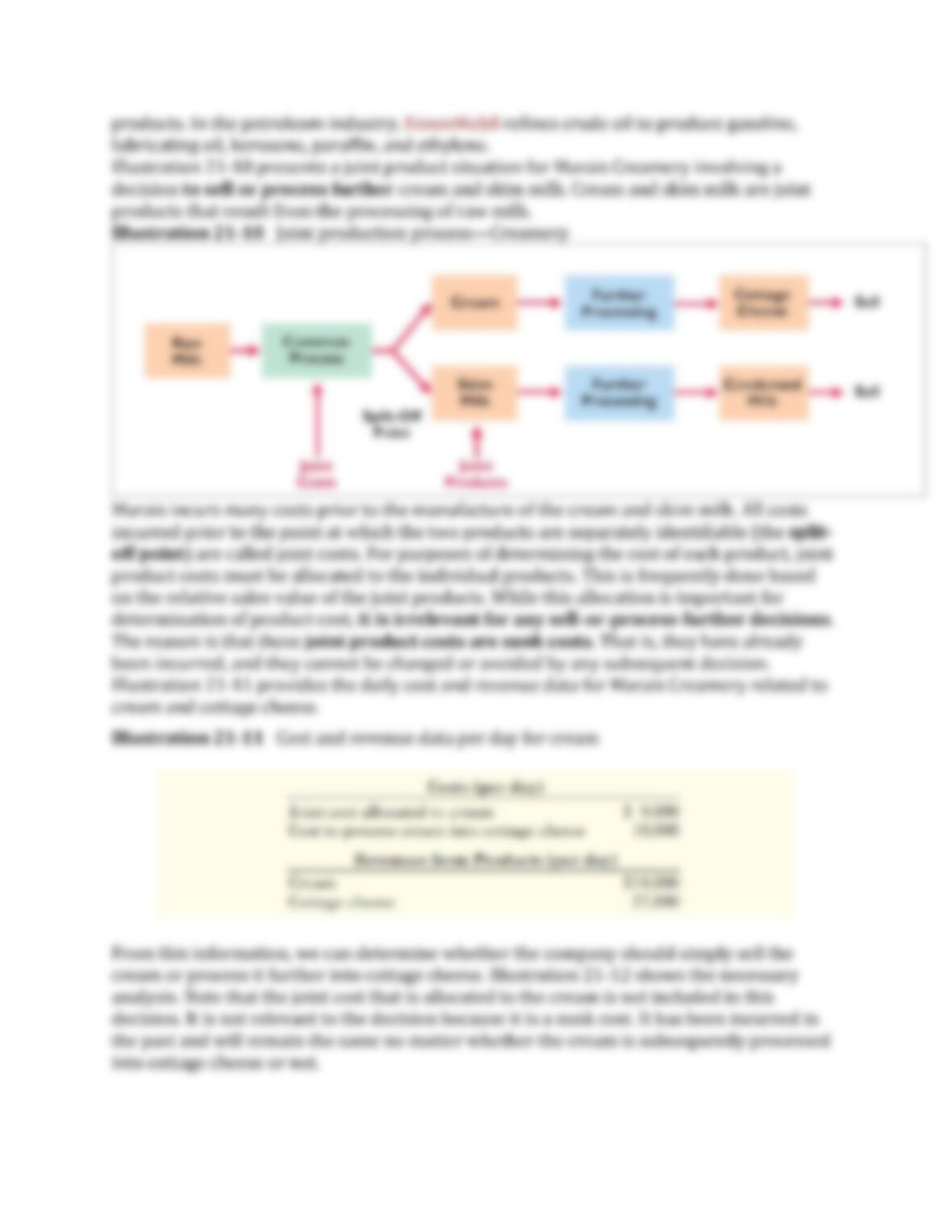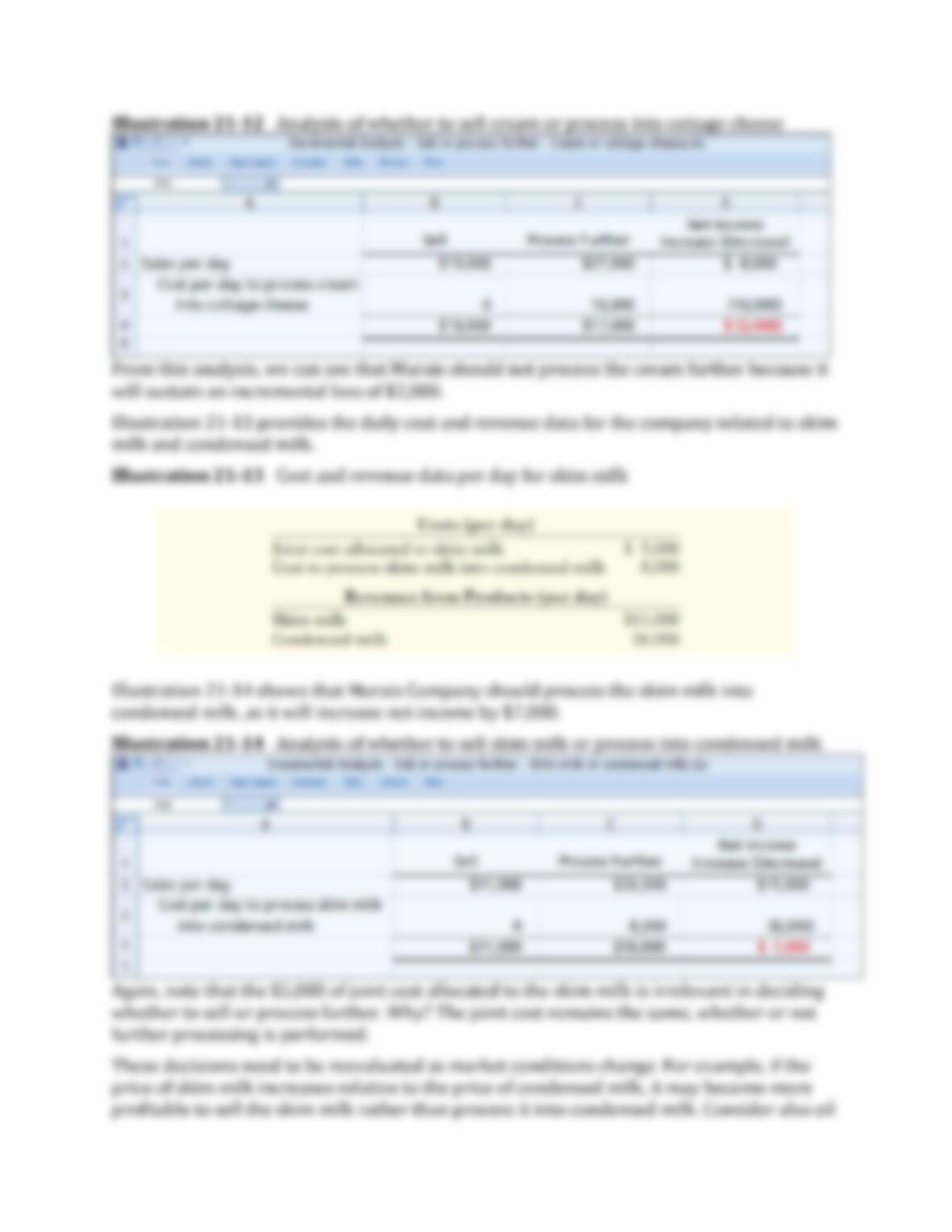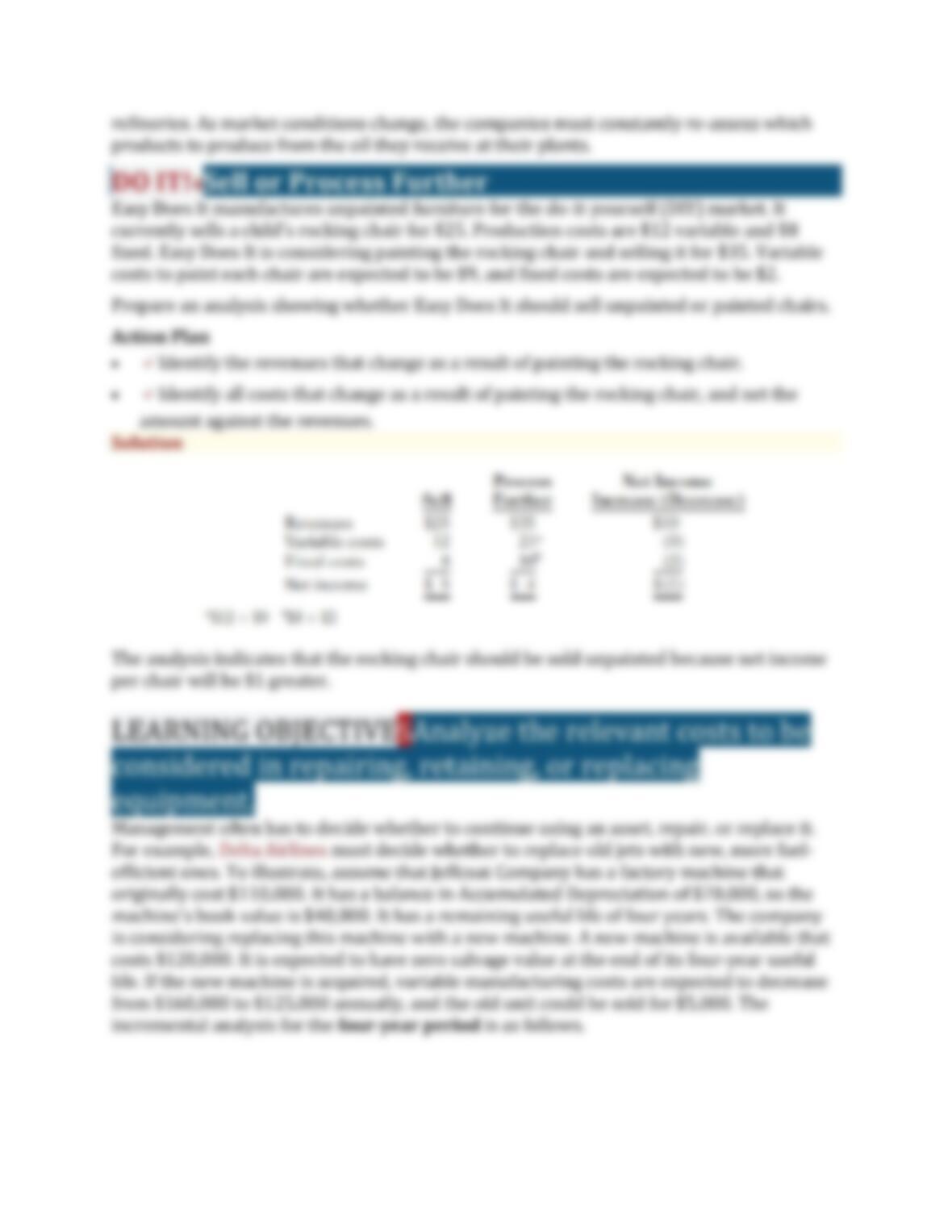
LEARNING OBJECTIVE1Describe management’s decision–
making process and incremental analysis.
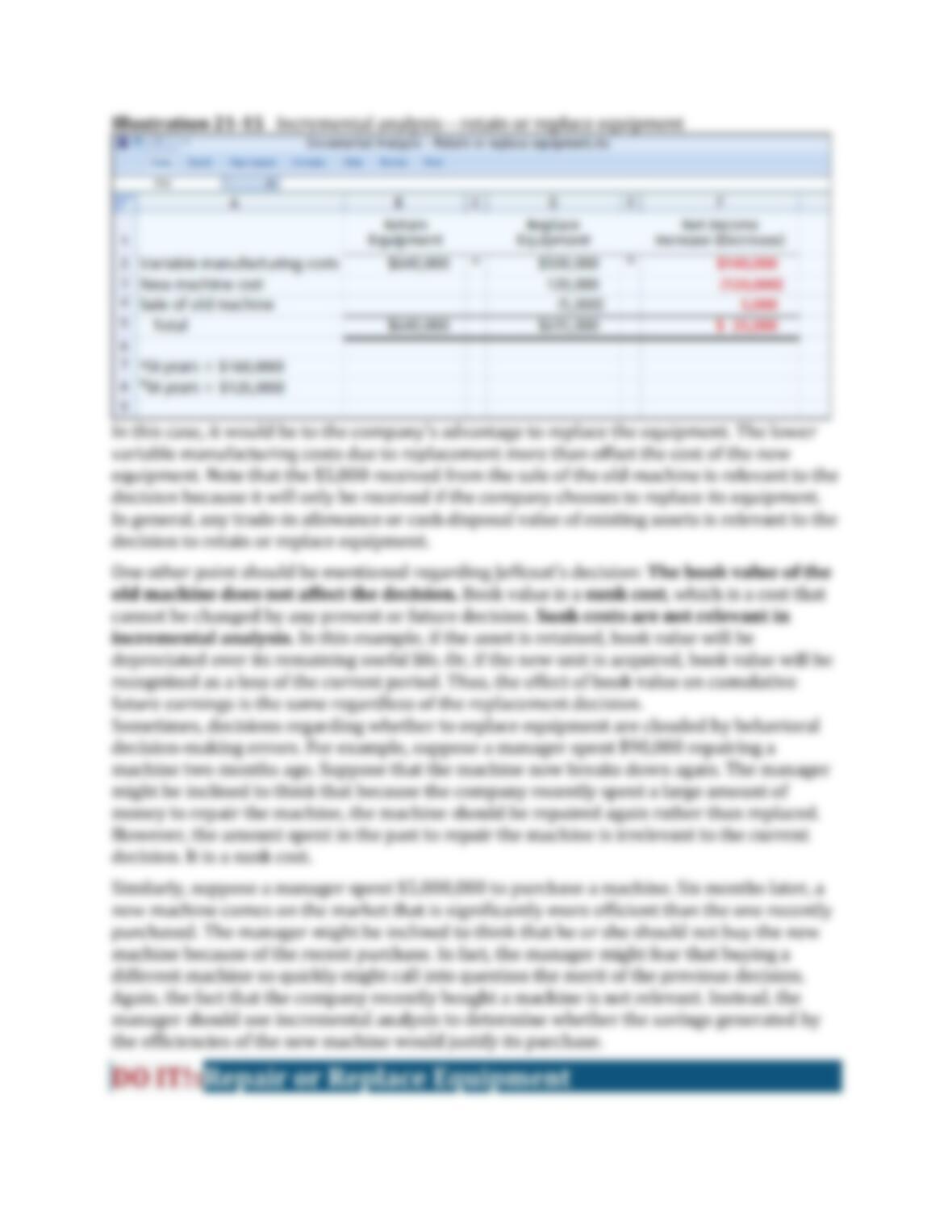
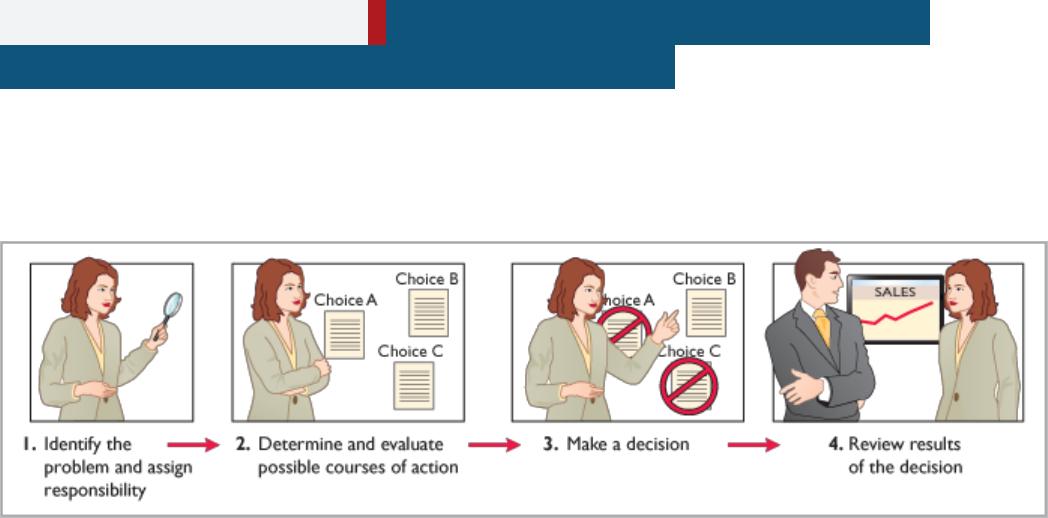
Making decisions is an important management function. Management’s decision-making
process does not always follow a set pattern because decisions vary significantly in their
scope, urgency, and importance. It is possible, though, to identify some steps that are
frequently involved in the process. These steps are shown in Illustration 21-1.
Illustration 21-1 Management’s decision-making process
Accounting’s contribution to the decision-making process occurs primarily in Steps 2 and
4—evaluating possible courses of action and reviewing results. In Step 2, for each possible
course of action, relevant revenue and cost data are provided. These show the expected
overall effect on net income. In Step 4, internal reports are prepared that review the actual
impact of the decision.
In making business decisions, management ordinarily considers both financial and
nonfinancial information. Financial information is related to revenues and costs and their
effect on the company’s overall profitability. Nonfinancial information relates to such
factors as the effect of the decision on employee turnover, the environment, or the overall
image of the company in the community. (These are considerations that we touched on in
our Chapter 15 discussion of corporate social responsibility.) Although nonfinancial
information can be as important as financial information, we will focus primarily on
financial information that is relevant to the decision.
Incremental Analysis Approach
Decisions involve a choice among alternative courses of action. Suppose you face the
personal financial decision of whether to purchase or lease a car. The financial data relate
to the cost of leasing versus the cost of purchasing. For example, leasing involves periodic
lease payments; purchasing requires “up–front” payment of the purchase price. In other
words, the financial information relevant to the decision are the data that vary in the future
among the possible alternatives. The process used to identify the financial data that change
under alternative courses of action is called incremental analysis. In some cases, you will
find that when you use incremental analysis, both costs and revenues vary. In other cases,
only costs or revenues vary.
Just as your decision to buy or lease a car affects your future financial situation, similar
decisions, on a larger scale, affect a company’s future. Incremental analysis identifies the
probable effects of those decisions on future earnings. Such analysis inevitably involves
estimates and uncertainty. Gathering data for incremental analyses may involve market
analysts, engineers, and accountants. In quantifying the data, the accountant must produce
the most reliable information available.
Alternative Terminology
Incremental analysis is also called differential analysis because the analysis focuses on
differences.
How Incremental Analysis Works
The basic approach in incremental analysis is illustrated in the following example.
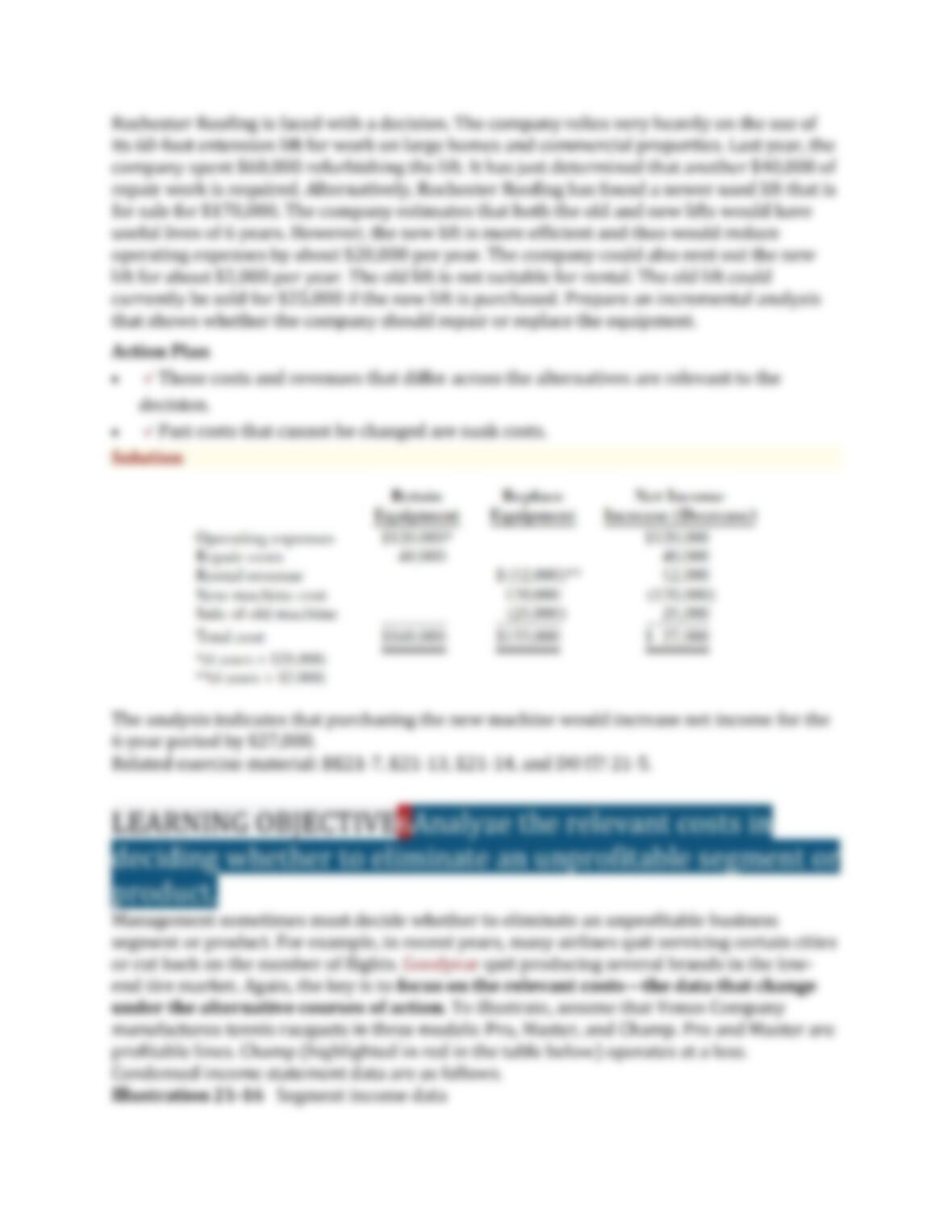
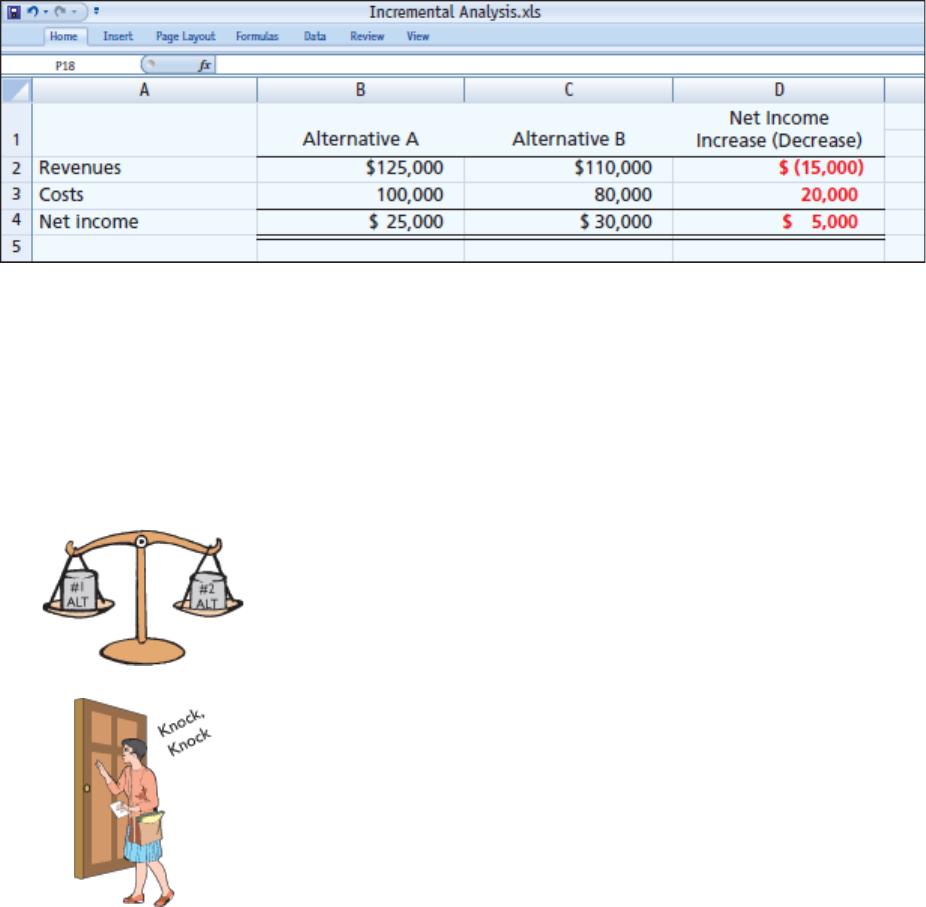
Illustration 21-2 Basic approach in incremental analysis
This example compares Alternative B with Alternative A. The net income column shows the
differences between the alternatives. In this case, incremental revenue will be $15,000 less
under Alternative B than under Alternative A. But a $20,000 incremental cost savings will
be realized.1Although income taxes are sometimes important in incremental analysis, they
are ignored in the chapter for simplicity’s sake. Thus, Alternative B will produce $5,000
more net income than Alternative A.
In the following pages, you will encounter three important cost concepts used in
incremental analysis, as defined and discussed in Illustration 21-3.
Illustration 21-3 Key cost concepts in incremental analysis
• Relevant cost In incremental analysis, the only factors
to be considered are those costs and revenues that differ
across alternatives. Those factors are called relevant
costs. Costs and revenues that do not differ across
alternatives can be ignored when trying to choose
between alternatives.
• Opportunity cost Often in choosing one course of
action, the company must give up the opportunity to
benefit from some other cource of action. For example, if
a machine is used to make one type of product, the
benefit of making another type of product with that
machine is lost. This lost benefit is reffered to
as opportunity cost.
• Sunk cost Costs that have already been incurred and
will not be changed or avoided by any present or future
decisions are referred to as sunk costs. For example, the
amount you spent in the past to purchase or repair a
laptop should have no bearing on your decision whether
to buy a new laptop. Sunk costs are not relevant costs.
Incremental analysis sometimes involves changes that at first glance might seem contrary
to your intuition. For example, sometimes variable costs do not change under the
alternative courses of action. Also, sometimes fixed costs do change. For example, direct
labor, normally a variable cost, is not an incremental cost in deciding between two new
factory machines if each asset requires the same amount of direct labor. In contrast, rent
expense, normally a fixed cost, is an incremental cost in a decision whether to continue
occupancy of a building or to purchase or lease a new building.
It is also important to understand that the approaches to incremental analysis
discussed in this chapter do not take into consideration the time value of money.
That is, amounts to be paid or received in future years are not discounted for the cost of
interest. Time value of money is addressed in Chapter 26 and Appendix G.
Service Company InsightAmerican Express
That Letter from AmEx Might Not Be a Bill
No doubt every one of you has received an invitation from a credit card company to open a new
account—some of you have probably received three in one day. But how many of you have received
an offer of $300 to close out your credit card account? American Express decided to offer some of
its customers $300 if they would give back their credit card. You could receive the $300 even if you
hadn’t paid off your balance yet, as long as you agreed to give up your credit card.
Source: Aparajita Saha-Bubna and Lauren Pollock, “AmEx Offers Some Holders $300 to Pay and Leave,” Wall Street Journal
Online (February 23, 2009).
What are the relevant costs that American Express would need to know in order to determine to
whom to make this offer?
Qualitative Factors
In this chapter, we focus primarily on the quantitative factors that affect a decision—those
attributes that can be easily expressed in terms of numbers or dollars. However, many of

the decisions involving incremental analysis have important qualitative features. Though
not easily measured, they should not be ignored.
Consider, for example, the potential effects of the make-or-buy decision or of the decision
to eliminate a line of business on existing employees and the community in which the plant
is located. The cost savings that may be obtained from outsourcing or from eliminating a
plant should be weighed against these qualitative attributes. One example would be the
cost of lost morale that might result. Al “Chainsaw” Dunlap was a so–called “turnaround”
artist who went into many companies, identified inefficiencies (using incremental analysis
techniques), and tried to correct these problems to improve corporate profitability. Along
the way, he laid off thousands of employees at numerous companies. As head of Sunbeam,
it was Al Dunlap who lost his job because his Draconian approach failed to improve
Sunbeam’s profitability. It was reported that Sunbeam’s employees openly rejoiced for
days after his departure. Clearly, qualitative factors can matter.
Relationship of Incremental Analysis and Activity-Based
Costing
In Chapter 18, we noted that many companies have shifted to activity-based costing to
allocate overhead costs to products. The primary reason for using activity-based costing is
that it results in a more accurate allocation of overhead. The concepts presented in this
chapter are completely consistent with the use of activity-based costing. In fact, activity-
based costing results in better identification of relevant costs and, therefore, better
incremental analysis.
Types of Incremental Analysis
A number of different types of decisions involve incremental analysis. The more common types
of decisions are whether to:
1. Accept an order at a special price.
2. Make or buy component parts or finished products.
3. Sell products or process them further.
4. Repair, retain, or replace equipment.
5. Eliminate an unprofitable business segment or product.
We consider each of these types of decisions in the following pages.
DO IT!1Incremental Analysis
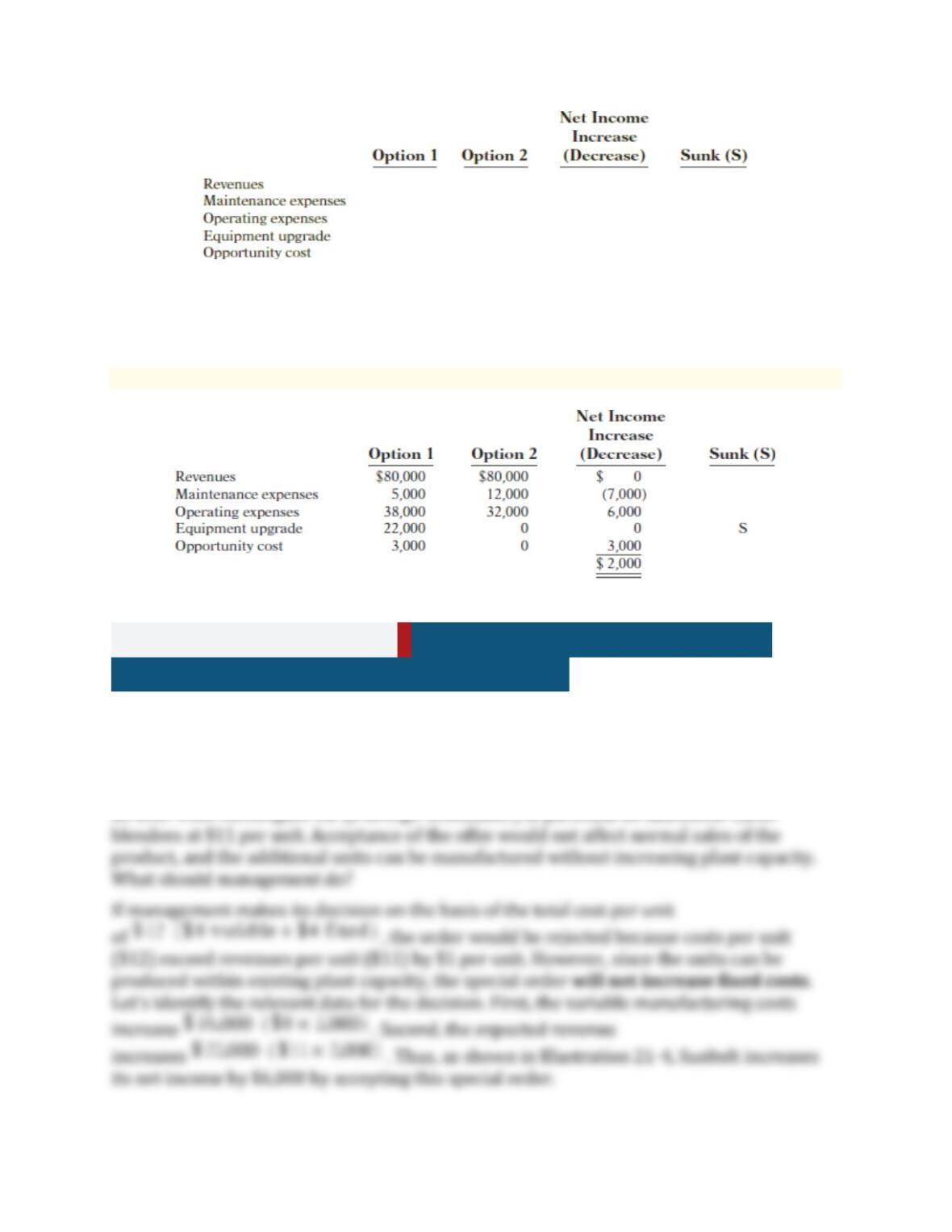
Owen T Corporation is comparing two different options. The company currently follows
Option 1, with revenues of $80,000 per year, maintenance expenses of $5,000 per year, and
operating expenses of $38,000 per year. Option 2 provides revenues of $80,000 per year,
maintenance expenses of $12,000 per year, and operating expenses of $32,000 per year.
Option 1 employs a piece of equipment that was upgraded 2 years ago at a cost of $22,000.
If Option 2 is chosen, it will free up resources that will increase revenues by $3,000.
Complete the following table to show the change in income from choosing Option 2 versus
Option 1. Designate any sunk costs with an “S.”
Action Plan
• ✓Past costs that cannot be changed are sunk costs.
• ✓Benefits lost by choosing one option over another are opportunity costs.
Solution
LEARNING OBJECTIVE2Analyze the relevant costs in
accepting an order at a special price.
Sometimes a company has an opportunity to obtain additional business if it is willing to
make a price concession to a specific customer. To illustrate, assume that Sunbelt Company
produces 100,000 Smoothie blenders per month, which is 80% of plant capacity. Variable
manufacturing costs are $8 per unit. Fixed manufacturing costs are $400,000, or $4 per
unit. The Smoothie blenders are normally sold directly to retailers at $20 each. Sunbelt has