sustainability
Article
Impacts of Environmental Factors on Waste, Energy,
and Resource Management and
Sustainable Performance
Mohd Helmi Ali 1,* , Suhaiza Zailani 2, Mohammad Iranmanesh 3and Behzad Foroughi 3
1Faculty of Economics and Management, Universiti Kebangsaan Malaysia, Selangor 43600, Malaysia
2Faculty of Business and Accountancy, University of Malaya, Kuala Lumpur 50603, Malaysia;
shmz@um.edu.my
3Graduate School of Business, Universiti Sains Malaysia, Penang 11800, Malaysia;
iranmanesh@usm.my (M.I.); foroughi@usm.my (B.F.)
*Correspondence: mohdhelmiali@ukm.edu.my
Received: 18 February 2019; Accepted: 29 March 2019; Published: 25 April 2019
Abstract:
The management of waste, energy, and resources has received special attention from
academics and practitioners due to the growing evidence for its effects on the environment. The aim
of this study is to investigate the environmental drivers of waste, energy, and resource management
and, in turn, its effect on the sustainable performance of manufacturing firms. The data were
collected from a survey of 173 large manufacturing firms in Malaysia and analysed using partial least
squares. The results indicate that although environmental regulatory pressure, customer pressure,
environmental uncertainty, and expected business benefits have positive effects on the extent of waste,
energy, and resource management, social responsibility has no effect. Furthermore, waste, energy,
and resource management has a positive effect on the sustainable performance of large manufacturing
firms. The findings of this study extend the knowledge of the drivers and outcomes of waste, energy,
and resource management. The results can help policymakers to adjust policies and strategies in a
way to inspire managers to implement waste, energy, and resource management.
Keywords:
environmental factors; waste management; energy management; resource management;
sustainable performance
1. Introduction
Industrialization has been rapid in most Asian countries, including China, Indonesia, and Malaysia.
Although industrialization and manufacturing have considerable social and economic benefits [
1
],
they consume both renewable and non-renewable materials, as well as significant amounts of
energy [
2
], and they cause land, water, and air pollution [
3
]. Considering the existence of several global
environmental problems, such as global warming and ozone depletion, there is increasing pressure
from customers, governments, and non-governmental organizations (NGOs) on manufacturers to
act responsibly towards the environment and future generations, and to consider the environmental
impacts of their activities [
4
,
5
]. Additionally, pressures from stakeholders and also material costs and
scarcity push manufacturers to move towards sustainable manufacturing practices, such as reducing
material and energy consumption as well as waste generation [
6
]. As such, research on waste, energy,
and resource (WER) management has received special attention [7,8].
Previous studies on WER management in the context of manufacturing have taken different
directions. One group has examined techniques and practices to minimize resource and energy usage
and waste generation [
9
,
10
]. A second group has investigated the challenges of WER management and
sustainable manufacturing [
11
,
12
]. A third set has evaluated the impacts of WER management on the
Sustainability 2019,11, 2443; doi:10.3390/su11082443 www.mdpi.com/journal/sustainability
Sustainability 2019,11, 2443 2 of 16
environmental, financial and social performance of manufacturers [
13
,
14
]. A fourth group of studies has
focused on the barriers and drivers of successful implementation of environmental initiatives [
15
–
17
].
Although many important aspects of WER management have been covered in the literature, a closer
investigation of the previous studies reveals several gaps. First, the impacts of environmental factors
on the extent of WER management have not been ascertained. Previous studies have shown that
environmental factors such as environmental regulations, customer pressure, social responsibility,
and environmental uncertainty have a significant role in the environmental initiatives of manufacturing
firms [
17
,
18
]. However, no study on the potential relationship between these factors and the extent
of WER management is reported in the literature. To address this gap, the impacts of environmental
factors on WER management of large manufacturing firms were investigated in this study. The focus
of the study is on environmental factors as, for large firms, internal barriers, such as lack of financial
and human resources are not serious obstacles to WER management [
18
]. Second, several studies
have shown the benefits of waste management and reductions in the use of energy and resources
for the environmental, social, and financial performance of firms. However, they tested the direct
impacts of each separate WER management practice on aspects of performance [
19
,
20
]. For example,
Iwata and Okada [
20
] showed that greenhouse gas reduction has a positive effect on long-term
financial performance. To the best of our knowledge, no study has tested the effects of overall WER
management as a second-order construct on overall sustainable performance. Testing the relationship
between WER management and sustainable performance as second-order constructs extends the
literature by answering the question “Do WER management practices overall lead to sustainable
performance?” As firms are now obliged to make efforts to balance their economic, environmental,
and social performance [
21
], it is important to understand the factors that can affect overall sustainable
performance. Furthermore, most studies have focused on the financial and environmental outcomes of
WER management [
19
,
20
] and a study on social outcomes of WER management is lacking. Previous
studies have shown that problems in companies’ social practices have negative effects on their financial
performance (FP) [
21
,
22
]. To address these gaps, this study develops reflective-formative second-order
constructs of both WER management and sustainable performance as core competencies of firms and
investigates the relationship between them.
The findings of this study will contribute to the literature on WER management in three ways.
First, multidimensional formative scales are developed to measure overall WER management as an
integrated single construct. Second, the impacts of environmental factors on the extent of manufacturing
firms’ WER management are investigated. Third, the relationship between overall WER management
and sustainable performance is evaluated. The results can guide policymakers seeking to promote
WER management practices among manufacturing firms. Furthermore, understanding the impacts
of WER management on sustainable performance will help the managers of manufacturing firms to
realize that WER management overall will improve the performance of firms [7,8].
2. Literature Review
2.1. Waste, Energy, and Resource Management
Brundtland [
23
] defines sustainability as “meeting the needs of the present generation without
compromising the ability of future generations to meet their own needs” (p. 8). The definition
of sustainability ranges from an inter-generational philosophical stance to a multi-dimensional
and multi-scale term. The impacts of decisions on future generations are the focus of the
inter-generational philosophical stance. The multi-dimensional focus includes topics related to
the ‘triple-bottom-line’ of balancing corporate social responsibility, including balancing economic,
environmental, and social dimensions of sustainability [
24
]. In this study, sustainable performance
refers to the economic, environmental, and social performance of firms. Economic performance refers
to elements, such as cost reduction and productivity, market share, and profitability enhancement [
25
].
Environmental performance refers to reduction in hazardous materials consumption, waste generation,
Sustainability 2019,11, 2443 3 of 16
energy consumption, and material usage and compliance with environmental regulations [
25
].
Social performance refers to the ability of the firm to meet or exceed stakeholder expectations
regarding social issues and consequently to enhance the firm’s image in the eyes of the general public
and employees [25].
Daly [
26
] introduced three rules that must be met in order to be sustainable: (1) the extraction or
harvest rates of resources should not exceed their regeneration rates, (2) waste and emission generation
rates should not exceed the natural absorption capacities of the ecosystem, and (3) absorption
and regenerative capacities are natural capital, and an inability to keep these capacities represents
consumption of this natural capital which is not sustainable. Today, overall, none of these rules
are being met and humans use energy and resources and produce waste at rates that are greater
than the planet’s natural regeneration and absorption capacities, causing environmental issues such
as global warming and ozone depletion. As such, substantial improvements in the efficiency of
energy and resource use as well as reductions in waste and emission generation are needed [
10
].
WER management is one of the ways to achieve sustainability [
7
,
8
]. Significant amounts of energy and
resources are consumed in manufacturing and significant amounts of waste are produced [
6
]. As such,
there is a need for manufacturers to change their processes and incorporate WER management in
all of their operations. The WER management concept was modelled as a second-order composite
in this study, which comprised waste management, energy management and resource management.
Waste management refers to practices that aim to reduce material consumption and waste production,
such as aspect-impact analysis, the 4R program (reduce, reuse, recycle, and recover), and product life
cycle analysis [
25
]. Energy management refers to practices that aim to reduce energy consumption
and its impact on the environment, such as energy conservation programs, regular energy audit,
using energy efficient equipment, and using renewable energy [
25
]. Resource management refers to
practices that aim to optimize resource usage, such as giving priority to recyclable, repairable, reusable,
renewable, and biodegradable products, regular reviews of the process flow, and implementing a
paperless policy [25].
Integrating WER management into manufacturing sectors is not a new concept. Kurdve et al. [
27
]
studied the tactics and models which help manufacturers to integrate WER management into their
operations. Some studies have combined the concepts of WER management and other manufacturing
practices, such as lean manufacturing [
10
,
28
]. However, few studies have investigated the impacts of
environmental factors on the extent of WER management and also the impacts of WER management
on sustainable performance. Sustainability has three pillars, namely economic, environmental,
and social. As such, achieving sustainable performance requires implementing practices that lead
to better economic, environmental and social performance. Economic performance is the most
important driver for firms, especially in developing countries, in implementing environmentally
friendly practices [
29
]. Nonetheless, it has been reported that environmental practices can provide
competitive advantage, enhance brand reputation, reduce energy, and resource consumption and cost
and reduce waste, and consequently lead to better economic performance in the long-term [
18
,
30
].
Furthermore, environmental practices can stimulate firms to meet their social responsibilities [31].
2.2. Institutional Theory
Institutional theory, proposed by North [
32
], suggests that three external isomorphic
factors—coercive, normative and mimetic [
33
,
34
]—create pressures on firms and drive their decisions
and practices. Coercive pressure refers “to both formal and informal political and regulatory influence
from government or other powerful organisations or the society” [
35
]. Scott [
34
] stated that coercive
pressures push companies to implement a specific management practice. Failing to respond to this
pressure can jeopardize a firm’s legitimacy. Normative pressure refers to “recognised standards that
dictate what behaviours are acceptable in various sectors of activity, such as the values and norms held
by professional associations” [
36
]. Mimetic pressure refers “to a specific behaviour in an organization’s
market and the perceived success of competing organizations that have already adopted it” [
37
].
Sustainability 2019,11, 2443 4 of 16
Previous studies have shown that decisions to adopt and implement environmental initiatives are highly
affected by isomorphic pressures [
17
,
18
]. In the light of institutional theory and literature, the present
study evaluates the impacts of five isomorphic pressures, namely environmental regulatory pressure,
customer pressure, environmental uncertainty, expected business benefits, and social responsibility,
on shaping the WER management practices of manufacturing firms.
The term ‘regulation’ in the present context refers to environmental procedures and rules that
are imposed on firms by the government and regulatory institutions to push them to implement
environmental initiatives such as WER management [
18
,
38
]. Regulation is a commonly cited
driver of firms’ environmental practices [
17
,
18
,
39
], as is customer pressure [
18
,
40
]. According to
Han et al. [
41
] and Han and Hwang [
42
], as customers are increasingly aware of environmental
issues, they impose ever greater pressure on firms to be responsible for the impacts of their activities
on the environment. A previous study introduced environmental uncertainty as another driver of
environmental
practices [43,44]
. Environmental uncertainty refers to the unpredictable and frequent
changes in competitor behaviour, technological development, and customer preferences perceived by
the managers of a firm [
44
]. The uncertain business environment pushes firms to be more proactive
than firms in less turbulent environments [
43
]. Expected business benefits is another isomorphic
pressure that researchers have found to be an important driver of environmental practices [
18
,
40
].
The expected business benefits of implementing environmental practices can be either financial or
non-financial, and include, for example, enhancement of the firm’s reputation, cost reductions and
revenue increases [
45
]. Finally, social responsibility is a kind of normative pressure [
34
] that, according
to the literature, has a substantial effect on firms’ decision to implement environmental practices [
46
,
47
].
Social responsibility refers to “an organization’s sense of responsibility that is voluntarily held by that
organization towards the society and results in its motivations to consider and pursue that particular
society’s welfare” [18].
3. Conceptualization and Hypotheses Development
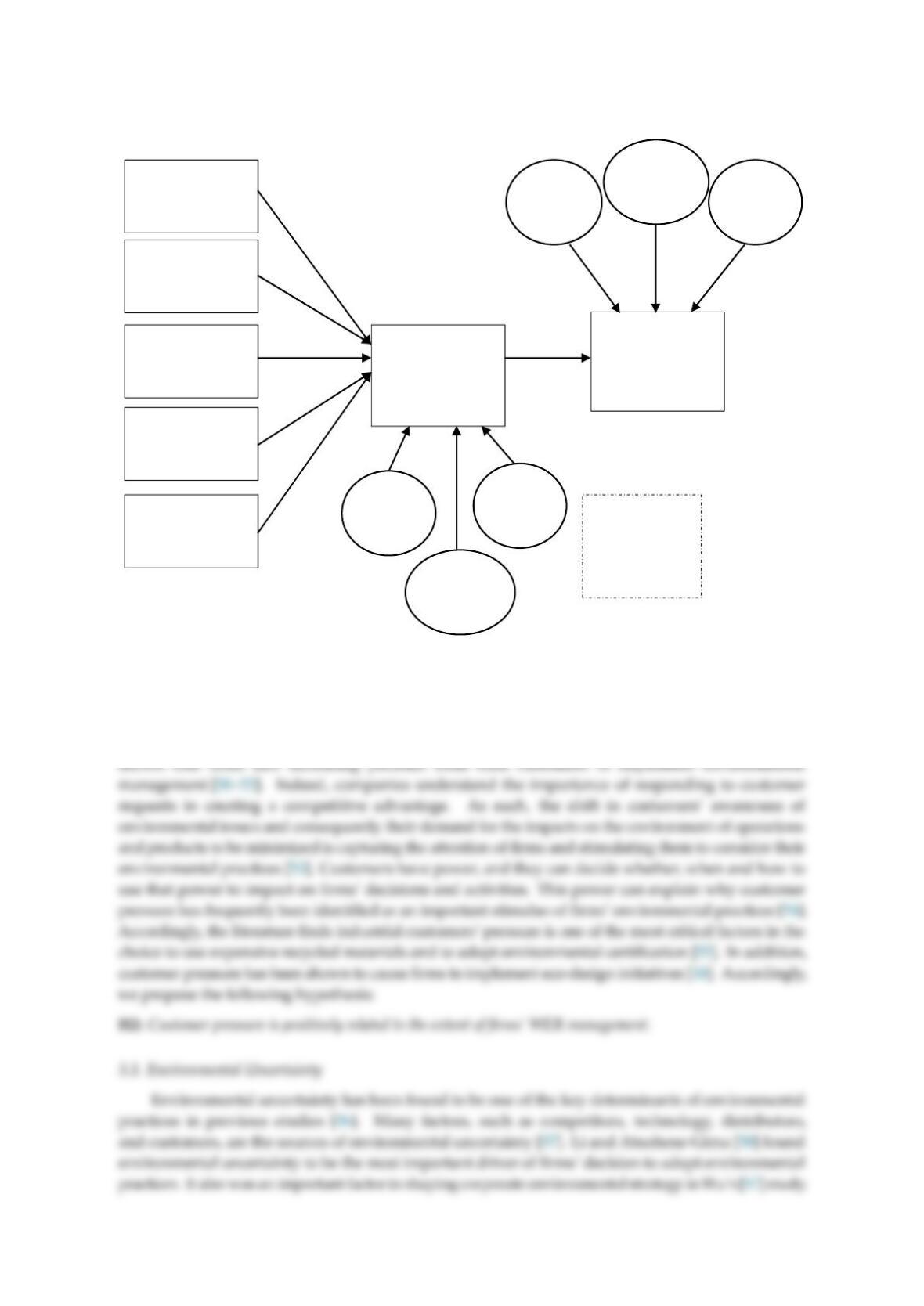
Based on the review of the literature on the drivers of green practices and institutional theory [
48
],
environmental regulatory pressure, customer pressure, environmental uncertainty, expected business
benefits, and social responsibility are proposed as environmental factors that may shape a manufacturing
firm’s extent of WER management and consequently its sustainable performance (Figure 1). In the
following subsections, the hypotheses are developed and supported.
3.1. Environmental Regulatory Pressure
Regulations are considered as coercive mechanisms that impose pressure on firms to perform
specific practices [
34
]. These regulations, standards and rules that include elements of imposition and
inducement may come from government, parent companies as well as international organizations.
Previous studies have shown that regulatory pressures are the most powerful factor to motivate
firms to implement environmental practices and be responsible for the effects of their activities on the
environment [
48
]. Cheng et al. [
49
] asserted that environmental regulatory pressure is the main driver of
firms’ decision to adopt environmental practices in their activities. Testa et al. [
50
] found that regulatory
pressures force firms to reduce their environmental impact and improve their energy efficiency. In the
context of climate change, it is expected that environmental regulations will become more stringent
and firms will face greater pressure to comply with environmental good practice (e.g., reduce material
consumption, implement an energy conservation programme, optimize resource usage and have
specific objectives for waste management). This will not only help them to meet the requirements of
regulations but will also give them competitive advantage. Therefore, it is proposed that environmental
regulatory pressures affect the extent of WER management of firms. Thus, we hypothesize that:
H1: Environmental regulatory pressure is positively related to the extent of firms’ WER management.
Sustainability 2019,11, 2443 5 of 16
Sustainability 2019, 11, x FOR PEER REVIEW 5 of 16
Figure 1. Conceptual framework.
3.1. Environmental Regulatory Pressure
Regulations are considered as coercive mechanisms that impose pressure on firms to perform
specific practices [34]. These regulations, standards and rules that include elements of imposition and
H1
H2
H3
H4
H5
H6
Environmental
Regulatory
Pressure
Customer Pressure
Environmental
Uncertainty
Expected Business
Benefits
Social
Responsibility
Waste, Energy
and Resource
Management
Sustainable
Performance
Economic
Performance
Environmental
Performance Social
Performance
Waste
Management
Energy
Management
Resource
Management Control
Variable
ISO 14000
Figure 1. Conceptual framework.
3.2. Customer Pressure
Customers are the main financial stakeholders of firms and have the power to exert considerable
pressure on them to behave in an environmentally friendly manner [
51
]. Previous studies have
Sustainability 2019, 11, x FOR PEER REVIEW 10 of 16