Thanks to global competition, faster product development, and increasingly flexible
manufacturing systems, an unprecedented number and variety of products are competing in
markets ranging from apparel and toys to power tools and computers. Despite the benefits to
consumers, this phenomenon is making it more difficult for manufacturers and retailers to
predict which of their goods will sell and to plan production and orders accordingly.
As a result, inaccurate forecasts are increasing, and along with them the costs of those errors.
Manufacturers and retailers alike are ending up with more unwanted goods that must be
marked down—perhaps even sold at a loss—even as they lose potential sales because other
articles are no longer in stock. In industries with highly volatile demand, like fashion apparel,
the costs of such “stockouts” and markdowns can actually exceed the total cost of
manufacturing.1
To address the problem of inaccurate forecasts, many managers have turned to one or another
popular production-scheduling system. But quick-response programs, just-in–time (JIT)
inventory systems, manufacturing resource planning, and the like are simply not up to the task.
With a tool like manufacturing resource planning, for example, a manufacturer can rapidly
change the production schedule stored in its computer when its original forecast and plan prove
incorrect. Creating a new schedule doesn’t help, though, if the supply chain has already been
filled based on the old one.
Similarly, quick response and JIT address only part of the overall picture. A manufacturer
might hope to be fast enough to produce in direct response to demand, virtually eliminating the
need for a forecast. But in many industries, sales of volatile products tend to occur in a
concentrated season, which means that a manufacturer would need an unjustifiably large
capacity to be able to make goods in response to actual demand. Using quick response or JIT
also may not be feasible if a company is dependent on an unresponsive supplier for key
components. For example, Dell Computer Corporation developed the capability to assemble
personal computers quickly in response to customers’ orders but found that ability constrained
by component suppliers’ long lead times.
We think that manufacturers and retailers alike can greatly reduce the cost of forecasting errors
by embracing accurate response, a new approach to the entire forecasting, planning, and
production process. We believe that companies can improve their forecasts and simultaneously
redesign their planning processes to minimize the impact of inaccurate forecasts. Accurate
response provides a way to do both. It entails figuring out what forecasters can and cannot
predict well, and then making the supply chain fast and flexible so that managers can postpone
decisions about their most unpredictable items until they have some market signals, such as
early-season sales results, to help correctly match supply with demand.
Accurate response helps retailers improve forecasts and redesign planning processes to
minimize the impact of inaccurate forecasts.
This approach incorporates two basic elements that other forecasting and scheduling systems
either totally or partially lack. First, it takes into account missed sales opportunities. Forecasting
errors result in too little or too much inventory. Accurate response measures the costs per unit
of stockouts and markdowns, and factors them into the planning process. Most companies do
not even measure how many sales they have lost, let alone consider those costs when they
commit to production.

Second, accurate response distinguishes those products for which demand is relatively
predictable from those for which demand is relatively unpredictable. It does this by using a
blend of historical data and expert judgment.
Those two elements help companies rethink and overhaul not only every important aspect of
their supply chains—including the configuration of their supplier networks, schedules for
producing and delivering unfinished materials, transportation, and the number and location of
warehouses—but also the designs of their products. Armed with the knowledge of which
products have predictable demand and which do not, they can then take different approaches to
manufacturing each class of product. Those in the relatively predictable category should be
made the furthest in advance in order to reserve greater manufacturing capacity for making
unpredictable items closer to the selling season. Such a strategy enables companies to make
smaller quantities of the unpredictable products in advance, see how well the different goods
fare early in the selling period, and then use that information to determine which products to
make more of.
Accurate response thus enables companies to use the power of flexible manufacturing and
shorter cycle times much more effectively. And the capability to do a better job of matching
supply and demand produces savings that drop straight to the bottom line. One supplier in the
fashion-ski-apparel business, Aspen, Colorado-based Sport Obermeyer, Ltd., has slashed its
mismatch costs in half by using accurate response.
By dramatically reducing mismatch costs, this approach also gives companies the option of
taking a further action: lowering prices. Currently, suppliers, distributors, and retailers alike
build mismatch costs into their prices. In other words, they try to make consumers pay more to
cover the cost of inaccurate forecasts.
For companies that deal with new or seasonal products, the accurate response approach
is essential.
Clearly, companies that make or sell products with long lifetimes and steady sales do not need
to make such changes to their forecasting and planning systems. Forecasts for those products
are likely to be consistently close to the mark, and in any case, the long lifetimes of such
products greatly reduce the cost of any forecast inaccuracy. But for companies that deal with
products that are new or highly seasonal, or have short lifetimes, the accurate response
approach is essential. Any manufacturer whose capacity is constrained during peak production
periods can benefit from making better use of its off-peak capacity. And any retailer that has
difficulty predicting demand can likewise benefit by learning which products to order in bulk
before the selling season and which to order in increments during the season.
The Growing Need to Face Demand Uncertainty
A few companies are already using some of the techniques incorporated in accurate response.
The Timberland Company, the fast-growing New Hampshire-based shoe manufacturer, for
example, has developed a sophisticated production-planning system linked to a sales-tracking
system that updates demand forecasts. Those systems, along with efforts to reduce lead times in
obtaining leather from tanners, have enabled the company to reduce stockout and markdown
costs significantly.

L.L. Bean, the Maine outdoor-sporting-goods company, has started to use its understanding of
uncertainty to drive its inventory-planning decisions. As a direct marketer, Bean finds it easy to
capture stockout data. Having discovered that forecasts for its continuing line of “never out”
products are much more accurate than those for its new products, Bean estimates demand
uncertainty differently for each category and then uses those estimates in making product–
supply decisions.
But most companies still treat the world as if it were predictable. They base production
planning on forecasts of demand made far in advance of the selling season to provide ample
time for efficient production and distribution. And when that approach results in shortages of
some products, and in pipelines filled with obsolete components and finished goods because
anticipated hot sellers have bombed, it is generally seen as a forecasting problem. Everyone
unfairly blames the forecasters.
Most organizations do a poor job of incorporating demand uncertainty into their
production-planning processes.
The real problem, though, is that most companies do a poor job of incorporating demand
uncertainty into their production-planning processes. They are aware of demand uncertainty
when they create a forecast—witness the widespread reliance on safety stocks—but they design
their planning processes as if that initial forecast truly represented reality. They do this for two
reasons. First, it’s complicated to factor multiple demand scenarios into planning; most
companies simply don’t know how to do it. Second, the dramatic increase in demand
unpredictability is fairly recent, so most companies haven’t yet changed their planning systems
to adapt to it. The result, as shown by the sharp increase in department store markdowns in the
past two decades, has been catastrophic. (See the graph “Skyrocketing Markdowns in the Retail
Industry.”)
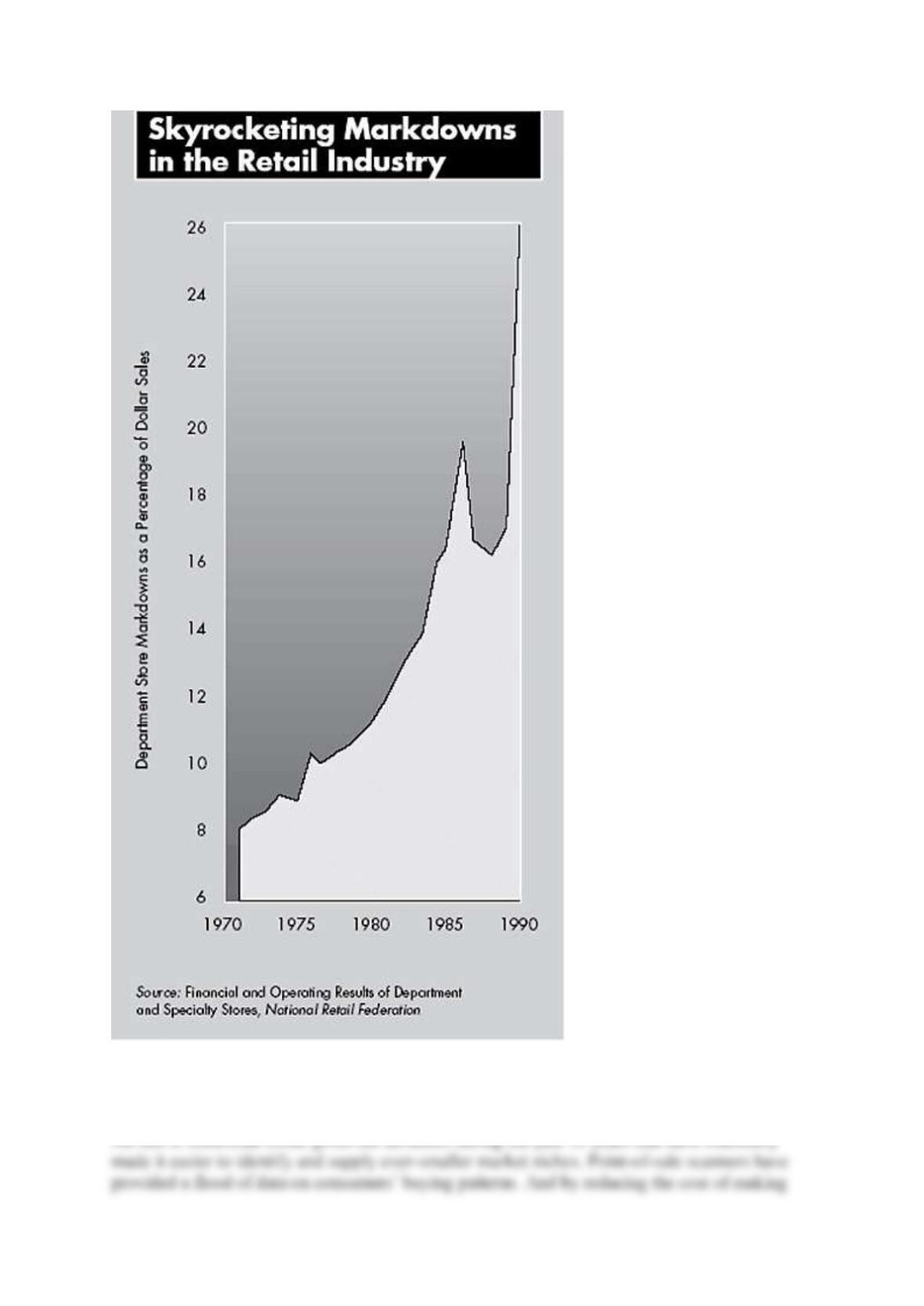
Skyrocketing Markdowns in the Retail Industry Source: Financial and Operating Results of
Department and Specialty Stores, National Retail Federation