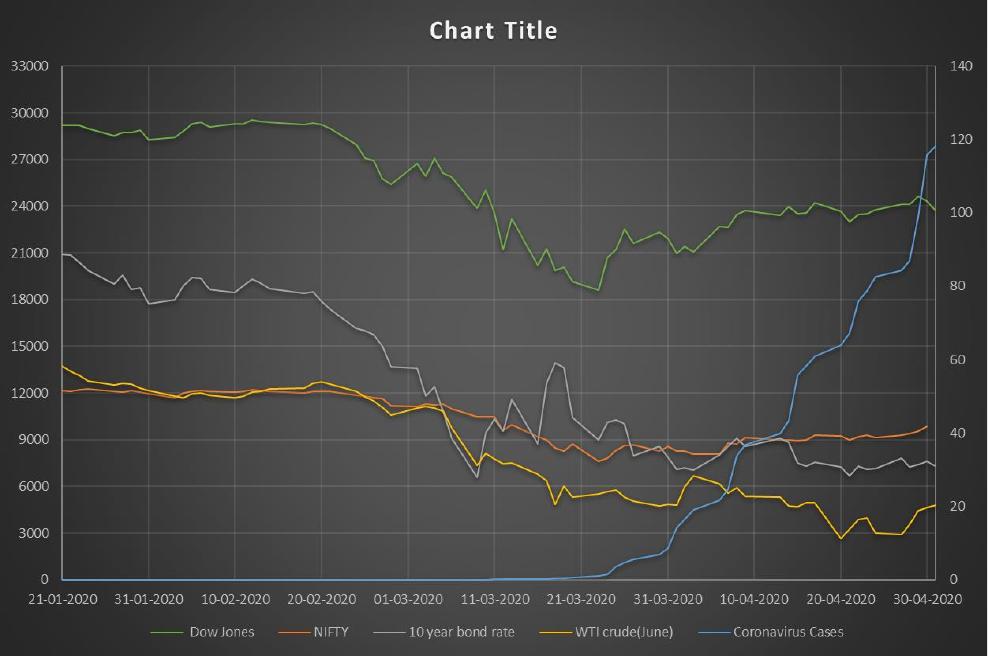
• The first coronavirus case was found on 21st Jan in the country, during that time the Dow jones
was bullish at 29196.4 and the 10-year government bond yield was steady at 1.77%.
• Federal Reserve met on 29th Jan leaving the target range for its federal funds rate unchanged at
1.5-1.75 percent, saying the current stance of monetary policy is appropriate to support
sustained expansion of economic activity, strong labour market conditions, and inflation
returning to the 2 percent objective and the interest on excess reserves rate (IOER) was raised
by 5 basis points to 1.6%.
• On 30th Jan, WHO declared 2019-nCOV outbreak a public health emergency of international
concern. The number of cases in the country was only 5 so the news had minimal impact on Dow
jones and bond rates.
• On 11th Feb, The FED Reserve chairman in an official statement stated that monetary policy may
no longer be sufficient to fight the next recession. The market overlooked these statements from
the FED chair and Dow Jones was at a high of 29551.42.
• On 21st Feb, WHO Director general warned that window of opportunity to contain virus was
narrowing. This weakened the investor sentiments and in the next 10 days Dow Jones fell nearly
8% and the 10-year G-sec yield went down to 1.15%.
• On 3rd March, the FED reserve had to lower the target range for its federal funds rate by 50bps
to 1-1.25%, interest on excess reserves rate (IOER) was also cut by 50bps to 1.1%. This action
helped the Dow Jones climb around 1100 points from 25920 to 27090.
• But due to increasing coronavirus cases, weak investor sentiments and an oil war between Saudi
Arabia and Russia the Dow Jones crashed around 2000 points in a single day on 9th March.
• To make things worse, Trump announced a temporary 30-day travel ban against Europe on 11th
March and the Dow Jones on 12th March saw another 2300 points crash coming down 23500 to
21200. The 10-year G-sec rate was at 0.81% showing the investors were turning to safer haven.
• On 16th March, US news channels stated that coronavirus could extend till august. Federal
Reserve lowered the target range for its federal funds rate by 100bps to 0-0.25 percent and
launched a massive $700 billion quantitative easing program during an emergency move on to
protect the US economy from the effects of the coronavirus, but the damage was done in the
equity markets, Dow Jones saw its biggest one day drop of 3000 points(13%) and the 10-year G-
sec yield went down to 0.74%.
• On 18th March, scientists stated that it would take 18 months to make a vaccine, due to this
news the Dow Jones came another 1500 points to 18500.
•