VAT, GST AND ITS IMPACT
SUBMITED BY
Group no: 10:Shweta,Shankesh Singh,Manika Temani
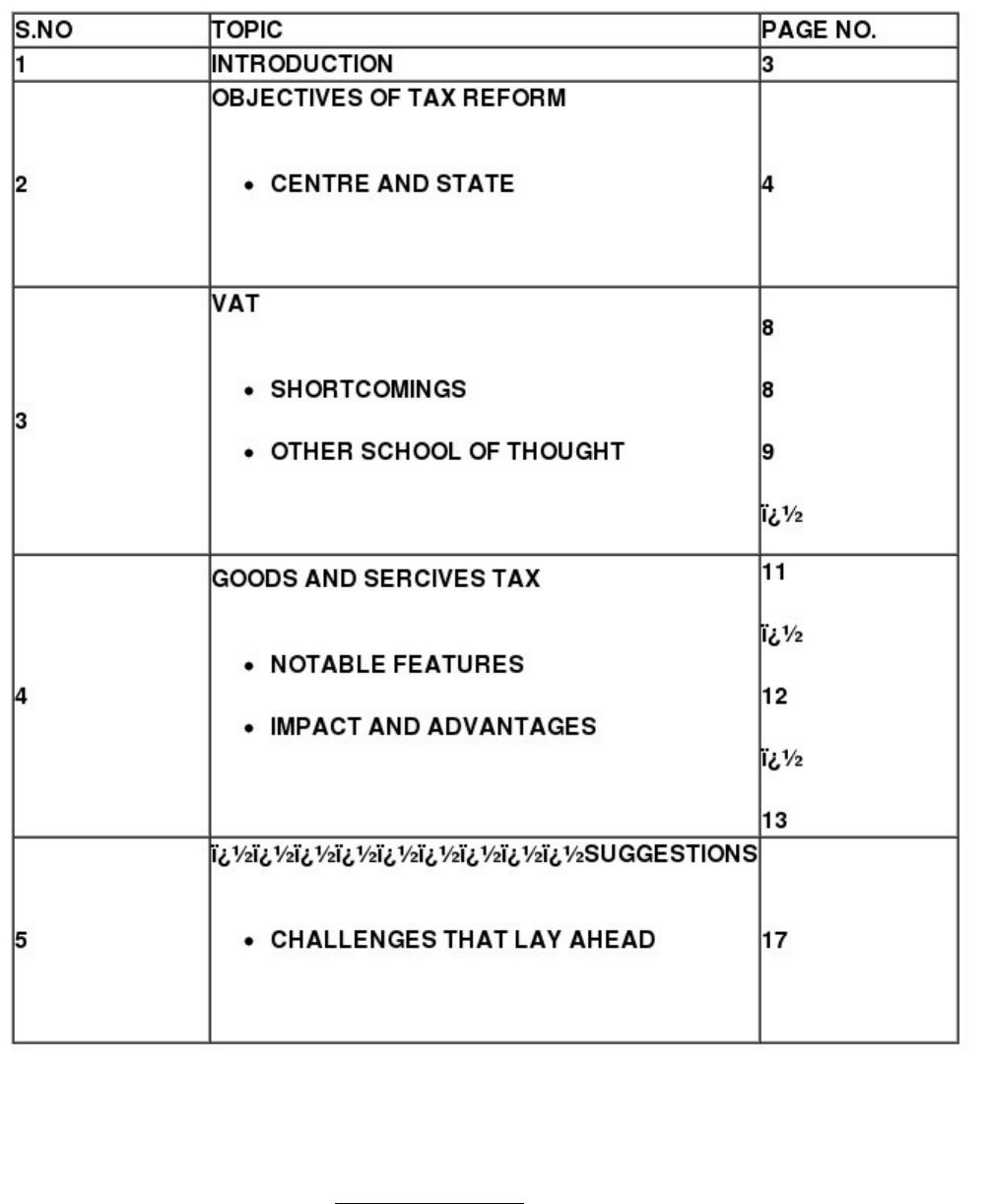
INDEX
INTRODUCTION
Tax earning is one of the most important sources of revenue for any government. In India,
tax is basically of two types – Direct Tax and Indirect Tax. The direct tax is directly paid to
the government by individuals. Income tax is a good example of this type of taxation.
Indirect tax (such as sales tax, value added tax, or goods and services tax), on the other
hand, is a tax collected by an intermediary (such as a retail store) from the person who
bears the ultimate economic burden of the tax (such as the customer). In this paper we
focus on the functioning of indirect tax to generate revenue across states of India. It can be
well observed from various data sources that commercial tax i.e. the tax on goods and
services in India, contributes almost a quarter of the total revenue collected across the
nation. In the recent past also commercial tax has been a significant contributor in total
taxes collected by the central as well as state governments. From the year 2003,
Government of India introduced Value Added Tax (referred to as VAT) over Sales Tax
(referred to as ST) for the commercial sector. The main motive of the Government behind
this move was to introduce transparency and raise the efficiency of the tax collection
system (The Empowered Committee of State Finance Ministers, 2009).
The model of taxation of goods followed in India for more than fifty years post
–independence was characterized by cascading and distortionary tax on production. A
cascade tax or cascading tax is a turnover tax that is applied at every stage in the supply
chain, without any deduction for the tax paid at earlier stages. Such taxes are distorting in
that they create an artificial incentive for vertical integration. These according to many led
to misallocation of resources and dampen economic growth. Such cascading effects
ultimately have a negative impact on the tax base thereby hindering the process of revenue
generation and resource mobilization of the Government. To address this major problem of
the prevailing taxation-system, VAT was introduced in early years of twentieth century. A
VAT is a form of consumption tax. From the perspective of the buyer, it is a tax on the
purchase price. From that of the seller, it is a tax only on the value added to a product.VAT
in theory avoids the cascade effect of ST by taxing only the value added at each stage
of production. It was thought that VAT would address the problems of the existing
system of taxes and is seen as an important breakthrough in the sphere of indirect tax
reform in India.
Even after two decades of reforms the system of domestic trade taxes in the country
remains deficient. The idea of a unified GST was coined by Kelkar Task Force around 7-8
years ago. Ever since, a widely held presumption has been that GST will be a single VAT
to be levied nationally replacing both the Cen.VAT and the VATs now being levied at the
state level. The FMs statement setting a target date for having a national GST in place “that
should be shared between the Centre and the states” may seem to strengthen this
presumption.The idea of a single, unified tax on goods and services administered only
by the central government is hugely attractive to many, particularly businesses.

•OBJECTIVES OF TAX REFORM
The basic objective of tax reform would be to address the problems of the current system
discussed above. It should establish a tax system that is economically efficient and neutral
in its application, distributional attractive, and simple to administer.
Distributional or sectoral concerns have been at the heart of the excessive differentiation of
the Indian tax system—but that the objectives are negated by the cascading effects of the
taxes. While an optimal design of the consumption tax system, taking into account both
production efficiency and distributional concerns, would not imply uniformity of the
overall tax structure, the desired structure can be achieved by a combination of taxes and
transfers. Ahmad and Stern (1991) analyze the optimal pattern of tax rates implied by a
given degree of aversion to poverty and concern for the poor.At high levels of concern for
the poor, one would reduce the tax on cereals (but not dairy products) and increase the
taxes on non-food items (durables). Thus, a differentiated overall structure appears
desirable for a country in which the government has consistently expressed a concern
for the poor.However, individual taxes should not be highly differentiated, as that
complicates administration and makes it difficult to evaluate the overall effects of the tax
design. This applies particularly to value-added type of taxes. In principle, a single rate (or
at the most two-rate) VAT, together with excises and spending measures could achieve the
desired distributional effects, for reasonable degrees of inequality aversion of policy
makers.
In particular, it is important from an administrative perspective that close substitutes
should not be taxed at very different rates—to avoid leakages and distortions. Revenue
considerations suggest that the tax base should be broad, and comprise all items in the
consumer basket, including goods, services, as well as real property.
The neutrality principle would suggest that the tax be a uniform percentage of the final
retail price of a product, regardless of the supply-chain arrangements for its manufacturing
and distribution; the tax on inputs be fully creditable to avoid tax cascading; and the tax be