MKT 6046 | IMC Plan | Taylor Cavins and Negin Miresmaily
ALLIANT
INTERNATIONAL
UNIVERSITY
Integrated Markeng Communicaon Project:
Tesla’s New Model M
Integrated Marketing Communications Project: Tesla’s New Model M 1
Tesla is an automotive company that strives to provide electric powered transportation to
the masses. With the price of oil and gas skyrocketing in the last decade, Tesla has led the market in
electric power technology for the automotive industry. I am excited to announce the upcoming
changes as the newly appointed International Marketing Manager of Tesla Motors, Incorporated.
Starting today, we are starting development of the first line of e-motorcycles. This groundbreaking
introduction from Tesla will be set for international launch eight weeks from today. Product, place,
price, and promotion will be the focus of this outline as Tesla diversifies its product line and expands
to the Chinese market.
The “Model M” e-motorcycle product line will be marketed to the demanding Chinese
market. This state-of-the-art product satisfies the need for low-cost mobility to China. Most major
cities in the world are too crowded to accommodate all of the people, much less cars. This product
includes the quality and reputation of Tesla Motors with fully interactive touch screen controls and
digital display that are disabled during operation for safety. The honeycomb reinforced aluminum
frame body is a market leading advancement for lightweight, durable, and cost-efficient
manufacturing. To cut on production costs, the only color offerings will be black, white, and gunmetal.
This will be marketed as “the closest thing to a luxury car, on two wheels.” An advantage to selling in
the Chinese market is that we can leverage our Western brand since it is associated with quality and
trust (Harrison & Hedley, 2010). With two options to choose from, we will be able to entice a range of
customers. From lower income families to wealthy motorcycle enthusiasts, our products will inspire
community and pride. Customization is an important aspect of marketing to the Asian markets
(Kotabe & Helsen, 2013, p.20). The availability of upgrades, or add-ons, will inspire the Chinese to
build their own personal product with the Tesla name. Giving them the opportunity to create and
personalize the product seems to increase the likelihood of acceptance.
We are targeting the Chinese market due to their acceptance of two-wheeled transportation
and the large number of overpopulated cities. According to Statista, “China has the largest domestic
motorcycle market worldwide. As of 2012, every fifth Chinese household owned a motorcycle. In
comparison, a statistic demonstrates that only 2.5 percent of U.S. households owned a motorcycle”
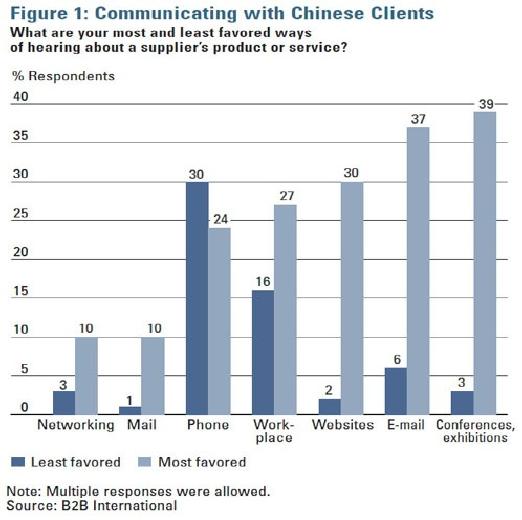
(China: Motorcycle and scooter possession by income 2013). According to this chart from the China
Business Review, we will advertise to the market through conferences, exhibitions, websites, and
email (2010). Even though Tesla is marketing to China exclusively, our standardized efforts will
increase opportunities to coordinate across markets and integrate with future opportunity (Kotabe &
Helsen, 2013, p.19).

Integrated Marketing Communications Project: Tesla’s New Model M 2
In 2013, 26 percent of respondents earning up to 2,000 Yuan owned a motorcycle or a motor
scooter for private use in China (China: Motorcycle and scooter possession by income 2013). This
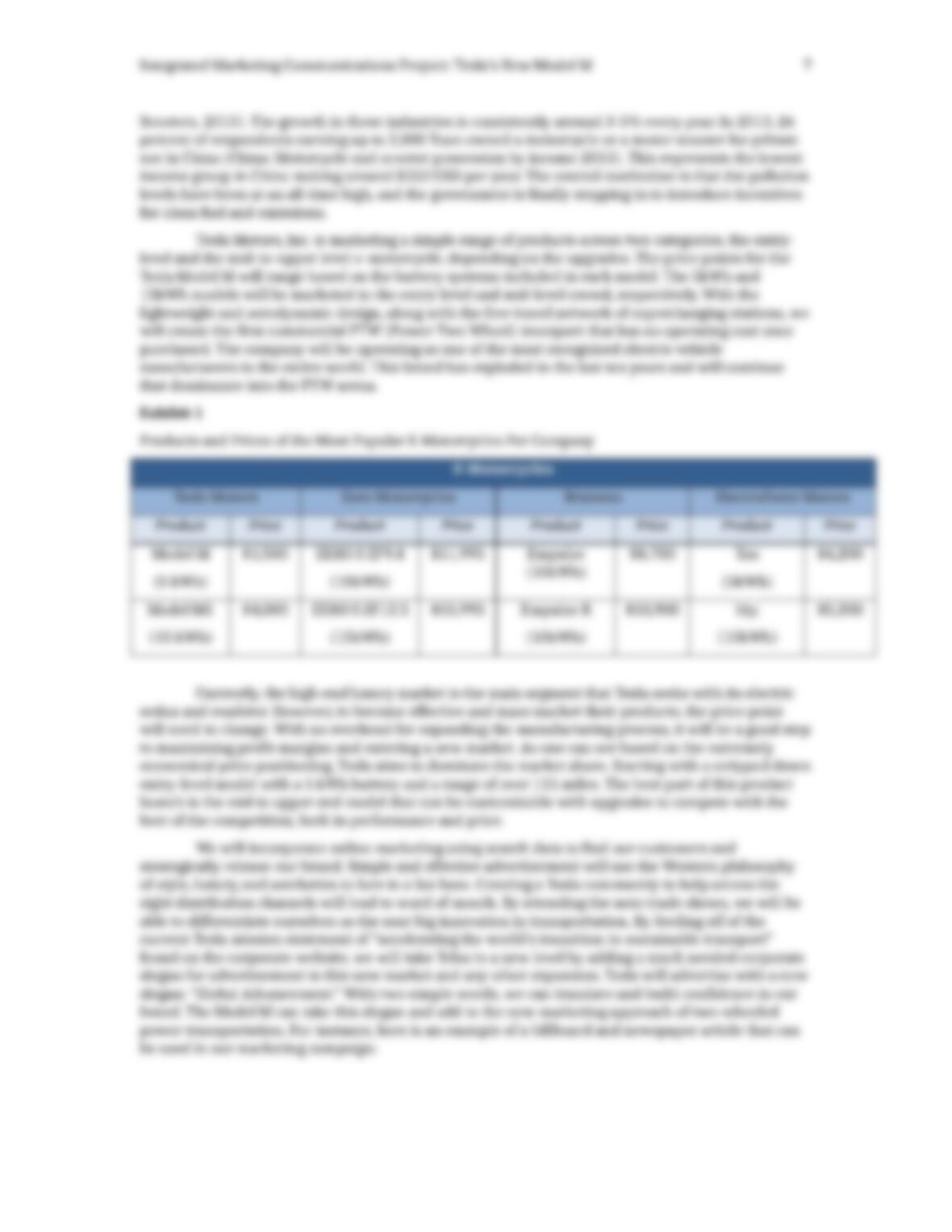
represents the lowest income group in China making around $350 USD per year. The price points for
the Tesla Model M will range based on the battery systems included in each model. The 10kWh and
25kWh models will be marketed to the entry-level and mid-level crowd, respectively. With the
lightweight and aerodynamic design, along with the free travel network of supercharging stations, we
will create the first commercial PTW (Power Two Wheel) transport that has no operating cost once
purchased. Compared to our competitors, our price will appear higher. However, the total cost of
ownership will be the number that we will compare to our competitors and immediately overwhelm
our rivals. Leading in the technological advances for this industry and being accessible to all income
levels will make this the most successful marketing campaign the automotive industry has seen. The
10kWh model will cost a flat $2,000 USD, and the 25kWh model will start at $4,000 USD with
upgrades available. These upgrades will be bolt-on additions to the baseline product and will lead to
increased profit margin. Low-cost and customizable financing is normal across the Asian markets and
will give us an edge in pursuing the lower income families with long-term payments (Kotabe &
Helsen, 2013, p.20).
As mentioned earlier, Tesla will depend heavily on the online marketing. According to the
China Business Review, “The number of Internet users in China exceeds 400 million, making China
the world’s largest online community” (Harrison & Hedley, 2010). Due to this fact, being associated to
the artistic and interactive website that Tesla currently offers will be crucial in attracting the Chinese
consumers. There is not a specific time that is best to market this brand. With a national tour called
“Discover the future of driving in [insert city name here],” Tesla will advertise and have exhibitions to
network and interact with our products. These events will last anywhere from a couple of days to an
entire month, depending on the size of the demographic. With the focus on Internet marketing, the
cost of promotion will be greatly decreased. From very little research, you will notice that the
exhibition schedule for new technology and the automobile market is year-round throughout China.
The systemic management of this aspect of the marketing mix is crucial. We will be distributing to a
social environment that is familiar with the American culture. This approach will take into account
the connection between our marketing plan and the social system within China (Rosenbloom &
Dimitrova, 2011).
The global systems approach will be our best asset in managing this emerging market of China.
“In the past 20 years, China’s real annual GDP growth rate has averaged 9.5 percent a year” (Kotabe &
Helsen, 2013, p.3). Global marketing and brand awareness will be the same throughout each business
unit. Operational fragmentation leads to higher costs (Kotabe & Helsen, 2013, p.18). To minimize this,
we will not consolidate into an international or a multinational company. Our goal will be to operate
globally from the main distribution center in California. Tesla will review the marketing mix regularly,
as some elements will need to change as the product or service, and its market, grow, mature, and
adapt in an ever-changing competitive environment (Harrison & Hedley, 2010). The impact of this
global systems perspective will evolve into expansion into new markets based on the experiences
from the Chinese growth.
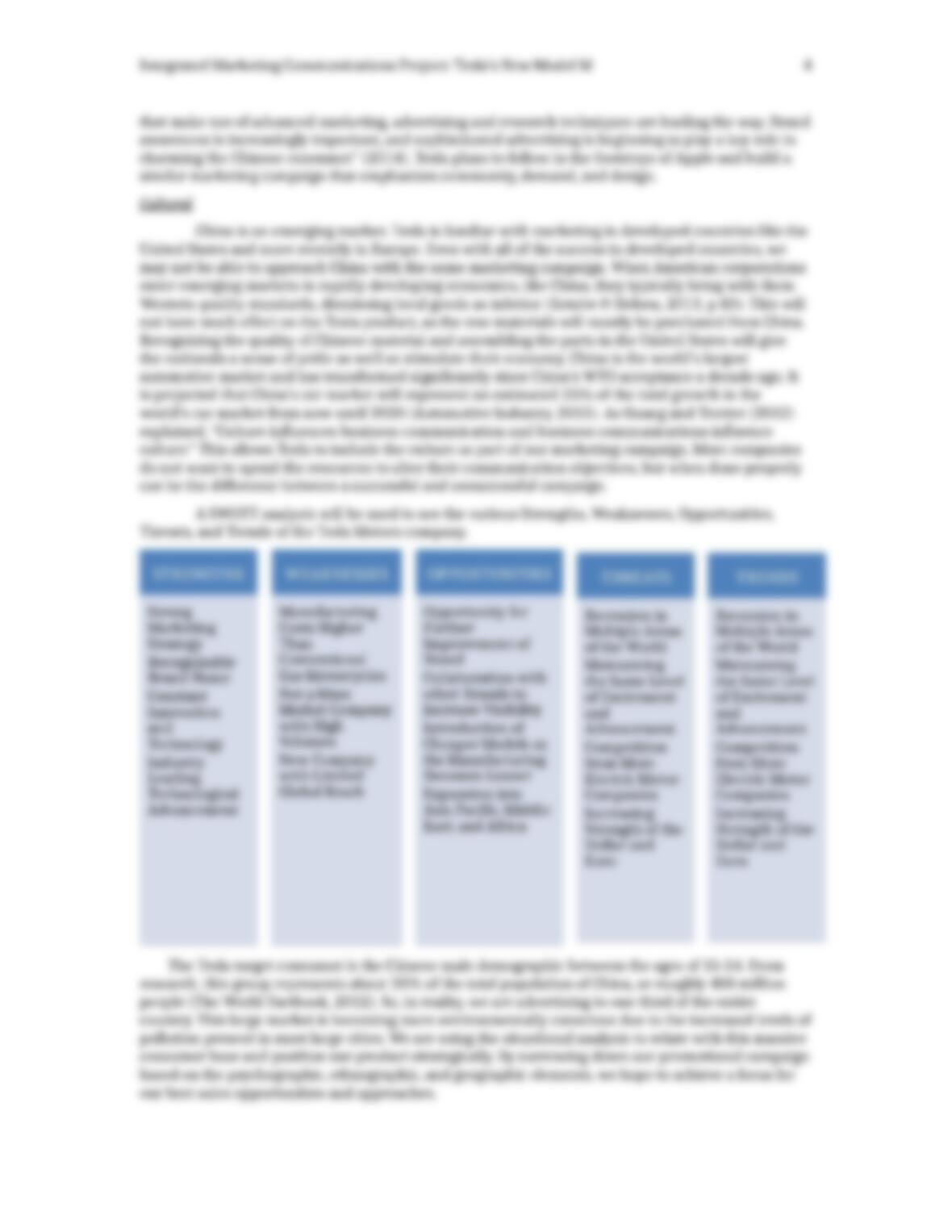
With the recent expansion of Tesla Motor’s automotive market to China, we are looking to
optimize our marketing plan to better understand this emerging marketplace. Each of the external
environments affects the strategic development and success of this brand in China. This is why a
situational analysis is the first stage in building an effective and efficient campaign. By determining
the challenging and encouraging areas within the economic, political, financial, legal, and cultural
elements, we can better analyze the market and clearly develop a plan to distribute our product.
Economic
China leads the world in luxury brand sales with almost 47% of global sales for these
consumer goods being purchased in China (U.S. Relations with China, 2015). Tesla created the first
high-end electric sedan for the automotive market. Now, with the introduction of an e-motorcycle
with an entry level price point, as well as the high-end equivalent, Tesla can meet the demand for
both demographics with one release. One barrier to entry could be the difficulty of achieving success
due to the World Bank’s recent ranking of China at 96th in its “Ease of Doing Business Report” (Doing
Integrated Marketing Communications Project: Tesla’s New Model M 3
Business in China, 2014). As China’s rapid economic growth of the last couple decades begins to slow,
the political pressure has been reduced to help stimulate growth. Some challenges that might hinder
us would be the “rising local debt, potential property bubbles, outflows of capital, shadow banking,
excess capacity in industry sectors, and endemic corruption across industry sectors” (Doing Business
in China, 2014). Our management team will need to determine the risk involved in each of these
areas to justify the marketability of the Model M in China.
Political
As mentioned with the economic environment, the political influence has started to become
more evident. The US Department of Commerce mentioned in an article on the Chinese Automotive
Industry (2015) that the central and provincial governments introduced consumption subsidies for
all-electric and hybrid vehicles. This brings with it decreased import taxes and restrictions for any
electric vehicle, such as the Model M. Tesla will be operating as a (WFOE) Wholly Foreign-Owned
Enterprise. “China joined the World Trade Organization (WTO) in December 2001. The United States
reached a bilateral agreement with China on WTO accession that secures broad-ranging,
comprehensive, one-way trade concessions on China’s part, in which China made specific
commitments to open its market to U.S. exports of industrial goods, service, and agriculture to a
degree unprecedented in the modern era” (Kotabe & Helsen, 2013, p.44). As China relaxes its trade
rules and remains open to its World Trade Organization (WTO) obligations, new products and
industries are increasingly present (Doing Business in China, 2014). In saying this, now is the time for
Tesla to enter the Chinese market and set its plan for offering a 100% battery powered e-motorcycle.
Knowing that corruption is prevalent in politics andin most business settings, it will need to be clear
among management that no illegal activity will be acceptable and that Tesla’s reputation is the most
important part of keeping the brand operational and prosperous.
Financial
The Chinese government is investing over $16 billion in BEV (Battery Electric Vehicles) by
the year 2020 with the hopes of having over 5 million units on the road by that time (Automotive