9–600–143
R E V : O C T O B E R 1 , 2 0 1 7
________________________________________________________________________________________________________________
Professors Stefan Thomke and Ashok Nimgade prepared this case. HBS cases are developed solely as the basis for class discussion. Cases are not
intended to serve as endorsements, sources of primary data, or illustrations of effective or ineffective management.
Copyright © 2000, 2017 President and Fellows of Harvard College. To order copies or request permission to reproduce materials, call 1-800-545-
7685, write Harvard Business School Publishing, Boston, MA 02163, or go to http://www.hbsp.harvard.edu. No part of this publication may be
reproduced, stored in a retrieval system, used in a spreadsheet, or transmitted in any form or by any means—electronic, mechanical,
photocopying, recording, or otherwise—without the permission of Harvard Business School.
S T E F A N T H O MK E
A S H O K N I M G A D E
IDEO
“I should have had café latte,” thought Dennis Boyle as he was sipping his strong espresso at
Peet’s coffeehouse, just around the corner from his office. Many designers and engineers from his
company, IDEO, one of the world’s largest and arguably most successful product development firms,
often gathered here and talked. It was late summer in Palo Alto, the heart of California’s Silicon
Valley, and Boyle gathered his thoughts for a meeting with David Kelley, the head and founder of
IDEO.
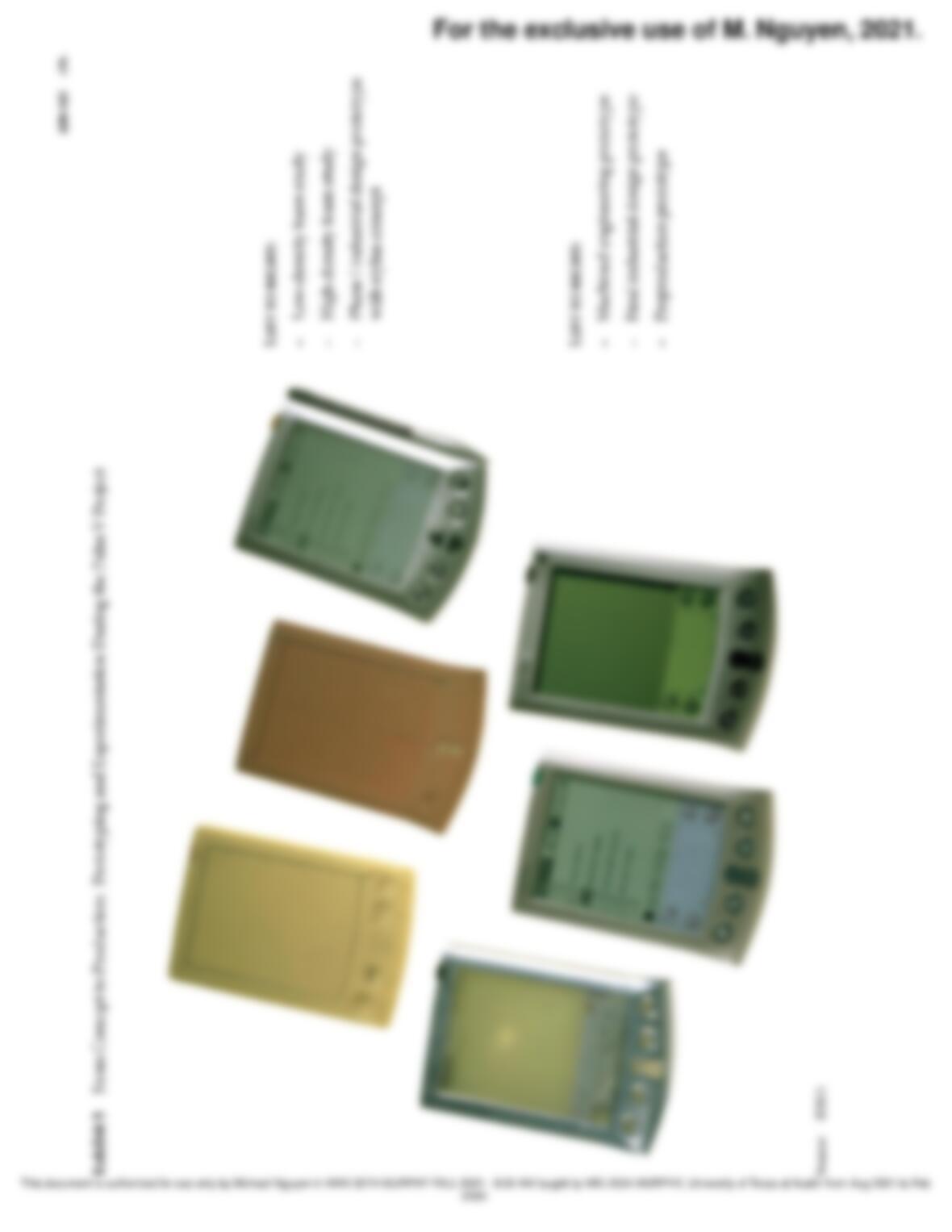
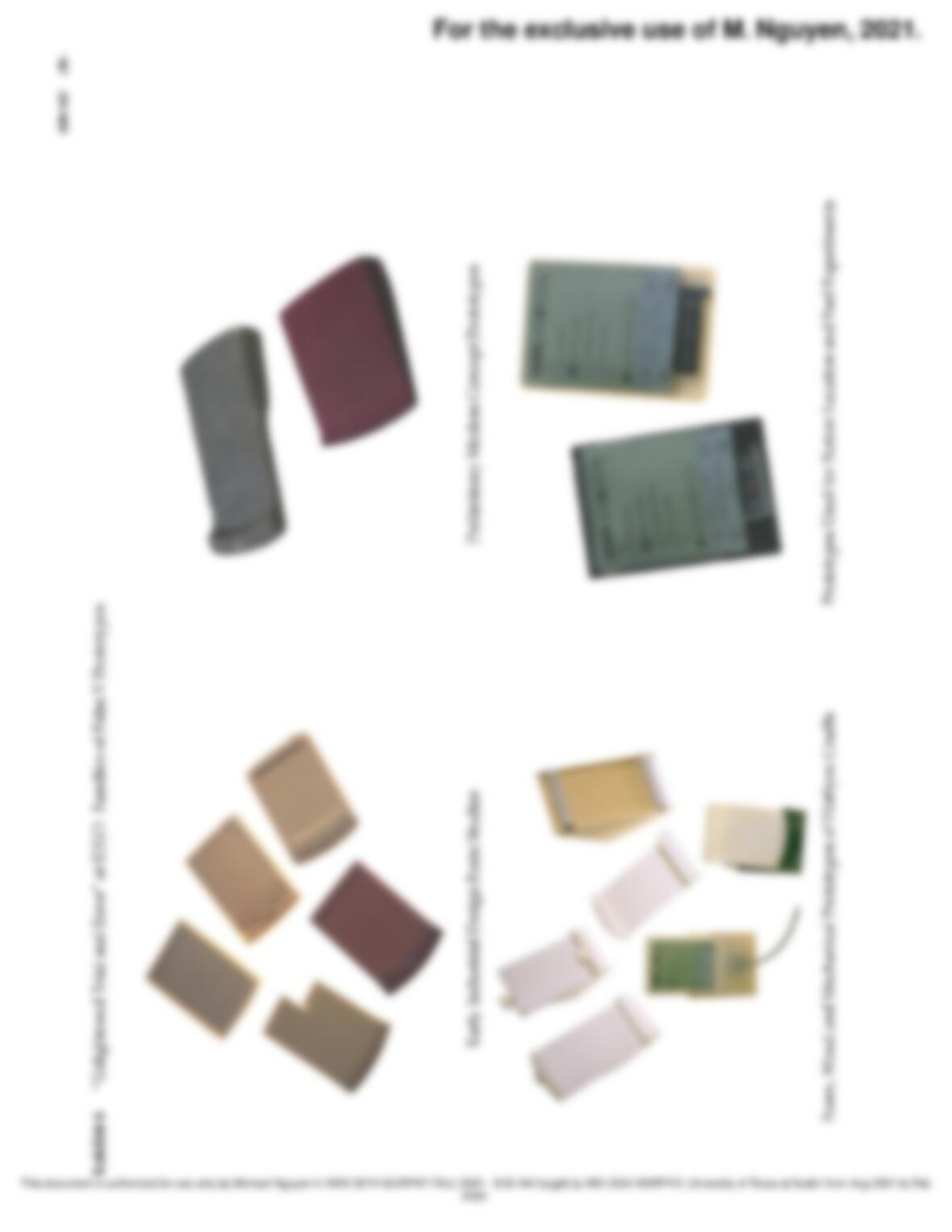
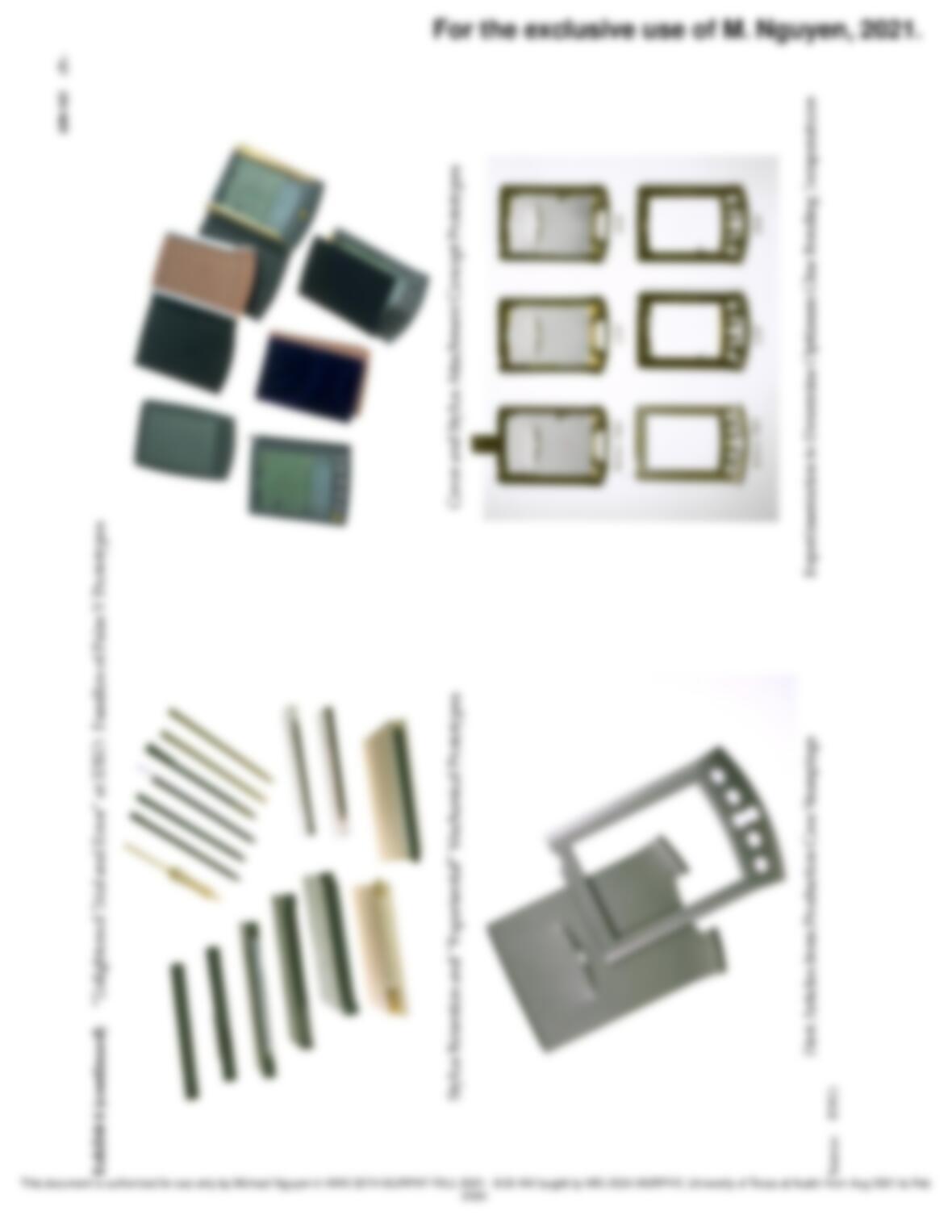
Boyle had just led his group through the development of 3Com’s Palm V hand-held computer,
which designers and managers at both firms already considered a successful product with very large
commercial potential. Now he was being asked to design the competing Visor product by the very
same individuals he had worked with previously. The only twist was that these clients themselves
now worked at Handspring, a new venture whose goal was to come out with a fully compatible,
slightly smaller and less expensive palm-size computer that could easily add functionality. 3Com
had even licensed out operating software to Handspring.
Although working on the Palm V challenged IDEO’s engineering skills, working with Handspring
promised to challenge the very manner in which it operated. It operated on the principle of getting
all team members to “fail often to succeed sooner”—a creative process that often looked to outsiders
like “spinning wheels.” The process usually generated a fountain of absurd-appearing but innovative
ideas before the final answer and product miraculously came through a process of discipline and fast
decision-making.
The IDEO philosophy melded Californian iconoclasm with a genuine respect for new ideas and
invention. For over two decades, the firm contributed to the design of thousands of new products
ranging from the computer mouse to the stand-up toothpaste dispenser. Along the way, it had also
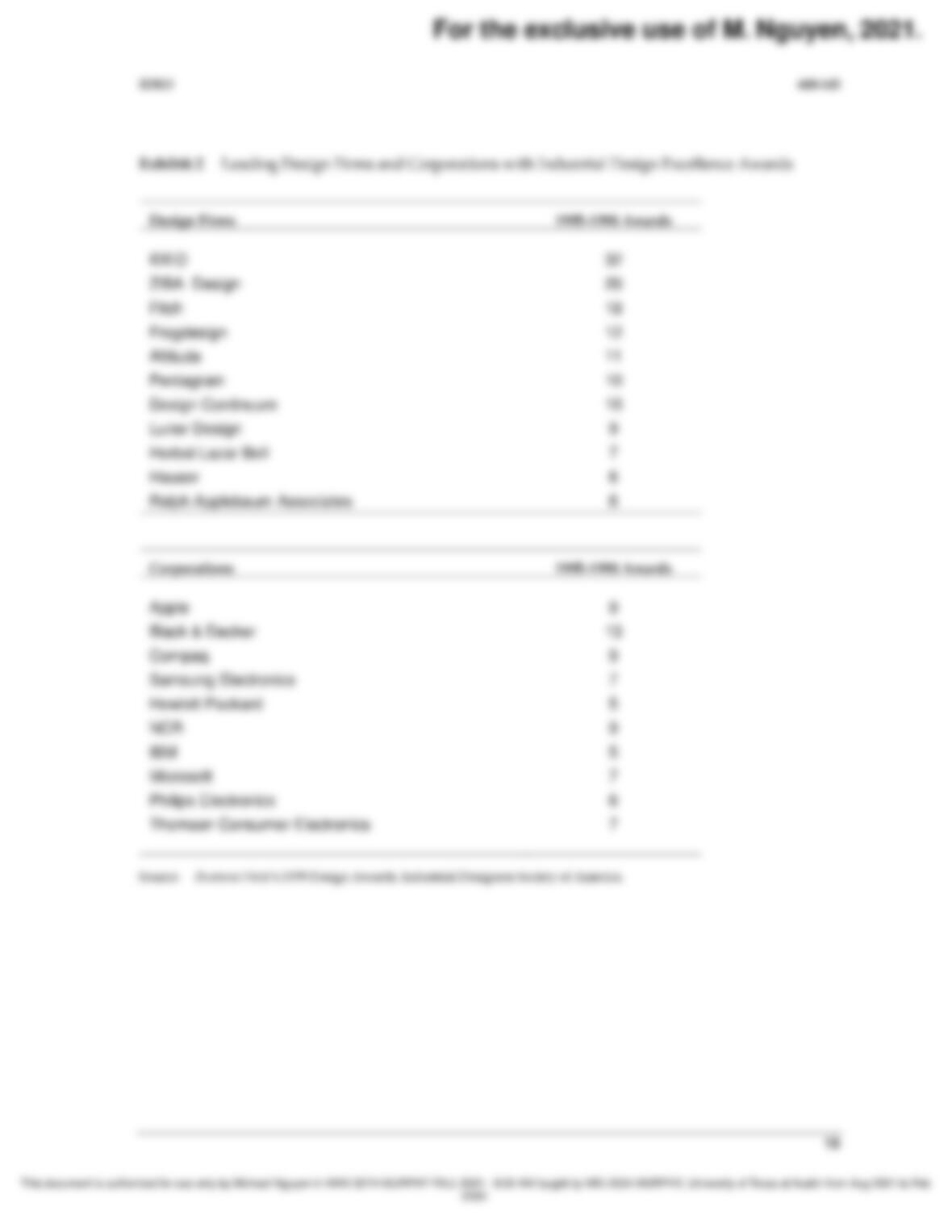
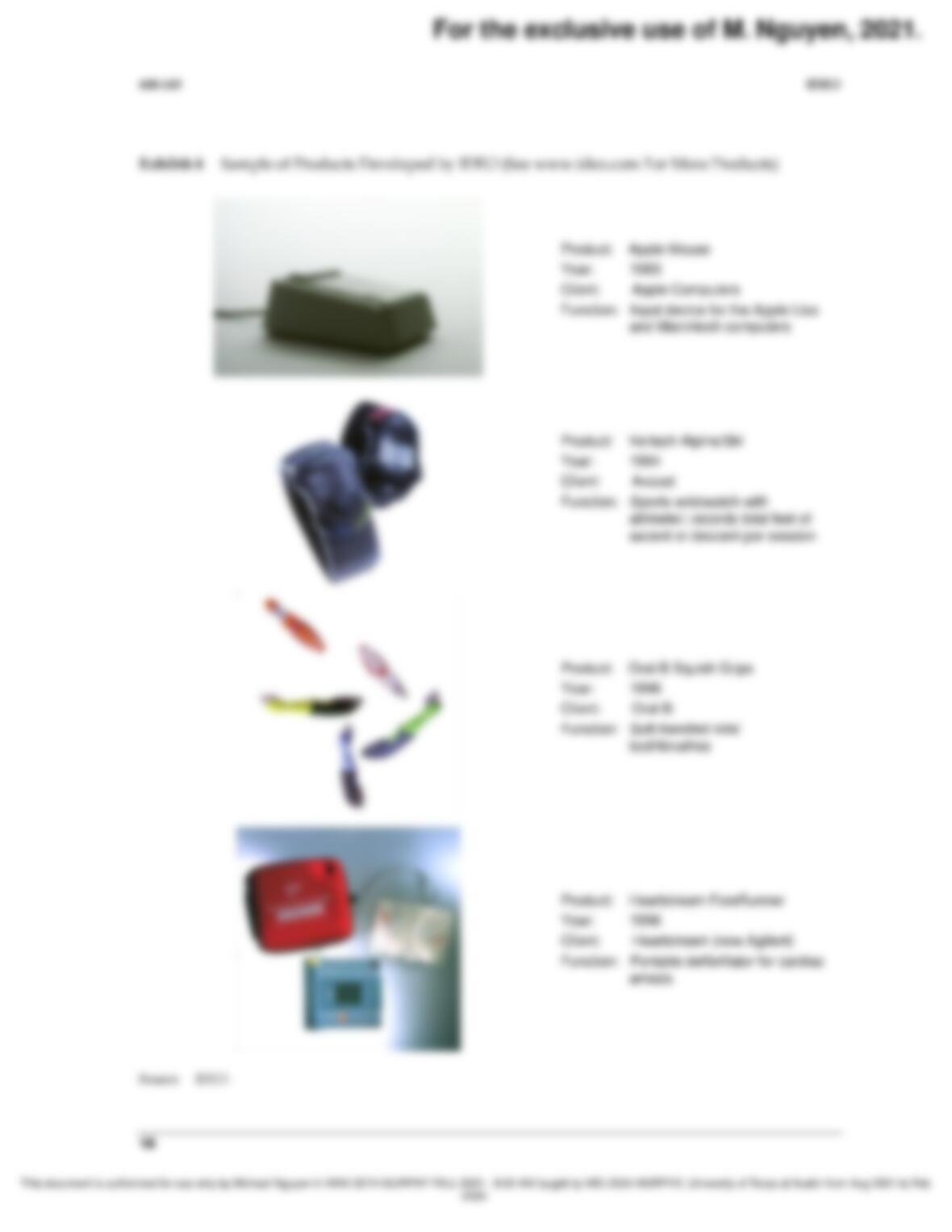
become the largest award-winning design firm in the world (see Exhibit 2). IDEO came to national
prominence when ABC’s Nightline illustrated its innovation process by showing its designers re–
engineer a decades-old icon, the supermarket shopping cart, in just five days.
Now Boyle had to decide whether he should suggest to Handspring’s management to add more
time to a development schedule that was less than half of what it took to design the stunningly
beautiful and innovative Palm V. Boyle’s group feared that an overly aggressive development
schedule would require them to bypass many of the early development stages that the firm was
For the exclusive use of M. Nguyen, 2021.
This document is authorized for use only by Michael Nguyen in MAN 327H MURPHY FALL 2021 – 9:30 AM taught by MELISSA MURPHY, University of Texas at Austin from Aug 2021 to Feb
2022.

600-143 IDEO
2
particularly good at and, at the end, deliver a product that could be so much better if they just had
more time.
History of IDEO
[David Kelley] and the company he heads, IDEO of Palo Alto, has designed more of the things at our
fingertips than practically anyone else in the past 100 years, with the possible exception of Thomas Edison.
– San Francisco Examiner
1
It was desperation caused by recalcitrant furniture during a college move that drove David Kelley
to enter the Carnegie-Mellon campus workshop in search of a saw. The sights and sounds of the
strange new world captured the fancy of the electrical engineering major from Ohio. For a while, in
fact, he considered switching majors to fine arts but stayed with engineering. The internal switch that
flickered on, however, would lead Kelley to leave engineering jobs at Boeing and NCR to embark on
the journey that, according to Fortune Magazine, would make him “one of the most powerful people
in Silicon Valley.” But the first thing Kelley would ever actually design of consequence was a
telephone that could only ring one number: his own. He presented this to his college girlfriend.
In 1975, Kelley joined the Stanford University program in product design. These were heady days
with Kelley finding that “In Silicon Valley everything was new. . . there were no preconceived
notions.”
2
Through part-time consulting experience, Kelley found to his surprise that most
consulting firms consisted of specialists, with technological companies lacking clear access to a
general product development firm. In 1978, amid the Silicon Valley boom, Kelley gave up writing his
Ph.D. thesis. (Nonetheless, even without a formal Ph.D. he would become a professor at Stanford
University.)
Kelley went on to form and run David Kelley Design for the next decade. IDEO started in 1991
when David Kelley Design merged with two companies: ID Two, led by renowned designer Bill
Moggridge, and Matrix, started by Mike Nuttall. The name IDEO came to life when Bill Moggridge
scanned his dictionary for suitable names and liked “ideo–“ (a Greek word which meant “idea”) as it
formed the foundation of many important combined words such as ideology and ideogram. Kelley,
whose company was larger than the other two combined, took over as chief executive of the new
firm.
The merger brought under one umbrella all services client companies needed to design, develop,
and manufacture new products: mechanical and electrical engineering, industrial design,
ergonomics, information technology, prototype machining, and even cognitive psychology. IDEO
thus pioneered the design version of “concurrent engineering”—a fusion of art and engineering to
produce aesthetically pleasing products that were also technically competent.
3
As an example of the
utility of concurrent engineering, consider how the decision to add air vents to a computer to prevent
overheating might detract from the product’s streamlined aesthetics if the designers and engineers
failed to work together closely.
1
R. Garner, San Francisco Examiner, May 23, 1994, p. B-1.
2
L. Watson, “Palo Alto Product Designer Finds Business Booming,” The San Francisco Chronicle, August 3, 1992, p. C3.
3
J. Lew, “Of mice and Miatas: “Design shops shape our lives,” San Francisco Examiner, August 12, 1992, p. 4.
For the exclusive use of M. Nguyen, 2021.
This document is authorized for use only by Michael Nguyen in MAN 327H MURPHY FALL 2021 – 9:30 AM taught by MELISSA MURPHY, University of Texas at Austin from Aug 2021 to Feb
2022.

IDEO 600-143
3
The hardest places to practice concurrent engineering, quite understandably, were in devices
involving compact and complex design such as automotive components, medical instruments, and
small computing devices where small changes would have often unforeseeable ripple effects on
components far removed. IDEO, with its equal emphasis on design and engineering, took up many
of these challenges. In contrast, its leading competitors historically had stressed industrial design
over engineering.
Major IDEO clients included Apple Computer, AT&T, Samsung, Philips, Amtrak, Steelcase,
Baxter International, and NEC Corp. IDEO’s thirst for variety led it to complete thousands of
projects, including 50 projects for Apple Computer (including its first mouse), ski goggles, the Avocet
Vertech Skiers watch, and a large variety of medical instrumentation. The company also participated
in Hollywood film projects, creating scale–model submarines for “The Abyss” and a 25-foot
mechanical whale for “Free Willy”. In the 1990s, IDEO won more industry awards than any other
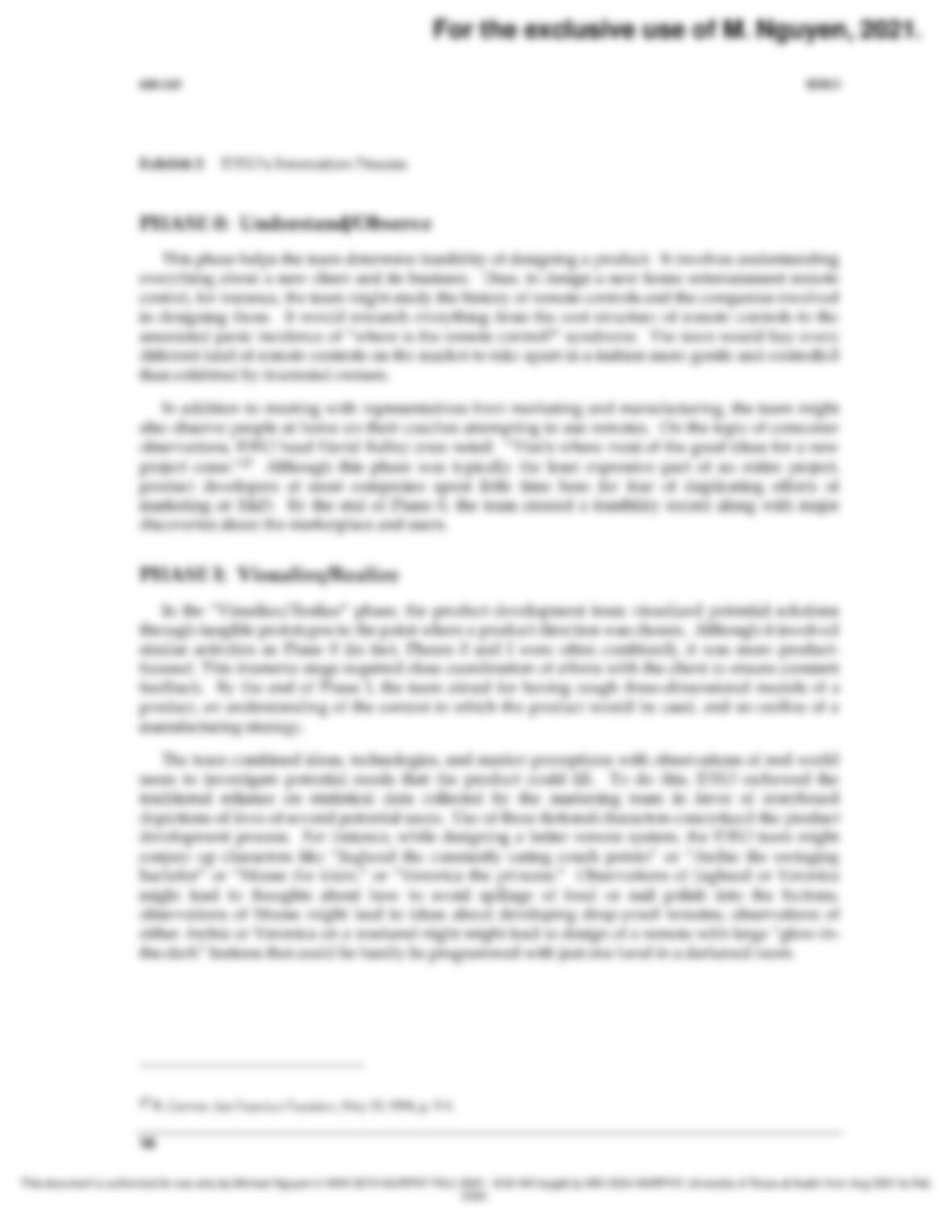
design firm worldwide (see Exhibits 2 and 4).
In the late 1990s, IDEO employed over 300 staff and maintained design centers in Boston, Chicago,
San Francisco, London, Palo Alto, Grand Rapids, New York, Milan, Tel Aviv, and Tokyo. The sites
were chosen for their stimulating locations. Although all centers operated independently, seeking
business locally, they exchanged a high volume of e–mail and often shared talent as needed. Over the
years, while his employees focused on designing client products, Kelley increasingly found himself
designing and re–designing IDEO. “I’m more interested in the methodology of design . . .,” according
to Kelley. “I’m the person who builds the stage rather than performs on it.”
Part of this stage-building involved studying the IDEO environment in new ways. Instead of
merely relying on employee surveys, the company also studied workplace interactions through
suspended video cameras in order to optimize office design.
4
IDEO also sought to improve its own
design processes by reviewing all completed projects. According to Kelley, “We pick the things each
client does well, and assimilate them into our methodology. We’re not good at innovating because of
our flawless intellects, but because we’ve done thousands of products, and we’ve been mindful.”
5
With corporate downsizing, IDEO and other design firms flourished as companies outsourced
more design projects. IDEO’s fees generally ran from as little as $40,000 to over $1 million,
depending on the scope of the project. Revenues came from about 30% each in medical, consumer,
and telecommunications/computers with an additional 10% from industrial products.
6
IDEO came to national prominence when it allowed ABC to televise a segment showing its
designers meeting the challenge of re-engineering the commonplace shopping cart—a virtually
unchanged icon for the past several decades, despite its creaky and obdurate wheels and often
unwieldy basket—in just five days. The IDEO design replaced the traditional large basket with a
system of baskets that allowed consumers to use the shopping cart as a “base camp” for shopping.
Innovative new wheels allowed greater maneuverability in the store. Hooks on the frame would
allow for bagged items to be transported out to the parking lot. The lack of a central basket removed
much of the incentive for stealing the shopping carts.
4
P. Roberts, P, “Live! From your office! It’s…,” Fast Company, October 1999.
5
T.S. Perry, “Designing a Culture for Creativity,” Research Technology Management, March 1995, v. 38(2), pp. 14-17.
6
R. Rosenberg, “By design, these firms take on other companies’ products,” The Boston Globe, May 11, 1997, p. C1.
For the exclusive use of M. Nguyen, 2021.
This document is authorized for use only by Michael Nguyen in MAN 327H MURPHY FALL 2021 – 9:30 AM taught by MELISSA MURPHY, University of Texas at Austin from Aug 2021 to Feb
2022.

600-143 IDEO
4
Design Philosophy and Culture
If a picture is worth a thousand words, a prototype is worth ten thousand.
– IDEO innovation principle
Central to IDEO’s design philosophy was the role of prototyping. According to Tom Kelley,
general manager and David Kelley’s brother, “we prototype more than our clients suspect, and
probably more than our competitors.” Frequent prototyping served as the most important way for
his company to communicate with clients, marketers, experts, and end users. Prototypes ensured
everyone was imagining the same design during discussions about a product. All IDEO offices had
shops staffed by highly skilled machinists to rapidly produce both simple and sophisticated
prototypes. Quite often, according to Whitney Mortimer, a Harvard MBA who joined the firm in the
late ‘90s, “the real ‘aha’s’ in product development occur here.”
But in the early stages, perfecting a sophisticated model was considered a waste of time. “You
learn just as much from a model that’s wrong as you do from one that’s right,” according to engineer
Steve Vassallo. Thus, designers and engineers themselves created early prototypes from readily
available material such as cardboard, foamcore, Legos, and Erector sets.
Rapid prototyping at IDEO followed the three “R’s”: “Rough, Rapid, and Right!” The final R,
“Right,” referred to building several models focused on getting specific aspects of a product right.
For example, to design a telephone, an IDEO team carved dozens of pieces of foam and cradled them
between their heads and shoulders to find the best shape for a handset. “You’re not trying to build a
complete model of the product you’re creating,” per Vassallo. “You’re just focusing on a small section
of it.”
7
Quick and dirty prototyping allowed for a greater number of iterations. “By our method,” David
Kelley claimed, “you could never design a video recorder you couldn’t program. [Researchers at
larger companies] are afraid of looking bad to management, so they do an expensive, sleek prototype,
but then they become committed to it before they really know any of the answers. You have to have
the guts to create a straw man.” At IDEO, these straw men were repeatedly knocked down, a process
which left IDEO’s staffers with thick skin. “Failure,” Kelley felt, “is part of the culture. We call it
enlightened trial and error.”
8
In an allied process, IDEO sought to generate as many ideas as possible early in the design process
through almost daily brainstorming sessions. A much-used paraphrased quotation from Einstein
epitomized the playfulness of the early stage: “If at first an idea does not sound absurd, then there is
no hope for it.” The entire process resembled a funnel, with several ideas at the top, three or four at
the base, and only one making it all the way through. People were generally not upset if their idea
did not become the definitive solution since the act of clipping off ideas brought the entire team
closer to the solution—similar to legendary baseball batter Babe Ruth who outlined his strategy once
as, “Every strike I make gets me closer to a home run.” In addition, discarded ideas were archived
and sometimes kept for possible future products.
Sometimes in the course of a project, when progress appeared to come to a standstill, the leader
could call for what has come to be known as a Deep Dive approach. In this process, the team
7
T.S. Perry, “Designing a Culture for Creativity.” Research Technology Management, March 1995, v. 38(2) pp. 14–17.
8
Ibid.
For the exclusive use of M. Nguyen, 2021.
This document is authorized for use only by Michael Nguyen in MAN 327H MURPHY FALL 2021 – 9:30 AM taught by MELISSA MURPHY, University of Texas at Austin from Aug 2021 to Feb
2022.

IDEO 600-143
5
would focus intensively for an entire day to generate a large number of creative concepts, weed out
weak ideas, and start prototyping based on the top handful of solutions.
To an outsider, however, the entire process could appear messy. “The nature of the organization
is very much like David Kelley’s mind,” says Arnold Wasserman who was part of IDEO’s innovation
strategy group. “Both are seriously playful and messy. And both are comfortable with confusion,
incomplete information, paradox, irony, and fun for its own sake.”
9
The inherent inability to precisely predict the innovation process’ outcome, time and cost made it
extremely important to keep clients involved. At the beginning of a new project, IDEO would submit
cost and time estimates to potential clients. As a project unfolded and designers came up with
innovative ideas and concepts, project managers had to ensure that those concepts were within
agreed upon budgets and timelines. However, designers often aimed for perfection which could
potentially lead to cost and time overruns – also known as “creeping elegance” in design circles – and
clients needed to be aware of those opportunities for further innovation and the cost and time
involved. As a result, IDEO required very frequent client meetings where all those issues would be
discussed.
After a visit to the company’s Palo Alto office, business writer Tom Peters likened IDEO to a
veritable playground. In his words, “IDEO is a zoo. Experts of all flavours co-mingle in offices that
look more like cacophonous kindergarten classrooms. . . . Walk into the offices of IDEO design in
Palo Alto, California, immediately you’ll be caught up in the energy, buzz, creative disarray and
sheer lunacy of it all. Breach the reception area at XYZ Corp . . . and you’ll think you’ve walked into
the city morgue.”
10
In keeping with its playroom atmosphere, on Mondays all company branches held “show-and-
tells” where designers and engineers could showcase their latest insights and products. Also, of
increasing importance to designers was IDEO’s “Tech Box,” the company’s giant “shoebox” for
curiosities and interesting gadgets meant to inspire innovators. Designers could rummage through
the contents and play with the switches, buttons, and odd materials in search of new uses. The Tech
Box included some 300 objects ranging from an archery bow based on pulleys to heat pipes that
would turn uncomfortably hot almost the moment they were placed in a cup of hot water.
The culture itself reflected the importance that management attached to creating a democracy of
ideas. Most design firms had less than two dozen employees. Growing IDEO to 300 employees
involved keeping each unit small. Thus, growth was achieved by budding out smaller design studios
whenever one appeared to grow too large. Much quoted was David Kelley’s confident assertion that
“This company will never be larger than 40 people.”
11
Following an amoeboid growth strategy, even
in a small section of Palo Alto, found the company in possession of nine different buildings.
Employees were encouraged to design their own workspace to reflect their own personalities.
Some strung up their bicycles on pulleys. Rolling doors could quickly seal offices for privacy. Staffers
kept personal possessions in portable bookshelves and cabinets so that moves between projects could
be accomplished rapidly. One studio suspended the wing of a DC-3 airplane with a blinking red
winglight from the ceiling.
9
R. Garner, San Francisco Examiner, May 23, 1994, p. B-1.
10
T. Peters, “The Peters Principles,” Forbes ASAP, September 13, 1993, p. 180.
11
B. Katz, “A leadership style,” Perspective, Fall 1999.
For the exclusive use of M. Nguyen, 2021.
This document is authorized for use only by Michael Nguyen in MAN 327H MURPHY FALL 2021 – 9:30 AM taught by MELISSA MURPHY, University of Texas at Austin from Aug 2021 to Feb
2022.

600-143 IDEO
6
In keeping with Silicon Valley informality, the company discouraged formal titles and did not
mandate a dress code. Management encouraged employees to leave their desk and walk around,
especially during mental blocks. “It’s suspicious when employees are at their desk all day,”
according to general manager Tom Kelley, “because it makes you wonder how they pretend to
work.” IDEO paid high rent for its prime Silicon Valley location so as to encourage stimulating
interactions between employees. Free, unlocked loaner bicycles at the Palo Alto lobbies also
facilitated movement between each building. Designers were encouraged to talk to one another or
even call a brainstorming session through email.
Management rarely fired employees. “We do a better job of managing good employees than of
weeding out lower performing employees,” David Kelley admitted. “But with small studios, there’s
literally nowhere to hide for noncontributors.” High-performing employees were rewarded by being
given more challenging projects to lead. Each employee was assessed through peer review sessions,
with peers chosen by the employee. Management also sought to reward high performers through
more shares in its client venture capital base.
Through much of the 1990s, turnover, at less than 5% per year, was shockingly low by Silicon
Valley standards. The company typically recruited young individuals out of its own internship
programs. Recruiting was a long process, entailing meeting with 10 staff members, often over lunch.
A disproportionate number of recruits came from Stanford University, where Kelley continued to
serve as a professor.
An individual could work on one large project as a principal or on as many as three to four
projects as a contributor. IDEO was a flat organization to an extreme. All work was done in project
teams, which formed for the life of a project and then disbanded. As a result there were no
permanent job assignments or job titles. There were no organization charts or titles to distract from
the quality of the work. Project leaders often emerged on the basis of personal excitement about a
project. Motivation from peer pressure also spurred employees to put in 50– to 60-hour weeks in
creative endeavors.
12
The lack of hierarchy also avoided the problem of promoting designers and engineers into
administrative positions and out of their first love: creating products. But the “no–policy policy”
could make for confusion among new recruits. Even proponents of the IDEO culture, including
veteran Larry Shubert, admitted that “The culture is partly to be comfortable with ambiguity and
confusion. . . We err on the side of autonomy. There’s some discomfort, yes.”
13
But growth appeared to bring its own changes. According to Jeff Smith, president of the Palo
Alto-based Lunar Design and an admirer of IDEO, “How well they’re able to remain creative and not
become bureaucratic and politicized will be very interesting. There’s rumor of politics and agendas.
. . .” Even David Kelley admitted some increase in bureaucratization. “People are talking about it like
it’s a company. ‘Is it okay to invite my wife to this?’ Nobody ever asked me that before… Or, ‘Is it
okay if I go home and mow the lawn this afternoon?’ Of course, it’s okay.”
14
12
T.S. Perry, “Designing a Culture for Creativity.” Research Technology Management, March 1995, v. 38(2) pp. 14–17.
13
S. Orenstein, “The doyen of design,” Stanford, May/June 1996, pp. 74–79.
14
Ibid.
For the exclusive use of M. Nguyen, 2021.
This document is authorized for use only by Michael Nguyen in MAN 327H MURPHY FALL 2021 – 9:30 AM taught by MELISSA MURPHY, University of Texas at Austin from Aug 2021 to Feb
2022.
IDEO 600-143
By the late 1990s, however, the turnover had crept up to 10% as the promise of unparalleled high-
tech wealth at Internet-based firms beckoned employees. To counter the trend of increasing attrition,
IDEO sought to redo its compensation strategy, planning to do more equity deals and seek royalties.
IDEO’s Innovation Process
It is inconceivable that the head guy in any organization will know all the answers.
– David Kelley, IDEO founder
If prototyping was central to IDEO’s design process, brainstorming was central to its
methodology. The two processes, actually, went hand in hand, with brainstorming sessions leading
to rapid prototyping or vice versa. The goal was to quickly create a whirlwind of activity and ideas,
with the most promising ideas developed into prototypes in just days. The firm followed several
principles of brainstorming: stay focused on the topic; encourage wild ideas; defer judgment to avoid
interrupting the flow of ideas; build on the ideas of others (since it was usually more productive than
seeking glory for one’s own insights); hold only one conversation at a time to ensure that introverts
also got their say; go for quantity (very productive brainstorming could generate 150 ideas in 30 to 45
minutes); and be visual, since sketching ideas would help people understand them.
Throughout a single project, the project leader might hold brainstorming sessions, or
“brainstormers.” No more than eight invitees attended these sessions, which ran under the above
rules. IDEO personnel viewed invitations to these sessions as a sign of worth and rarely turned them
down. In an organization whose lobbies sported large bowls of M&M chocolates, David Kelley once
said “brainstormers are the candy. . .You are in the middle of a project, handling endless details, and
then you get invited to a brainstormer, where you get to have all sorts of good ideas and leave with
15
For the exclusive use of M. Nguyen, 2021.