CASE STUDY
CHAPTER 17
Question 1
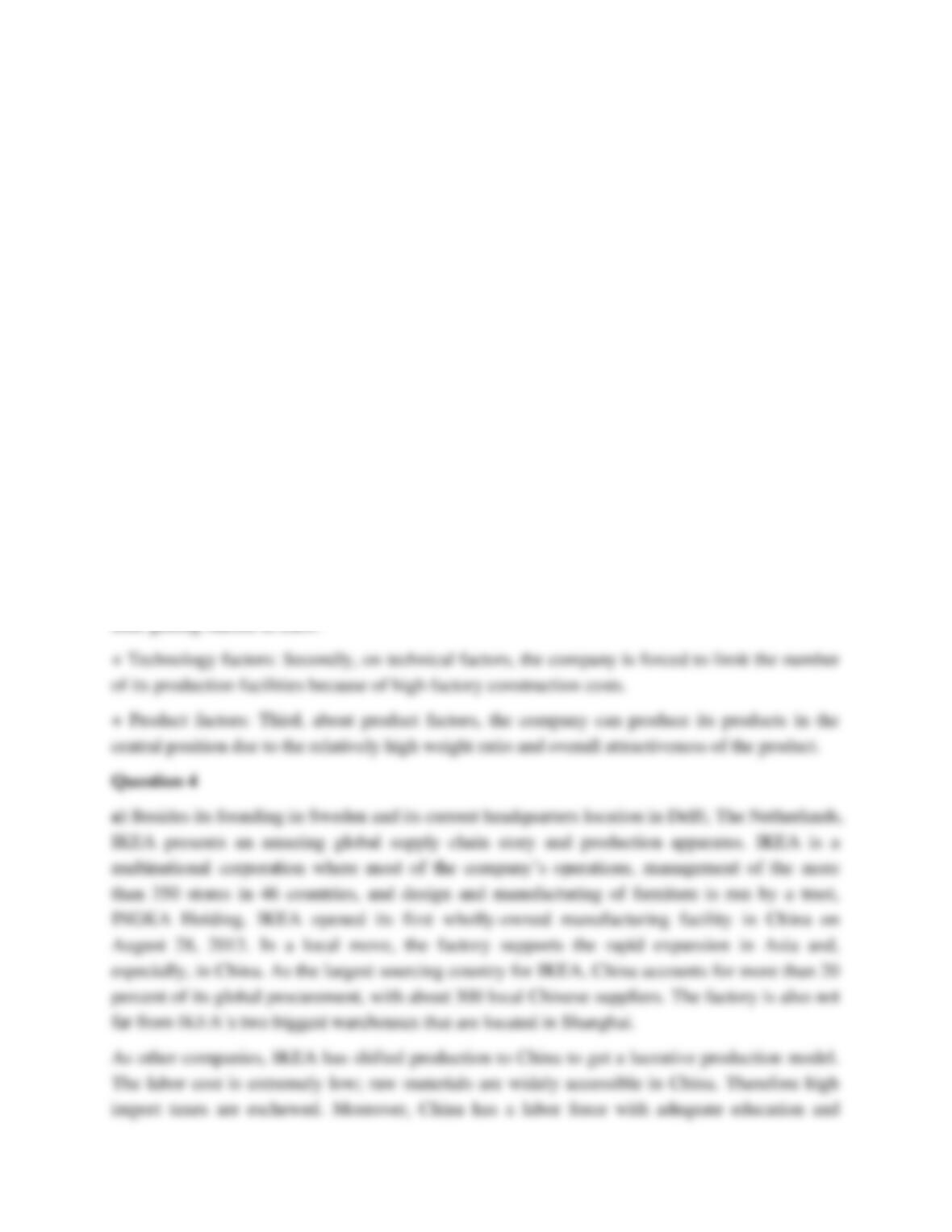
According to the readings data, this company should use a concentration strategy because it can
significantly reduce production costs per unit by using the same equipment to produce different
products, allowing the company to achieve economies of scale.
+ Common tax rates in the industry are low.
+ High factory construction costs to produce microprocessors,
+ The ratio of value to weight of the product is high
+ Low trade barriers
+ Externalities arise from the concentration of businesses that prefer certain locations
+ The ratio of value to weight of the product is high and the product is for universal demand.
Class IB1401
Subject IBI101
Members:
1. Võ Tấn Triệu (leader)
4. Hồ Ngọc Trân
2. Trần Đoan Vy
5. Lưu Thị Mai Anh
3. Hồ Thị Thanh Ngân
Research from the non-profit organization APQC shows that centralized organizations have
about 3% lower production costs than decentralized companies. For an organization with an
annual turnover of $ 5 billion, this is a difference of $ 150 million. The APQC study also found
that material inventory turnover rate and production schedule efficiency are higher than in
manufacturing companies.
Centralized production can, therefore, enable better forecasting, more local work, more
consistent production, and more efficient use of limited resources. The cost of materials may also
be lower for concentrated production sites located near the source of that material.
=> All of these factors favor a centralized versus decentralized production strategy.
– In terms of location, the company should consider three factors:
+ Country factors: First, on national factors, the company should set its factory in a country with
a team of skilled workers. On the contrary, if choosing a low-skilled country like Laos, the
company will face many big risks as the workers here are mostly unskilled, no stock market and
Laos are at a disadvantage in favour of its position on the map. Being off the coast means Laos
will always have difficulty selling their products to the world. They cannot be shipped by
themselves. Laos will always depend on its maritime neighbours such as Thailand and Vietnam.
This is not only inconvenient for Laos but also expensive. For example, Lao products exported
via Thai ports will be subject to Thai tariffs industry will be less competitive and have a harder