160A: International Microeconomics
Homework 1 Answer Key
Professor Swenson
1. Ricardian Trade
Suppose that the marginal product of labor (MPL) for China and Thailand are the following
Cell Phones Chargers
China 30 40
Thailand 30 50
a) Which country has absolute advantage in cell phones?
Neither country has an absolute advantage in cell phones. (Thailand has absolute
advantage in chargers.)
b) Which country has comparative advantage in cell phones?
China has comparative advantage in cell phones.
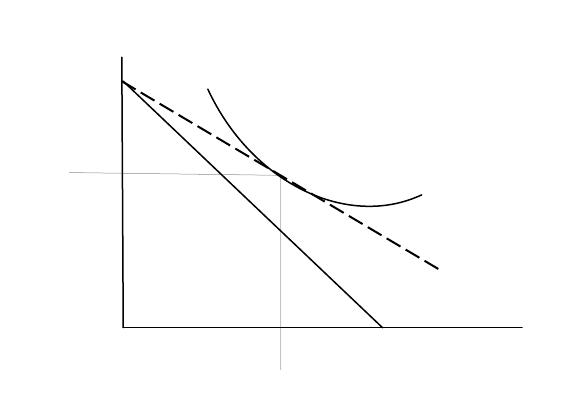
c) Suppose China has 100 units of labor. Draw the production possibility frontier for China.
d) What is the possible range of prices (cell phones to chargers), when trade is opened?
In the Ricardian model, the relative price of cell phones to chargers before trade is determined
by the ratio of (MPL-charger)/(MPL-cell phone) in both countries before trade.
For China: (P-cell phone)/(P-charger) = (MPL-charger)/(MPL-cell phone) = 40/30 = 4/3
For Thailand: (P-cell phone)/(P-charger) = (MPL-charger)/(MPL-cell phone) = 50/30 = 5/3
Cell
Phones
3000
Dcp
Dch 4000 Chargers
When the two countries trade, the relative price will be between the two pre-trade relative prices.
As a result, we know the relative price with trade will satisfy:
4/3 ≤ (P-cell phone)/(P-charger) ≤ 5/3
e) Now consider the effects of trade. Add a world trade price line to your diagram in c), and
illustrate a plausible consumption point for the China.
World trade price line is given by the bold dashed line. It originates from the intercept on the y-
axis, since China is completely specialized in the production of cell phones.
China is producing 3000 cell phones and no chargers.
Chinese consumers are consuming Dcp cell phones, and Dch chargers.
f) Does China import or export chargers?
China IMPORTS chargers.
g) Based on Chinese consumption during trade, label the amount of Chinese exports and imports
on your diagram.
Based on the picture China is exporting (3000-Dcp) cell phones, and is importing (Dch)