Econ%1%
Chapters%9%Practice%Problems!
1. What is the fundamental basis for trade among nations?
a.
shortages or surpluses in nations that do not trade
b.
misguided economic policies
c.
absolute advantage
d.
comparative advantage
2. A tariff is a
a.
limit on how much of a good can be exported.
b.
limit on how much of a good can be imported.
c.
tax on an exported good.
d.
tax on an imported good.
3. If a country allows trade and, for a certain good, the domestic price without trade is
higher than the world price,
a.
the country will be an exporter of the good.
b.
the country will be an importer of the good.
c.
the country will be neither an exporter nor an importer of the good.
d.
Additional information is needed about demand to determine whether the
country will be an exporter of the good, an importer of the good, or neither.
4. Assume, for the U.S., that the domestic price of pineapples without international
trade is lower than the world price of pineapples. This suggests that, in the
production of pineapples,
a.
the U.S. has a comparative advantage over other countries and the U.S. will
export pineapples.
b.
the U.S. has a comparative advantage over other countries and the U.S. will
import pineapples.
c.
other countries have a comparative advantage over the U.S. and the U.S. will
export pineapples.
d.
other countries have a comparative advantage over the U.S. and the U.S. will
import pineapples.
5. Suppose the United States exports cars to Switzerland and imports cheese from
France. This situation suggests
a.
the United States has a comparative advantage relative to France in producing
cheese, and Switzerland has a comparative advantage to the United States in
producing cars.
b.
the United States has a comparative advantage relative to Switzerland in
producing cars, and France has a comparative advantage relative to the United
States in producing cheese.
c.
the United States has an absolute advantage relative to Switzerland in producing
cars, and France has an absolute advantage relative to the United States in
producing cheese.
d.
the United States has an absolute advantage relative to France in producing
cheese, and Switzerland has an absolute advantage relative to the United States
in producing cars.
6. The nation of Woodland forbids international trade. In Woodland, you can exchange
1 pound of chicken for 5 pounds of salt. In other countries, you can exchange 1
pound of chicken for 7 pounds of salt. These facts indicate that
a.
Woodland has a comparative advantage, relative to other countries, in producing
chicken.
b.
other countries have an absolute advantage, relative to Woodland, in producing
chicken.
c.
the price of chicken in Woodland exceeds the world price of chicken.
d.
if Woodland were to allow trade, it would export salt.
7. In analyzing the gains and losses from international trade, to say that Moldova is a
small country is to say that
a.
Moldova can only import goods; it cannot export goods.
b.
Moldova’s choice of which goods to export and which goods to import is not
based on the principle of comparative advantage.
c.
only the domestic price of a good is relevant for Moldova; the world price of a
good is irrelevant.
d.
Moldova is a price taker.
8. When the nation of Duxembourg allows trade and becomes an importer of software,
a.
residents of Duxembourg who produce software become worse off; residents of
Duxembourg who buy software become better off; and the economic well-being
of Duxembourg rises.
b.
residents of Duxembourg who produce software become worse off; residents of
Duxembourg who buy software become better off; and the economic well-being
of Duxembourg falls.
c.
residents of Duxembourg who produce software become better off; residents of
Duxembourg who buy software become worse off; and the economic well-being
of Duxembourg rises.
d.
residents of Duxembourg who produce software become better off; residents of
Duxembourg who buy software become worse off; and the economic well-being
of Duxembourg falls.
9. When a country allows trade and becomes an importer of a good,
a.
consumer surplus and producer surplus both increase.
b.
consumer surplus and producer surplus both decrease.
c.
consumer surplus increases and producer surplus decreases.
d.
consumer surplus decreases and producer surplus increases.
10. Trade raises the economic well-being of a nation in the sense that
a.
the gains of the winners exceed the losses of the losers.
b.
everyone in an economy gains from trade.
c.
since countries can choose what products to trade, they will pick those products
that are most beneficial to society.
d.
the nation joins the international community when it begins to engage in trade.
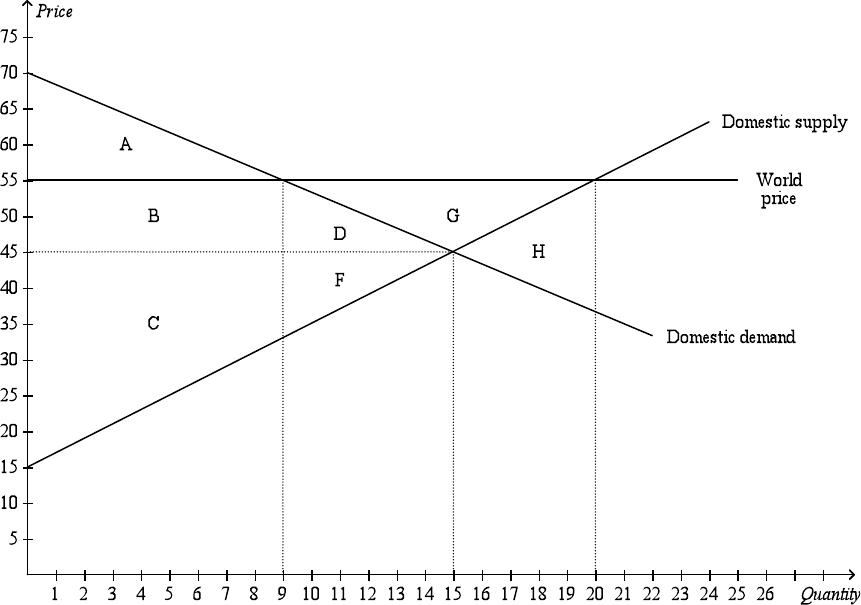
Figure 1!
The figure illustrates the market for wool in Scotland.
!
11. Refer to Figure 1. From the figure it is apparent that
a.
Scotland will experience a shortage of wool if trade is not allowed.
b.
Scotland will experience a surplus of wool if trade is not allowed.
c.
Scotland has a comparative advantage in producing wool, relative to the rest of
the world.
d.
foreign countries have a comparative advantage in producing wool, relative to
Scotland.
12. Refer to Figure 1. From the figure it is apparent that
a.
Scotland will export wool if trade is allowed.
b.
Scotland will import wool if trade is allowed.
c.
Scotland has nothing to gain either by importing or exporting wool.
d.
the world price will fall if Scotland begins to allow its citizens to trade with other
countries.
13. Refer to Figure 1. With trade, Scotland will
a.
export 11 units of wool.
b.
export 5 units of wool.
c.
import 15 units of wool.
d.
import 6 units of wool.
14. Refer to Figure 1. In the absence of trade, the equilibrium price of wool in
Scotland is
a.
$15.
b.
$45.
c.
$55.
d.
$70.
15. Refer to Figure 1. In the absence of trade, total surplus in Scotland is represented by
the area
a.
A + B + C.
b.
A + B + C + D + F.
c.
A + B + C + D + F + G.
d.
A + B + C + D + F + G + H.
16.Refer to Figure 1. When trade in wool is allowed, consumer surplus in Scotland
a.
increases by the area B + D.
b.
increases by the area C + F.