HUM 313.01
Exam 2 Study Guide
• The exam will draw from the primary texts, information on the Powerpoint slides, the lectures, and questions discussed in
class, and any additional outside texts that we looked at in class.
• There will be approximately 65 objective questions at 2 points each and 1 essay question worth 40 points. In total, the exam
will be worth 170 points. The objective questions will be a combination of multiple choice, true/false, and quotation
identification (quotation identification will only be for famous or important quotations discussed in class).
• Please look back over each of the works we’ve read and be able to identify or answer the following:
– At the most basic level, you should be able to match each author to title of the work
– Critical biographical details for the authors that we read, though only as much as are on the slides
– Historical/geographical/social context, though only as much as we talked about in class
– All the people represented in the Powerpoints, but only in relation to the works we discussed
• Anything else on the slides that doesn’t fall into these categories but that was covered in class
• You should also be able to answer questions about the subjects in each of the works. What dilemmas do the speakers within
it address or face? What questions do the authors explore? How are the different pieces in dialogue with one another?
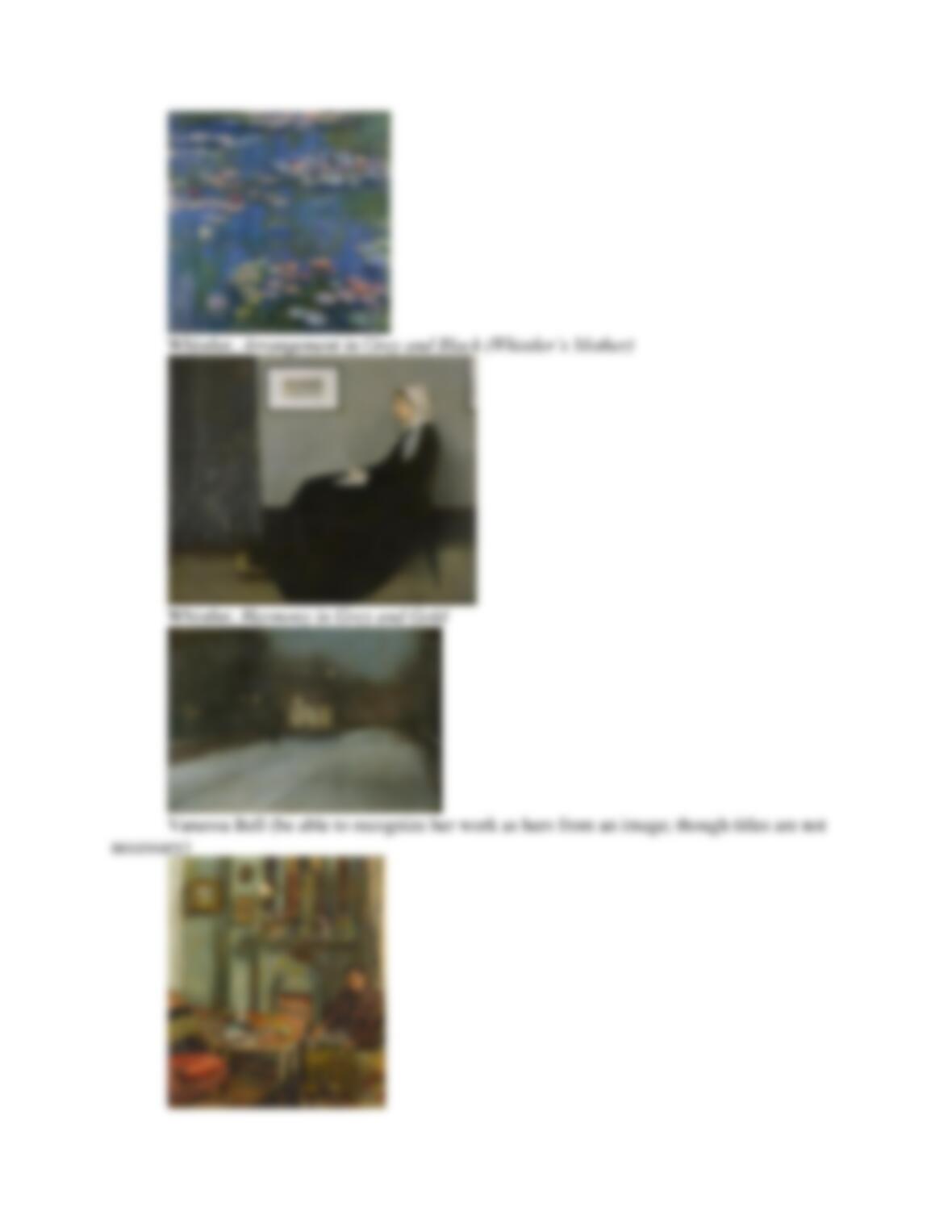
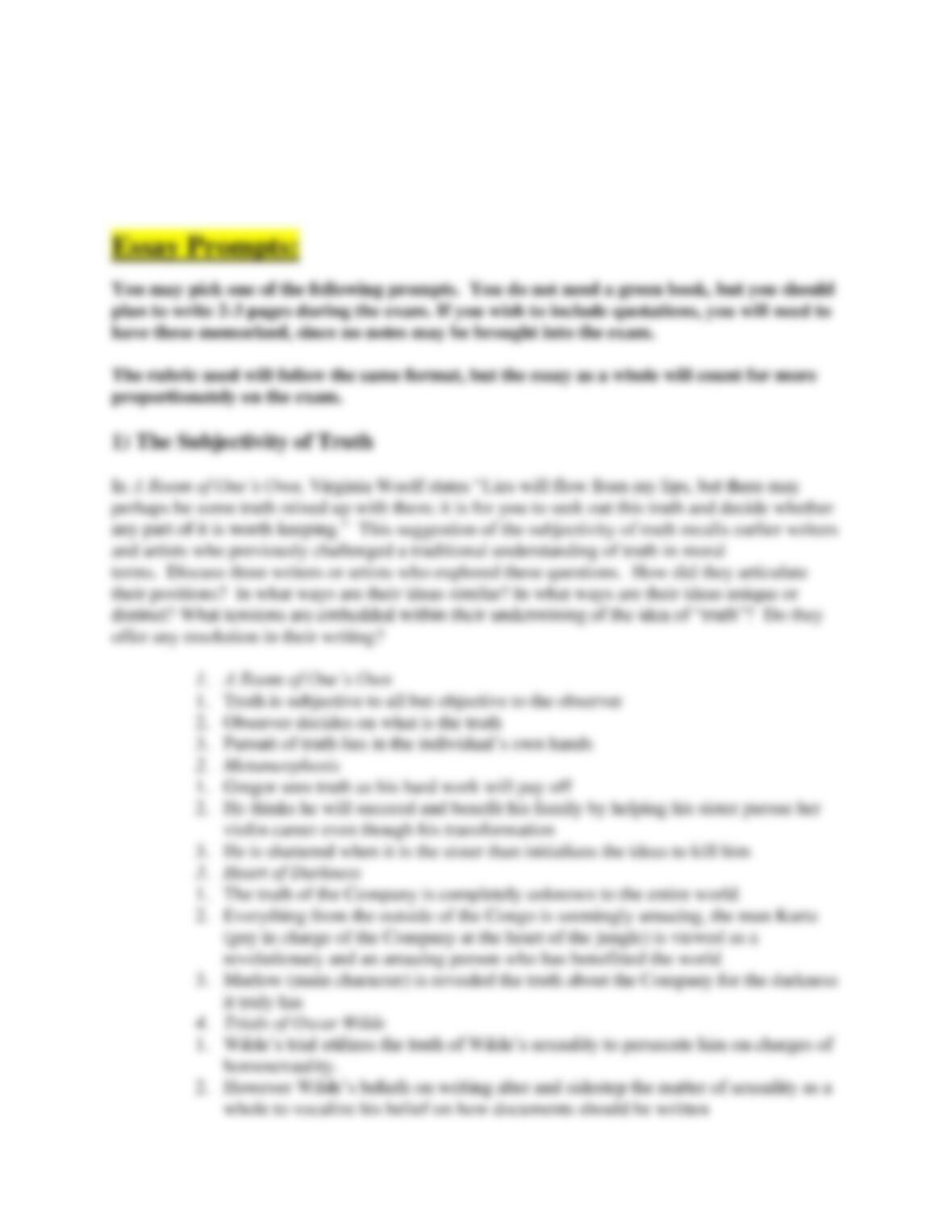
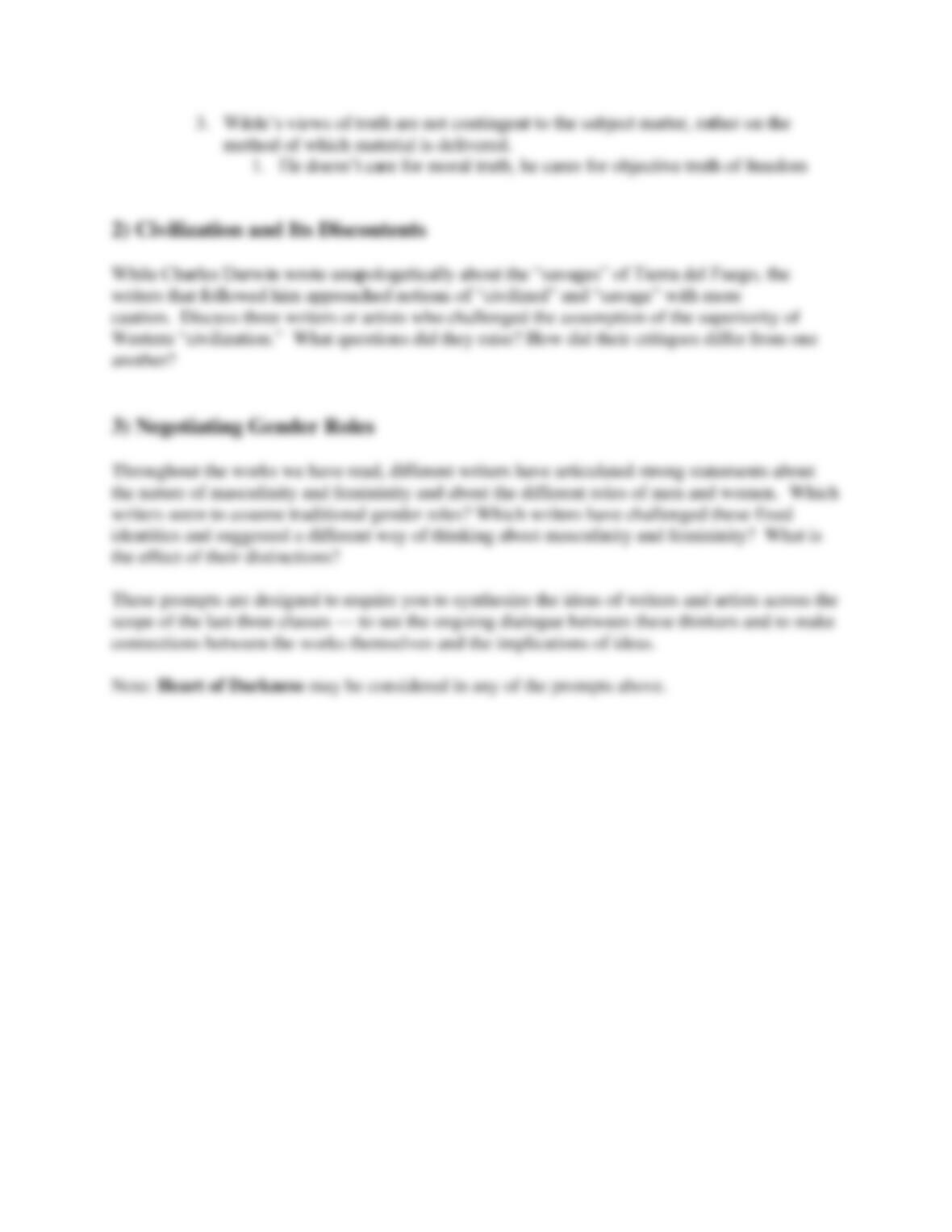
• For the paintings, you need to be able to identify the title and painter from an image printed on the exam (see list below)
• Note: audio musical selections will not be played during the test, but there will be 1-2 questions derived from the musical
selection.
• See below for more specific points about each selection.
People and Docs
John Ruskin
• “Imperial Duty” (in relation to author’s other works, intended audience,
masculine ideals, Ruskin’s final charge, How would Conrad view this final
charge?)
o “There is a destiny now possible to us. The highest of a nation to ever
have been accepted.”
▪ Grace to obey the Lord – Christian God
▪ Famous part: “This is what she must do or perish. She must
found colonies as fast and as far as she is able… of
worthiest men.”
▪ She should seize every piece of land she can set her foot
on. Teach the colonists that their chief virtue is fidelity to
their country. These colonies “must be fastened fleets”
▪ Similar to how the British are still British when they are out
at sea – the colonists should consider themselves British
despite not living in the homeland. Have a fixed purpose
of your country.
▪ Conrad would critique this idea.
• “Superlative Statements” slide – Be able to identify author for each
o (Culture represents) “the best which has been thought and said.”
▪ Matthew Arnold – Culture and Anarchy (1869)
▪ “There is a destiny now possible to us — the highest ever
set before a nation to be accepted or refused.”
▪ John Ruskin – “Imperial Duty” (1870)
▪ “The British Empire is “the mightiest and most beneficial
Empire ever known in the annals of mankind.”

▪ Times coverage of Queen Victoria’s Diamond Jubilee (1897)
▪ Big festival celebrating the empire. Called the British
Empire “the mightiest and most beneficial empire known in
mankind.”
▪ Kipling – “The White Man’s Burden” (1897/1899)
▪ “The air was dark […] over the biggest and the greatest,
town on earth” – from Heart of Darkness, Part I, p. 3
(1899)
▪ “Send forth the best ye breed”
▪ Send those people out into the Empire as
representatives of the British.
Rudyard Kipling
• Biographical points
o Early years in India
o Spoke Hindi first; spoke English as a second language
o Sent back to England for education at the age of 5
o Father became curator of the Lahore Museum in 1875
o In 1876 India was recognized as the British India Empire (or the India
Empire or Empire of India), with Queen Victoria ruling as the Empress of
India
o Kipling returned to India in 1882 to work as a journalist
o Wrote short stories on the side; Plain Tales from the Hills (1888) a
popular success
o Led to Kipling’s career as a writer, considered by many to be the greatest
short story writer in English
o Married an American and spent many happy years in Vermont
▪ “The happiest period in his life” – wrote The Jungle Book during
this time
▪ He saw in America the young energy that’s similar to that early
energy of the British
▪ Conrad alludes to that in “Heart of Darkness”
▪ Saw Germany as a threat due to their build up of a navy –
threatened the British
▪ So he liked America as an ally
o Views on God:
▪ Kipling wrote that he believed in “a personal God to whom we are
personally responsible for wrong doing,” but admitted an inability
to believe in eternal punishment or reward in the divinity of
Christ.”
• “The White Man’s Burden” intended audience and “Recessional” intended
audience – Queen Victoria’s Diamond Jubilee
o Moral law
▪ “Recessional” dedicated to the UK
▪ “Recessional” Poem – Important Points:
▪ Last 2 stanzas very powerful

▪ He is invoking the Lord in this poem despite not
having a traditional belief in God.
▪ God is a symbol of moral righteousness –
calls him to make sure that we do not get
reckless/greedy
▪ For the British
▪ “The White Man’s Burden” dedicated to the US
▪ Initially written for the British for the occasion of the
Diamond Jubilee in 1897, but Kipling was worried that the
tone of this poem would sound too smug or overconfident,
thus, writes “Recessional” for the British and instead gives
“The White Man’s Burden” to the US in acquisition to the
US’s war in the Philippines in 1899
▪ “The White Man’s Burden” Poem – Important Points:
▪ The savages are seen as children from an older time.
As a white country, this is your responsibility/duty
to take your responsibility on.
▪ Says this will take a long time that we will be dug
into this imperialistic endeavor. Our responsibility
to bring this light into the dark.
Joseph Conrad
• Biographical points
o Born to Polish parents in Russian-occupied Ukraine
o Father was a successful writer who translated the works of William
Shakespeare, Charles Dickens, and other authors
o The young Conrad was brought up speaking Polish, Russian, French, and
English
o Due to political turmoil, the family was forced to relocate back to Poland,
a journey which weakened both his parents
o Parents died of tuberculosis; he was orphaned at age 11
o Attempted suicide in 1878 at age 20
o Subsequently joined the British marines or merchant navy in 1878, and
would work for them for the next 16 years
o Here he learned to perfect his English and began writing while at sea.
o Became a naturalised British subject in 1886.
o Spent four months traveling through the Belgian Congo in 1890-1891
where he witnessed the kinds of horrors described by Marlow in Heart of
Darkness.
▪ He wrote that the primary task of the novelist “is to make you
see.”
• Heart of Darkness in Context points (the Berlin Conference, the Scramble for
Africa, Stanley & Livingstone);
o The Berlin Conference (1884-1885)
▪ Carving up the continent of Africa as if it were a cake
▪ No African diplomats present
▪ Only 2 diplomats at the conference had even visited Africa
▪ Results:
▪ Scramble for Africa = “New Imperialism”
▪ 1880-1914 (Until WWI)
▪ European control over Africa rose from 10% in
1870 to 90% by 1914
o Joseph Conrad spent 4 months traveling through the Belgian Congo in
1890-1891
Henry Morton Stanley
• Stanley is Livingstone (Stanley = Marlow and Livingstone = Kurtz)
• Livingstone: Missionary/explorer within the London Missionary Society – trying to find
source of Nile and abolish slave trade – went missing
• Stanley went out to find Livingstone since he went missing
• Stanley helped set up the “Congo Free State” that King Leopold II of Belgium wanted.
o Stanley did not treat the natives too well, however.
• King Leopold II of Belgium
o King’s Goals:
▪ To open to civilization the sole part of the globe which it has not
yet penetrated. To pierce the darkness that has enveloped this
particular culture.
▪ Remember Video
• Brussels & Belgian Congo
o The setting in which Heart of Darkness takes place.
o The “yellow” colored region on the map of Africa at the time, controlled
by Belgium. The king of Belgium was Leopold II.
• Conrad’s view of the universe
• Conrad’s Letter to R.B. Cunninghame Graham, 10 December 1897
• Has a grim view of the universe.
• Conrad is an agnostic, most likely an atheist. His view of a dark,
ultimately meaningless universe (we are an accident that we exist
at all) persists in his literature. He wants out of this system. Even if
he commits suicide, it does not stop this dark/tragic universe – this
machine that keeps on going.
o Reference to “Heart of Darkness”: 2 women knitting –
knitting the course of history, nothing we can do about it.
• The significance of the Franklin expedition
• Sir John Franklin of The Franklin Expedition
• He led an ill-fated expedition in the search of the Northwest
Passage
• They became stranded in the arctic circle of Northern Canada
• Expedition was famous due to accounts of cannibalism between
the British sailors
• Main Point: The idea that their own civilized gentleman could
have relapsed into a state of savagery by eating each other to
survive was horrifying.
o This is a very touchy subject, so much so, that Charles
Dickens was brought on board to try and defend the
Franklin Legacy
o “The Frozen Deep” by Charles Dickens
▪ Was written in response to this event in order to
counter rumors of British cannibalism.
• Significance of Britain in relation to the Roman Empire
o “The Frozen Deep” by Charles Dickens
▪ He blames eskimos because they are considered savages. You
cannot trust the savages. Claims that the rumors of cannibalism
among the Franklin Expedition were made up and are false.
▪ Demonstrates a parallel of how a lone Roman would have been
surrounded by savages in the northern lands of Britain back when
the Roman Empire was still existing.
• H of D original publication venue
o Originally published in a British Military magazine – Backwoods
Magazine.
o Questions on slides about Pts I – III
▪ (See HoD Slides 36-39)