HS201 Dietary Self Analysis Project
All Questions Regarding This Project Should Be Sent to
Jordan Badger at jbadger@bu.edu
The Dietary Self Analysis Project allows you to evaluate your present diet for nutritional
adequacy. You will be analyzing your diet for: calories, fat, percentage of calories from fat,
saturated fat, percentage of calories from saturated fat, cholesterol, calcium, sodium, iron,
vitamin C, folic acid, and fiber, as well as if you have adequate servings from all of the MyPlate
food groups.
This project is due April 4, 2017. It must be typed, not hand written. You must also
keep a copy. There will be 10 points deducted from your project grade for every week, or
part thereof, that your project is late.
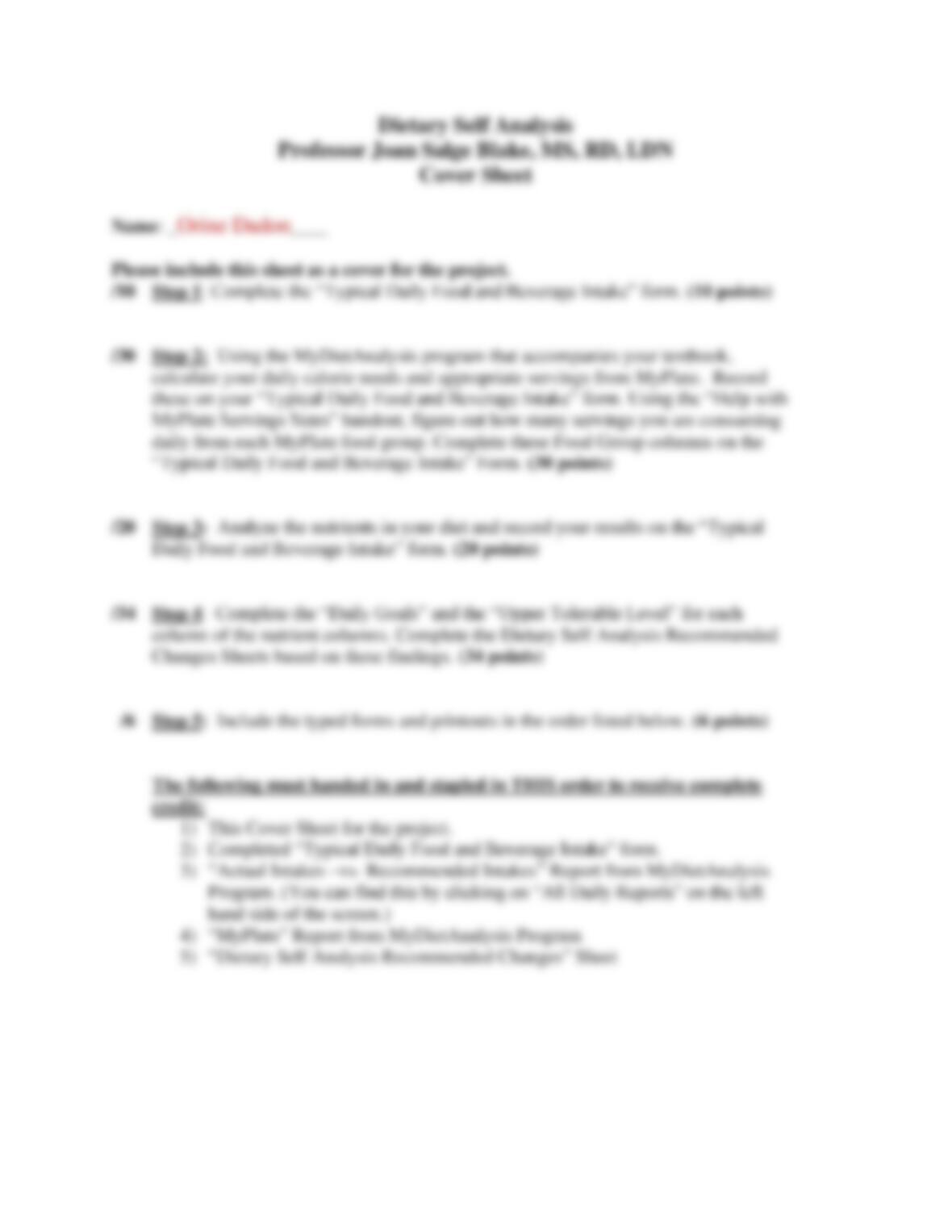
Step 1: Record all the food and beverages you typically consume in a single day on the “Typical
Daily Food and Beverage Intake” sheet, taking care to list ALL foods, beverages, including
condiments and sauces, and supplements in accurate household measures (i.e., cups, ounces,
tablespoons, etc.). Every food consumed should be recorded on a separate line (i.e. do NOT just
write ‘sandwich’ but rather, bread: 2 slices, roast beef: 2 ounces, romaine lettuce: 1 leaf, tomato:
1 slice, mayo: 2 tablespoons, etc.) (10 points)
Step 2: Log on to the MyDietAnalysis program and enter your personal information (set up a
“Profile”). Once this is set up, go to the Profile Summary Screen and click on “View DRI” on
the left side of the screen. Based on your profile, the program will tell you how many calories
you should be consuming daily as well as your daily goals for specific nutrients.
To uncover your MyPlate Food Group Goals, enter the food and beverages on your
“Typical Daily Food and Beverage Intake” form using the MyDietAnalysis program, “Diet
Tracker”. The MyDiet Analysis program only contains a limited selection of foods. Select foods
that are close to what you consumed. You may not be able find the exact foods you consume.
The goal of the project is to enter the most representative choices as possible. Once you select
the food, you will be able to change the portion size. For example, if a salad dressing is measured
in 100 grams portions, you can change it to tablespoons once you select it.
Using the “Help with MyPlate Serving Sizes” handout, calculate how many servings
you are consuming from each MyPlate food group daily listed on the “Typical Daily Food and
Beverage Intake” form. For example, if you eat two slices of whole wheat toast for breakfast,
you would uncover, with the “Help with MyPlate Serving Sizes” handout that a slice of bread
is considered a serving from the grain group. Thus, you would record “2” under the Grain Group
Column on your “Typical Daily Food and Beverage Intake” form as you would have consumed 2
servings from the grain group at breakfast. Complete the food group columns on the “Typical
Daily Food and Beverage Intake” form.
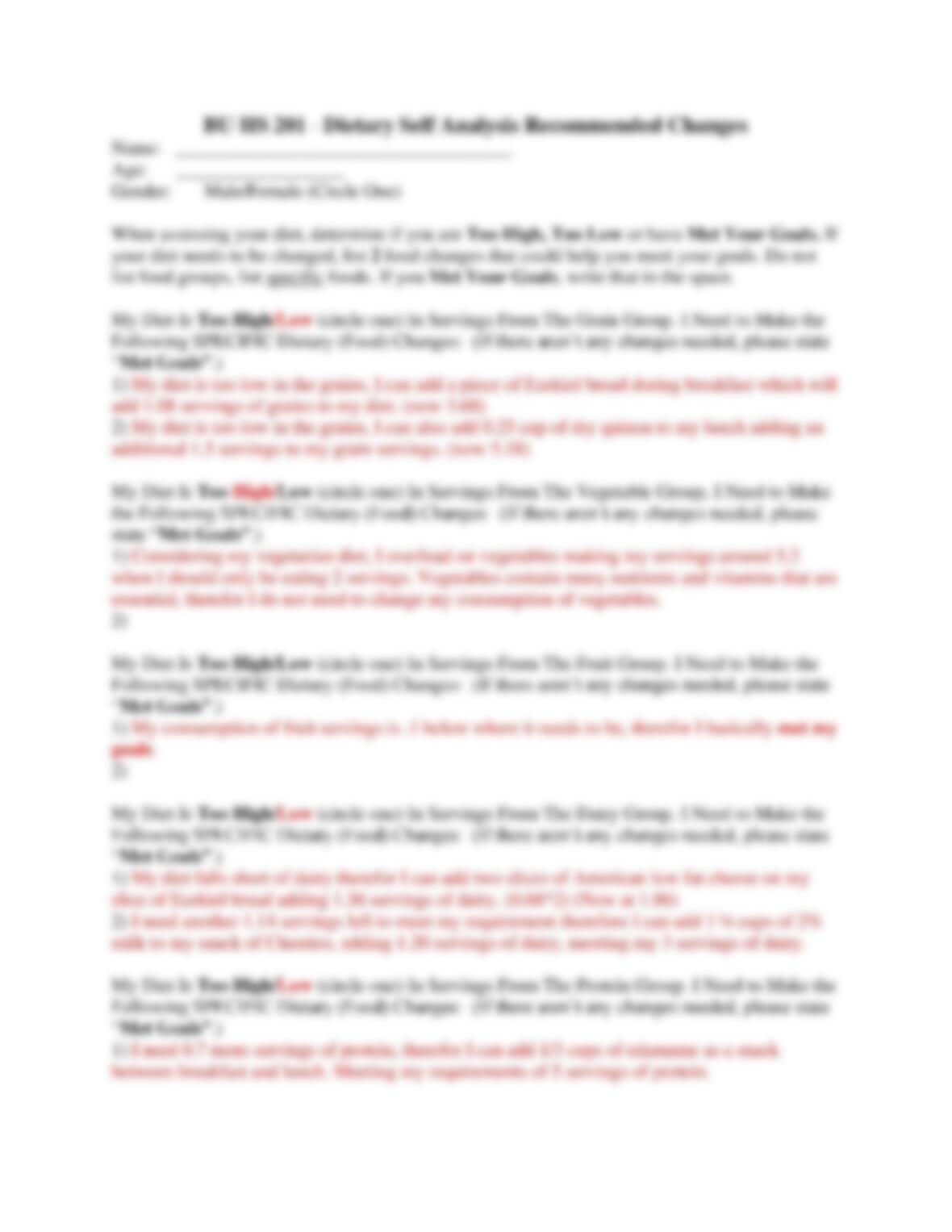
Once finished, click on “Reports”. To uncover your MyPlate Food Group goals, click on
“MyPlate” on the left side of screen. The “MyPlate” report will compare your total daily intake to
the recommended amount needed daily based on your profile. (30 points)
Step 3: To analyze specific nutrients in your diet such as fiber, click on the “Single Nutrient” report
on the left hand side of the screen. Next, in the middle of this screen, you will see a dropdown menu.
Choose the nutrient you want information on (i.e. fiber). Click on “Show Report”. Copy these values
from the report to the “Typical Daily Food and Beverage Intake” form. Complete the “Daily Goals”
and the “Upper Tolerable Level” for each column (as appropriate and based on your needs) that can
be found at the bottom of your “Typical Daily Food and Beverage Intake” form. The values for each
nutrient will be given in class throughout the semester and can also be found in the textbook. (20
points)
Note: The MyDietAnalysis program will not calculate your percentage of calories from total fat