Individual Assignment

2
Table of Contents
1.INTRODUCTION ………………………………………………………………………………………………………. 2
2. FACTORS THAT AFFECT THE COMPETITIVENESS OF HUMAN RESOURCES ……………………. 3
2.1. The organizational culture of the shipping company …………………………………………… 3
2.2. The organizational structure of the shipping company ……………………………………….. 3
2.3. The diversity of human resources ……………………………………………………………………… 4
2.4. The social climate on board the ship …………………………………………………………………. 4
2.5. The multinational working environment …………………………………………………………… 5
2.6. The technology ……………………………………………………………………………………………….. 5
2.7. The regulations for safety ………………………………………………………………………………… 5
3. THE HR PRACTICES …………………………………………………………………………………………………. 6
4. THE CREW PRACTICES …………………………………………………………………………………………….. 8
5. THE ALIGNATION OF HR AND CREW PRACTICES ……………………………………………………….. 9
6.CONCLUSION ………………………………………………………………………………………………………… 10
7.REFERENCES …………………………………………………………………………………………………………. 11
8.BIBLIOGRAPHY …………………………..…………………………………………………………………………. 11
1.INTRODUCTION
The challenges of the 21st century have made Human Resource (HR) Management a
critical parameter for survival and sustainable competitiveness and success of modern
enterprises, organizations and companies. HR department is responsible for replying

3
CV’s and selecting rare and qualified employees who will add value to the company. It
trains, rewards and manages the smooth and efficient communication among
employers. Since nothing is stable, such as the laws and the environment, HR
department is a dynamic and continuous process which is always open to change and
transformation. New strategic policies, systems and activities are necessary for the
achievement of the company’s goals.
2. FACTORS THAT AFFECT THE COMPETITIVENESS OF HUMAN RESOURCES
2.1. The organizational culture of the shipping company
Organizational culture refers to the beliefs, attitudes and values that are shared by all
employers of the company. Every organization or company is composed of various
elements, such as behavioral norms, company’s system of knowledge, ideology, laws
and day-to-day rituals. Organizational culture affects the development of business
and functional strategies by influencing the decision-making patterns of the shipping
company, as well as the ways goals are achieved. For instance, a company that shares
bureaucratic culture, shares hierarchical coordination and its operation its based-on
rules, and standard procedure. A bureaucracy-friendly company always works with
predictability and efficiency. Another type of culture is the clan one. In such kind of
culture, decisions are taken after a lot teamwork and conversations. (Lorange, 2005)
2.2. The organizational structure of the shipping company
Organizational structure can be defined as the administration design of the company.
Its role is to minimize or regulate the influence of individuals’ changes in the
organization. According to Mintzberg, organizational structure can be defined as the
way that “labor is divided into distinct tasks and then its coordination achieved among
those tasks.” It is a management approach that depends on a transformation that
forms the organization around its processes, teams and results, relying on
coordination among all departments of the company. In order for the company to
ensure the competitiveness and the success, the human resources are formally
designated in the organizational chart, with responsibility for managing the
interdepartmental projects and proposing improvements. The company is like a series
of interconnected functional processes in which the policies and guidelines are
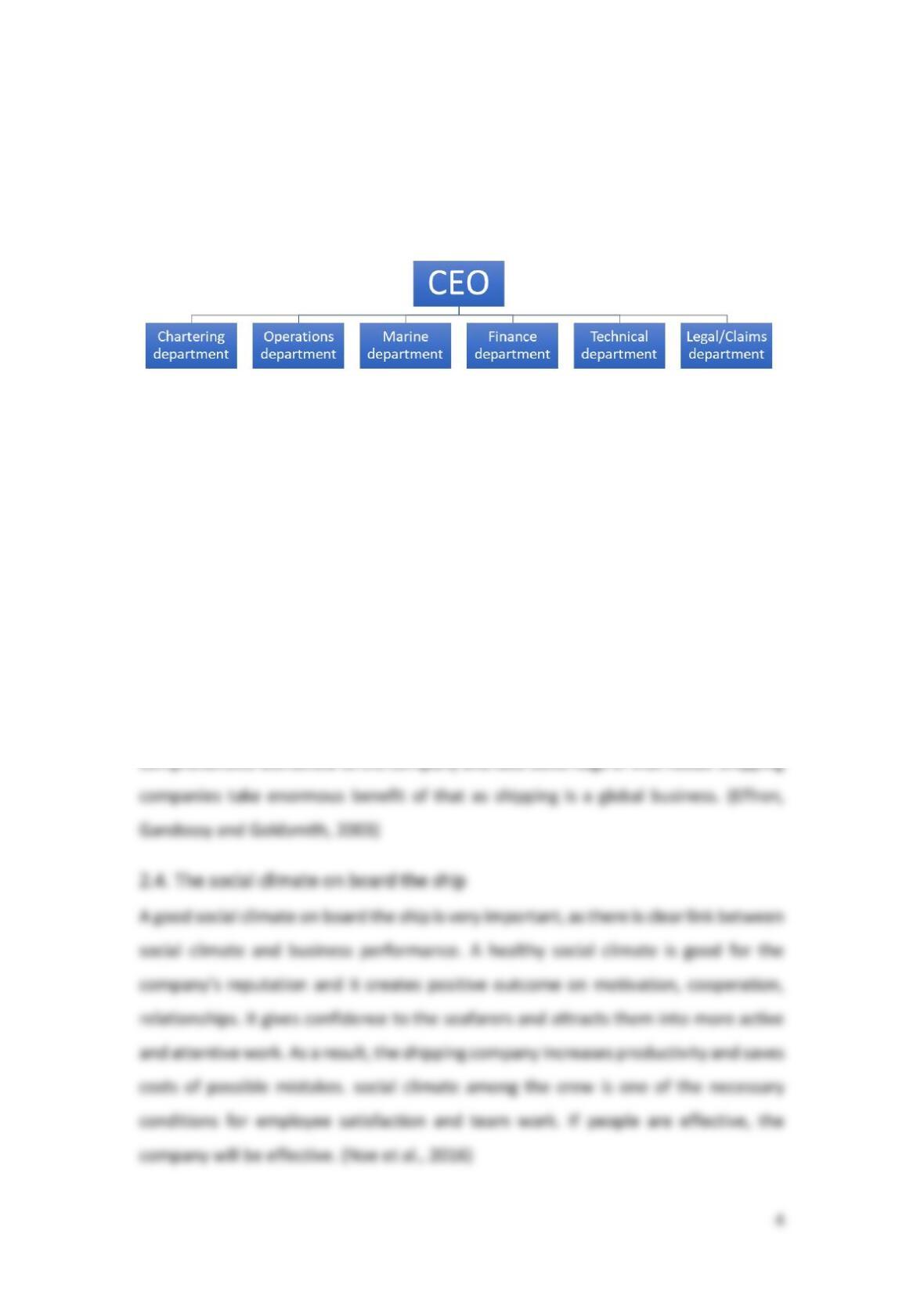
defined by upper management. In general, the concern for organizational structure is
to facilitate the flow of activities between the different departments, so the company
will acquire the competitive advantage that all employees have a greater participation
in the final result. (Hierarchy Structure, 2019)
Chart 1: An example of an organizational chart that illustrates the structure of a company.
2.3. The diversity of human resources
The term diversity often generates controversy and confusion, but in shipping
companies brings substantial potential benefits. First of all, diverse teams lead to more
innovative and effective ideas. The logic behind this is that innovation requires
employees to go outside of the common paradigms of operation, using diverse
perspectives to reach new thinking. Similarity can cause group thinking, which
minimizes creativity. Also, individuals from different countries have a deep awareness
of the needs in that country, enabling them to add considerable value and a