How to Become
a Better Leader
SPRING 2012 VOL.53 NO.3
REPRINT NUMBER 53312
Ginka Toegel and Jean-Louis Barsoux
Please note that gray areas reflect artwork that has been
intentionally removed. The substantive content of the ar-
ticle appears as originally published.

getty images
When executives identify a leader they admire, they often underestimate how much
that individual may have struggled to curb certain patterns of behavior or certain dominant facets
of his or her personality. Great leaders make it look easy. But in truth, the majority of effective lead-
ers that we have observed — even so-called
naturals like virgin Group’s Richard Branson —
have worked hard on themselves.
the traits that serve an executive well in one
leadership position often do not work well in an–
other. Moving up the hierarchy into new roles or
environments, executives may find they need to
play up or rein in different facets of their personal-
ity. What were strengths can become weaknesses.
fortunately, advances in personality research
can provide executives with a much richer picture
of their personality. Psychologists have identified
countless traits that distinguish individuals from
one another. Research in recent decades has con–
verged toward five broad dimensions, each
comprising a cluster of traits. these dimensions
appear so robust that they have been dubbed the
Big five. now widely accepted, the same five fac–
tors are found consistently with different research
methods, as well as across time, contexts and cul–
tures. (see “the Making of the Big five,” p. 53.)
in contrast with other models of personality,
the Big five were derived from the everyday lan–
guage that people use to describe one another.
starting with a master list of nearly 18,000 person-
ality descriptors, the list was eventually boiled
down to five fundamental factors: need for stabil–
ity,1 extraversion, openness, agreeableness and
conscientiousness.
Virgin Group’s
Richard Branson
has said that he
was “shy and
retiring” before
starting the airline.
How to Become
a Better Leader
Good leaders make their work look easy. But the reality is that most
have had to work hard on themselves — by managing or compen–
sating for potentially career-limiting traits. to grow as an executive,
you need to recognize and manage your strongest tendencies.
By Ginka ToeGel and Jean-louis BaRsoux
The leading
quesTion
How can
leaders
recognize and
manage their
psychological
preferences?
Findings
executives need
to understand their
natural inclinations
in order to modify
them or compen–
sate for them.
Most successful
executives have
had to work hard
on themselves.
leaders need to
recognize their
outlier tendencies
and learn how
others perceive
those tendencies.
sPRiNg sloan ManaGeMenT ReVieW 51
Leadership
A12-MI1-003 Toegel.indd 51 3/6/12 5:02 PM
W 53sLOaNRevieW.mit.eDU

52 MiT sloan ManaGeMenT ReVieW sPRiNg 2012 sloanreview.mit.edu
Leadership
Of course, personality scores are not performance
scores; no personality traits lead directly to positive or
negative performance. however, those scores can
alert executives to areas that require attention. A trait
that is effective in one context may become redun–
dant or counterproductive when the situation
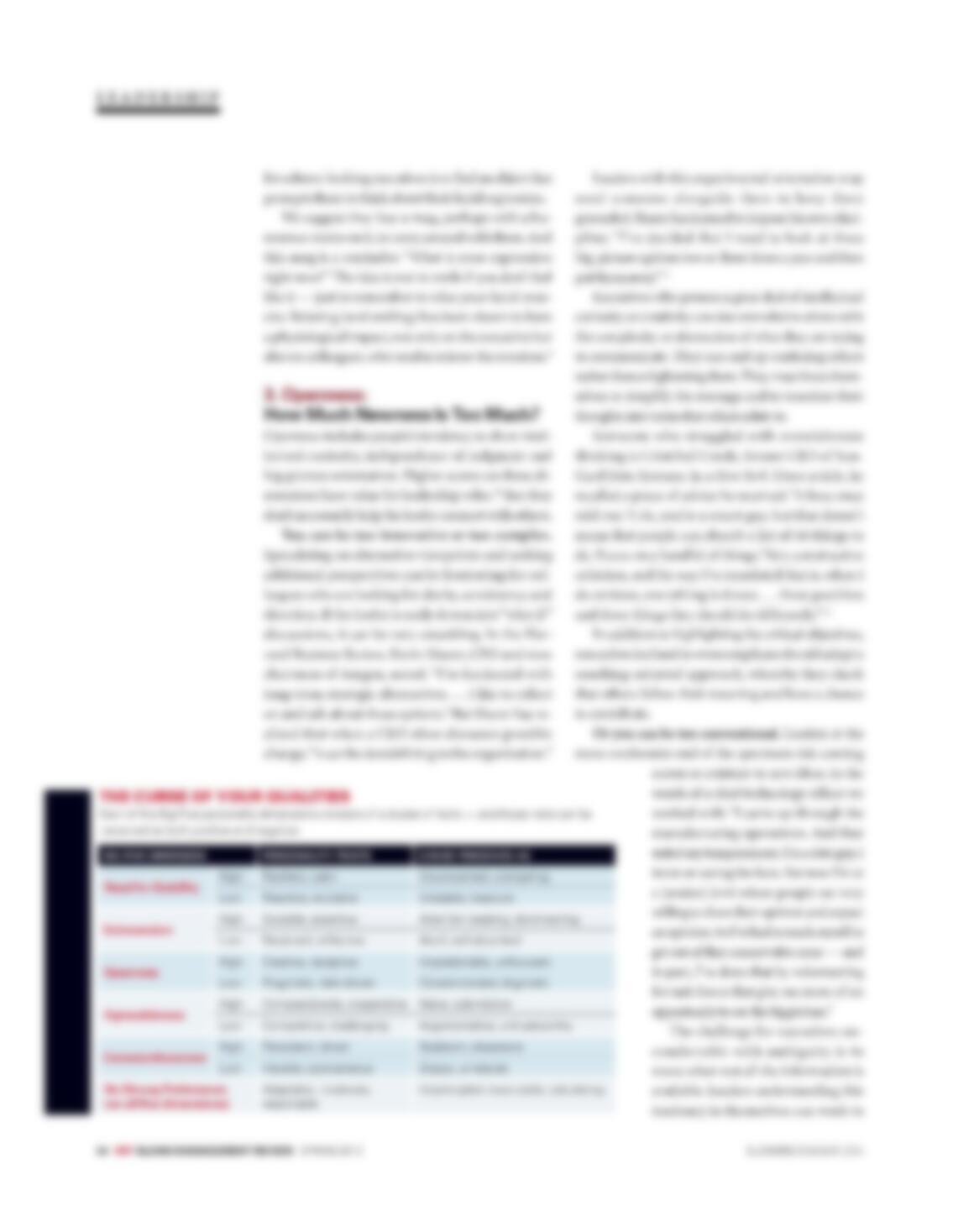
changes.2 (see “the curse of your Qualities,” p. 54.)
Common leadership Pitfalls
Leaders at all levels are under intense pressure to push
harder and go faster. under these conditions, execu–
tives sometimes have difficulty controlling their
inherent psychological preferences. And the higher
they go in an organization, the more their behaviors
come under scrutiny and influence others.
drawing on our extensive coaching work with se–
nior executives, we identify some of the most
common leadership pitfalls associated with high and
low scores on each of the Big five personality dimen–
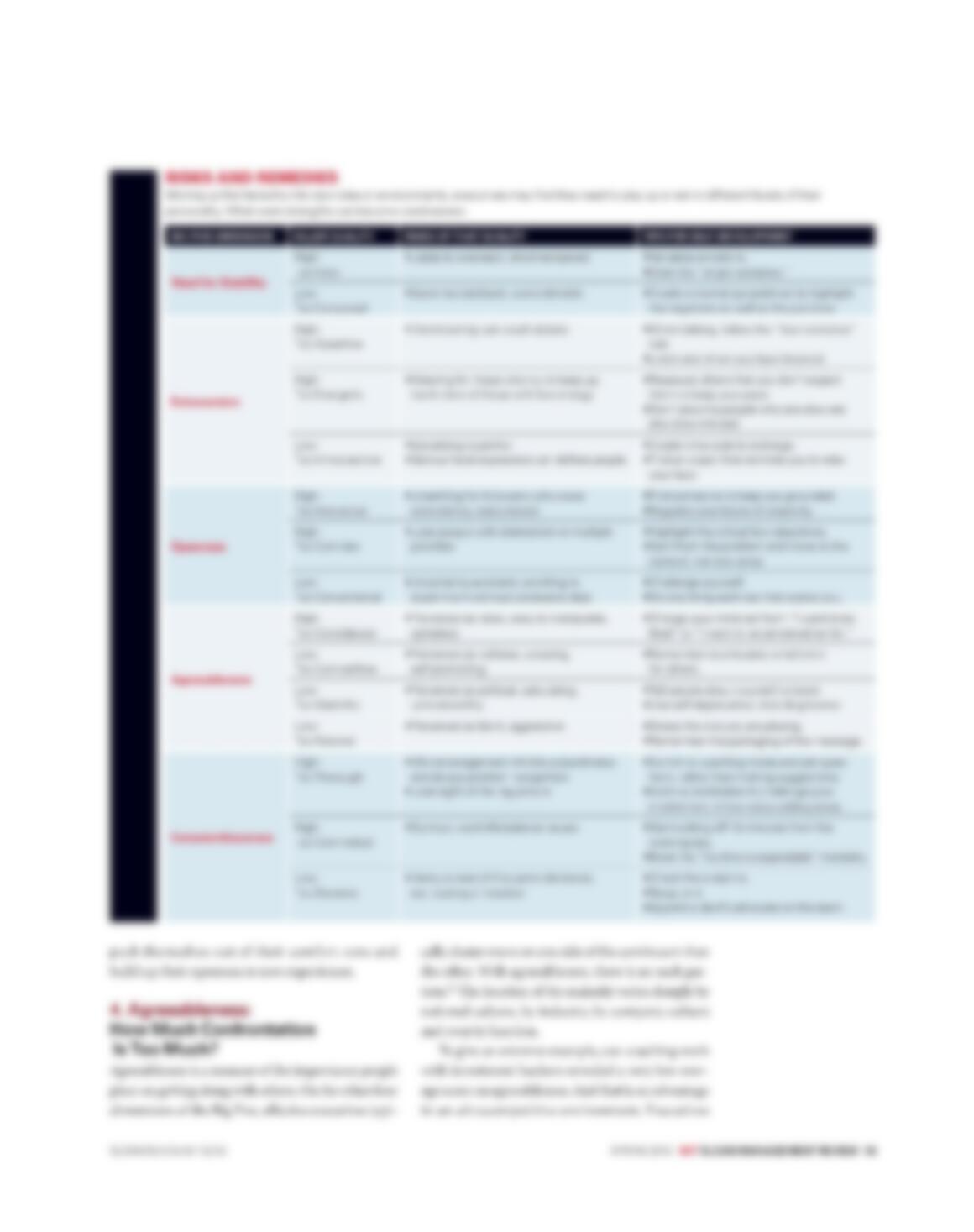
sions. (see “About the Research.”) We offer a mix of
testimony from high-profile executives and anony-
mous quotes from executives we have coached to
illustrate those potential hazards and how to deal
with them. (see “Risks and Remedies, p. 55.”)
1. need for stability:
How Much stress is Too Much?
emotional stability can be a valuable quality for ex-
ecutives, helping them cope with stress, setbacks
and uncertainty. But it has its drawbacks, too.
You can be too composed. Poise under pressure
helps executives project a reassuring image when
others may be inclined to panic. Many executives we
coach pride themselves on their ability to remain
calm. the risk of this trait is that they can appear
uninspiring or lacking in urgency. they may have
difficulty understanding why others are worried.
Moreover, such executives may come across as
unduly confident. One strategy to counter overop–
timism is to create mental lists. Alongside three
hopeful reasons for why something will work out,
an executive prone to overoptimism should come
up with three gloomy reasons why it may not.
Or you can be too impatient — and overreact.
sometimes successful executives have a pronounced
tendency to be impatient. Robert iger, ceO of Walt
disney, has acknowledged in an article in the New
York Times that this is an area he’s worked on: “i’ve
learned, in general, to be more patient. … i’ve learned
to listen better and manage reaction time better. What
i mean by that is not overreacting to things that are
said to me, because sometimes it’s easy to do that.”3
certain executives we coach are less resilient to
stress and struggle to stay calm, reflecting a high need
for stability. too often, they deal with their anger by
suppressing it. the problem is that the anger can ac–
cumulate unseen and unexpressed until it spills over
on an unsuspecting victim. to avoid overreacting, ex–
ecutives need to find ways of emptying their anger
container before it reaches the brim. the simplest
method is to verbalize those negative emotions: “i feel
disappointed/frustrated/upset/irritated because … .”
Research in brain imaging suggests that putting our
feelings into words dampens those feelings.
Whether stating an emotion or writing it in a
journal, the simple act of expressing it activates a
region of the brain involved in forms of self-control
and self-regulation.4 it is a bit like drilling a hole in
the side of the anger container. executives some–
times worry that verbalizing emotion will make
them look weak. in fact, it conveys confidence. it
expels negative energy while providing others with
a better understanding of how the executive ticks.
2. extraversion:
How Much Company is Too Much?
extraversion reflects our desire to be with other
people and to draw energy from them. Leadership is
abouT The ReseaRch
the research for this article is based on findings from more than 2,000 in-depth con–
versations with international executives regarding their personality scores. these
interviews were conducted by us separately, while the executives were attending
leadership programs at Duke University, London Business school and imD.
We used the NeO Pi-R five-factor instrument, which has become the dominant
framework for researching personality and a staple ingredient in many leadership
development programs. (executives who have not been exposed to it can assess
themselves free on a noncommercial version of the test, iPiP, available at http://
www.personalitytest.net/ipip/ipipneo1.htm.)
the personality inventory comprises 30 facets, but not all of these are equally rel–
evant to the work environment. Based on our experience, particularly ginka toegel’s
previous work as a practicing psychotherapist, we spent 80% of the time in our one-
to-one sessions talking about 15 of those dimensions, which we believe represent
the top challenges for most executives.
the confidential nature of these sessions prevent us from naming the executives,
so we cite them anonymously. We also draw on publicly available interviews with
high-profile business figures. although we did not conduct Big Five personality inven–
tories with these leaders, their comments reflect key insights about personality traits
that they learned to manage as they moved into positions of leadership.
A12-MI1-003 Toegel.indd 52 3/6/12 5:02 PM
about influencing people, so it can be an advantage
to be outgoing, assertive and energetic. there is
strong evidence that these characteristics help exec–
utives to be perceived as leaderlike.5 the association
with effective leadership is much weaker.6
You can be too assertive — or too energetic. high
scores on the extraversion dimension can trigger per–
ceptions that the executive is too talkative or
domineering — with the added implication that he or
and adapt their energy levels accordingly.
in particular, leaders with high energy levels need
to be aware that this disposition can create tension
with slower-paced people, especially those whom the
leaders regard as slow-minded or uncommitted.
Worse, these slower-paced individuals may then
underperform, living down to the executive’s dimin–
ished expectations.7 As a senior executive from the
finance sector told us: “Whenever i had to meet with
The Making oF The big Five
Psychologists have identified countless
personality traits and dimensions that dis-
tinguish us from one another. But research
in recent years has converged toward five
broad dimensions, each comprising a clus-
ter of traits that account for the majority of
the differences among individual personali-
ties. these dimensions have been dubbed
the Big Five.
although researchers did not set out to
find five dimensions, that is what emerged
from their analyses of the data. the line of
research began with gordon allport and Har–
old Odbert, who scoured dictionaries to
identify 17,953 words in everyday language
that people use to describe one another and
published their results in 1936. that master
list was reduced, in several stages, until it
was eventually boiled down to just five di–
mensions in 1961 by two U.s. air Force
researchers, who had rare access to main–
frame computers. Unfortunately, their
findings failed to reach an academic audi–
ence until the 1980s. at that point, the
introduction of the personal computer and
the availability of specialized software en–
abled other research teams to factor analyze
the data and confirm the existence of five
overarching domains. the first inventory
based on the Big Five factors was launched
by Paul t. Costa, Jr. and Robert R. mcCrae in
1985.i these five factors have since proved
a rich conceptual framework for integrating
diverse research findings and theory in per–
sonality psychology.
the stronger the trait, the more likely it is
that the person in question will display trait-
related behaviors in terms of how he or she
relates to people, solves problems, plans
work and expresses himself or herself. in–
vestigations into where those traits actually
come from suggest that around half of the
variance is inherited and the other half is ac–
quired through experience, especially in
early childhood.ii though major life crises
occasionally produce shifts on some person–
ality dimensions, most changes in adulthood
tend to be gradual and limited.iii
A12-MI1-003 Toegel.indd 53 3/6/12 5:02 PM
A12-MI1-003 Toegel.indd 54 3/6/12 5:02 PM
A12-MI1-003 Toegel.indd 55 3/6/12 5:02 PM
A12-MI1-003 Toegel.indd 56 3/6/12 5:02 PM
A12-MI1-003 Toegel.indd 57 3/6/12 5:02 PM
A12-MI1-003 Toegel.indd 58 3/6/12 5:02 PM
A12-MI1-003 Toegel.indd 59 3/6/12 5:02 PM
A12-MI1-003 Toegel.indd 60 3/6/12 5:02 PM