Financial Markets and Institutions
Ninth Edition
Chapter 5
How Do Risk and Term
Structure Affect Interest
Rates?
Copyright © 2018 Pearson Education, Ltd. All Rights Reserved.

Copyright © 2018 Pearson Education, Ltd. All Rights Reserved.
Chapter Preview (1 of 4)
In the last chapter, we examined interest rates, but made a
big assumption—there is only one economy-wide interest
rate. Of course, that isn’t really the case.
In this chapter, we will examine the different rates that we
observe for financial products.

Copyright © 2018 Pearson Education, Ltd. All Rights Reserved.
Chapter Preview (2 of 4)
We will fist examine bonds that offer similar payment
streams but differ in price. The price differences are due to
the risk structure of interest rates. We will examine in
detail what this risk structure looks like and ways to examine
it.

Copyright © 2018 Pearson Education, Ltd. All Rights Reserved.
Chapter Preview (3 of 4)
Next, we will look at the different rates required on bonds
with different maturities. That is, we typically observe higher
rates on longer-term bonds. This is known as the term
structure of interest rates. To study this, we usually look at
Treasury bonds to minimize the impact of other risk factors.

Copyright © 2018 Pearson Education, Ltd. All Rights Reserved.
Chapter Preview (4 of 4)
So, in sum, we will examine how the individual risk of a bond
affects its required rate. We also explore how the general
level of interest rates varies with the maturity of the debt
instruments. Topics include:
•Risk Structure of Interest Rates
•Term Structure of Interest Rates

Copyright © 2018 Pearson Education, Ltd. All Rights Reserved.
Risk Structure of Interest Rates
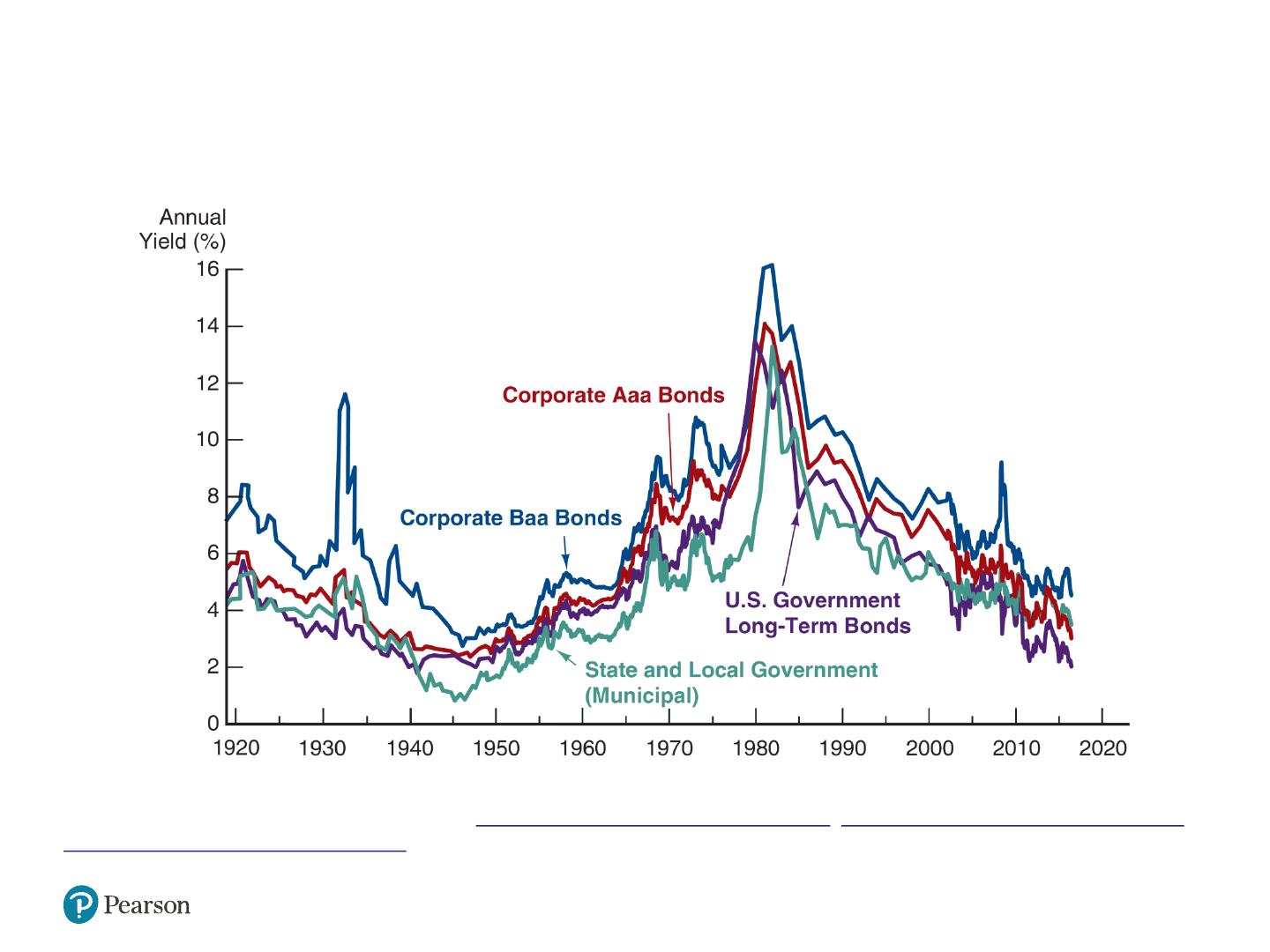
•To start this discussion, we first examine the yields for
several categories of long-term bonds over the last 90
years.
•You should note several aspects regarding these rates,
related to different bond categories and how this has
changed through time.
Copyright © 2018 Pearson Education, Ltd. All Rights Reserved.
Figure 5.1 Long-Term Bond Yields, 1919–2016
Sources: Board of Governors of the Federal Reserve System, Banking and Monetary Statistics, 1941–1970; Federal
Reserve Bank of St. Louis FRED database, https://fred.stlouisfed.org/series/GS10, https://fred.stlouisfed.org/series/AAA,
https://fred.stlouisfed.org/series/BAA.

Copyright © 2018 Pearson Education, Ltd. All Rights Reserved.
Risk Structure of Long Bonds in the U.S.
The figure shows two important features of the interest-rate
behavior of bonds.
•Rates on different bond categories change from one year
to the next.
•Spreads on different bond categories change from one
year to the next.

Copyright © 2018 Pearson Education, Ltd. All Rights Reserved.
Factors Affecting Risk Structure of
Interest Rates
To further examine these features, we will look at three
specific risk factors.
•Default Risk
•Liquidity
•Income Tax Considerations

Copyright © 2018 Pearson Education, Ltd. All Rights Reserved.
Default Risk Factor
One attribute of a bond that influences its interest rate is its
risk of default, which occurs when the issuer of the bond is
unable or unwilling to make interest payments when
promised.

Copyright © 2018 Pearson Education, Ltd. All Rights Reserved.
Default Risk
U.S. Treasury bonds have usually been considered to have
no default risk because the federal government can always
increase taxes to pay off its obligations (or just print money).
Bonds like these with no default risk are called default-free
bonds.

Default Risk Factor (1 of 3)
But are these bonds truly default-free bonds? During the
budget negotiations in Congress in 1995–1996, and then
again in 2011–2013, the Republicans threatened to let