Abdulazizkhon Abduganiev #14012649
Comparative Management
HOW DO INFORMAL INSTITUTIONS INFLUENCE CORPORATE
GOVERNANCE IN RUSSIA AND HOW ARE THEY DIFFERENT FROM INDIA?
INTRODUCTION
It goes without saying that the Culture is the main denominator in shaping a country’s
overall insight. A widely accepted definition of culture was suggested by Dutch researcher
Hofstede (1984):
“Culture is the collective programming of the mind which distinguishes the members of one
group or society from those of another. Culture consists of the patterns of thinking that
parents transfer to their children, teachers to their students, friends to their friends, leaders
to their followers, and followers to their leaders. Culture is reflected in the meanings people
attach to various aspects of life; their way of looking at the world and their role in it; in their
values, that is, in what they consider as ‘good’ and ‘evil’; in their collective beliefs, what
they consider as ‘true’ and as ‘false’; in their artistic expression, what they consider as
beautiful’ and as ‘ugly’.”
From this definition one can draw a conclusion that the values are the most underlying
aspect of the culture. Hofstede suggested that in order to understand culture, you need look
into cultural values. Those values can shape attitudes and that behaviour can form the
people’s behaviour. Consequently, the behaviour of individuals forms the society and social
environment as whole. That was adequate to understand the importance of the culture and the
question arises if it has effect in shaping the corporate governance of a state.
Corporate governance is defined as an arrangement of connections between an
organization’s administration, its board, its stakeholders and different partners such as
government. Corporate governance additionally gives the structure through which the goals
of the organization are set, and the methods for achieving those goals (OECD 2004). In other
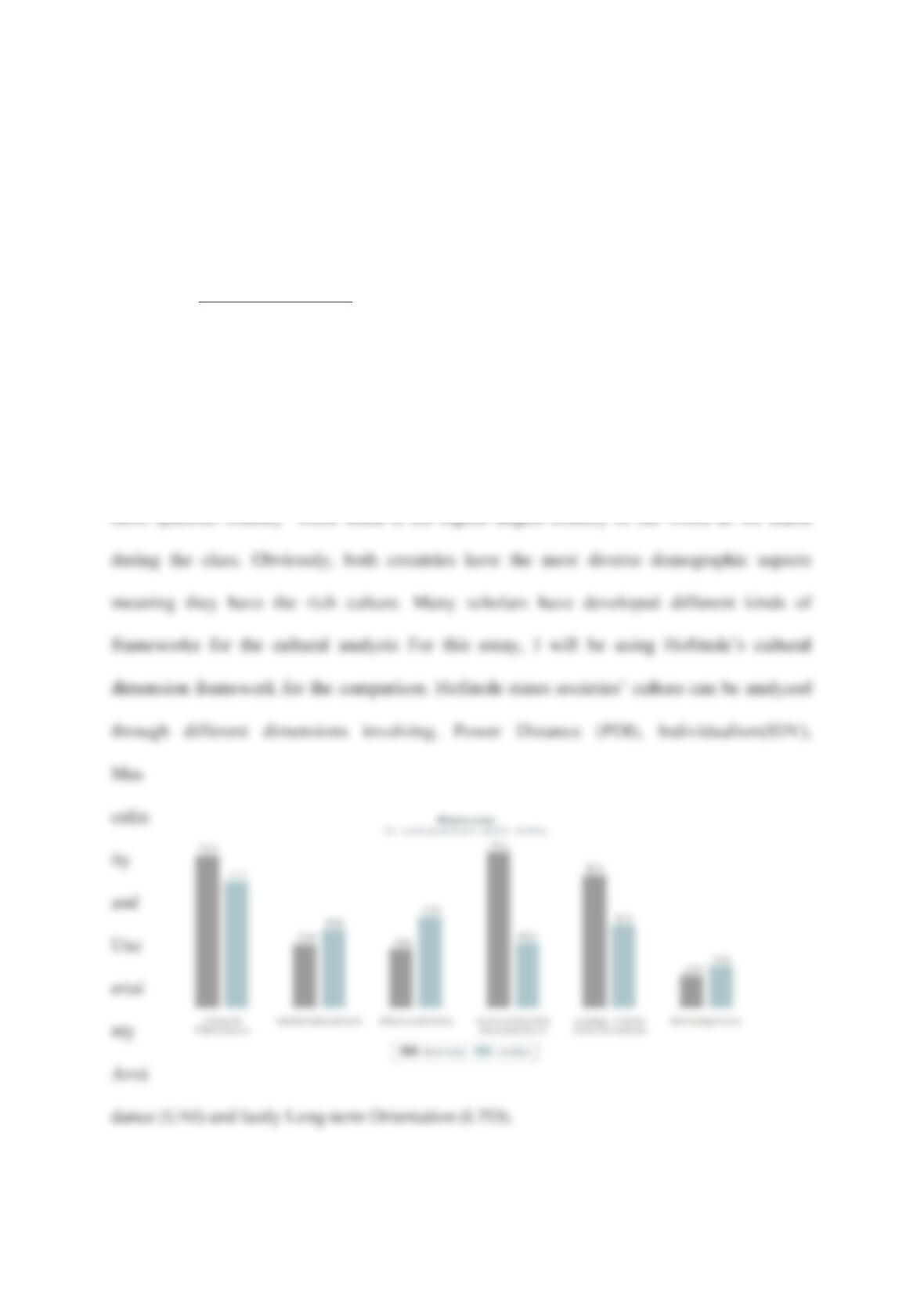
words, It describes organization’s structure for balancing the benefit among the board
members and shareholders and the society as whole. I am inclined to believe that the cultural
aspect plays a pivotal role in forming the corporate governance of the country and for this
essay, I will develop my arguments with the help of country cases that are India and Russia
focusing on automotive industry.
CROSS-CULTURAL COMPARISONS OF INDIA AND RUSSIA
It is common knowledge that Russia and India are the the countries that have the least
problems with country area and population. Russia holds #9 in world rank in terms of
population while the latter country is the second to China in the world. And Russia is the