6
How Congress Makes Laws
Lesson 6 Study Guide
1. Identify the four types of congressional committees and match each to their purpose/functions.
– Standing
– Joint
– Select
– Conference
Standing committees are the main committees of Congress. They are called standing
committees because they are permanent committees that exist continually from one elected
Congress to the next and are where the main work gets done. An idea proposed for a law starts
out as a bill. Every bill considered by Congress goes to a particular standing committee as its first
step in the process of potentially becoming a law. The different standing committees represent
different areas of specialization. Every standing committee also has multiple subcommittees
attached to them, which represent further areas of specialization.
– Permanent, existing from one Congress to the next
– Every congressional bill first goes to a standing committee as part of the legislative process
– Every standing committee has multiple subcommittees
A joint committee is one of these special purpose types of committees. Joint committees are
called “joint” because they join together members from both the House and the Senate who
work together to facilitate business between the two houses. Joint committees often study
policy issues or conduct investigations. An important thing to know about Congress is that in
addition to its lawmaking role, it also has investigative powers that allow it to conduct
investigations in order to determine if a new law needs to be considered to address a problem
of some type or whether an existing law needs to be changed so that it works better

– Contain members from both houses in order to facilitate business between them when
necessary
– Study policy issues or conduct investigations
▪ Subpoena power
– No lawmaking duties
Select committees are committees set up for a special purpose, usually on a temporary basis.
The special purpose might be to serve as a task force for a particular project or to conduct a
special investigation. They usually do not write and debate bills.
– Special, temporary committees appointed for specific purposes, projects, or investigations
A conference committee is a special type of joint committee that reconciles differences
between bills passed in the House and Senate, because sometimes the version of the bill that
passes in one chamber is slightly different from the version that passes in the other, because of
amendments or changes that were demanded by members in one or the other house. But
before a bill can be sent to the president to be signed into law, the House and Senate versions of
a bill must be identical, and those differences are worked out by a conference committee, which
is composed of both House and Senate members and usually members of both parties
– A special joint committee that reconciles differences between bills passed by the House and
Senate
2. Recognize what it means for Congress to have subpoena power and what that power entails.
(slide 3)
As part of its investigative authority, Congress can issue what is called a subpoena. A subpoena
is a legal order to appear in court. But instead of ordering someone to appear in court, Congress
can issue a subpoena ordering someone to appear before a congressional committee in order to
provide that committee with information, and by law that person must appear and testify to the
committee under oath, just as in court of law. And if someone lies to a congressional committee
while testifying, they can be charged with perjury and suffer criminal penalties
3. Recognize the role of the majority party in congressional committees.
From Internet:
The majority party controls most committee staff and resources, but a portion (consistent with
party division) is shared with the minority. Bills and resolutions are referred to committees,
which select items for further consideration.

4. Recognize the relationship between committees and subcommittees.
Every standing committee of the House and the Senate will have some number of related
subcommittees. Every member of the House and Senate serves on one or more committees and
subcommittees. They seek to serve on committees they believe will best help them serve their
constituents at home or that will raise their public profile, both of which will help their prospects
for getting re-elected (slide 8)
From Internet:
A congressional subcommittee in the United States Congress is a subdivision of a United States
congressional committee that considers specified matters and reports back to the
full committee. Subcommittees are formed by most committees to share specific tasks within
the jurisdiction of the full committee.
5. Identify the majority parties in both chambers of Congress and recognize the size of those
majorities.
6. Recognize the role of committee chairpersons.
The chairs of committees are very powerful because they control the agenda of the committee,
determining when it meets, what business it will conduct, and which bills or other legislation it
will consider. The chair position usually goes to the person who is the longest serving member of
the majority party on the committee (slide 8)
7. Recognize how a bill begins, the role of a bill sponsor, and in which chamber bills start out.
Ideas for laws (proposals) can originate from any source—from members of Congress, the
president, executive branch agencies, interest groups, or from any citizen. However, ONLY a
member of Congress can formally introduce a bill for consideration by the House or Senate.
A member of Congress who introduces a bill is known as the bill’s sponsor
A bill can be first introduced in either the House or Senate but must eventually pass in both
chambers. The only exception are bills to raise revenues, which must begin in the House

8. Recognize the role of the public during consideration of bills.
Most committee hearings in Congress are open to the public and have visitor seating
9. Identify the meaning of bill markup in committee.
After the hearing, the bill receives markup, when committee/subcommittee members
potentially change or amend the original version of the bill
Internet:
A committee markup is the key formal step a committee ultimately takes for the bill to advance
to the floor. Normally, the committee chair chooses the proposal that will be placed before the
committee for markup: a referred bill or a new draft text.
10. Recognize the length of time allowed to debate a bill in each chamber and how it is determined.
11. Identify how many votes are required to pass bills in both chambers in Congress.
On the House floor the bill is debated for the allowed time specified by the rule and is then
voted on by the full House membership (435 votes). ▪ It takes a simple majority voting in favor
to pass a bill. ▪ A simple majority is 218 votes out of 435. ▪ In the House of Representatives of
the 117 th Congress following the 2020 elections, there are 221 Democrats and 211 Republicans
12. Recognize the role of the filibuster in Senate debates and the power it gives to individual
senators.
After a bill is debated on the floor of the Senate, then the bill is voted on by the full Senate
membership (100 votes).
▪ However, since a vote on a bill cannot be taken until debate has ended, special Senate rules
allow members to filibuster a bill to prevent a vote.
Filibustering is the act of engaging in unlimited debate. Old Senate rules required a filibustering
Senator to actually stand on the floor of the chamber and talk continuously (longest on record is
24 hours). New Senate rules do not require actual debate.
▪ If a senator filibusters a bill, Senate rules allow a filibuster to be stopped by passing a motion
to invoke cloture, which simply means the filibuster is ended and a vote can be taken. However,
it takes a supermajority of 60 votes in favor to invoke cloture.
▪ If 60 votes in favor of invoking cloture cannot be obtained, then the bill is defeated. If
obtained, then only 30 additional hours of debate is allowed before a final vote is taken.

The final vote on a Senate bill requires only a simple majority vote in favor to pass. ▪ A simple
majority is 51 votes out of 100. ▪ In the Senate of the 117 th Congress following the 2020
elections, there are currently 50 Republicans, 48 Democrats, and 2 Independents. ▪ If a 50-50 tie
vote occurs, then the Vice-President of the United States, as the constitutional President of the
Senate, can cast the tie-breaking vote. This is the only time the Vice-President may cast a vote. ▪
The significance of the Senate filibuster rule is that it empowers the minority party.
13. Identify how Congress can override a president’s veto of a bill.
If the president vetoes the bill, Congress can override the president’s veto with a two-thirds
majority vote in each chamber and the bill will become law without the president’s signature. ▪
A successful override requires 288 votes in the House and 67 votes in the Senate
14. Identify the major steps in the process of how a bill becomes a law in their correct order.
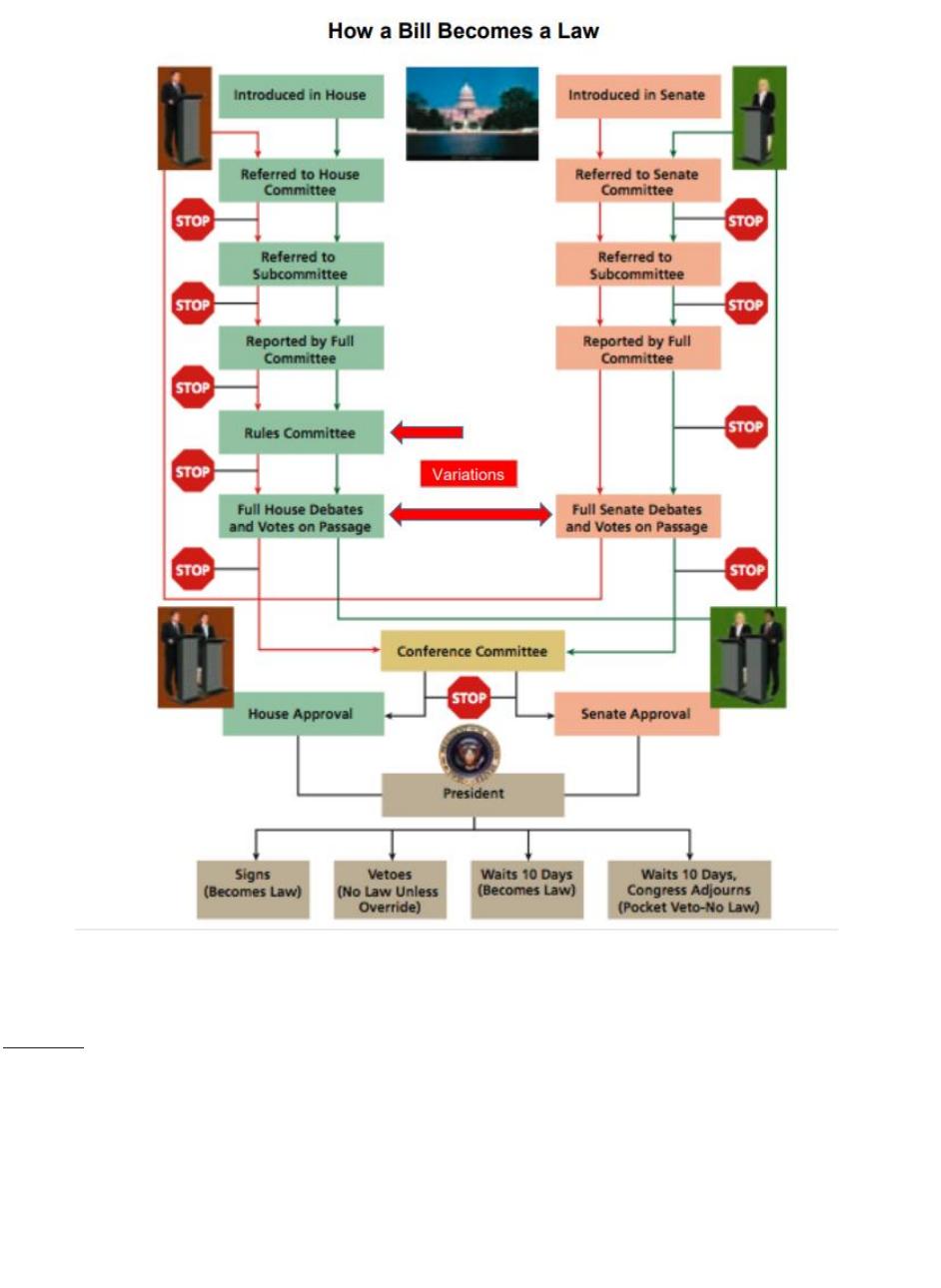
Internet:
Steps
• Step 1: The bill is drafted. …
• Step 2: The bill is introduced. …
• Step 3: The bill goes to committee. …
• Step 4: Subcommittee review of the bill. …
• Step 5: Committee mark up of the bill. …

• Step 6: Voting by the full chamber on the bill. …
• Step 7: Referral of the bill to the other chamber. …
• Step 8: The bill goes to the president.
• Step 9: Bill goes to president
• Step 10: Overriding a veto
15. Recognize the terms “earmarks” and “pork” and how they relate to bills.
Sometimes, either to persuade a reluctant member to support a bill, or to do a favor for a loyal
member, special funding may be included in a bill that will pay for a desired project in that
member’s district or state. That type of spending is said to be earmarked for a special project.
Terms to know
-Invoking cloture
-Bipartisan
Invoking cloture: If a senator filibusters a bill, Senate rules allow a filibuster to be stopped by passing a
motion to invoke cloture, which simply means the filibuster is ended and a vote can be taken
Bipartisan: When any bill is voted on, if it receives favorable support by both Republicans AND
Democrats, then that bill is said to have received bipartisan support
Steps of How a Bill Becomes a Law
1. Ideas for laws (proposals) can originate from any source
—from members of Congress, the president, executive branch agencies, interest groups, or
from any citizen. However, ONLY a member of Congress can formally introduce a bill for
consideration by the House or Senate.
2. Only about 5% of the total number of bill that get introduced ever make into law. ▪ Key point:
There are multiple points of potential failure during the process of how a bill becomes a law,
which is why relatively few bills make it successfully to passage.
3. A bill can be first introduced in either the House or Senate but must eventually pass in both
chambers. The only exception are bills to raise revenues, which must begin in the House.
4. A member of Congress who introduces a bill is known as the bill’s sponsor.
5. Once introduced, a bill is sent to the clerk of the chamber, who assigns it a number. House
bills are designated H.R., for example bill H.R. 209. Senate bills are designated by an S., for
example S. 98. Bills will also be given a name, for example: S. 1150 Raise the Wage Act.
6. The bill is then printed, distributed, and sent to the appropriate standing committee(s) for
consideration AFTER it is referred there by the Speaker of the House or Senate Majority
Leader. Standing committees are also often called full committees. ▪ Note the power held by
the Speaker and the Majority Leader to control whether a bill is referred to committee. They
control the schedule for consideration of all bills.
7. After a bill is sent to the appropriate standing committee or subcommittee, then the chair of
the committee decides whether to hold a hearing on the bill. ▪ Hearings provide
committee/subcommittee members the opportunity hear expert advice about the bill if needed
and to hear from those who support and oppose the bill. ▪ Most committee hearings in
Congress are open to the public and have visitor seating.
8. After the hearing, the bill receives markup, when committee/subcommittee members
potentially change or amend the original version of the bill.
9. After marking up the bill, the new version of the bill is voted on by committee/subcommittee
members and either passes or fails by majority vote. If it fails, then the bill expires and is dead.
10. If the bill passes in the full (standing) committee, then it is “reported” favorably out of
committee and goes next to be debated and voted on by all members on the floor of the
chamber.
11. When reported favorably to the floor of the House of Representatives, the bill must first go
to the Committee on Rules, where it is given a rule and placed on the calendar. ▪ The bill rule
determines the amount of time allowed for debate of the bill on the floor and specifies whether
amendments to the bill will be allowed.
12. On the House floor the bill is debated for the allowed time specified by the rule and is then
voted on by the full House membership (435 votes). ▪ It takes a simple majority voting in favor
to pass a bill. ▪ A simple majority is 218 votes out of 435. ▪ In the House of Representatives of
the 117 th Congress following the 2020 elections, there are 221 Democrats and 211 Republicans.
13. If the bill passes in the full House, then it is sent to the Senate for consideration, if it is not
already being considered there simultaneously. 2
14. Unlike the House, where the time allowed to debate a bill on the floor of the chamber is set
by the Rules Committee, in the Senate there is no limit on the time allowed for debate.
15. After a bill is debated on the floor of the Senate, then the bill is voted on by the full Senate
membership (100 votes). ▪ However, since a vote on a bill cannot be taken until debate has
ended, special Senate rules allow members to filibuster a bill to prevent a vote. Filibustering is
the act of engaging in unlimited debate. Old Senate rules required a filibustering Senator to
actually stand on the floor of the chamber and talk continuously (longest on record is 24
hours). New Senate rules do not require actual debate. ▪ If a senator filibusters a bill, Senate

rules allow a filibuster to be stopped by passing a motion to invoke cloture, which simply
means the filibuster is ended and a vote can be taken. However, it takes a supermajority of 60
votes in favor to invoke cloture. ▪ If 60 votes in favor of invoking cloture cannot be obtained,
then the bill is defeated. If obtained, then only 30 additional hours of debate is allowed before a
final vote is taken.
16. The final vote on a Senate bill requires only a simple majority vote in favor to pass. ▪ A
simple majority is 51 votes out of 100. ▪ In the Senate of the 117 th Congress following the 2020
elections, there are currently 50 Republicans, 48 Democrats, and 2 Independents. ▪ If a 50-50
tie vote occurs, then the Vice-President of the United States, as the constitutional President of
the Senate, can cast the tie-breaking vote. This is the only time the Vice-President may cast a
vote. ▪ The significance of the Senate filibuster rule is that it empowers the minority party.
17. The House and Senate must pass identical versions of the same bill. When they pass two
different versions, then the bills must go to a conference committee where the differences are
worked out and a unified bill is produced. ▪ The unified bill is then returned to each chamber for
a final vote. ▪ If the conference committee fails to achieve a unified version, or if the unified bill
does not pass the final vote in BOTH chambers, then the bill is dead. 18. When any bill is voted
on, if it receives favorable support by both Republicans AND Democrats, then that bill is said to
have received bipartisan support.
19. Sometimes, either to persuade a reluctant member to support a bill, or to do a favor for a
loyal member, special funding may be included in a bill that will pay for a desired project in
that member’s district or state. That type of spending is said to be earmarked for a special
project. Many bills have these earmarks added to them as a result of political deal-making,
and the practice is criticized because much of it is considered to be wasteful spending,
unnecessarily increasing the cost of government. This type of wasteful spending is more often
called pork barrel spending, or just “pork” for short, as in “that bill is filled with pork.”
20. IF a bill successfully passes BOTH houses of Congress, then it is next sent to the president
for consideration, who either signs it or vetoes it. 21. If the president signs the bill, then it
becomes law.
22. If the president vetoes the bill, Congress can override the president’s veto with a two–
thirds majority vote in each chamber and the bill will become law without the president’s
signature. ▪ A successful override requires 288 votes in the House and 67 votes in the Senate.
LESSON 6
Flash Cards
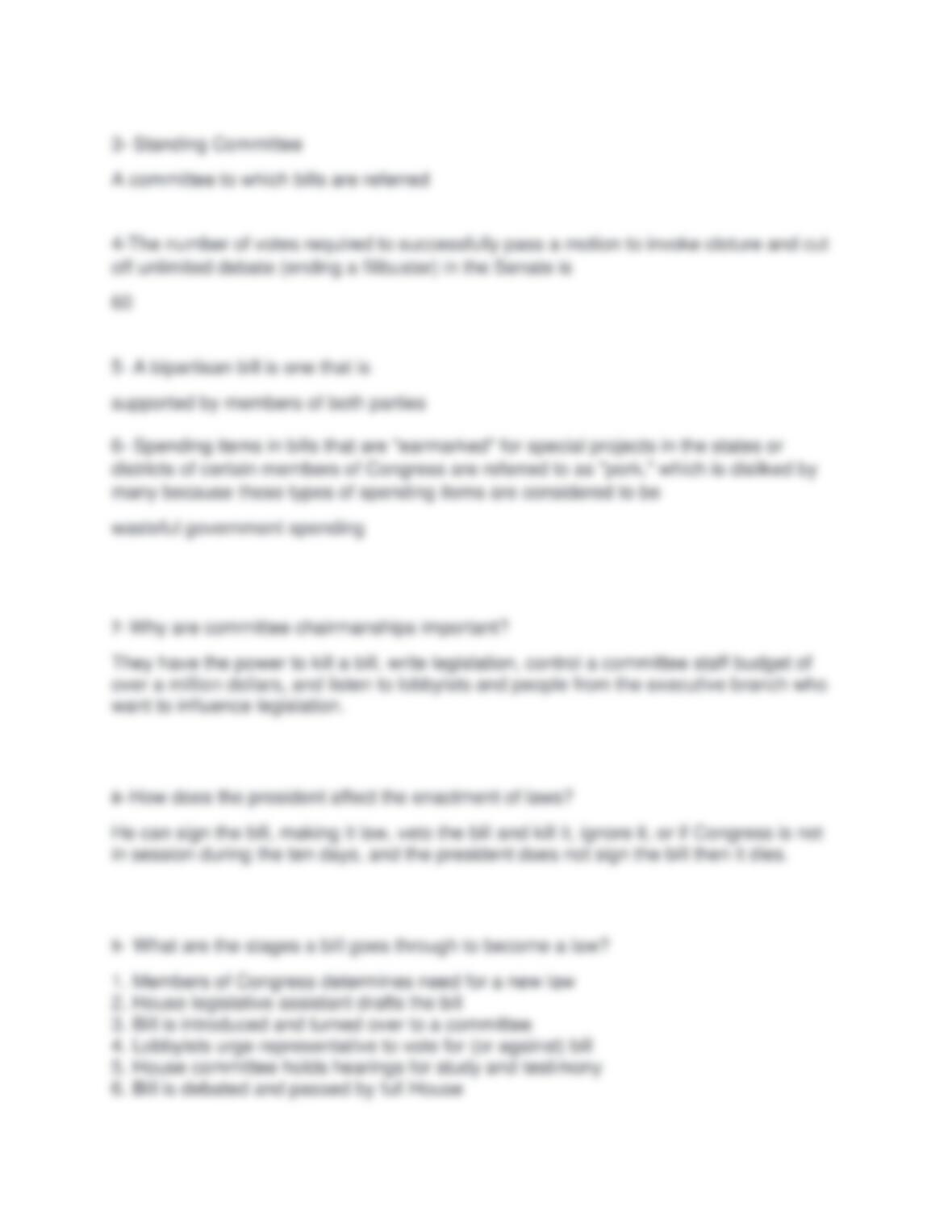
1- The current majority party of the US House of representatives is the – Democratic Party
2- The current majority arty of the U.S Senate is the -Democratic Paty

3- A standing committee of Congress is a permanent congressional committee that exist from one
congressional session to another. True
4- A joint committee of Congress contains members from both the House of Representatives and
the Senate. True
5- The minority party of the House of Representatives has control over a certain number of
committees and subcommittees. False
6- Every standing committee of House and Senate as subcommittees that focus on specialized
areas of the standing committees. True
7- An order issued by a congressional committee forcing someone to appear before it to answer
questions is called a_____. Subpoena
8- The person who controls the activities of each committee and subcommittee is the ______ of
the committee. Chair
9- Democrats currently control every committee in the Senate. True
10– Some bills can be considered first in the Senate before moving to the House of Representatives.
True. (The only bill that MUST begin in the House is the bill that deal with raising revenues
(TAXES))
11– A member of Congress who introduces a bill is called the bill’s. Sponsor
12– When congressional committees consider bills, they often hold open hearings and invite
members of the public to give their views about a bill. True
13– The process of changing or revising a bill in congressional committees is called. Markup
14– One thing different between the House and the Senate in the process of how a bill becomes a
law is that all bills in the House must First go to the Rule Committee before going to the foor to
be debated. True
15– When the House Rules Committee puts rules on a bill among the rules will be length of time
allowed for _____ of the bill. Debate
16– There is never a time limit on debate of a bill in the Senate. True
17– No vote can be taken on a bill in either the House or Senate until members have had the
opportunity to _______________ the bill. Debate

18– Senators can prevent a bill from being voted on in their chamber by engaging in unlimited
debate on it, a tactic known as. Filibuster
19– A senate filibuster can be ended only if a motion to invoke cloture is successfully passed. True
20– The number of Senate votes required to invoke cloture and end filibuster is. 60
21– Ending a filibuster in the U.S Senate really just means ending the debate of bill so a regular
simple majority vote can take place. True
22– When a regular simple majority vote takes place in the Senate the number of votes required to
pass a bill is. 51
23– If there is a 50-50 tie vote in the Senate, then the _____ is the person who votes to break the
tie. Vice President
24– The filibuster is not available to members of the House of Representatives, so all votes require
only a simple majority to pass, which is ________ votes. 218
25– The republican party is currently the majority party of the House of Representatives. False
26– When money gets added to bills to pay for special projects as favors to certain legislators, or to
guarantee their support for a bill, it drives up the cost of government and is considered
unnecessary and wasted. This type of spending is referred to as. Pork barrel spending or
just “PORK’’
27– The official name for pork barrel spending measures included in a bill is. “Earmarks” meaning
dollars are earmarked to pay for specific project.
28– When democrats and republicans cooperate and work together to pass a bill or to get some
other legislative work done, it is an example of. Bipartisanship
29– If a bill passes in the Senate with 50 Republican Senators and 9 Democratic Senators voting in
favor of it, can it be called a bipartisan ill? YES
30– After a bill passes in one chamber, the other chamber must pass an identical version of the bill
before it can go to the president. True
31– If identical versions of a bill do not pass in the House and Senate, the bill goes to a ____ to work
out the differences. Conference committee
32– If the president vetoes a bill passed a by Congress, he constitution gives Congress the power to
_____ the presidential veto. Override
33– Overriding a presidential veto requires a ____ majority vote in both chambers of Congress.
Two thirds
Test 6
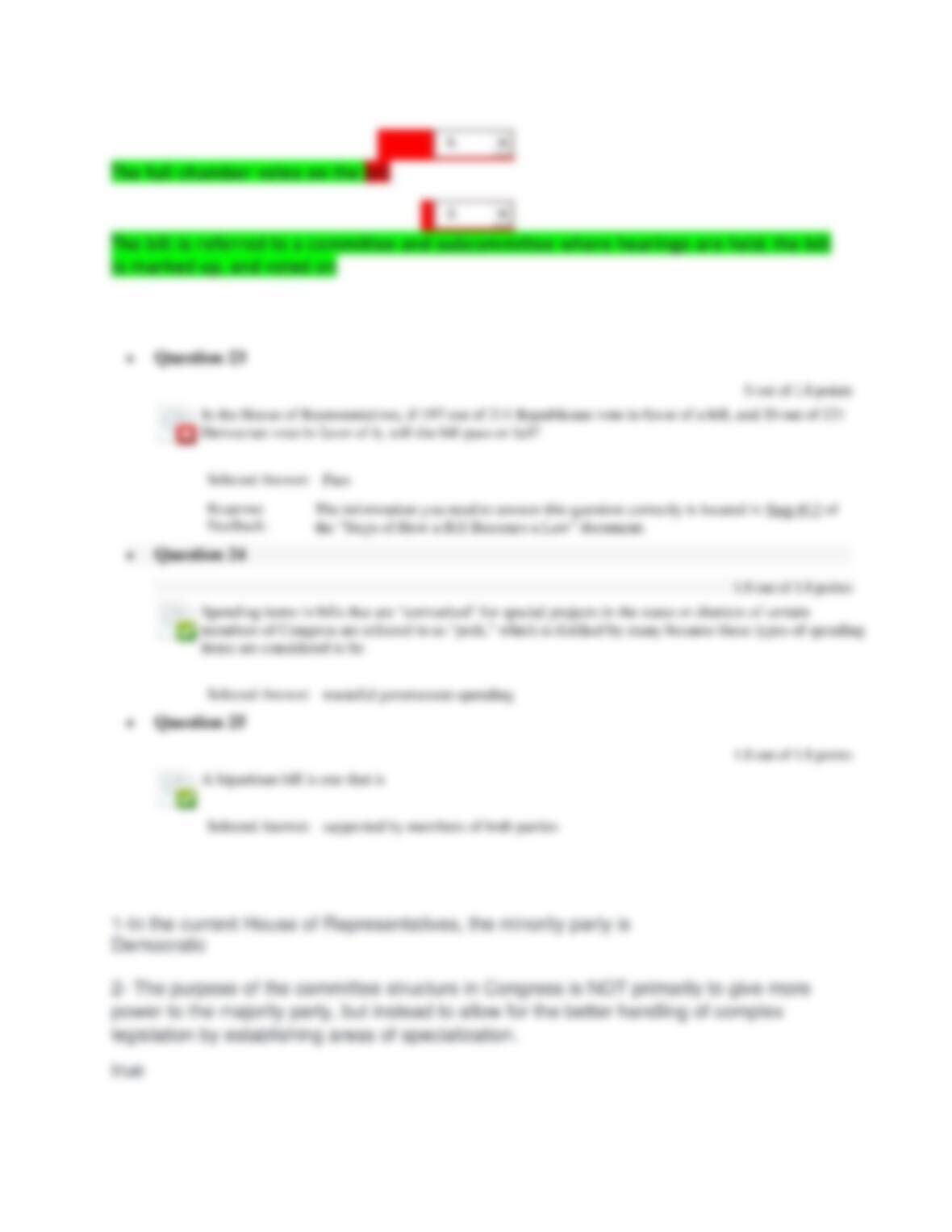
Question 1
Match each of the committee types below to its associated function.
You must get all of the answers correct to earn any points for this question.
D.
Standing
Committee
C.
Joint Committee
B.
Conference
A.
A committee set up for a one-time project or task
B.
A committee to reconcile differences between
House and Senate bills
C.
A committee comprised of Senate and House
Committee
members