Chemistry and Art CH 1086
Experiment 5: Mixing Colors
Introduction
The light that we ordinarily encounter, whether sunlight or artificial, is what we call
“white light” Nevertheless we do not live in a black and white world, but a very colorful one. If
an object reflects all light waves it appears white. If no wavelengths of light are reflected the
object appears black. Most objects, however, absorb some wavelengths and reflect or transmit
others.
When three colors can be combined to form all possible colors, they are called primary
colors. However, we must distinguish between colored light (luminous object like sun) and
colored object (illuminated object like painting).
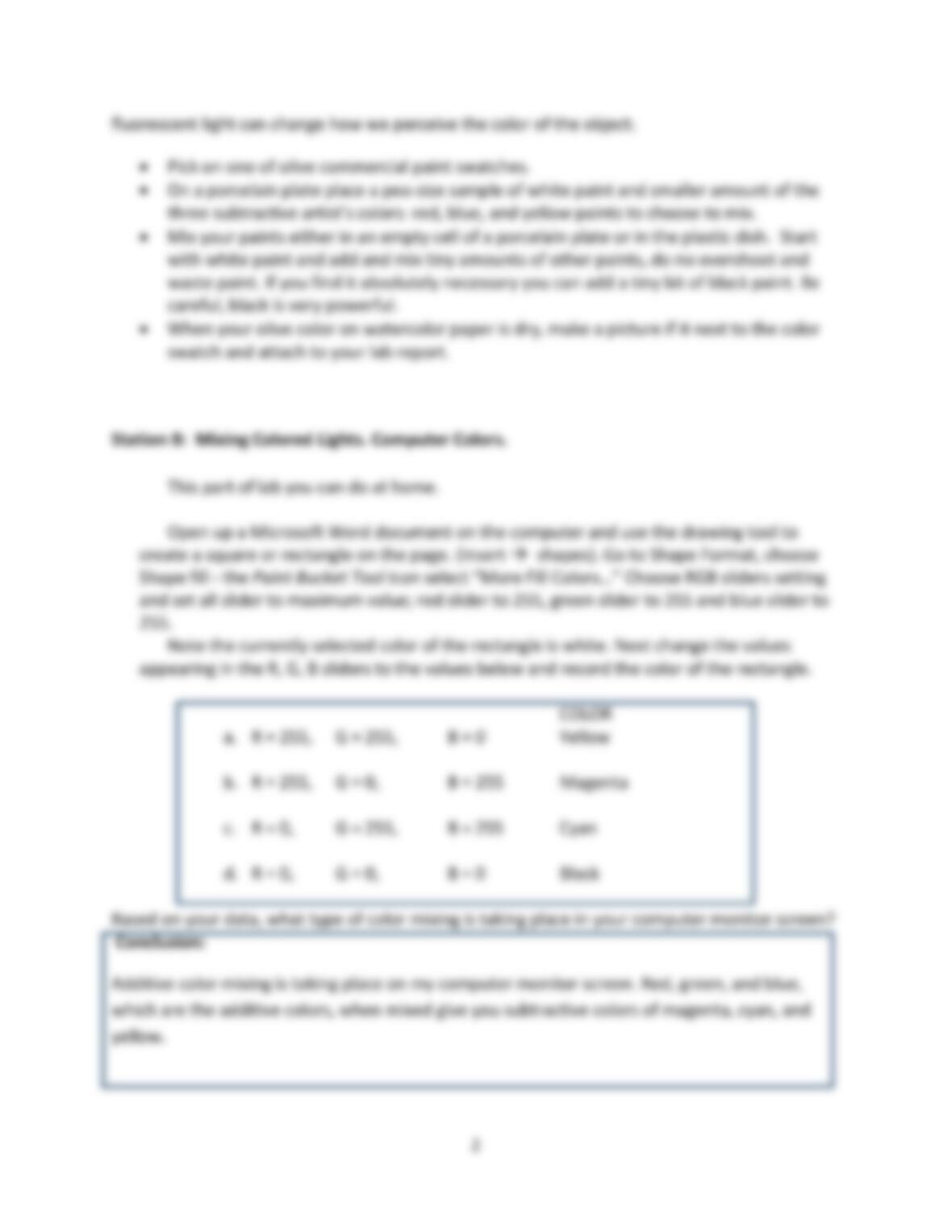
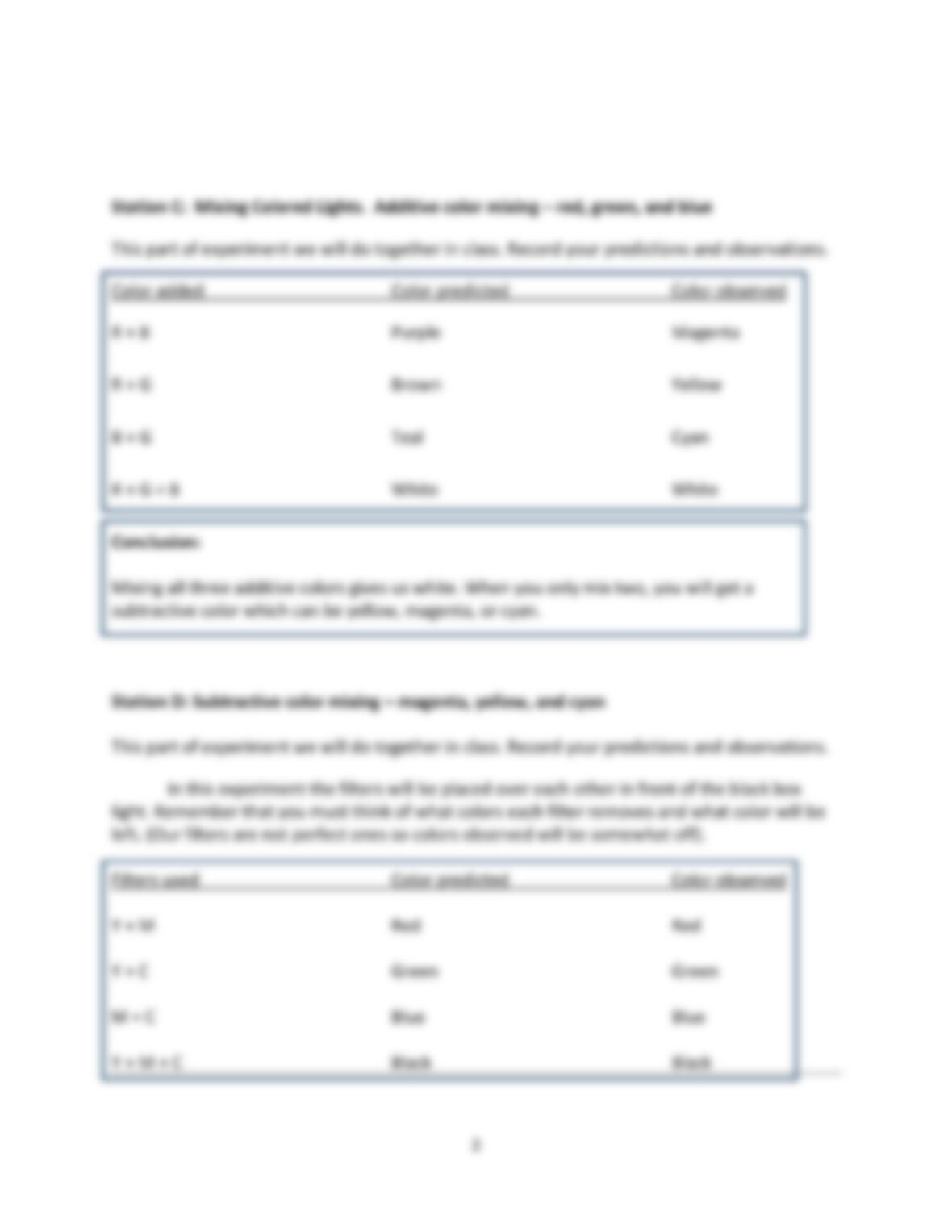
When mixing colored lights, the primary colors are (red), green (G), and blue (B). In
additive color models, such as RGB, white is the “additive” combination of all primary colored
lights, while black is the absence of light. When these three colored lights are shone on a white
surface it appears white. Therefore, these are called additive primary colors.
Things are very different when working with pigments. Artists speak of red (R), yellow
(Y), and blue (B) pigment primaries. Printers, however, who have to be very precise with their
color mixing, use magenta (M), cyan (C), and yellow (Y) as their color primaries. The CMYK color
model (process color, four color) is a subtractive color model, used in color printing. CMYK