Problem 2.5 (10 pts)
Part A (5 pts)
•(1 pts) Attempt
•(1 pts) Find and use approximate number of proteins, base pairs, and lipids in E. coli
•(3 pts)
–Find number of carbon in proteins, base pairs, and lipids
–Same for nitrogen
–Same for phosphates
First, What is the make up of an E. coli cell?
3∗106proteins, 4 ∗106base pairs, and 2 ∗107lipids (see numbers given in chapter). And we know
there are 300 amino acids in a protein.
Second, how many carbons are in each of these components? On average, there are 5 carbons in an amino
acid, 20 carbons in a base pair, and 40 carbons in a lipid.
Now, let’s find the number of carbon atoms in our cell.
3∗106proteins ∗300amino acids
1 protein ∗5carbon
1amino acid = 4.5∗109carbon atoms(≈5∗109carbon atoms)
4∗106base pairs ∗20carbons
1base pair = 8 ∗107carbon atoms
2∗107lipids ∗40carbons
1lipid = 8 ∗108carbon atoms
Note, if we add these numbers together 4.5∗109+ 8 ∗107+ 8 ∗108= 5.3∗109(≈5∗109) carbon atoms total.
We see that this number is absolutely dominated by carbon that comes from the proteins and that the DNA
base pairs and lipids can practically be ignore.
When considering nitrogen (N) we use the same exact process, but now we instead use the fact that there
are 2 N in one amino acid, 8 N in one amino acid, and 1 N in a lipid. This leads to 2 ∗109N from amino
acids, 3 ∗107N from base pairs, and 2 ∗107N from lipids (again the proteins are the largest by far). Adding
these together (and slightly rounding) gives a total number of Nitrogen ≈2∗109.
Lastly, when considering phosphate, there are 2 phosphate per base pair and 1 phosphate per lipid. Using
the same method as above, we find the number of phosphates to be ≈3∗107.
Part B (5 pts)
•(1 pts) Attempt
•(1 pts)
–Find grams of glucose in medium
–Find grams of salt in medium
1
•(1 pts)
–Turn grams of glucose into number of carbon atoms
–Turn grams of salt into number of nitrogen atoms
•(2 pts)
–How many cells can that much carbon supply?
–How many cells can that much Nitrogen supply?
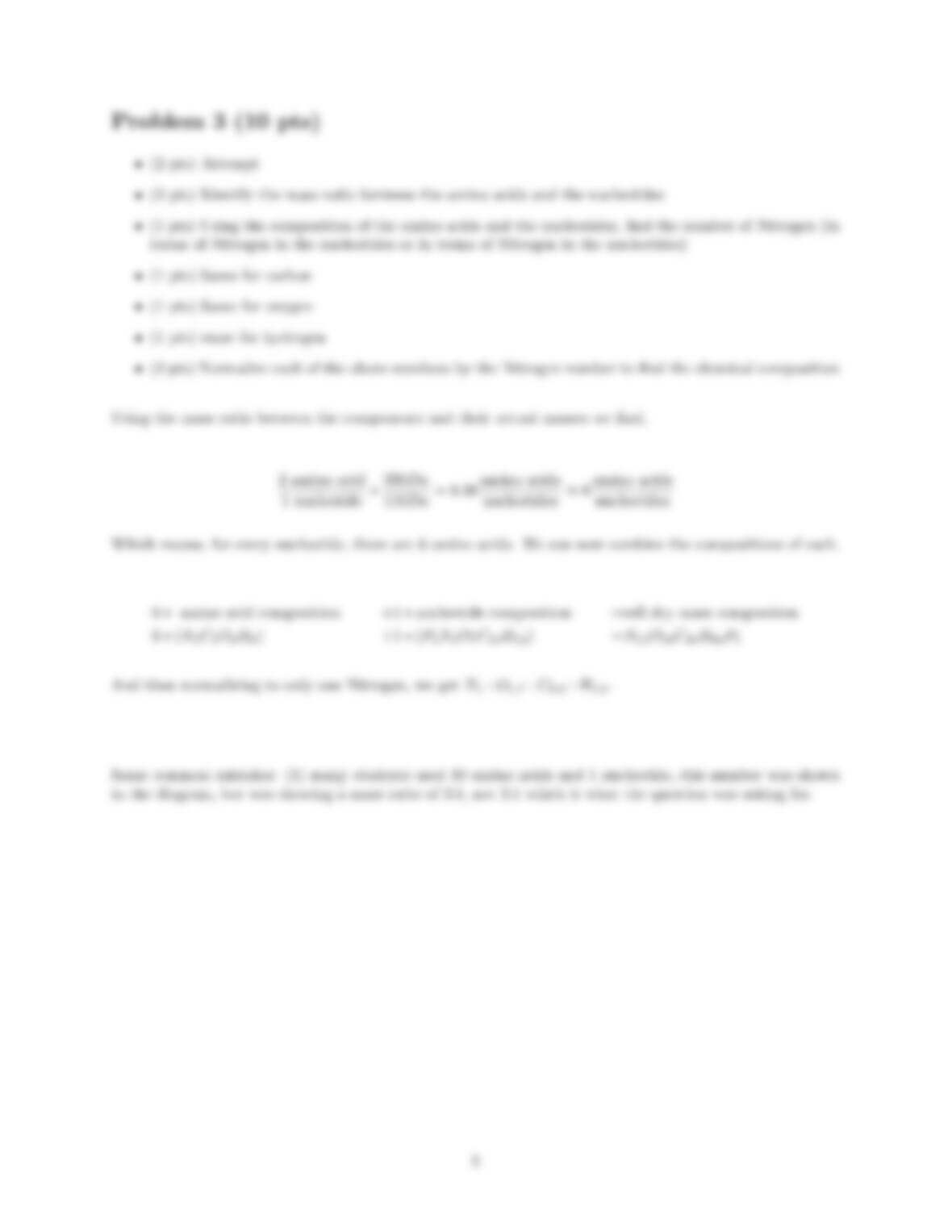
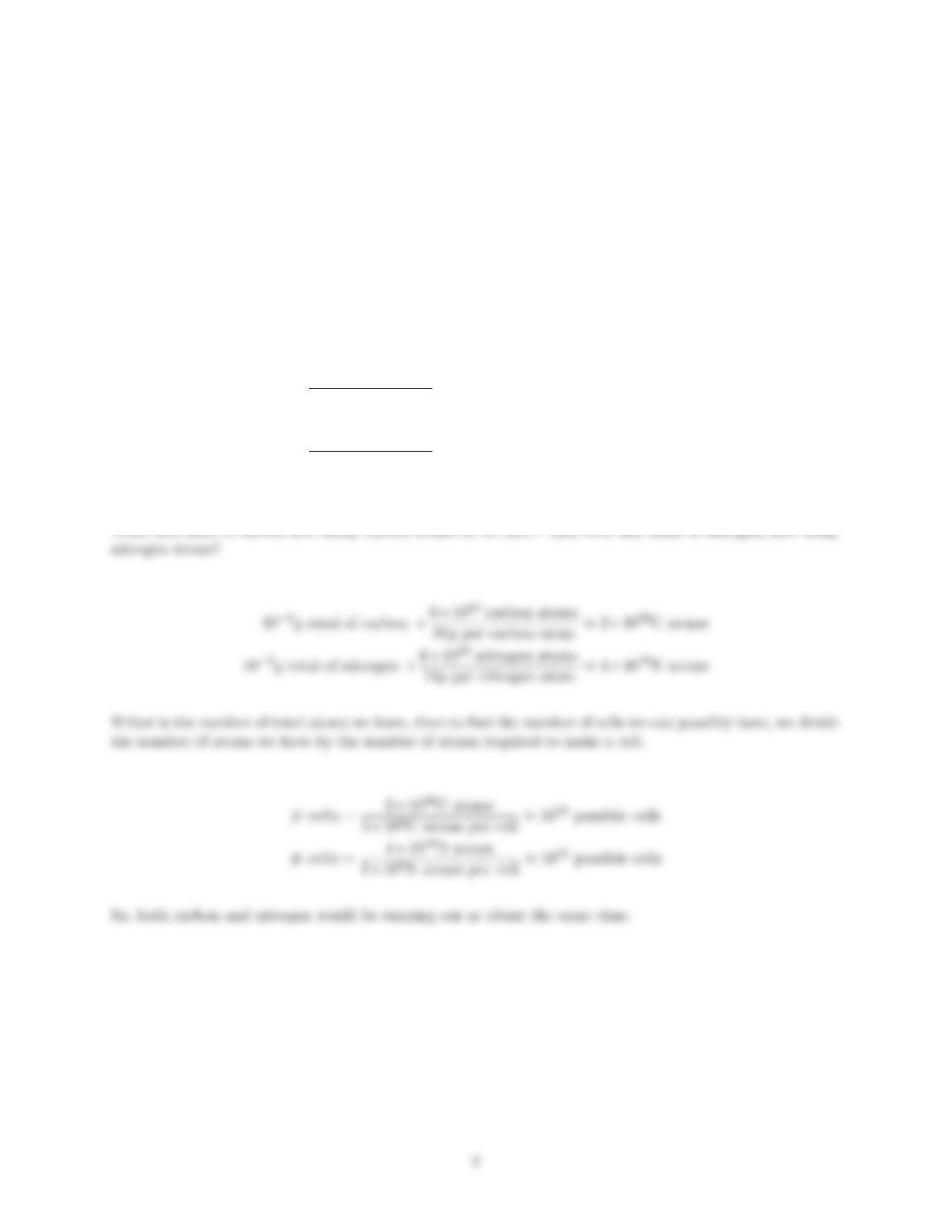
If we have 5mL of solution, how much carbon and nitrogen do we have? (recall glucose = C6H12O6)
0.5gof glucose
100mL of solution ∗5mL = 2 ∗10−2gof glucose
2∗10−2gof glucose ≈1∗10−2gof carbon
0.1gof NH4Cl
100mL of solution ∗5mL = 5 ∗10−3gof NH4Cl
5∗10−3gof NH4Cl ≈1∗10−3gof nitrogen