Economics 101
Summer 2008
Answers to Homework #1
Please make sure your homework includes your name and the time and day of your
discussion section. In addition, please write legibly and neatly and make sure your
answer is clearly marked (you might place a box around your answer). Homework should
be stapled (there is no stapler at the lecture), and it should be neat. All homework must be
turned in on the date it is due in the large lecture and it must be turned in at the beginning
of the lecture. No late homework assignments will be accepted.
Note: Homework #1 includes a review of some basic math principles that we use
throughout the course. Show your work and do not use a calculator in doing these
problems.
1. For this question you are given information about the linear relationship between two
variables. Write an equation in slope-intercept form expressing this relationship.
a. B and C are two variables that are linearly related to one another and variable C is
measured on the y-axis. You are given two points on the line and the coordinates of these
two points are (10, 5) and (20, 10).
b. X and Y are linearly related to one another. One point on this line is (100,2000) and
the slope of the line is -100. Y is measured on the vertical axis.
c. P and Q are linearly related to one another with P measured on the y axis. The slope of
this relationship is -10 and the x-intercept is 500.
d. W and V are linearly related to one another with V measured on the y-axis. The
midpoint of this line is (200,100) and every time W increases by 50 units, V decreases by
25 units.
1.
a. C = (1/2) B
b. Y = 12,000 – 100 X
c. Y = 5000 – 10 X
d. V = 200 – (1/2) W
2. For each set of equations below find the equilibrium values for the two variables.
a. X = 100 – 2Y
X = 500 – 4X
b. Y = 500 – 4X
Y = X
c. P = 4000 – Q, where Q is measured on the horizontal axis
P = 2000 + Q
d. Q = 1000 – 2P, where Q is measured on the horizontal axis
Q = 500 + 6P
2.
a. (X, Y) = (-300, 200)
b. (X, Y) = (100, 100)
c. (Q, P) = (1000, 3000)
d. (Q, P) = (875, 62.5)
3. The percentage change in a variable is equal to the
{[(new measure of the variable) – (initial measure of the variable)]/(initial measure of the
variable)}*100.
a. Suppose the initial value of X is 80 in 2006 and that X increases by 20 points in 2007.
Calculate the percentage change in X between 2006 and 2007.
b. Suppose the value of X in 2007 is 100 and that X decreases by 25% in 2008. Calculate
the value of X in 2008.
c. Suppose P decreases by 10% while Q increases by 100%. The initial values of P and Q,
respectively, are 10 and 100. What are the new values of P and Q?
3.
a. % change in X between 2007 and 2008 = {[100 – 80]/80} * 100 = 25%
b. % change in X between 2007 and 2008 = {[(value of X in 2008 ) – 100]/100} * 100 or
-25% = (value of X in 2008) – 100 and therefore the value of X in 2008 = 75
c. % change in Q = 100%, this implies that the new level of Q = 200
% change in P = -10%, this implies that the new level of Q is 9
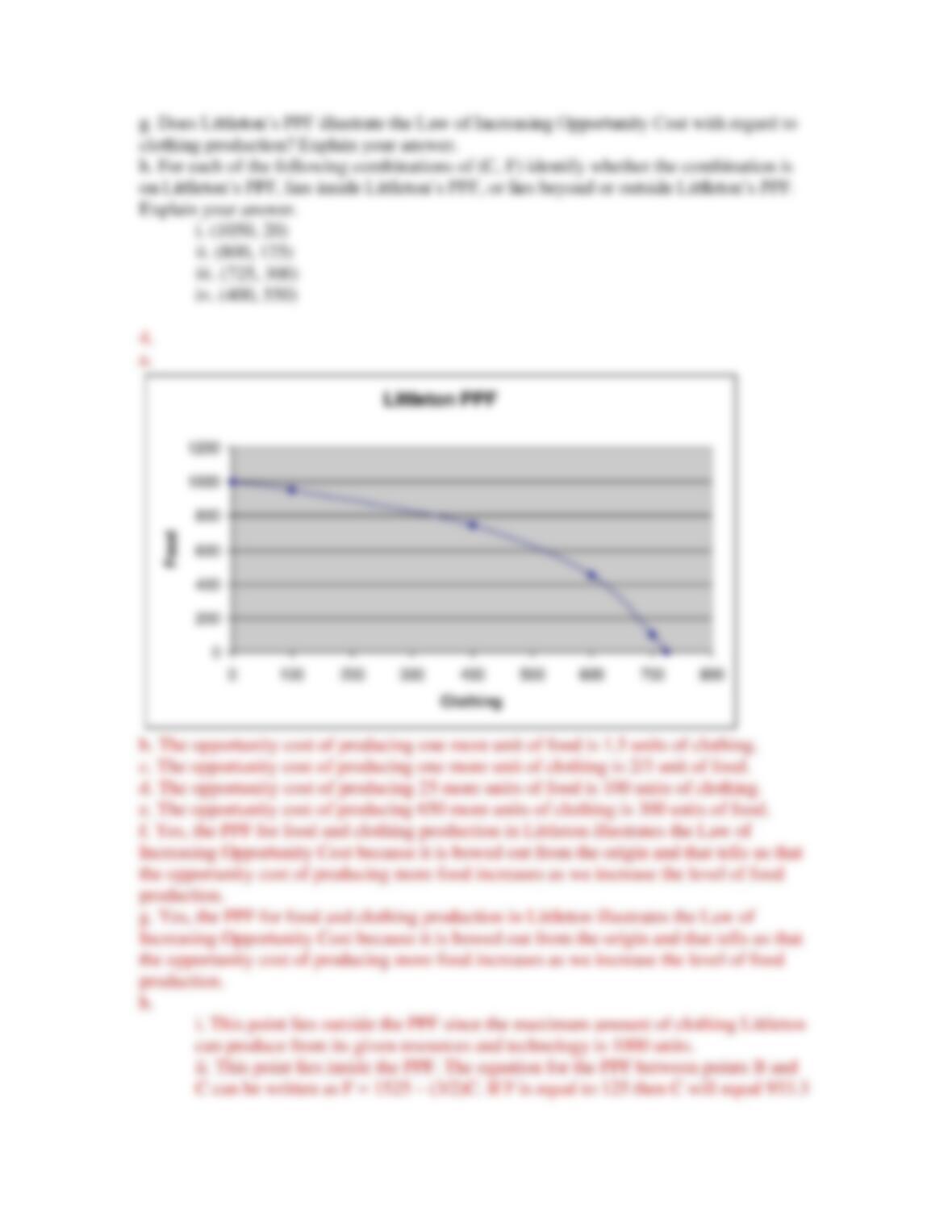
4. The following table describes the production possibility frontier (PPF) for 2008 for
Littleton, a community that produces two goods, food and clothing, from its available
resources and technology. Assume Littleton’s PPF is linear between the points listed in