HOME OFFICE AND BRANCH ACCOUNTING
Companies may increase their volume of sales by establishing sales outlets in various
areas. These sales outlets may be a branch or an agency.
When a company operates a branch, the branch must maintain accounting records to
facilitate its reporting responsibility to the home office.
Problems dealing with Home Office and Branch Accounting appear in almost every
CPA examination. Candidates should be familiar with the problems involving the
following:
1. Uses of the reciprocal accounts.
2. Preparation of a Reconciliation Statement.
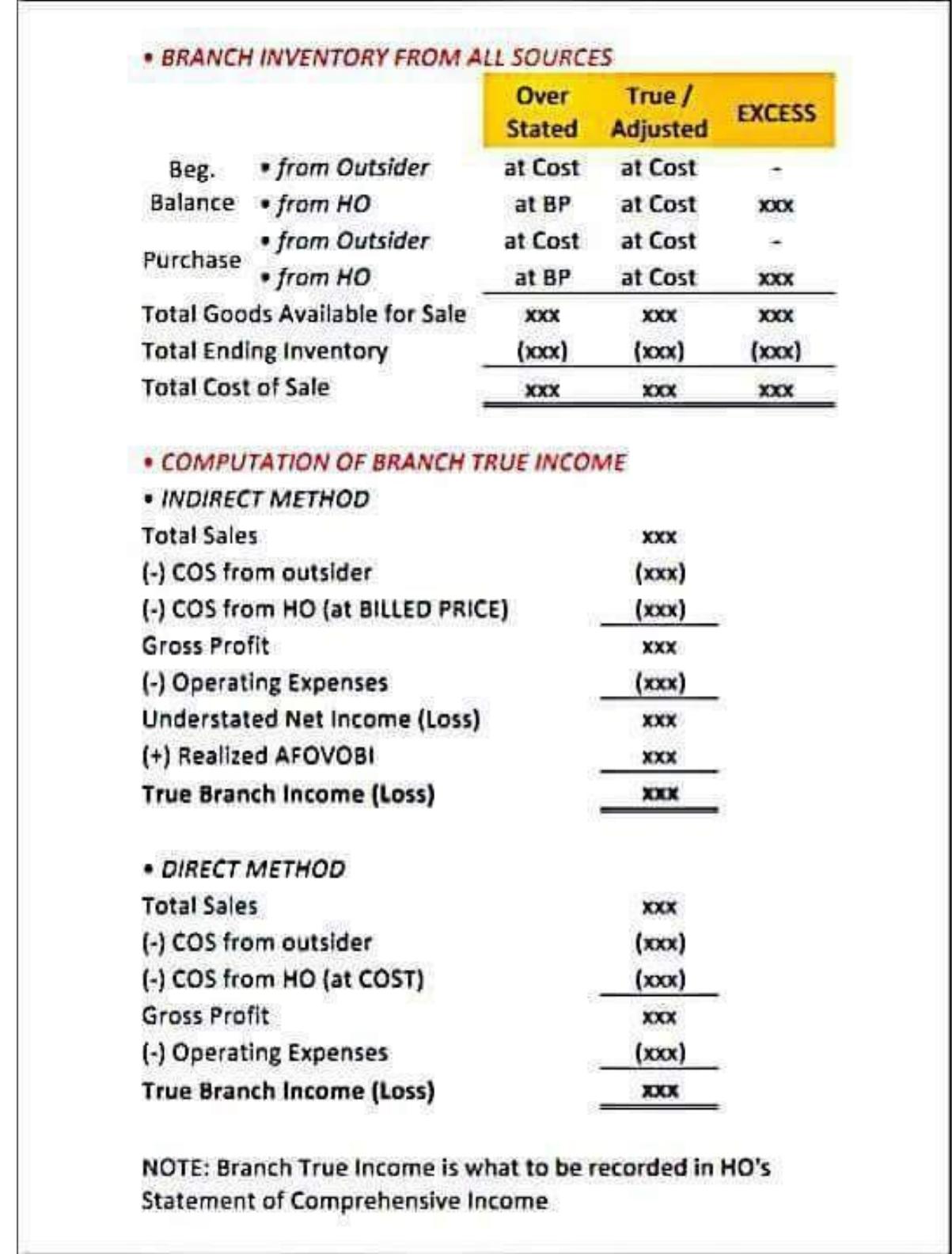
3. Billing of Merchandise by Home Office to Branch above cost.
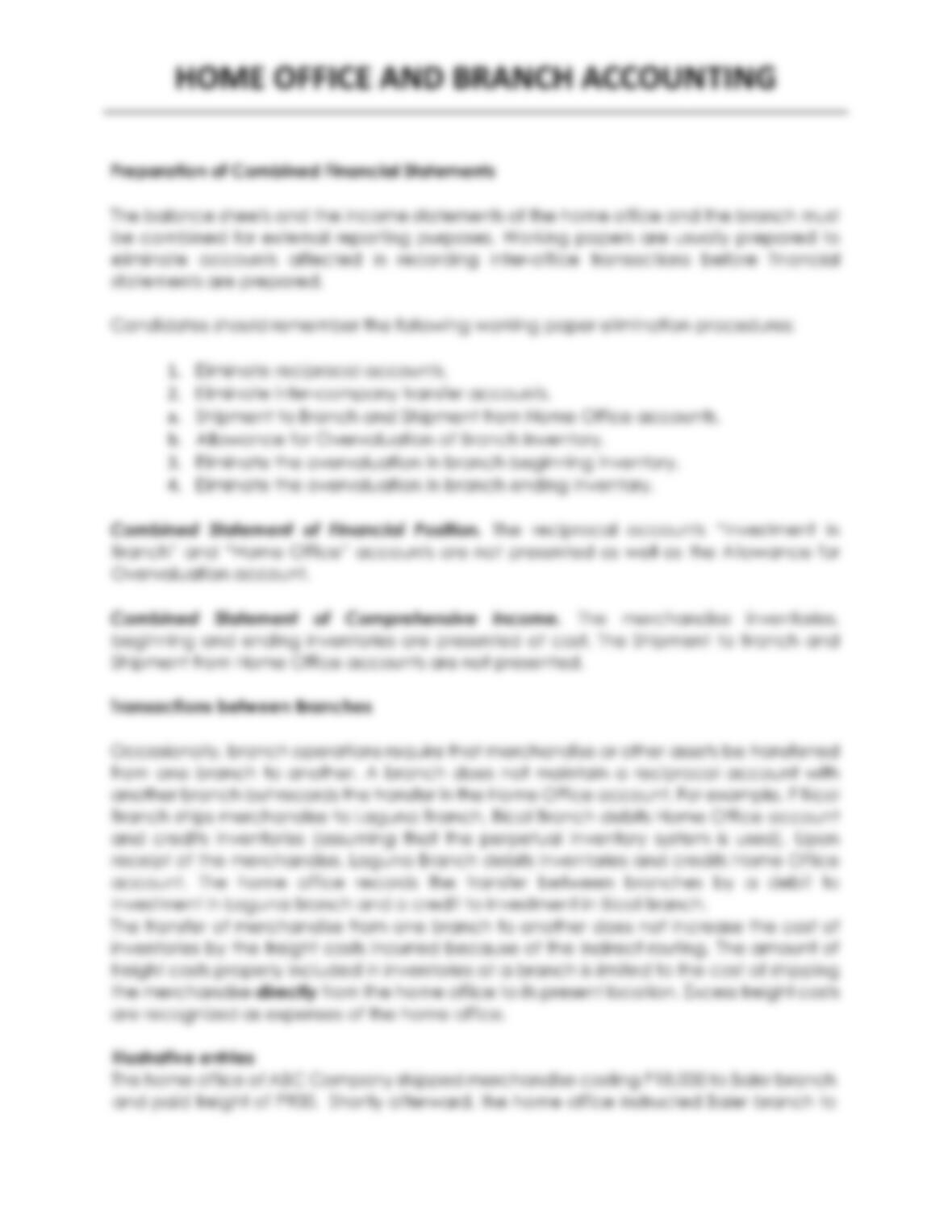
4. Preparation of Combined Financial Statements.
Uses of the Reciprocal Accounts
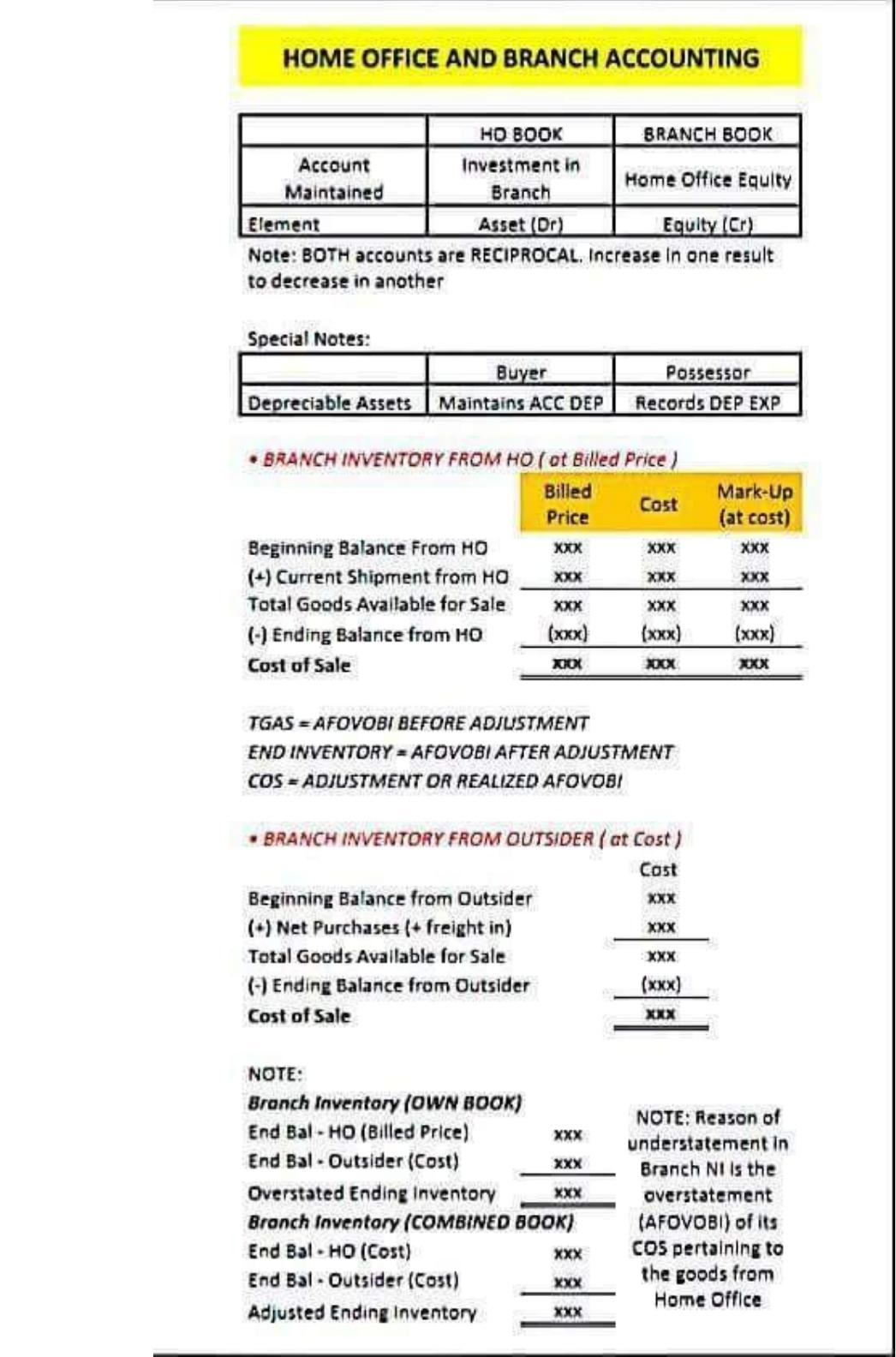
In recording inter-office transactions, two reciprocal accounts are used, namely, the
Investment in Branch (Branch Current) account used by the home office which is
classified as an asset; and the Home Office (HO Current account) used by the branch
which is classified as a liability.
The reciprocal nature of the Investment in Branch and the Home Office accounts and
the way in which they are affected by various inter-office transactions are shown below:
(Home Office Books) (Branch Books)
Investment in Branch
Home Office
Assets transfer to branch
Assets transfer from branch
Branch profit
Branch loss
Account Title
Where
reported
Financial Statement
Presentation
Investment in branch
Home office
books
Asset on the Statement of
Financial Position of the
home office
Home office current
Branch books
Equity on the Statement of
Financial Position of the
Branch
xx
xx
xx
xx
xx
xx
xx
xx

HOME OFFICE AND BRANCH ACCOUNTING
Shipment to branch
Home office
books
Deduction from the goods
available for sale on the
Income Statement of the
home office
Shipment from home
office
Branch books
Addition to the goods
available for sale on the
Income Statement of the
Branch
Illustrative Entries
ABC Company of Makati City established a branch in Surigao City. The following are
transactions of the Company and its branch together with the entries:
1. Establishment of a Branch
“Home office transfers to the Surigao branch P50,000 in cash, new office equipment
that costs P25,000, and new store equipment with a cost of P125,000”
Home office: Investment in Surigao branch 200,000
Cash 50,000
Office equipment 25,000
Store equipment 125,000
Branch: Cash 50,000
Office equipment 25,000
Store equipment 125,000
Home office current 200,000
When a company establishes a branch, the transfer of assets to the branch is
recorded by the home office in the Investment in Surigao branch account. Likewise,
the branch records the transfer with an entry to the Home office account. Note that
after both the home office and the branch have recorded the transfer, the
Investment in Surigao branch account on the home office books and the Home
office account on the branch books have reciprocal balances of P 200,000.
2. Merchandise Shipments to a Branch at Cost
“Home office transfers merchandise at cost of P 175,000 to its Surigao branch paying
freight cost of P7,500. Home office uses periodic inventory system”
Home office: Investment in Surigao branch 182,500
Shipment to Surigao branch 175,000
Cash 7,500
Branch: Shipment from home office 175,000
HOME OFFICE AND BRANCH ACCOUNTING
Freight – in 7,500
Home office current 182,500
Both the home office and the branch treat the transfer of merchandise in the same
way as the transfer of any other asset. The balance of the Shipments to Branch
account is subtracted from the total of beginning inventory and purchases in the
computation of the home office’s cost of goods sold for the period. This reduces the
total goods available for sale and avoids overstatement of cost of goods sold.
The Shipments from home office account on the branch books is included in the
computation of the branch’s cost of goods sold as an addition to purchases; it
increases the branch’s total goods available for sale.
The home office’s Shipments to branch account and the branch’s Shipments from
home office account are nominal accounts and therefore closed at the end of the
period to the Income Summary account together with the other revenue and
expense accounts. Freight costs incurred in shipping merchandise from the home
office to a branch become part of the cost of the branch inventory.
3. Accounting for Branch Property, Plant and Equipment
“Home office purchases P75,000 of office equipment for its Surigao branch. The assets
are recorded in the books of the branch.”
Home office: Investment in Surigao branch 75,000
Cash 75,000
Branch: Equipment 75,000
Home office current 75,000
The procedures to be used in accounting for branch property, plant and equipment
will depend on whether branch Property, Plant and Equipment are recorded in the
branch or in the home office books.
If branch assets are recorded in the books of the branch, and property, plant and
equipment are purchased by the home office for the branch, an entry is required on
the books of both the home office and the branch.
If branch assets are recorded in the books of the home office rather than on the
books of the branch, the home office records the purchase as follows:
Home office:
Equipment
75,000
Cash
75,000
Branch:
No entry
HOME OFFICE AND BRANCH ACCOUNTING
On the other hand, no entry is necessary in the book of the home office if the branch
purchases property, plant and equipment that are recorded on the books of the
branch. As an example, assume that Surigao branch purchased the office
equipment to be used by the branch. The following entries are made:
Home office:
No entry
Branch:
Equipment
62,500
Cash
62,500
If the branch purchases property, plant and equipment that are recorded on the
books of the home office, entries are needed by both the home office and the
branch.
Home office: Equipment 62,500
Investment in Surigao branch 62,500
Branch: Home office current 62,500
Cash 62,500
When the branch purchases an asset that is carried on the home office books, the
balance of both the reciprocal accounts is reduced. The transaction is treated as if
the branch had purchased equipment for the home office.
4. Apportionment of Expenses
Branch expenses incurred and paid by the branch are recorded directly on the
books of the branch in the usual manner. However, the home office may allocate
expenses to a branch. These allocated expenses might be of several types:
a. Expenses incurred by the branch but paid by the home office.
b. Expenses incurred by the home office on behalf of the branch, for
example, depreciation on branch equipment carried on the home office
books.
c. Allocation of expenses incurred by the home office; for example, a portion
of the cost of general advertising.
“Utilities expenses incurred by Surigao branch and billed to home office master
account, P30,000; Depreciation expense on Surigao branch fixed assets carried on
home office books, P8,750; Advertising expense allocated to Surigao branch,
P18,750.”
The home office already has recorded these expenses in the usual manner, as if they
are related to the home office. Periodically, the home office notifies the branch of
HOME OFFICE AND BRANCH ACCOUNTING
the allocated expenses. The home office records the following entry upon notifying
the branch of the P57,500 of allocated expenses:
Home office: Investment in Surigao branch 57,500
Utilities expense
30,000
Depreciation expense
8,750
Advertising expense
18,750
Branch:
Utilities expense
30,000
Depreciation expense
8,750
Advertising expense
18,750
Home office current
57,500
Without these entries, the home office income would be understated and the branch
income would be overstated.
5. Collection of Accounts Receivable
In some cases, the Branch may collect accounts receivable of the home office or
the home office may collect account receivable of the branch. In both cases, the