Evolution of Technology in SME Warehouses and Its Impact on Performance during Period of
Uncertainty
Institutional Affiliation
Author Note
Course Number and Name
Professor
Date
Evolution of Technology in SME Warehouses and Its Impact on Performance during Period of
Uncertainty 2
Background
Numerous small and medium sized enterprises (SMEs) depend on technology for their
daily operations (Wong et al, 2020). Recent trends in technological advancements has eased
operational burden and even promoted security to both clients and the warehouse staff. For
instance, the implementations of technologies like programmed warehousing systems, CCTV
cameras, and e-commerce have been major technological trends that are emerging in the logistic
industry especially for the small and medium size warehouses. This trends in technology have
proven to help the organizations in operating efficiently especially during uncertain times for
example the COVID-19 pandemic, a global outbreak of the novel corona virus (Watkins, 2020).
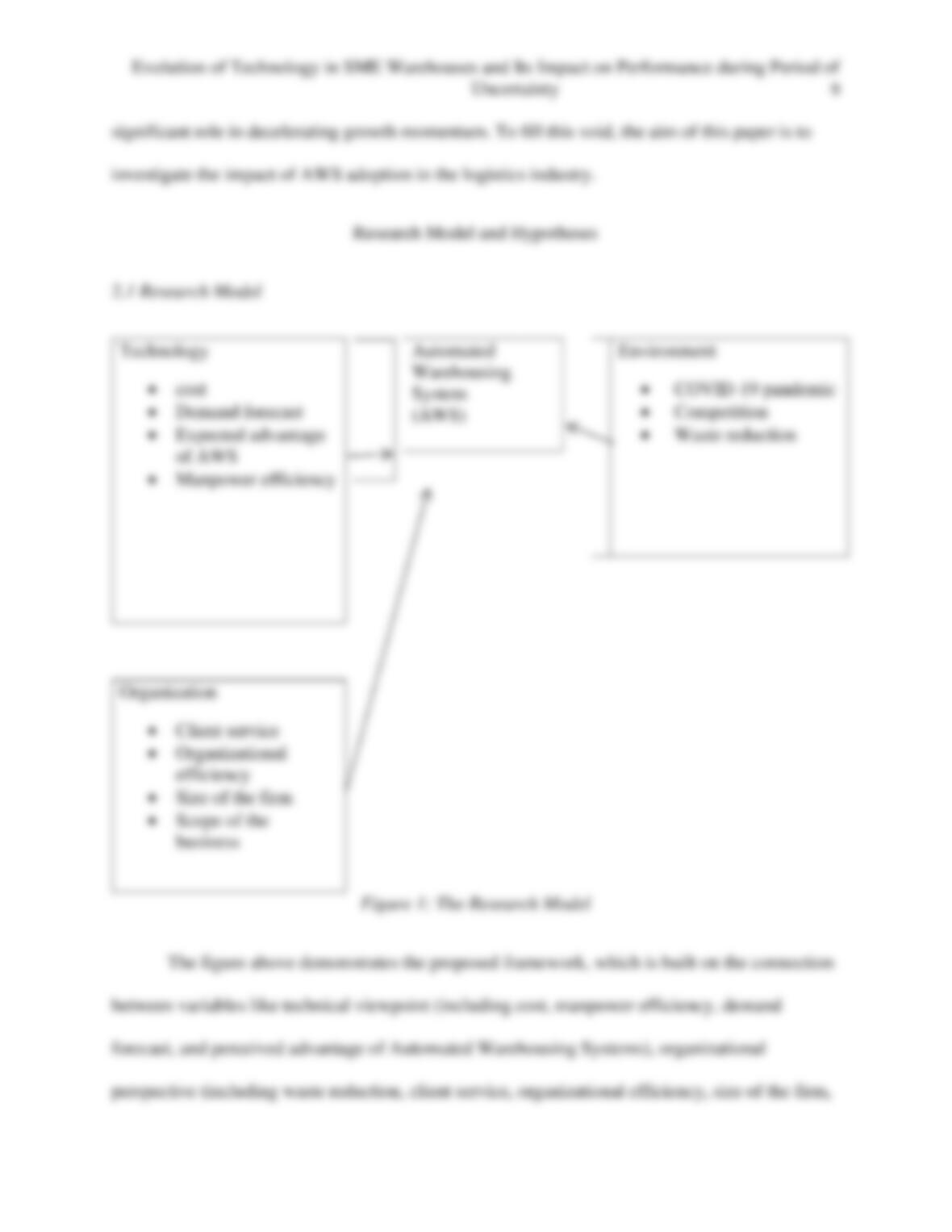
In this research study, we aim to develop a conceptual prototypical using an Technology-
Organization-Environment (TOE) framework to explore the numerous factors that influences
small and medium sized (SME) logistic companies to embrace technology (Jia et al, 2017). The
model proposes that SME warehouses implementation of technological advancements are
influenced by perceived benefits, cost, the scope of the firm, external influence (for example,
partners and competition), and the size of their firms and the performance of operations.
The main aim of this study is to discover the significance of technology adaptation in
SMEs (Small and medium business enterprises), and the how the increased use of technology
will influence their performance during a crisis (Mendy & Rahman, 2019). The data that were
used in the study were collected from 80 (United Kingdom Based) small and medium
warehouses while the analyzation of the information was done through the uses of structural
equation modeling with least squares. The results of our study proposed that the perceived
benefits, cost, the scope of the firm, external influence (for example, partners and competition),
and the size of their firms and the performance of operations (Hassan, 2017) are all essential
Evolution of Technology in SME Warehouses and Its Impact on Performance during Period of
Uncertainty 3
dynamics which influence the adoption of evolutional technology in SMEs (Small and Medium
enterprises). As a result the conclusion backing should be given for small and medium
organizations from the aspects of organization and technology to enhance the use of technology
in managing materials and clients during a crisis (COVID-19) (Bartik et al, 2020). In order to
measure the impact of technology in this study, the use of Automatic Warehousing Systems
(AWS) will be the proposed software (Boysen et al, 2019).
Introduction
Currently numerous industries including manufacturing, retail and even logistic
companies have incorporated the Automatic warehousing system (AWS) software in their daily
operations. Specific to this study we will experiment this software as a kind of evolutionary
technological trend, which is essential for small and medium size enterprises (SMEs) in an
uncertain environment through the creation of stability worth (Egger, 2020). There is a limited
supply of factors of production especially land in the recent years and the most affected
enterprises were mostly the smaller and medium sized ones. As a result of the scarcity of these
resources there has been a surge of demand for the frequent and concurrent development of
Automatic Warehousing Systems (AWS) using robotics and information. This software is
heavily connected to client and material management hence it is greatly utilized in different areas
including management of traffic. The software reduces the operational cost and energy while at
the same time increases performance and the overall intelligence of an enterprise. When it comes
to the improvisation of supply chain efficiency the Automatic Warehousing Systems software
plays a key role. Warehousing business is often referred to as logistic companies which hold an
essential role in the supply chain and also business competition. Additionally, the global
economic progress is accredited to logistic companies. The logistics sector has a positive impact
Evolution of Technology in SME Warehouses and Its Impact on Performance during Period of
Uncertainty 4
on economic growth. With the COVID-19 pandemic, most consumers preferred online shopping
in 2020, resulting in a total of 22 billion monthly e-commerce transactions (Abdillah, 2020). The
number of people buying goods and services online has risen dramatically from the previous year
(2019), when just 1.92 billion people did so (Huang et al, 2019).
There is a rapid development of E-commerce in the world especially in warehousing
industries providing a high efficiency for peoples’ advantage through automated techniques and
equipment (Vilken et al, 2019). For instance, the delivery of goods and customer interactions by
courier warehouse industries are often very common; hence for their warehouse system software
there is need for it to be accurate and fast. However, not all warehouses have a first-hand access
to goods especially the SMEs (Small and Medium businesses) hence the optimization of the floor
operations is critical. The SMEs current resources face numerous challenges in improving their
rate of manpower and organisational efficiency, client service, time, demand prediction and
stock management. Technological evolution is frequently used to reduce such challenges
especially the Automated Warehousing software. The use of Automatic Warehousing Systems
(AWS) is a current trend in warehousing industries although IT (Information Technology) was
initially used by the industries. Currently there is a wide use of internet with an estimate of
59.9% of the global population which is 4.66 Billion individuals as of 2020 (Setti & Wanto,
2019). The internet is highly accredited for the promotion of IT utilization and solid business
performance in uncertain times (Setti & Wanto, 2019). The increased number of internet users
and the invention of smart technological gadgets clients are embracing e-commerce which is
very efficient because they are not restricted by operational hours. In 2019, during the onset of
the novel COVID-19 virus many businesses were shut down and customers were required to turn
to online stores to access essential services and goods (Gao et al, 2020). Due to the increased
Evolution of Technology in SME Warehouses and Its Impact on Performance during Period of
Uncertainty 5
online orders client service staff at small and medium business (SME) are overwhelmed by the
large number of pending orders that require immediate action fast. Supply chain anatomy usually
involves the shipment of finished goods from the manufacture to the warehouses and from the
warehouses to consumers. Hence, the efficiency of logistic industries (Warehouses) has an
essential role on delivery and storage of products. Additionally, staying ahead in a competing
market SME warehouses need to upgrade their designs, operations and distribution networks and
hence to cut down on cost and time the use of technology is important. The introduction of AWS
(Automatic Warehouse Systems) is regarded as a sign of the rise of great technology industries
for the movement of goods (Mirzaei & De Kosta, 2021). Despite the worldwide lockdown of
numerous countries around the Globe in 2020, the logistic industry has still managed to grow