1
2
HLTH101
Health Behavior Change Project
PUPROSE
The purpose of this assignment is for you to work on your own WELLNESS by adopting a health
behavior that will help you to improve your own life. You will be journaling daily to keep track of
progress.
INSTRUCTIONS
Below is a behavior change process that you are to follow in changing any health-related behavior you
wish. Your choice of behavior should be made after completion of the pre-test assessment.
You must complete the assessment and submit it for REVIEW. You do not have to limit your choices
to the categories in this assessment since some behaviors (e.g., better use of time, meditation, etc.) are not
included. The only requirement is that behavior you want to change must clearly be health-related.
The intent of the assignment is to provide you with a specific, step-by-step process to try as a method of
changing behavior now or anytime in the future. Once you have decided upon the behavior you wish to
change complete Step 1, sign the bottom of the page and hand it in to the instructor.
You will be required to submit this COMPLETED packet during the first few weeks of the
semester. There will be a journal check approximately halfway through the semester. Pages 1,2 and
3 showing selection of behavior to be changed.
Near the end of the semester (see Syllabus for exact due date) you will be required to submit:
1) evidence of your progress in record/journal form with daily/weekly journaling,
2) a three to four-page reflection paper based on this process.
3
BEHAVIOR CHANGE PROCESS OF_______________________________________
STEP 1: SELECT YOUR GOAL.
From the results of your Pre-test and/or your awareness of your own behaviors, identify one behavior that
you would like to work on changing.
What is that behavior?
How would you like to change that behavior?
Changing this behavior becomes your long-term goal for this project. You will need to be very specific
in stating this goal.
S.M.A.R.T. GOALS ARE BEST
“We want to set the goals that our heart conceives, that our mind believes and that our bodies
will carry out.” –Jim Rohn
Specific – A specific goal has a much greater chance of being accomplished than a general goal.
To set a specific goal you must answer the six “W” questions:
*Who: Who is involved?
*What: What did I want to accomplish?
*Where: Identify a location.
*When: Establish a time frame.
*Which: Identify requirements and constrains
*Why: Specific reasons, purpose or benefits of accomplishing the goal.
Measurable – Establish concrete criteria for measuring progress toward the attainment of each
goal you set. To determine if your goal is measurable, ask questions such as…… How much?
How Many? How will I know when it is accomplished?
Attainable – When you identify goals that are most important to you, you begin to figure out
ways you can make them come true. You develop the attitudes, abilities, skills and financial
capacity to reach them.
Realistic – To be realistic, a goal must represent an objective toward which you are both willing
and able to work. A goal can be both high and realistic; you are the only one who can decide
just how high your goal should be.
Timely – A goal should be grounded within a time frame. With no time frame tied to it there’s
no sense of urgency.
BEHAVIOR CHANGE PROCESS OF_______________________________________
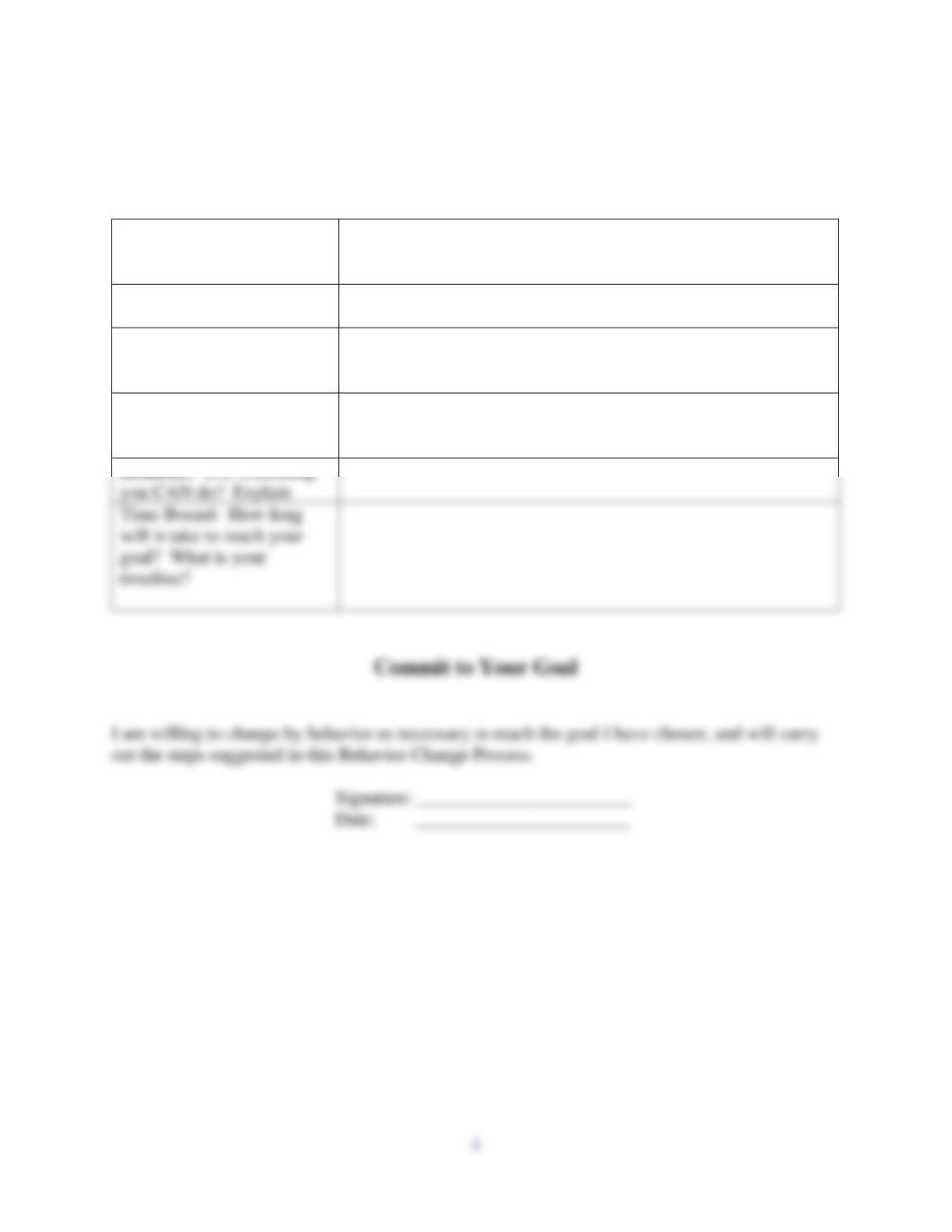
Complete a detailed description of how you are going to accomplish your SMART goal:
S.M.A.R.T. Goal
Example of how you will accomplish this:
Specific: What exactly are
you going to do?
Measurable: How are you
going to measure that you
did it?
Action Orientated: What
actions do you have to do
to reach this goal?
Realistic: Is it something
you CAN do? Explain
goal? What is your
timeline?