Sabrina Yuwen Huang
Professor Turnbull
4 November 2019
Fall 2019 Term Paper
Ancient Mayan Architecture
The Mayan civilization was one of the most sophisticated civilizations that started from
1800 B.C. to A.D. 900, but did not prosper at a fast rate until A.D. 250. It extended from
southeastern Mexico across today’s Belize, Guatemala, and tiny parts of Honduras and El
Salvador. Mayans had developed their own calendar systems, which reflected their advancement
in observing planets and stars. More importantly, the buildings, temples, pyramids, and other
architecture designs all are thoughtfully incorporated with their astronomy discoveries. This
paper will first introduce the basic Mayan city plans and crucial monuments. Then, we will take
a close look at the most famous Mayan ruins, Chichen Itza. The various structures, such as El
Castillo, ball court, and temples reflected different aspects of ancient Mayans life, from religious
activities, to entertainment, to astronomy.
All Mayan architectures were built out of stone, thatch, and wood with baroque painting,
stone carvings, and stucco statues. Interestingly, Maya civilization was never an allied empire.
They were more like Greek poleis, small city states that ruled closer areas but had little
acquaintance with further cities. These city states clashed yet traded often. That was why the
architecture styles addressed similar characteristics across the entire Mayan empire. Due to
frequent architectural cultural exchange, Mayan cities shared certain characteristics, for example,
general layout. The cities were usually consisted of peasants’ homes, temples, palaces, ball
courts, and plazas. There would be groups of significant buildings, usually temples, palaces, and
acropolis, surrounding the center plaza, spiritual and physical heart of the city (Minster
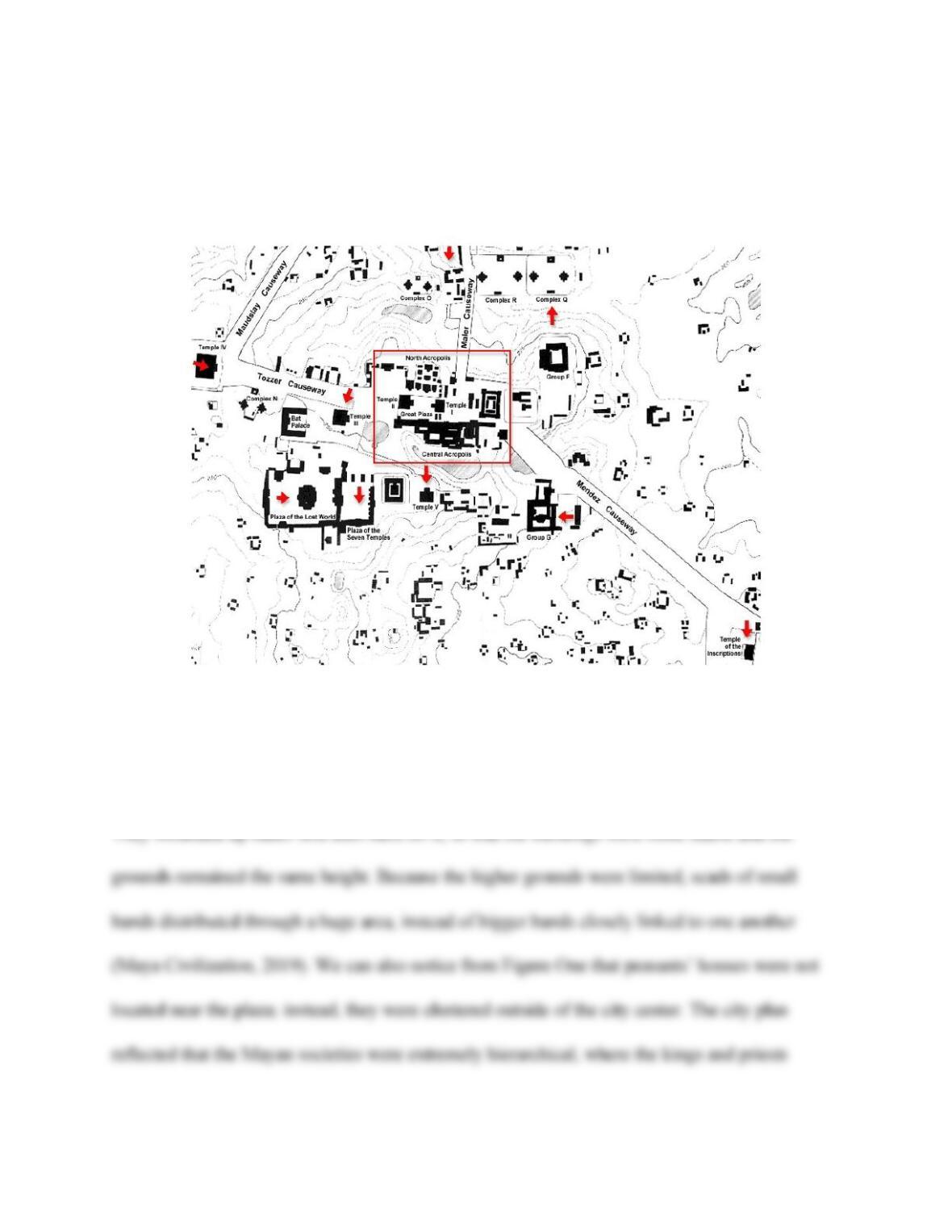
Architecture, 2019). Figure One is a graphed city plan of Tikal, one of the important cities of
Mayan civilization. The red box highlights the adjacency of the plaza and critical architectures.
The boxed area is also located at the highest altitude compared to other areas.
[Figure One]
Various altitude levels was a main reason to their rarely neat cities. Living in tropical forests, the
Mayans needed to build on irregularly shaped higher ground to dodge floods and moistness.