Premium PowerPoint Slides by:
V. Andreea CHIRITESCU
Eastern Illinois University
N. GREGORY MANKIW
PRINCIPLES OF
ECONOMICS
Eight Edition
Elasticity and Its
Application
CHAPTER
5
© 2018 Cengage Learning®. May not be scanned, copied or duplicated, or posted to a publicly accessible website, in whole or in part, except for use
as permitted in a license distributed with a certain product or service or otherwise on a password-protected website or school-approved learning
management system for classroom use. 1

Look for the answers to these questions:
•What is elasticity?
•What kinds of issues can elasticity help us
understand?
•What is the price elasticity of demand?
How is it related to the demand curve?
How is it related to revenue & expenditure?
•What is the price elasticity of supply?
How is it related to the supply curve?
•What are the income and cross-price
elasticities of demand?
2
© 2018 Cengage Learning®. May not be scanned, copied or duplicated, or posted to a publicly accessible website, in whole or in part, except for use
as permitted in a license distributed with a certain product or service or otherwise on a password-protected website or school-approved learning
management system for classroom use.

A scenario:
•You design websites for local businesses.
–You charge $200 per website, and currently sell
12 websites per month.
•Your costs are rising (including the
opportunity cost of your time)
–You consider raising the price to $250.
• The law of demand: you won’t sell as many
websites if you raise your price.
–How many fewer websites?
–How much will your revenue fall, or might it
increase?
3
© 2018 Cengage Learning®. May not be scanned, copied or duplicated, or posted to a publicly accessible website, in whole or in part, except for use
as permitted in a license distributed with a certain product or service or otherwise on a password-protected website or school-approved learning
management system for classroom use.

The Elasticity of Demand
•Elasticity
–Measure of the responsiveness of Qdor Qs
•To a change in one of its determinants
•Price elasticity of demand
–How much the quantity demanded of a
good responds to a change in the price of
that good
•Loosely speaking, it measures the price–
sensitivity of buyers’ demand
4
© 2018 Cengage Learning®. May not be scanned, copied or duplicated, or posted to a publicly accessible website, in whole or in part, except for use
as permitted in a license distributed with a certain product or service or otherwise on a password-protected website or school-approved learning
management system for classroom use.
Price Elasticity of Demand
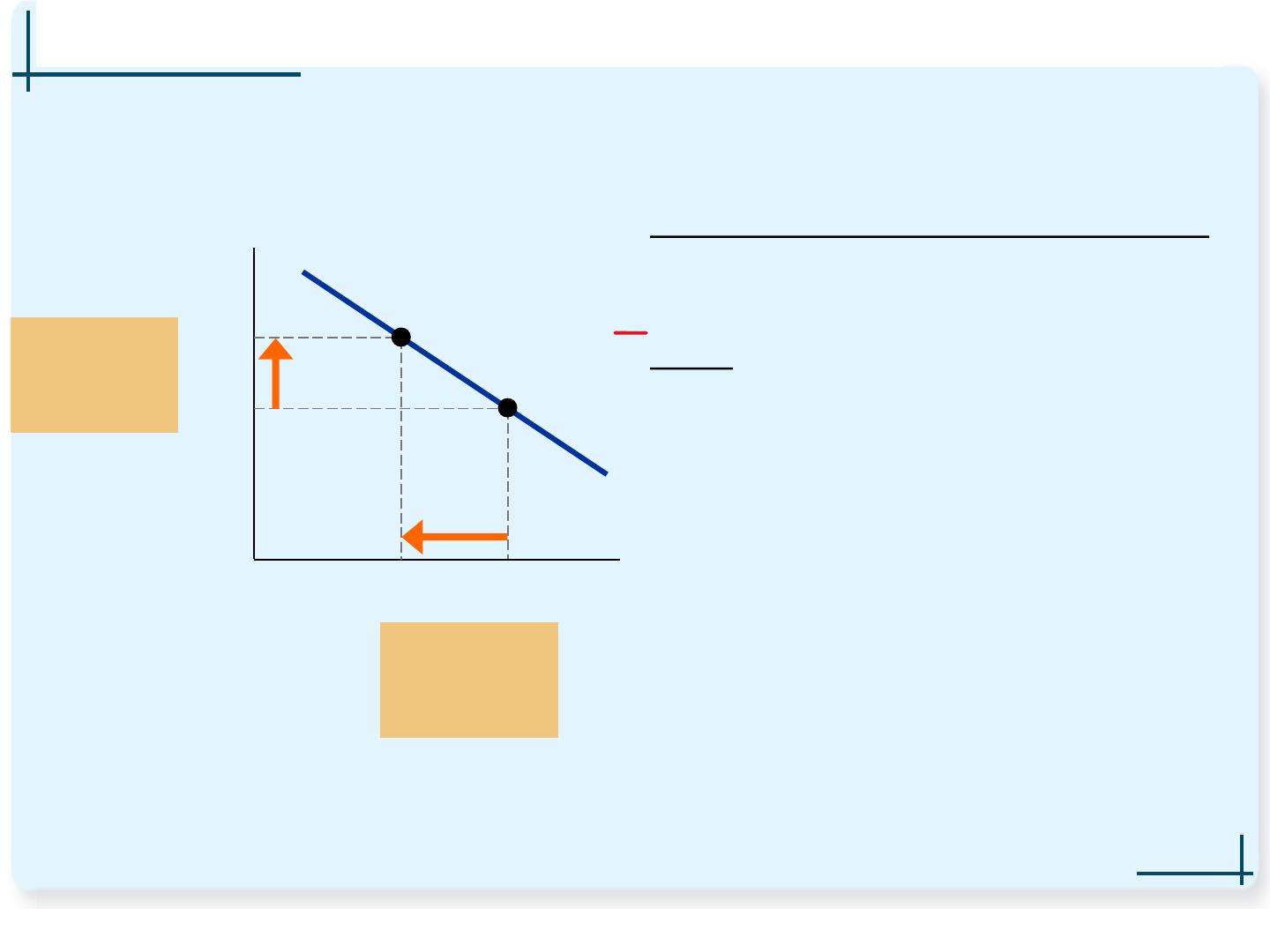
Price elasticity of demand =
Along a D curve, P and Q
move in opposite directions,
which would make price
elasticity negative.
We will drop the minus sign and report all price elasticities as positive
numbers.
5
© 2018 Cengage Learning®. May not be scanned, copied or duplicated, or posted to a publicly accessible website, in whole or in part, except for use
as permitted in a license distributed with a certain product or service or otherwise on a password-protected website or school-approved learning
management system for classroom use.
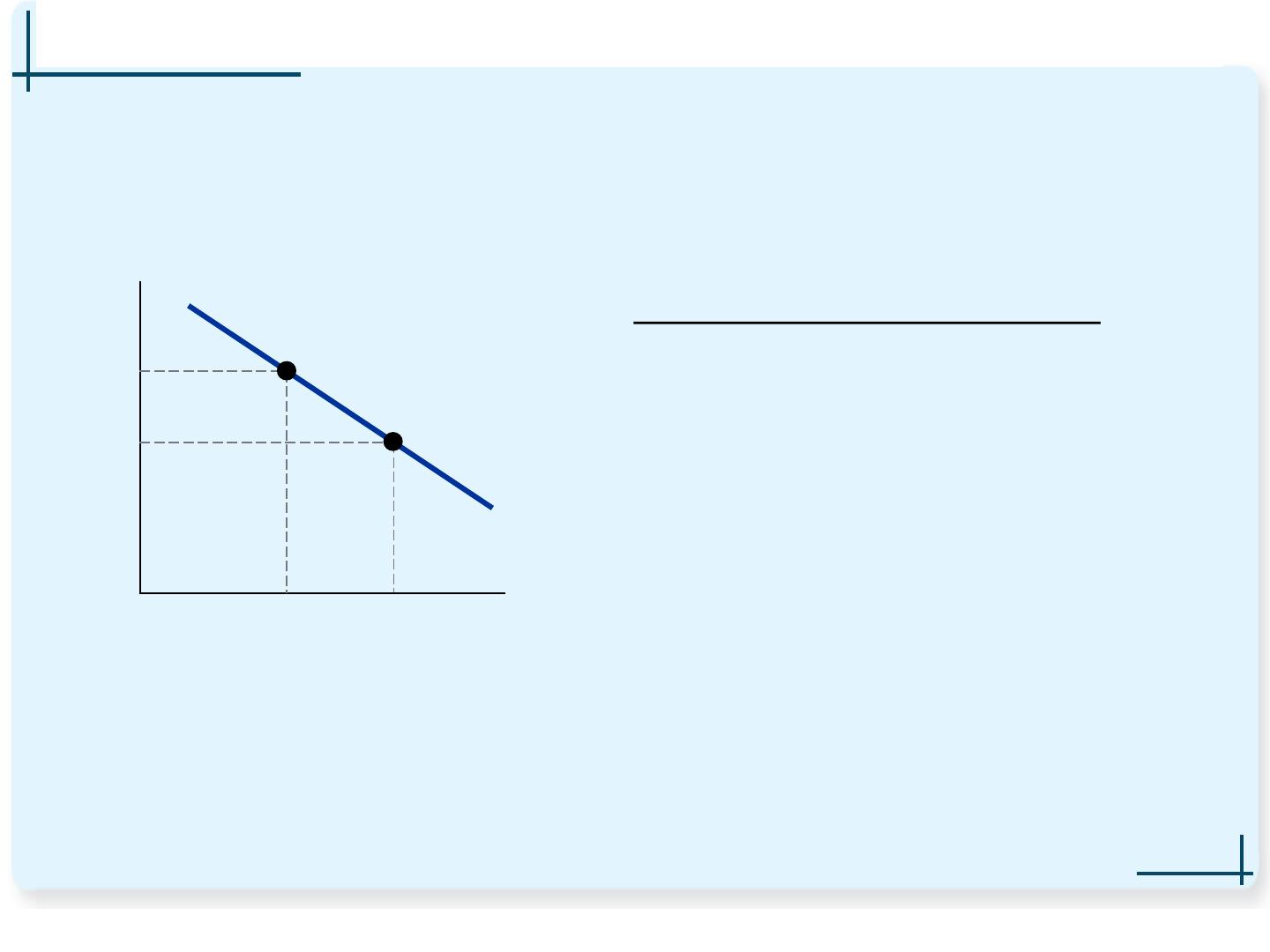
P
Q
D
Q2
P2
P1
Q1
Prises
by 10%
Qfalls
by 15%
15% 1.5
10%
d
percentage change in Q
percentage change in P
=
==
Calculating Percentage Changes
Going from B to A:
•the % change in P = – 20%
•the % change in Q = 50%
•Price elasticity = 50/20 = 2.5
6
© 2018 Cengage Learning®. May not be scanned, copied or duplicated, or posted to a publicly accessible website, in whole or in part, except for use
as permitted in a license distributed with a certain product or service or otherwise on a password-protected website or school-approved learning
management system for classroom use.
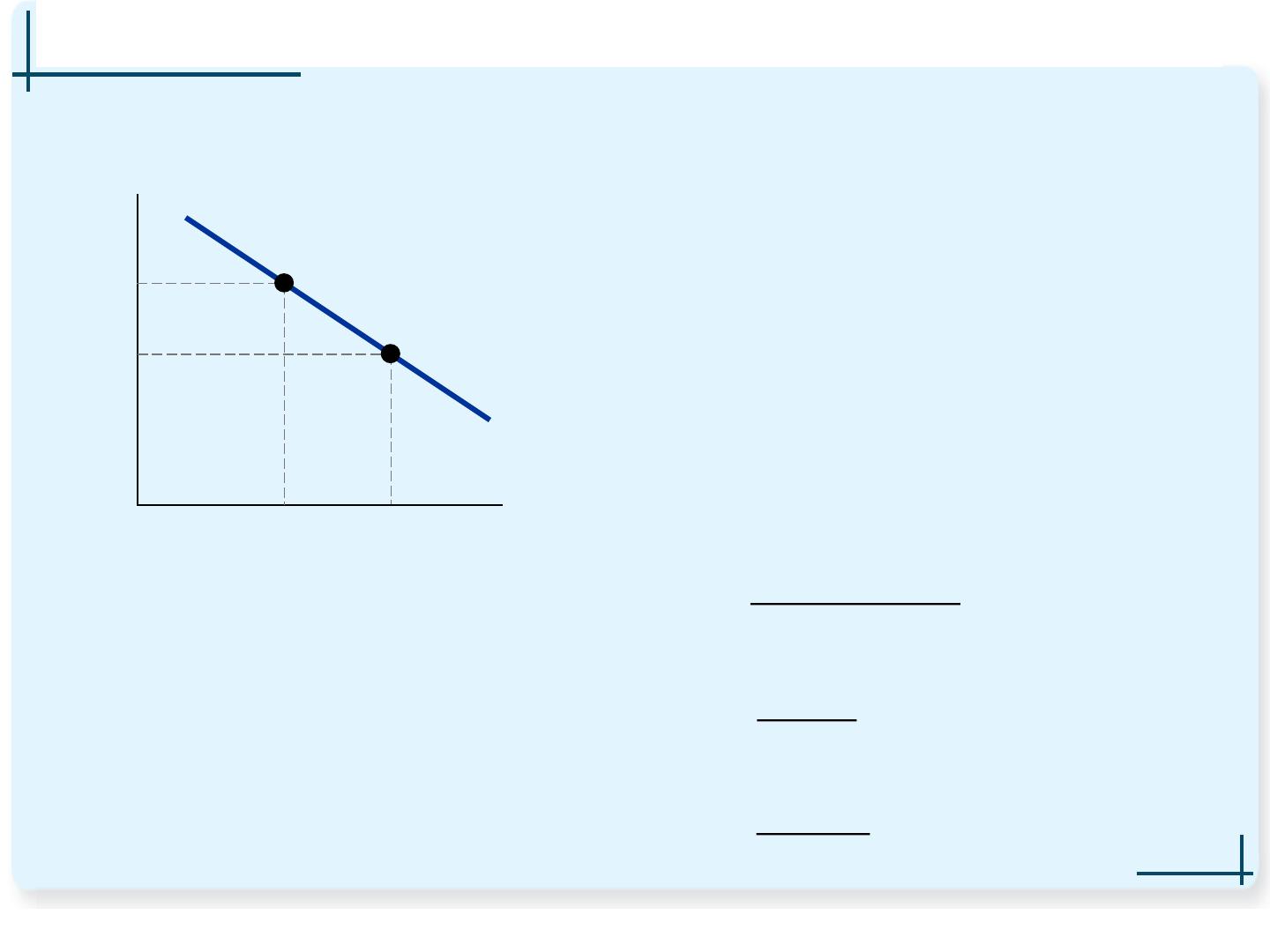
P
Q
D
$250
8
B
$200
12
A
Demand for your
websites
100%
end value start value
start value
−
=
Standard method of computing the
percentage (%) change:
Going from A to B:
•the % change in P = ($250–
$200)/$200 = 25%
•the % change in Q = – 33%
•Price elasticity = 33/25 = 1.33
We get different values!
The Price Elasticity of Demand
•Midpoint method
–The midpoint is the number halfway
between the start and end values
•The average of those values
7
© 2018 Cengage Learning®. May not be scanned, copied or duplicated, or posted to a publicly accessible website, in whole or in part, except for use
as permitted in a license distributed with a certain product or service or otherwise on a password-protected website or school-approved learning
management system for classroom use.
2 1 2 1
2 1 2 1
end value – start value
percentage change 100%
midpoint
2
Price elasticity of demand 2
(Q Q ) / [(Q Q ) / ]
(P P ) / [(P P ) / ]
=
−+
=−+
Calculating Percentage Changes
8
© 2018 Cengage Learning®. May not be scanned, copied or duplicated, or posted to a publicly accessible website, in whole or in part, except for use
as permitted in a license distributed with a certain product or service or otherwise on a password-protected website or school-approved learning
management system for classroom use.
P
Q
D
$250
8
B
$200
12
A
Demand for your websites
Using the midpoint method of
computing % changes:
$250 $200
% change in P = 100% 22.2%
$225
12 8
% change in Q = 100% 40%
10
40%
Price elasticity = 1.8
22.2%
−=
−=
=

Active Learning 1 Calculate an elasticity
Use the following information to calculate the
price elasticity of demand for iPhones:
•if P = $400, Qd= 10,600
•if P = $600, Qd= 8,400
•Use the midpoint method to calculate
percentage changes.
9
© 2018 Cengage Learning®. May not be scanned, copied or duplicated, or posted to a publicly accessible website, in whole or in part, except for use
as permitted in a license distributed with a certain product or service or otherwise on a password-protected website or school-approved learning
management system for classroom use.

Active Learning 1 Answers
Using the midpoint method to calculate
percentage changes:
•% change in P =
[($600 – $400)/$500] ×100 = 40%
•% change in Qd=
[(10,600 –8,400)/9,500] ×100 = 23.16%
•Price elasticity of demand =
= % change in Qd/ % change in P
= 23.16/40 = 0.58
10
© 2018 Cengage Learning®. May not be scanned, copied or duplicated, or posted to a publicly accessible website, in whole or in part, except for use
as permitted in a license distributed with a certain product or service or otherwise on a password-protected website or school-approved learning
management system for classroom use.

The Price Elasticity of Demand
•Determinants of price elasticity of demand
–We look at a series of examples comparing
two common goods
•In each example:
–Suppose prices of both goods rise by 20%
–Which good has the highest price elasticity
of demand? Why?
–What lesson we learn about the
determinants of price elasticity of demand?
11
© 2018 Cengage Learning®. May not be scanned, copied or duplicated, or posted to a publicly accessible website, in whole or in part, except for use
as permitted in a license distributed with a certain product or service or otherwise on a password-protected website or school-approved learning
management system for classroom use.
The Price Elasticity of Demand
Example 1: Breakfast cereal vs. Sunscreen
–Prices of both of these goods rise by 20%.
For which good does Qddrop the most?
Why?
•Breakfast cereal has close substitutes, so
buyers can easily switch if the price rises
management system for classroom use.
management system for classroom use.
management system for classroom use.
management system for classroom use.
management system for classroom use.
management system for classroom use.
management system for classroom use.
management system for classroom use.


management system for classroom use.

management system for classroom use.
management system for classroom use.
management system for classroom use.
management system for classroom use.
management system for classroom use.
management system for classroom use.
management system for classroom use.
management system for classroom use.

management system for classroom use.

management system for classroom use.