Greenhouse gas emissions have become an evident global issue. As the economy continues
to expand, the use for greenhouse gasses will increase, providing a respective increase in
the emissions of greenhouse gasses. The world has realized dramatic effects emitting
greenhouse gasses has on the environment, but the underlying question here is how to deal
with these massive emissions, without harming the flow of the economy.
Global warming is known as the continuing rise in the average temperature. Global
warming mainly results from a sufficient increase in the amount of greenhouse gases in the
air. This, in hand, also causes fluctuations in climate patterns, such as temperature, wind
pattern and precipitation changes, which can be detrimental to the environment.
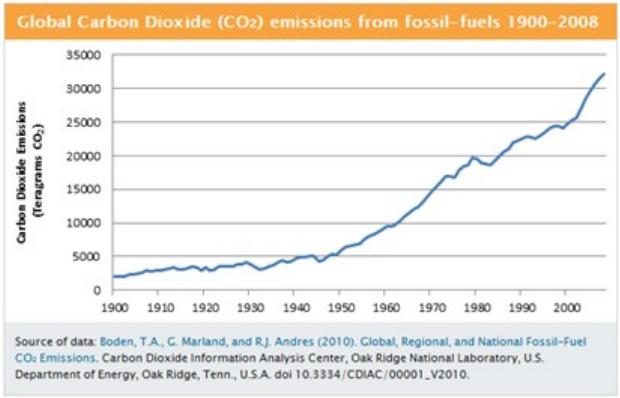
On a global scale, the two main greenhouse gasses that are emitted are Carbon dioxide at
77%, and methane at 14%. Energy Supply is the main source of global emissions, which is
the burning of fossil fuels for energy such as electricity and heat. According to the United
States Environmental Protection Agency and as shown in the graph labeled Figure 1,
“Global carbon emissions from fossil fuels have significantly increased since 1900.
Emissions increased by over 16 times between 1900 and 2008 and by about 1.5 times
between 1990 and 2008 (EPA).”
Many steps have been taken to help reduce these emissions and increase sustainability. An
article from the New York Times titled “E.P.A is Expected to Set Limits on Greenhouse
Gas Emissions by New Power Plants” discusses the issue of greenhouse gas emissions and
its expected predictions that will include separate standards for carbon dioxide emissions